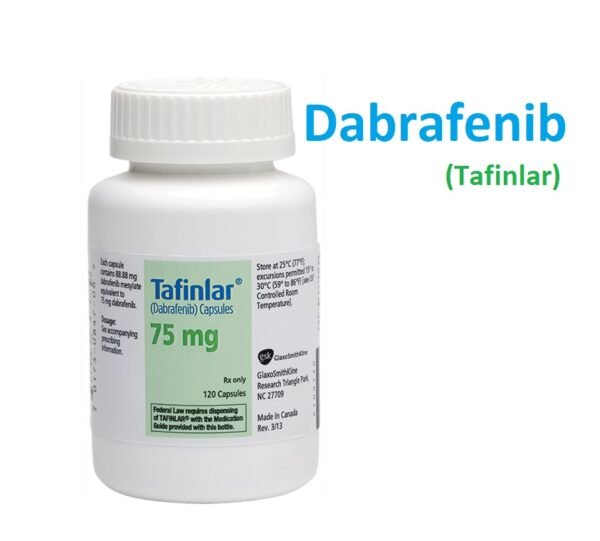
Dabrafenib Mesylate (Tafinlar) is a mutant BRAF-kinase inhibitor that is used as monotherapy or in combination with Trametinib (Mekinist) for the treatment of melanoma and other malignancies like anaplastic thyroid carcinoma and metastatic non-small cell lung cancer.
Dabrafenib (Tafinlar) Uses:
-
Melanoma:
- Used for the adjuvant treatment of melanoma (in combination with trametinib) in patients with a BRAF V600E or BRAF V600K mutation ( detected by an approved test), and lymph node involvement, following complete resection.
- Used for the treatment of unresectable or metastatic melanoma in patients with a BRAF V600E mutation (single-agent therapy) or in patients with BRAF V600E or BRAF V600K mutations (in combination with trametinib);
- confirm BRAF V600E or BRAF V600K mutation status with an approved test prior to treatment.
-
Non-small cell lung cancer, metastatic:
- Used for the treatment of metastatic non-small cell lung cancer (NSCLC) in patients with BRAF V600E mutation as detected by an approved test (in combination with trametinib).
-
Thyroid cancer, anaplastic, locally advanced or metastatic:
- Used for the treatment of locally advanced or metastatic anaplastic thyroid cancer (ATC) (in combination with trametinib) in patients with BRAF V600E mutation and with no satisfactory locoregional treatment options.
- Limitations of use: for patients having wild-type BRAF melanoma, wild-type BRAF NSCLC, or wild-type BRAF ATC, Trametinib is not indicated for the treatment of those patients.
Dabrafenib (Tafinlar) Dose in Adults
Note: Confirm BRAF V600 mutation status prior to treatment initiation.
Dabrafenib (Tafinlar) Dose in the treatment of Melanoma, adjuvant treatment (with BRAF V600E or BRAF V600K mutation):
- Oral: 150 mg twice in a day, approximately every 12 hours (in combination with trametinib); continue for up to 1 year in the absence of disease progression or unacceptable toxicity.
Dabrafenib (Tafinlar) Dose in the treatment of metastatic or unresectable melanoma (with BRAF V600E mutation):
- Oral: 150 mg twice in a day, approximately every 12 hours (single-agent therapy); continue until disease progression or unacceptable toxicity.
Dabrafenib (Tafinlar) Dose in the treatment of metastatic or unresectable melanoma (with BRAF V600E or BRAF V600K mutation):
- Oral: 150 mg twice daily, approximately every 12 hours (in combination with trametinib); continue until disease progression or unacceptable toxicity.
Dabrafenib (Tafinlar) Dose in the treatment of metastatic non-small cell lung cancer (with BRAF V600E mutation):
- Oral: 150 mg twice in a day, approximately every 12 hours (in combination with trametinib);
- continue until disease progression or unacceptable toxicity.
Dabrafenib (Tafinlar) Dose in the treatment of locally advanced or metastatic anaplastic Thyroid cancer (with BRAF V600E mutation):
- Oral: 150 mg twice in a day, approximately every 12 hours (in combination with trametinib); continue until disease progression or unacceptable toxicity.
-
Missed doses:
- A missed dose may be administered up to 6 hours prior to the next dose;
- Do not administer if less than 6 hours until the next dose (do not make up the missed dose).
Use in Children:
Not indicated.
Dabrafenib (Tafinlar) Pregnancy Category: N
- Its mechanism of action and animal reproduction research findings may determine if dabrafenib is safe for fetal harm.
- A highly effective non-hormonal contraceptive should be used by females with reproductive potential during treatment.
- It should be used for at least two weeks for single-agent therapy, or for 4 months for combination therapy. After treatment is completed, hormonal contraceptives may no longer work.
- Males may have impaired spermatogenesis (observed in animal research); before you consider therapy, it is important to think about family planning and fertility counseling.
Use of Dabrafenib while breastfeeding
- It is not known whether dabrafenib can be found in breast milk.
- The manufacturer does not recommend breastfeeding during treatment or for more than 2 weeks (single agent therapy) or for 4 months (combination Therapy with Trametinib).
- This is because there are serious adverse reactions that could occur in breastfed babies.
Dabrafenib (Tafinlar) Dose in Kidney Disease:
-
GFR ≥30 mL/minute/1.73 m²:
- No dosage adjustment required.
-
GFR <30 mL/minute/1.73 m²:
- The manufacturer's labeling doesn't provide any dosage adjustments (has not been studied).
Dabrafenib (Tafinlar) Dose in Liver disease:
-
Mild impairment:
- No dosage adjustment required.
-
Moderate to severe impairment:
- Manufacturer's labeling doesn't provide any dosage adjustments (has not been studied); however, metabolism is primarily hepatic and exposure may be increased in patients with moderate to severe impairment.
Common Side Effects of Dabrafenib (Tafinlar):
-
Cardiovascular:
- Hypertension
- Peripheral Edema
-
Central Nervous System:
- Headache
- Chills
-
Dermatologic:
- Hyperkeratosis
- Skin Rash
- Alopecia
- Palmarplantar Erythrodysesthesia
- Xeroderma
-
Endocrine & Metabolic:
- Hyperglycemia
- Hypophosphatemia
- Hypoalbuminemia
- Hyponatremia
-
Gastrointestinal:
- Nausea
- Diarrhea
- Abdominal Pain
- Vomiting
- Constipation
-
Hematologic & Oncologic:
- Anemia
- Lymphocytopenia
- Papilloma
- Neutropenia
- Hemorrhage
- Malignant Neoplasm Of Skin
-
Hepatic:
- Increased Serum Alanine Aminotransferase
- Increased Serum Alkaline Phosphatase
- Increased Serum Aspartate Aminotransferase
-
Neuromuscular & Skeletal:
- Arthralgia
- Myalgia
- Back Pain
-
Respiratory:
- Cough
-
Miscellaneous:
- Fever
Less Common Side Effects Of Dabrafenib (Tafinlar):
-
Cardiovascular:
- Cardiomyopathy
-
Central Nervous System:
- Dizziness
-
Gastrointestinal:
- Pancreatitis
- Gastrointestinal Hemorrhage
-
Hematologic & Oncologic:
- Thrombocytopenia
- Basal Cell Carcinoma
- Malignant Neoplasm
- Malignant Melanoma
-
Hypersensitivity:
- Hypersensitivity
-
Ophthalmic:
- Uveitis
-
Renal:
- Interstitial Nephritis
-
Respiratory:
- Nasopharyngitis
-
Miscellaneous:
- Febrile Reaction
Contraindications to Dabrafenib (Tafinlar):
The US labeling of the manufacturer doesn't contain any containdications.
Canadian labeling: Hypersensitivity of dabrafenib and any component of the formulation
Warnings and precautions
-
Cardiomyopathy
- Cardiac dysfunction can require interruption of dabrafenib therapy (see trametinib Monograph for trametinib dosage adjustments).
- Some patients experience cardiomyopathy after treatment interruptions, dose adjustments or permanent discontinuation.
- Cardiomyopathy can occur when trametinib is used alone or in combination.
- Before starting combination therapy, assess LVEF by echocardiogram or MUGA scan at one month. Then, every 2 to 3 years, while on therapy.
-
Dermatologic toxicities:
- You should monitor for signs and symptoms of skin toxicity, and secondary infections.
- It is possible to interrupt treatment, reduce dosage, or discontinue therapy.
- Combining trametinib with trametinib can lead to serious dermatologic toxicities (eg, rash and acneiform rash as well as dermatitis and palmar-plantar syndrome).
- This is a known complication of single agent trametinib therapy.
- Some patients needed hospitalization due to severe toxicity or secondary skin infections.
-
Febrile reactions
- It is possible to reduce or discontinue dosage. In the event of a febrile reaction, it may be necessary to administer antipyretics as secondary prevention.
- For pyrexia that is not accompanied by complications, such as hypotension, dehydration or severe chills/rigors, you should take prednisone 10mg daily or an equivalent for at least 5 days.
- Serious febrile reactions, including severe fever, were seen in dabrafenib single agent therapy, and when it was used with trametinib.
- For fevers >=38.5degC (101.3degF), or any other serious febrile reaction, stop dabrafenib treatment immediately.
- Also, evaluate for signs/symptoms and monitor serum creatinine to determine if there is evidence of kidney function after severe fever.
-
Hemorrhage
- You may need to interrupt treatment and reduce dosage. Permanently discontinue trametinib and dabrafenib for all grade 4 hemorhagic events.
- Dabrafenib may cause hemorhage or symptomatic bleeding in critical areas/organs.
- Major bleeding events (some of which are fatal) include intracranial, retroperitoneal and subarachnoid hemorhages.
-
Hyperglycemia
- Patients with diabetes or hyperglycemia should monitor their serum glucose at baseline as well as any clinically indicated intervals.
- Treatment may cause hyperglycemia (either with trametinib alone or with combination therapy).
- If this happens, you may need to initiate insulin or oral hypoglycemic agents therapy (or a higher dose if you are already taking).
-
Malignancy
- CuSCC was less common when used with trametinib to treat melanoma.
- Patients with NSCLC also had cases of cuSCC.
- Although rare, basal cell carcinoma (BCC), can also be caused by combination or single-agent treatment. However, it is possible for patients to experience more than one BCC.
- Before starting therapy, you should have a dermatology evaluation.
- This can be done every 2 months, or for as long as 6 months after discontinuation.
- Single-agent dabrafenib therapy was associated with an increase in the incidence of cutaneous squamous cells carcinoma (cuSCC), and new primary melanomas (cuSCC).
- This increased incidence was compared to control therapy in clinical trials.
- Studies of melanoma monotherapy showed that approximately one-third (or more) of patients with cuSCC developed multiple occurrences.
- Combination therapy can cause noncutaneous malignancies. Monitor for any signs or symptoms.
- If RAS mutation-positive, noncutaneous malignancies develop, Dabrafenib must be discontinued permanently (no trametinib dose reduction required).
-
Ocular toxicities:
- During treatment with combination therapy, it is important to have regular ophthalmic examinations (including retinal evaluation).
- Uveitis can include iritis and iridocyclitis. This condition is treatable with dabrafenib single agent therapy or when combined with trametinib.
- Combining trametinib with melanoma was shown to cause retina pigment epithelial dislocations (RPED). This is a known side effect of single-agent trametinib therapy.
- The retina's central macular area was the most common location for detachments. They were usually bilateral and multifocal.
- Refer patients to an ophthalmologist immediately (within 24hrs) if there is a loss of sight or other visual disturbances.
- This may require dabrafenib treatment interruption (or permanent discontinuation) but not trametinib therapy alteration.
- You should be looking out for any signs or symptoms of uveitis, such as eye pain, photophobia, vision problems, and so on.
-
Extension of QT
- Patients at higher risk of arrhythmias should be treated with caution.
- QTcF prolongation of >60 msec above baseline, or to >500msec was reported (rarely), either as a single agent in combination with trametinib.
-
Venous thromboembolism
- Dabrafenib therapy can be continued for DVT or PE that is not complicated; for PE that is life-threatening, trametinib should be permanently discontinued.
- Combining dabrafenib with trametinib can lead to fatal venous thromboembolism events (some even fatal).
- Combination therapy was associated with a higher incidence of DVT and PE.
- If symptoms such as DVT or PE are present, patients should immediately seek medical attention.
Dabrafenib: Drug Interaction
Note: Drug Interaction Categories:
- Risk Factor C: Monitor When Using Combination
- Risk Factor D: Consider Treatment Modification
- Risk Factor X: Avoid Concomitant Use
Risk Factor C (Monitor therapy). |
|
| Antidiabetic Agents | Hyperglycemia-Associated Agents can reduce the therapeutic effects of Antidiabetic Agents. |
| Clofazimine | High risk of Inhibitors causing an increase in serum CYP3A4 Substrates concentrations |
| CloZAPine | CloZAPine serum concentrations may be decreased by CYP3A4 Inducers Moderate |
| Codeine | CYP3A4 Inducers Moderate may reduce serum levels of active metabolites of Codeine. |
| CYP2B6 Substrates (High Risk with Inducers). | Dabrafenib could lower the serum concentration of CYP2B6 Substrates (High Risk with Inducers). |
| Moderate CYP2C8 inhibitors | Might decrease metabolism of CYP2C8 substrates (High Risk with Inhibitors). |
| Strong CYP3A4 Inducers | It may decrease serum levels of Dabrafenib. |
| Moderate CYP3A4 inhibitors | Might decrease metabolism of CYP3A4 substrates (High Risk with Inhibitors). |
| Deferasirox | High risk of Inhibitors causing an increase in serum CYP2C8 Substrates concentrations |
| Estriol (Systemic). | Moderate CYP3A4 Inducers may reduce the serum Estriol (Systemic) concentration. |
| Estriol (Topical). | Moderate CYP3A4 Inducers may reduce serum Estriol (Topical) concentrations |
| FentaNYL | FentaNYL serum concentration may be decreased by CYP3A4 Inducers Moderate |
| Pibrentasvir and Glecaprevir | Moderate CYP3A4 Inducers may reduce serum levels of Glecaprevir or Pibrentasvir. |
| Ifosfamide | CYP3A4 Moderate Inducers may reduce serum levels of Ifosfamide's active metabolite(s). CYP3A4 Moderate may increase serum levels of Ifosfamide's active metabolite(s). |
| Lumacaftor | May increase serum concentrations of CYP2C8 substrates (High risk with inhibitors or inducers). Lumacaftor could decrease serum concentrations of CYP2C8 substrates (High-Risk with Inhibitors and Inducers). |
| Agents that prolong QT (Highest risk) | QT-prolonging agents (Indeterminate risk - Caution), may increase the QTc prolonging effect of QT Prolonging Agents. When using these agents together, be sure to monitor for QTc interval prolongation or ventricular arrhythmias. Patients at higher risk for QTc prolongation might have additional risk factors. |
Risk Factor D (Consider therapy modifications) |
|
| Brigatinib | Moderate CYP3A4 Inducers may reduce the serum Brigatinib concentration. Management: If possible, avoid concurrent use of brigatinib and moderate CYP3A4 inducers. Combination: Increase the daily dose of Brigatinib by 30 mg increments for 7 days following treatment with current dose. Maximum of twice the dose. |
| CYP2C19 Substrates: High risk with Inducers | Dabrafenib can decrease serum concentrations of CYP2C19 substrates (High Risk with Inducers). Management: If possible, seek alternatives to the CYP2C19 substrat. Concomitant therapy should be avoided if possible. Monitor the clinical effects of the substrate carefully (especially therapeutic effects). |
| CYP2C8 Substrates, High risk with Inducers | Dabrafenib can decrease serum concentrations of CYP2C8 substrates (High Risk with Inducers). Management: If possible, seek alternatives to the CYP2C8 substrat. Concomitant therapy should be avoided if possible. Monitor the clinical effects of the substrate carefully (especially therapeutic effects). |
| CYP2C9 Substrates - High risk with Inducers | Dabrafenib can decrease serum concentrations of CYP2C9 substrates (High Risk with Inducers). Management: If possible, seek alternatives to the CYP2C9 substrat. Concomitant therapy should be avoided if possible. Monitor the clinical effects of the substrate carefully (especially therapeutic effects). |
| CYP3A4 Substrates - High risk with Inducers | Dabrafenib can decrease serum concentrations of CYP3A4 substrates (High Risk with Inducers). Management: If possible, seek alternatives to the CYP3A4 substrate. Concomitant therapy should be avoided if possible. Monitor the clinical effects of the substrate carefully (especially therapeutic effects). |
| Daclatasvir | Moderate CYP3A4 Inducers may reduce the serum level of Daclatasvir. Management: If you are using a moderate CYP3A4 inducer, increase the daclatasvir dosage to 90 mg daily. |
| Erdafitinib | Moderate CYP3A4 Inducers may reduce the serum level of Erdafitinib. Management: Modifications to the dose of Erdafitinib might be necessary. For more information, please refer to the full monograph. |
| Contraceptive: Estrogen Derivatives | The serum concentrations of Estrogen Derivatives may be decreased by dabrafenib (Contraceptive). Management: After discontinuing dabrafenib treatment, females with reproductive potential should consider an alternative, highly effective, nonhormonal method of contraception. |
| GuanFACINE | Moderate CYP3A4 inducers may cause a decrease in serum GuanFACINE. Management: Concomitant therapy using moderate CYP3A4 inducers may increase the guanfacine dosage by as much as twice. If moderate CYP3A4 inducer therapy is just starting, gradually increase the guanfacine dosage over 1-2 weeks. |
| Lorlatinib | CYP3A4 Moderate Inducers may increase the hepatotoxic effects of Lorlatinib. CYP3A4 Moderate Inducers may lower the serum Lorlatinib concentration. Use lorlatinib only with moderate CYP3A4 inducers. Monitor AST, ALT and bilirubin as soon as possible after starting the combination, and at least three times during the first week. |
| Lurasidone | Moderate CYP3A4 inducers may cause a decrease in serum Lurasidone. Management: Watch for decreased lurasidone effects when combined with moderate CYP3A4 inducers. If coadministered for seven or more days, consider increasing the lurasidone dosage. |
| Palbociclib | Moderate CYP3A4 Inducers may reduce the serum level of Palbociclib. Management: Although the US label doesn't give specific guidelines for moderate CYP3A4 inducers, the Canadian label suggests avoiding moderate CYP3A4 stimulators. |
| Perampanel | Perampanel serum concentration may be decreased by moderate CYP3A4 inducers (Moderate). Management: Perampanel can be used in conjunction with strong and moderate CYP3A4 inducers to increase the starting dose of perampanel to 4 mg/day. |
| Contraceptive Progestins | The serum concentration of Progestins may be decreased by dabrafenib (Contraceptive). Management: After discontinuing dabrafenib treatment, females with reproductive potential should consider an alternative, highly effective, nonhormonal method of contraception. |
| St John's Wort | The serum concentration of Dabrafenib may be decreased. Management: If possible, consider other options to St. John's Wort. Concomitant therapy should be avoided if possible. If this happens, watch out for decreased therapeutic effects of dabrafenib. |
| Stiripentol | High risk of Inhibitors causing an increase in serum concentrations of CYP3A4 substrates. Management: Avoid stiripentol use with CYP3A4 Substrates that have a narrow therapeutic Index. This is to avoid adverse effects and toxicities. Monitoring of any CYP3A4 substrate that is used with stiripentol should be closely done. |
Risk Factor X (Avoid Combination) |
|
| Abemaciclib | Moderate CYP3A4 Inducers may reduce serum Abemaciclib concentrations. |
| Asunaprevir | Moderate CYP3A4 Inducers may reduce serum Asunaprevir concentrations. |
| Axitinib | Moderate CYP3A4 Inducers may reduce the serum concentrations of Axitinib. |
| Bedaquiline | Moderate CYP3A4 Inducers may reduce the serum concentrations of Bedaquiline. |
| Bosutinib | Moderate CYP3A4 Inducers may reduce the serum Bosutinib concentration. |
| Cobimetinib | Moderate CYP3A4 Inducers may reduce serum Cobimetinib concentrations. |
| Conivaptan | High risk of Inhibitors causing an increase in serum CYP3A4 Substrates concentrations |
| Strong CYP2C8 inhibitors | May increase serum Dabrafenib concentrations |
| Strong CYP3A4 inhibitors | May increase serum Dabrafenib concentrations |
| Dasabuvir | Moderate CYP3A4 Inducers may reduce serum levels of Dasabuvir. |
| Deflazacort | Moderate CYP3A4 Inducers may reduce serum concentrations for the active metabolite(s), Deflazacort. |
| Elbasvir | CYP3A4 Inducers Moderate may reduce the serum Elbasvir concentration. |
| Encorafenib | CYP3A4 Inducers Moderate may reduce the serum Encorafenib concentration. |
| Flibanserin | Flibanserin serum concentration may be decreased by CYP3A4 Inducers Moderate |
| Fusidic Acid (Systemic). | High risk of Inhibitors causing an increase in serum CYP3A4 Substrates concentrations |
| Grazoprevir | CYP3A4 Inducers Moderate may reduce the serum concentrations of Grazoprevir. |
| Idelalisib | High risk of Inhibitors causing an increase in serum CYP3A4 Substrates concentrations |
| Neratinib | CYP3A4 Inducers Moderate may reduce the serum concentrations of Neratinib. |
| Nisoldipine | CYP3A4 Inducers Moderate may reduce the serum Nisoldipine concentration. |
| Olaparib | Moderate CYP3A4 Inducers may reduce the serum level of Olaparib. |
| Ranolazine | Ranolazine serum concentration may be decreased by CYP3A4 Inducers Moderate |
| Simeprevir | Moderate CYP3A4 Inducers may reduce the serum Simeprevir concentration. |
| Sonidegib | Moderate CYP3A4 Inducers may reduce Sonidegib serum concentrations. |
| Trametinib | May increase the toxic/adverse effects of Dabrafenib. |
| Velpatasvir | Moderate CYP3A4 Inducers may reduce the serum Velpatasvir concentration. |
| Venetoclax | Moderate CYP3A4 Inducers may reduce the serum concentrations of Venetoclax. |
Monitoring parameters:
- BRAFV600K or V600E mutation status (prior to treatment);
- serum glucose (particularly in patients with preexisting diabetes mellitus or hyperglycemia);
- electrolytes;
- renal function;
- dermatologic evaluations prior to initiation, every 2 months during therapy, and for up to 6 months following discontinuation to assess for new cutaneous malignancies;
- monitor for febrile drug reactions and signs/symptoms of infections;
- signs/symptoms of uveitis (eg, eye pain, photophobia, vision changes),
- monitor for signs/symptoms of hemolytic anemia, dermatologic toxicity (including secondary infections), and for noncutaneous malignancies.
For patients receiving combination therapy with trametinib:
- Hepatic function;
- CBC (baseline and periodically during therapy);
- assess LVEF (by echocardiogram or MUGA scan) at baseline, 1 month after therapy initiation, and then at 2- to 3-month intervals;
- monitor for signs/symptoms of hemorrhage, venous thromboembolism, interstitial lung disease, and RPED, or retinal vein occlusion.
- Monitor adherence.
How to administer Dabrafenib (Tafinlar)?
Oral:
- Administer orally at least 1 hour before or 2 hours after a meal; doses should be ~12 hours apart.
- Do not open, crush, or break capsules.
- When administered in combination with trametinib, take the one-time daily dose of trametinib at the same time every day with either the morning or evening dose of dabrafenib.
Mechanism of action of Dabrafenib (Tafinlar):
- Dabrafenib inhibits certain mutations in the protein kinase BRAF (BRAF) selectively.
- BRAF V600 mutations cause constitutive activation (BRAF) of the BRAF pathway.
- Dabrafenib inhibits tumor growth by BRAF inhibition.
- Combining trametinib with dabrafenib results in greater inhibition of MAPK pathway activity, leading to BRAF V600 cell death.
- It has been shown that trametinib and dabrafenib can work together to inhibit cell growth in lung carcinoma cell lines that are BRAF V600E mutant.
Absorption:
- Decreased with a high-fat meal (~1,000 calories; 58 to 75 grams of fat)
Protein binding
- 99.7% to plasma proteins
Metabolism:
- Hepatic via CYP2C8 and CYP3A4 to hydroxy-dabrafenib (active) which is further metabolized via CYP3A4 oxidation to the active metabolite desmethyl-dabrafenib.
Bioavailability:
- 95%
Half-life elimination:
- Parent drug: 8 hours;
- Hydroxy-dabrafenib (active metabolite): 10 hours;
- Desmethyl-dabrafenib (active metabolite): 21 to 22 hours
Time to peak:
- 2 hours;
- The time to reach peak concentration is delayed with a high-fat meal (~1,000 calories; 58 to 75 grams of fat)
Excretion:
- Feces (71%);
- urine (23%; metabolites only)
International Brand Names of Dabrafenib:
- Tafinlar
Dabrafenib Brands Names in Pakistan:
No brand is available in Pakistan.
.png)


