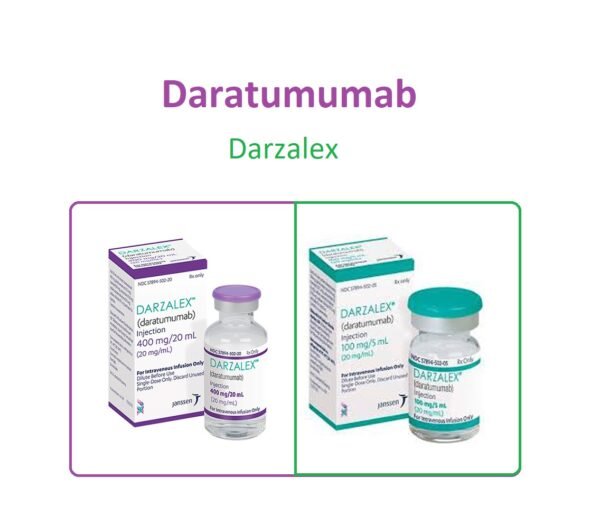
Daratumumab (Darzalex) is a fully human monoclonal antibody of the IgG1k subtype that targets CD38 that are highly expressed in myeloma cells.
Daratumumab (Darzalex) Uses:
-
Newly Diagnosed Multiple myeloma:
- Used in the treatment of newly diagnosed multiple myeloma (in combination with melphalan, bortezomib, and prednisone) in patients who are ineligible for autologous stem cell transplant.
-
Relapsed or Refractory Multiple myeloma:
- Used in the treatment of multiple myeloma (in combination with dexamethasone and either bortezomib or lenalidomide ) in patients who have received at least one prior therapy.
- Used in the treatment of multiple myeloma (in combination with pomalidomide and dexamethasone) in patients who have received at least two prior therapies, including lenalidomide and a proteasome inhibitor.
- Used in the treatment of multiple myeloma (as monotherapy) in patients who have received at least 3 prior lines of therapy, including a proteasome inhibitor and an immunomodulatory agent or who are double refractory to a proteasome inhibitor and an immunomodulatory agent.
Daratumumab (Darzalex) Dose in Adults
Note:
- Premedicate 1 to 3 hours prior to each infusion with a corticosteroid, an oral antipyretic, and an oral or IV antihistamines (see Premedications below).
- Post-infusion, administer an oral corticosteroid to all patients to reduce the risk of delayed infusion reactions (see Post-infusion medications below).
- To prevent herpes zoster reactivation, initiate antiviral prophylaxis within 1 week after starting daratumumab and continue for 3 months following completion of treatment.
- Per the manufacturer, daratumumab dosing should be based on actual body weight.
- The initial daratumumab dose (16 mg per kg on week 1) may be divided over 2 consecutive days (by administering 8 mg per kg per day on days 1 and 2 of week 1 of therapy) to facilitate administration.
Daratumumab (Darzalex) Dose in the treatment of newly diagnosed Multiple myeloma: IV:
Note: Refer to the specific protocol or to melphalan, bortezomib, or prednisone monographs for dosing when used in combination with daratumumab.
-
Daratumumab (Darzalex) In combination with bortezomib, melphalan, and prednisone:
- Weeks 1 to 6:
- 16 mg per kg once in a weak for 6 doses
- Weeks 7 to 54:
- 16 mg per kg one time in every 3 weeks for 16 doses
- Weeks 55 and beyond:
- 16 mg per kg once every 4 weeks until disease progression
- Weeks 1 to 6:
Daratumumab (Darzalex) Dose in the treatment of relapsed or refractory Multiple myeloma: IV:
Note: Refer to the specific protocol or to dexamethasone and lenalidomide, pomalidomide, or pomalidomide monographs for dosing when used in combination with daratumumab.
-
Monotherapy:
- Weeks 1 to 8:
- 16 mg per kg once in a weak for 8 doses
- Weeks 9 to 24:
- 16 mg per kg once every 2 weeks for 8 doses
- Weeks 25 and beyond:
- 16 mg per kg once every 4 weeks until disease progression
- Weeks 1 to 8:
-
Daratumumab (Darzalex) in combination with lenalidomide and low-dose dexamethasone:
- Weeks 1 to 8:
- 16 mg per kg once in a weak for 8 doses
- Weeks 9 to 24:
- 16 mg per kg once every 2 weeks for 8 doses
- Weeks 25 and beyond:
- 16 mg per kg once every 4 weeks until disease progression
- Weeks 1 to 8:
-
Daratumumab (Darzalex) in combination with pomalidomide and low-dose dexamethasone:
- Weeks 1 to 8:
- 16 mg per kg once a weak for 8 doses
- Weeks 9 to 24:
- 16 mg per kg once every 2 weeks for 8 doses
- Weeks 25 and beyond:
- 16 mg per kg once every 4 weeks until disease progression
- Weeks 1 to 8:
-
Daratumumab (Darzalex) in combination with bortezomib and dexamethasone:
- Weeks 1 to 9:
- 16 mg per kg once every week for 9 doses
- Weeks 10 to 24:
- 16 mg per kg once every 3 weeks for 5 doses
- Weeks 25 and beyond:
- 16 mg per kg once every 4 weeks until disease progression
- Weeks 1 to 9:
-
Missed dose:
- If a dose is missed, administer as soon as possible, and adjust the schedule accordingly (maintain the treatment interval).
- If a dose is missed, administer as soon as possible, and adjust the schedule accordingly (maintain the treatment interval).
-
Premedications:
- Administer 1 to 3 hours prior to each infusion.
- Additional background regimen specific corticosteroids (eg, prednisone) should NOT be administered on daratumumab infusion days when patients receive dexamethasone 20 mg (or equivalent) as a premedication.
-
Corticosteroid:
- Monotherapy:
- Methylprednisolone 100 mg IV or equivalent intermediate or long-acting corticosteroid; following the second infusion, the dose may be decreased (eg, methylprednisolone 60 mg [IV or oral] or equivalent)
- Combination therapy:
- Dexamethasone 20 mg (or equivalent) prior to each infusion;
- oral administration may be considered prior to subsequent infusions plus administer IV prior to the first infusion.
- Monotherapy:
- Antipyretic:
- Oral: Acetaminophen 650 to 1,000 mg plus
- Antihistamine:
- IV or Oral: Diphenhydramine 25 to 50 mg or equivalent
-
The following premedication regimen has also been reported:
- First infusion:
- Acetaminophen 325 mg orally, diphenhydramine 25 mg orally or IV, dexamethasone 20 mg IV, montelukast 10 mg orally, and famotidine 20 mg IV.
- Subsequent infusions:
- Acetaminophen 325 mg orally, diphenhydramine 25 mg IV, and dexamethasone 20 mg IV.
- First infusion:
-
Post infusion medication:
- Monotherapy:
- Administer an oral intermediate- or long-acting corticosteroid (eg, methylprednisolone 20 mg or equivalent) on the first and second day after all infusions.
- Combination therapy:
- Consider administering low-dose oral methylprednisolone (20 mg or less) or equivalent on the first day after the infusion.
- If dexamethasone or prednisone is administered the day after the infusion as part of the background combination chemotherapy regimen, additional post-infusion corticosteroid therapy may not be required.
- In patients with a history of chronic obstructive pulmonary disease, also consider short and long-acting bronchodilators and inhaled corticosteroids post-infusion.
- If no major infusion reactions occur during the first 4 infusions, these additional inhaled post-infusion medications may be discontinued.
- Monotherapy:
Use in Children:
Not indicated.
Daratumumab (Darzalex) Pregnancy Risk Category: D
- Studies on animal reproduction have not been done.
- Daratumumab's mechanism of action may result in myeloid and lymphoid cell loss, as well as decreased bone density.
- Live vaccines should not be administered to neonates or infants who have been exposed to daratumumab intrautero, until a hemologist can evaluate the situation.
- Daratumumab, a monoclonal anti-bodiment, is known to cross the placenta.
- Effective contraception should be used by females with reproductive potential during treatment and for three months following completion.
Use of Daratumumab while breastfeeding
- It is unknown if daratumumab can be found in breast milk.
- Daratumumab, a monoclonal anti-inflammatory antibody, can be detected in breastmilk and is not expected to enter infant or neonatal circulation in large quantities.
- According to the manufacturer breastfeeding during therapy should be considered in order to minimize the risk to the infant as well as the benefits to the mother.
Daratumumab (Darzalex) Dose in Kidney Disease:
-
CrCl 15 to 89 mL/minute:
- Manufacturer's labeling doesn't provide any dosage adjustments; however, CrCl between 15 to 89 mL per minute did not have any meaningful effect on daratumumab pharmacokinetics.
Daratumumab (Darzalex) Dose in Liver disease:
- Mild (total bilirubin 1 to 1.5 times ULN or AST > ULN) or moderate (total bilirubin 1.5 to 3 times ULN and any AST) impairment:
- The manufacturer's labeling doesn't provide any dosage adjustments, however, mild or moderate impairment did not have any meaningful effect on daratumumab pharmacokinetics.
- Severe impairment (total bilirubin >3 times ULN and any AST):
- The manufacturer's labeling doesn't provide any dosage adjustments(has not been studied).
Common Side Effects of Daratumumab (Darzalex):
-
Central Nervous System:
- Fatigue
- Headache
-
Gastrointestinal:
- Constipation
- Decreased Appetite
- Vomiting
- Nausea
- Diarrhea
-
Hematologic & Oncologic:
- Lymphocytopenia
- Anemia
- Neutropenia
- Thrombocytopenia
-
Neuromuscular & Skeletal:
- Arthralgia
- Limb Pain
- Musculoskeletal Chest Pain
- Back Pain
-
Respiratory:
- Cough
- Upper Respiratory Tract Infection
- Pneumonia
- Nasal Congestion
- Dyspnea
- Nasopharyngitis
-
Miscellaneous:
- Infusion Related Reaction
- Fever
Less Common Side Effects Of Daratumumab (Darzalex):
-
Cardiovascular:
- Hypertension
-
Central Nervous System:
- Chills
-
Infection:
- Herpes Zoster Infection
-
Miscellaneous:
- Physical Health Deterioration
Contraindication to Daratumumab (Darzalex):
History of severe hypersensitivity to daratumumab and any component of the formulation.
Warnings and precautions
-
Suppression of bone marrow
- When used with other chemotherapy agents to treat multiple myeloma, daratumumab can increase neutropenia or thrombocytopenia.
- Several treatment-emergent adverse effects were reported in clinical trials. These included anemia, Lymphopenia and Lymphopenia.
- Be on the lookout for signs and symptoms of bleeding or infection.
- Keep track of complete blood counts regularly; daratumumab may need to be delayed infusion to permit neutrophil and/or platelet recovery.
- It may be necessary to provide support with platelet transfusions and growth factors.
-
Infusion reactions
- Infusion reactions can be severe and/or fatal. These include anaphylactic reactions and hypoxia, dyspnea and bronchospasm.
- Signs and symptoms include irritation of the throat, cough, nasal congestion, nausea, vomiting, chills, or nausea.
- Wheezing, hypotension, pruritus and chest discomfort are some of the less common symptoms.
- Clinical trials revealed that approximately 50% of patients experienced infusion reactions. Most reactions were grade 1 and 2.
- You may experience reactions during subsequent infusions. Most reactions occur during the infusion, or within four hours. Some reactions can last up to 48 hours.
- Antipyretics, antihistamines and corticosteroids should be used for premedication. If necessary, stop infusions and treat as needed.
- It has been reported that premedication was also made with montelukast, famotidine and other ingredients.
- Reduce the dose for grade 1, 2, and 3 reactions. Permanently stop therapy for anaphylactic reactions or life-threatening grade 4, infusion reactions. Get emergency care if necessary.
- In a place with immediate access to resuscitative medications (eg, epinephrine or bronchodilators, steroids, glucocorticoids and/or oxygen), administer the medication.
- To reduce the chance of delayed infusion reactions, administer oral corticosteroids after daratumumab injection to all patients.
- Patients with chronic obstructive lung disease should also consider inhaled corticosteroids and short-acting bronchodilators. Keep an eye on them.
-
Interference with determination of myeloma response
- Daratumumab interference with these assays may impact the determination of complete response or disease progression in certain patients with IgG-kappa myeloma proteins.
- Daratumumab, a human IgG monoclonal antibody, can be detected using serum protein electrophoresis or immunofixation assays that monitor for endogenous m-protein.
Daratumumab: Drug Interaction
Note: Drug Interaction Categories:
- Risk Factor C: Monitor When Using Combination
- Risk Factor D: Consider Treatment Modification
- Risk Factor X: Avoid Concomitant Use
Risk Factor C (Monitor therapy). |
|
| Chloramphenicol Ophthalmic | May increase the toxic/adverse effects of Myelosuppressive Agents. |
| CloZAPine | CloZAPine's toxic/adverse effects may be exacerbated by myelosuppressive agents. Particularly, there may be an increase in the risk of neutropenia. |
| Promazine | May increase the myelosuppressive effects of myelosuppressive agents. |
Risk Factor X (Avoid Combination) |
|
| BCG (Intravesical). | Myelosuppressive agents may reduce the therapeutic effects of BCG (Intravesical). |
| Cladribine | May increase the myelosuppressive effects of Myelosuppressive Drugs. |
| Deferiprone | Deferiprone may have a neutropenic effect that myelosuppressive agents can increase. |
| Dipyrone | Might increase the toxic/adverse effects of Myelosuppressive Agents. In particular, there may be an increase in the risk of pancytopenia and agranulocytosis. |
Monitoring parameters:
- Complete blood cell counts periodically;
- type and screen (blood type) prior to initiating therapy;
- signs or symptoms of anaphylactic reaction and infusion reactions.
- Monitor for signs or symptoms of infection and or bleeding.
- Accelerated infusion rate (off-label):
- Monitor vital signs prior to infusion, every 15 minutes for the first hour, and then at the end of infusion;
- patients were observed for signs or symptoms of infusion reaction for 30 minutes after the initial accelerated infusion was completed.
How to administer Daratumumab (Darzalex)?
IV:
- Only for IV infusion.
- You should not give IV push or bolus.
- Before administering any corticosteroid or acetaminophen, you should premedicate with an IV or oral antihistamine (see Dosing).
- Infuse in a setting that can monitor and manage infusion reactions.
- Use an infusion set with a flow regulator, and an inline, low-protein-binding, polyethersulfone filter (0.22 mm or 0.2 mm) that is sterile and nonpyrogenic.
- Polybutadiene or Polyvinylchloride, Polyurethane or Polypropylene administration sets are required.
- Do not mix or infuse other medications. Manufacturer recommends that you not exceed the infusion rates for the first, second and subsequent infusions.
- If refrigerated, you can immediately begin infusions once the infusion bag has reached room temperature. Within 15 hours, the Infusion should be complete.
- If there is a severe reaction, interrupt infusion. Infusion may be resumed if the reaction has resolved (see Dosage Adjustment to Toxicity).
- Infusions that are not possible to complete should be stopped immediately. To reduce delayed infusion reactions, postinfusion, give an oral corticosteroid (see Dosing).
- Consider short- and long-acting steroids and inhaled corticosteroids for patients who have had a history of obstructive lung disorder.
Infusion rate
- Week 1 infusion: 500 mL [split dose infusion; 8 mg per kilogram per day for 2 consecutive days] or 1,000mL volume (single-dose injection; 16 mg/kg per day]
- For the first hour, infuse at 50mL/hour
- Infusion reactions that do not occur may be increased by 50mL an hour (maximum: 200mL an hour).
- Week 2 Infusion: 500 mL Volume; 16 mg/kg
- If there have been no infusion reactions in the week prior, use a 500 mL dilution volume.
- If you do not want to reduce the volume, use 1,000 mL.
- For the first hour, infuse at 50mL/hour
- Infusion reactions that do not occur may be increased by 50mL/hour (maximum: 200mL/hour)
- Infusions to follow (500 mL volume, 16 mg/kg)
- Only use a modified infusion rate (week 3 and up) for any subsequent infusions if there have been no infusion reactions.
- If you don't want to follow the instructions, please continue with week 2 infusions.
- For the first hour, infuse at 100mL an hour
- Infusion reactions that do not occur may be increased by 50mL an hour (maximum: 200mL an hour)
- Accelerated Infusion Rate (off-label).
- A small, single-center study was done to determine if an accelerated infusion rate could be used in patients who had received more than 2 daratumumab doses at standard infusion rates.
- The first 20 percent was infused over 30 minutes (200mL/hour), and the rest of the dose (80%) was then infused over 60 minutes (450mL/hour). This gave the dose a total time of 90 minutes.
- Premedications as they were previously administered were maintained (famotidine, montelukast and famotidine were part of the premedication regimen). However, in cases where tolerance was not possible, these may be tapered down over subsequent infusions (refer protocol for more details).
- Before infusion, vital signs were checked every 15 minutes for the first hour and at the end.
- Patients were monitored for signs and symptoms of an infusion reaction 30 minutes after their initial accelerated injection was completed.
- Patients must be able to tolerate a 500mL infusion before the accelerated infusion rate can be implemented.
Mechanism of action of Daratumumab (Darzalex):
- Daratumumab, an IgG1k monoclonal antibody against CD38, is a human monoclonal antibody. CD38, a cell-surface glycoprotein, is high expressed in myeloma cells but is low expressed in normal lymphoid or myeloid cells. Da
- ratumumab binds to CD38 and inhibits tumor growth. It also induces apoptosis via Fc-mediated cross-linking, immune-mediated tumor cell destruction through complement-dependent, antibody-dependent, and cellular phagocytosis.
Distribution:
- Central: Monotherapy: 4.7 ± 1.3 L;
- Combination therapy: 4.4 ± 1.5 L
Half-life elimination:
- Monotherapy: 18 ± 9 days;
- Combination therapy: 22 to 23 days
International Brand Names of Daratumumab:
- Darzalex
Daratumumab Brand Names in Pakistan:
There is no brand available in Pakistan.
.png)


