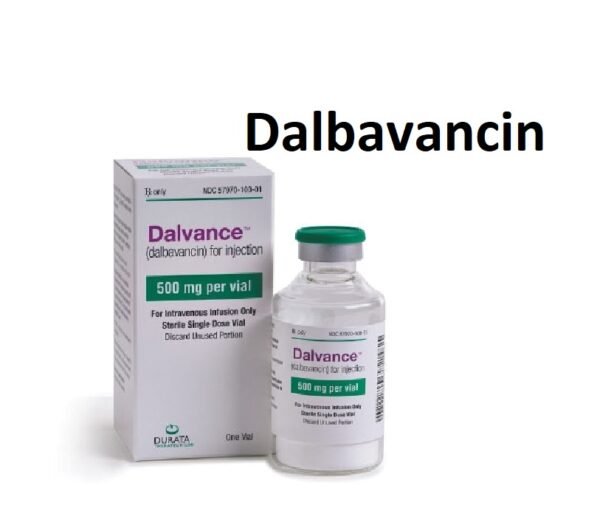
Dalbavancin (Dalvance) is a novel second-generation lipoglycopeptide that belongs to the same class as vancomycin. It is indicated for the treatment of skin and soft-tissue infections. The drug has a long half-life and can be administered as a single injection or two injections administered a week apart.
Dalbavancin (Dalvance) Uses:
-
Acute bacterial skin and skin structure infections:
- It is indicated for the treatment of acute bacterial skin and skin structure infections (ABSSSI) in adults caused by susceptible organisms of the following gram-positive microorganisms:
- Staphylococcus aureus (including methicillin-susceptible and methicillin-resistant strains),
- Streptococcus pyogenes,
- Streptococcus agalactiae,
- S. dysgalactiae,
- Streptococcus anginosus group (including S. anginosus, S. intermedius, S. constellatus), and
- Enterococcus faecalis (vancomycin-susceptible strains)
- It is indicated for the treatment of acute bacterial skin and skin structure infections (ABSSSI) in adults caused by susceptible organisms of the following gram-positive microorganisms:
Dalbavancin (Dalvance) Dose in Adults
Dalbavancin (Dalvance) Dose in the treatment of acute bacterial skin and skin structure infections: IV:
-
Single-dose regimen:
- 1,500 mg as a single dose slow intravenous infusion.
-
Two-dose regimen:
- 1,000 mg as a single dose slow IV infusion initially, followed by 500 mg one weel after the last dose.
Use in Children:
Not indicated
Dalbavancin (Dalvance) Pregnancy Risk Category: C
- Animal reproduction studies have shown that adverse fetal events can be observed.
- When assessing potential exposure to the fetus, it is important to keep in mind the long half-life dalbavancin.
Dalbavancin use during breastfeeding:
- It is unknown if the drug will be excreted into breast milk.
- It is recommended that you use it with caution if you are lactating.
Dalbavancin (Dalvance) Dose in Kidney Disease:
-
CrCl ≥30 mL/minute:
- Adjustment in the dose is not necessary.
-
CrCl <30 mL/minute (not on regularly scheduled dialysis):
- Single-dose regimen:
- 1,125 mg as a single dose
- Two-dose regimen:
- Initially, 750 mg as a single dose is administered that is followed by 375 mg as a single dose after one week of the first dose.
- Single-dose regimen:
-
ESRD patients receiving intermittent hemodialysis (IHD) (regularly scheduled):
- Adjustment in the dose is not necessary.
- The drug may be administered without regard to the timings of hemodialysis.
Dalbavancin (Dalvance) Dose in Liver disease:
-
Mild impairment (Child-Pugh class A):
- Adjustment in the dose is not necessary.
-
Moderate or severe impairment (Child-Pugh class B or C):
- In the manufacturer's labeling adjustment in the dose has not been provided as the drug has not been studied.
- It should be used with caution.
Side Effects of Dalbavancin (Dalvance):
-
Cardiovascular:
- Flushing
- Phlebitis
-
Central Nervous System:
- Headache
- Dizziness
-
Dermatologic:
- Skin Rash
- Pruritus
- Urticaria
-
Endocrine & Metabolic:
- Hypoglycemia
- Increased Gamma-Glutamyl Transferase
- Increased Lactate Dehydrogenase
-
Gastrointestinal:
- Nausea
- Diarrhea
- Vomiting
- Abdominal Pain
- Clostridioides Difficile Colitis
- Gastrointestinal Hemorrhage
- Hematochezia
- Melena
- Oral Candidiasis
-
Hematologic & Oncologic:
- Acute Posthemorrhagic Anemia
- Anemia
- Eosinophilia
- Hematoma
- Increased INR
- Leukopenia
- Neutropenia
- Petechia
- Thrombocythemia
- Thrombocytopenia
- Wound Hemorrhage
-
Hepatic:
- Hepatotoxicity
-
Hepatic:
- Increased Serum Alkaline Phosphatase
- Increased Serum Transaminases
-
Hypersensitivity:
- Anaphylactoid Reaction
-
Infection:
- Vulvovaginal Infection
-
Respiratory:
- Bronchospasm
-
Miscellaneous:
- Infusion Related Reaction
Contraindications to Dalbavancin (Dalvance):
- Allergic reactions to dalbavancin or any component of the formulation
Warnings and Precautions
-
Hepatic effects
- The treatment may cause hepatic impairment.
- Patients might have elevated ALT or AST levels that exceed three times the normal upper limit.
- Treatment discontinuation can reverse liver dysfunction.
-
Hypersensitivity reactions
- The treatment can cause severe allergic reactions, including skin reactions.
- If an allergic reaction is observed, the treatment can be stopped.
- Cross-reactions can occur in patients who have experienced allergic reactions to other glycopeptides.
- Before initiating treatment, patients must be tested for allergies to glycopeptides.
-
Infusion reactions
- Rapid infusion of the drug can cause reactions similar to "Red-Man Syndrome".
- Patients might experience urticaria, flushing, rash and pruritus.
- These reactions can be exacerbated if the infusion rate is decreased or stopped.
-
Superinfection
- The treatment may cause superinfections.
- Superinfections can include fungal and bacterial infections, including Clostridium difficile-associated diarrhea (CDAD), pseudomembranous collitis, and Clostridium difficile (formerly Clostridium).
- CDAD can be observed up to 2 months after the last antibiotic dose.
-
Hepatic impairment
- Patients with severe to moderate hepatic impairment (Child Puugh class B orC) should be cautious about using the drug.
Dalbavancin: Drug Interaction
Note: Drug Interaction Categories:
- Risk Factor C: Monitor When Using Combination
- Risk Factor D: Consider Treatment Modification
- Risk Factor X: Avoid Concomitant Use
Risk Factor C (Monitor therapy). |
|
| BCG Vaccine (Immunization) | Antibiotics can decrease the therapeutic effects of BCG Vaccine (Immunization). |
| Lactobacillus & Estriol | Antibiotics can reduce the therapeutic effects of Lactobacillus or Estriol. |
Risk Factor D (Consider therapy modifications) |
|
| Sodium Picosulfate | Antibiotics can reduce the therapeutic effects of Sodium Picosulfate. Patients who are currently using or have just finished using antibiotics should consider using an alternative product to cleanse the bowels before undergoing a colonoscopy. |
| Typhoid Vaccine | The therapeutic effects of Typhoid vaccine may be diminished by antibiotics. The only affected strain is the live attenuated Ty21a. Patients being treated with systemic antibiotics should avoid vaccination with live attenuated Typhoid vaccine (Ty21a). This vaccine should not be used until at least three days after the cessation or discontinuation of antibacterial agent treatment. |
Risk Factor X (Avoid Combination) |
|
| BCG (Intravesical). | The therapeutic effects of BCG (Intravesical) may be diminished by antibiotics |
| Cholera Vaccine | Cholera Vaccine may be less effective if taken with antibiotics. Treatment: Cholera vaccine should be avoided in patients who have received systemic antibiotics. |
Monitoring parameters:
- BUN, serum creatinine, and liver function tests (AST, ALT, bilirubin) at baseline.
- Patients should be monitored for superinfections during the treatment and any infusion-related reactions.
How to administer Dalbavancin (Dalvance)?
IV:
- It is administered as an intravenous infusion over at least 30 minutes.
- In case, other intravenous medications are administered via the same IV line, the line should be flushed with 5% DW before and after the drug is administered.
Mechanism of action of Dalbavancin (Dalvance):
- It is a lipoglycopeptide which interferes with cell wall production by binding to D-alanyl–D-alanine terminus in the stem pentapeptide.
- It is bactericidal against Staphylococcus aureus in vitro and streptococcus piyogenes in vitro.
Protein binding:
- 93% (primarily to albumin)
Metabolism:
- Minor metabolite (hydroxy-dalbavancin)
Half-life elimination:
- 346 hours
Excretion:
- Urine (33% as unchanged drug, 12% as hydroxy metabolite);
- feces (20%)
International Brand Names of Dalbavancin:
- Dalvance
- Xydalba
Dalbavancin Brand Names in Pakistan:
It is not available in Pakistan.
.png)