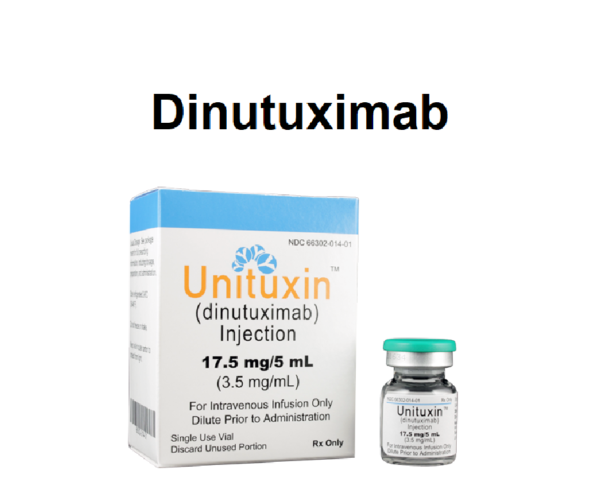
Dinutuximab (Unituxin) is a chemotherapeutic antineoplastic drug that is used to treat children with high-risk neuroblastoma.
Indications of Dinutuximab (Unituxin):
-
Neuroblastoma:
- It is useful for the treatment of high-risk neuroblastoma (in combination with granulocyte-macrophage colony-stimulating factor [GM-CSF; sargramostim], interleukin-2 [IL-2; aldesleukin] and 13-cis-retinoic acid [RA; isotretinoin]) in pediatric patients who achieve at least a partial response to prior first-line multiagent, multimodality therapy.
Use in Adults:
Not indicated
Dinutuximab dose in children:
Note:
- Before therapy, intravenous hydration and premedication with analgesics, antihistamines, and antipyretics are necessary.
- Hematologic, respiratory, hepatic, and renal function should be checked before each cycle of therapy.
Dinutuximab (Unituxin) Dose in the treatment of high-risk Neuroblastoma:
-
Infants, Children, and Adolescents:
- 17.5 mg/m²/day IV for 4 consecutive days for a maximum of 5 cycles (in combination with GM-CSF [sargramostim], IL-2 [aldesleukin] and 13-cis-retinoic acid [isotretinoin]).
- Infuse on days 4, 5, 6, and 7 during cycles 1, 3, and 5 (cycles 1, 3, and 5 are 24 days in duration);
- infuse on days 8, 9, 10, and 11 during cycles 2 and 4 (cycles 2 and 4 are 32 days in duration).
- In the reported trials, the youngest patient was 11 months of age.
-
Premedications:
- IV hydration: Normal saline 10 ml/kg infused over 1 hour just before each dinutuximab infusion.
- Antihistamine: Diphenhydramine:0.5 to 1 mg/kg/dose IV
- The maximum dose: 50 mg/dose; administer over 10 to 15 minutes starting 20 minutes before dinutuximab infusion and every 4 to 6 hours as tolerated during the infusion.
- Antiemetics: These should be given to prevent nausea and vomiting due to the moderate emetic potential of dinutuximab.
- Antipyretics: Acetaminophen: 10 to 15 mg/kg/dose per oral; administer 20 minutes before each infusion and every 4 to 6 hours as needed for fever and pain.
- The maximum dose: 650 mg/dose.
- Ibuprofen: 5 to 10 mg/kg/dose per oral every 6 hours as needed for control of persistent fever or pain.
- The maximum dose: 400 mg/dose.
- Analgesics: Morphine: 50 mcg/kg IV, administer immediately before dinutuximab infusion initiation; continue as a morphine drip at a rate of 20 to 50 mcg/kg/hour during and for 2 hours following completion of dinutuximab infusion.
- May administer additional morphine doses of 25 to 50 mcg/kg IV as needed up to once every 2 hours followed by an increase in the drip rate in clinically stable patients. Fentanyl or hydromorphone can be given if morphine is not tolerated.
- Adjunct therapy with gabapentin or lidocaine should be given if the pain is not controlled with opioids.
Dinutuximab (Unituxin) Dosing adjustment for toxicity:
-
Infants, Children, and Adolescents:
- Anaphylaxis, grade 3 or 4: Permanently discontinue therapy.
- Capillary leak syndrome:
- Moderate to severe, but not life-threatening: Immediately interrupt infusion. Once the symptoms resolve, treatment should be restarted with a 50% dose reduction.
- Life-threatening: Discontinue infusion for the current cycle,50% dose reduction should be done in next cycle. If life-threatening capillary leak syndrome recurs, permanently discontinue therapy.
- Hemolytic uremic syndrome: Therapy should be permanently stopped and supportive management should be given.
- Hyponatremia, grade 4 (despite appropriate fluid management): Permanently discontinue therapy.
- Hypotension (symptomatic hypotension, systolic blood pressure [SBP] less than the lower limit of normal for age, or SBP decreased by more than 15% compared to baseline): Interrupt infusion. Once symptoms resolve, a 50% dose reduction should be done. If blood pressure remains stable for ≥2 hours, gradually increase the infusion rate as tolerated up to a maximum rate of 1.75 mg/m²/hour.
- Infection (systemic)/sepsis, severe: Discontinue therapy until the infection resolves; may resume therapy with subsequent cycles.
- Infusion-related reaction:
- Mild to moderate reaction (eg, transient rash, fever, rigors, and localized urticaria that respond promptly to symptomatic treatment):
- 50% dose reduction and close monitoring are necessary.
- Upon resolution, gradually increase the infusion rate up to a maximum of 1.75 mg/m²/hour.
- Severe or prolonged reaction (eg, mild bronchospasm without other symptoms, angioedema that does not affect the airway):
- Immediately interrupt infusion.
- 50% dose reduction and close monitoring are necessary once symptoms resolve.
- If reaction recurs, discontinue therapy until the following day.
- If symptoms resolve and further treatment is warranted, premedicate with IV hydrocortisone 1 mg/kg (maximum dose: 50 mg/dose) and infuse at a rate of 0.875 mg/m²/hour in an intensive care unit.
- If reaction recurs again, therapy should be permanently stopped.
- Life-threatening reaction:
- Permanently discontinue therapy and administer supportive management.
- Mild to moderate reaction (eg, transient rash, fever, rigors, and localized urticaria that respond promptly to symptomatic treatment):
- Neuropathy:
- Grade 4 sensory neuropathy or grade 3 sensory neuropathy that interferes with daily activities for more than 2 weeks:
- Permanently discontinue therapy.
- Grade 2 or higher peripheral motor neuropathy:
- Permanently discontinue therapy.
- Grade 4 sensory neuropathy or grade 3 sensory neuropathy that interferes with daily activities for more than 2 weeks:
- Ocular neurological disorders (eg, blurred vision, photophobia, mydriasis, fixed or unequal pupils, optic nerve disorder, eyelid ptosis, and/or papilledema):
- Discontinue infusion until symptom resolution.
- Once symptoms are resolved, a 50% dose reduction is necessary.
- If reaction recurs, or if a reaction is accompanied by visual impairment (eg, subtotal or total vision loss), permanently discontinue therapy.
- Pain, severe (grade 3): Decrease the infusion rate to 0.875 mg/m²/hour. If pain is not adequately controlled despite rate reduction and use of maximum supportive measures, permanently discontinue therapy.
- Reversible posterior leukoencephalopathy syndrome: Permanently discontinue therapy.
- Serum sickness, grade 3 or 4: Permanently discontinue therapy.
- Transverse myelitis: Permanently discontinue therapy.
- Urinary retention (persistent after opioid discontinuation): Permanently discontinue therapy.
Dinutuximab dose in pregnancy: X
- Dinutuximab has not undergone any reproduction studies.
- The highest concentration of monoclonal antibody crosses the placenta in the last trimester.
- Dinutuximab may cause fetal harm, depending on how it works.
- Effective contraception is essential during therapy as well as for two months following the last dose.
Use of Dinutuximab while breastfeeding
- It is unknown if dinutuximab is excreted in breast milk.
- Breast milk contains IgG molecules.
- According to the manufacturer, breastfeeding is not recommended because of the risk of serious side effects for the infant.
Dinutuximab (Unituxin) Dose adjustment in renal disease:
- Infants, Children, and Adolescents:
- There are no dosage adjustments provided in the manufacturer’s labeling (has not been studied).
Dinutuximab (Unituxin) Dose adjustment in liver disease:
- Infants, Children, and Adolescents:
- There are no dosage adjustments provided in the manufacturer’s labeling (has not been studied).
Common Side Effects of Dinutuximab (Unituxin):
-
Cardiovascular:
- Hypotension
- Capillary Leak Syndrome
- Tachycardia
- Edema
- Hypertension
-
Central Nervous System:
- Pain
- Peripheral Neuropathy
-
Dermatologic:
- Urticaria
-
Endocrine & Metabolic:
- Hyponatremia
- Hypokalemia
- Hypoalbuminemia
- Hypocalcemia
- Hypophosphatemia
- Hyperglycemia
- Hypertriglyceridemia
- Hypomagnesemia
-
Gastrointestinal:
- Increased Serum ALT
- Vomiting
- Diarrhea
- Increased Serum AST
- Decreased Appetite
-
Genitourinary:
- Proteinuria
-
Hematologic & Oncologic:
- Thrombocytopenia
- Lymphocytopenia
- Anemia
- Neutropenia
- Hemorrhage
-
Hypersensitivity:
- Severe Infusion-Related Reaction
-
Infection:
- Sepsis
- Infection
- Bacteremia
-
Renal:
- Increased Serum Creatinine
-
Respiratory:
- Hypoxia
-
Miscellaneous:
- Fever
- Infusion-Related Reaction
Rare Side Effects Of Dinutuximab:
-
Central Nervous System:
- Peripheral Sensory Neuropathy
- Peripheral Motor Neuropathy
-
Dermatologic:
- Anaphylaxis
-
Endocrine & Metabolic:
- Weight Gain
-
Gastrointestinal:
- Nausea
-
Hematologic & Oncologic:
- Febrile Neutropenia
- Hemolytic-Uremic Syndrome
-
Ophthalmic:
- Blurred Vision
Dinutuximab (Unituxin) Side effect (Frequency not known):
-
Ophthalmic:
- Blepharoptosis
- Optic Nerve Damage
- Papilledema
- Photophobia
Contraindications to Dinutuximab (Unituxin):
- Anaphylaxis history to dinutuximab and any component of the formulations
Warnings and precautions
-
Suppression of bone marrow
- Dinutuximab has been known to cause bone marrow suppression, including severe (grades 3 or 4) anemia and neutropenia.
- It is important to monitor your full blood count regularly.
-
Capillary leak syndrome
- Some patients may experience severe capillary leak syndrome after receiving dinutuximab therapy.
- Capillary leak syndrome should not be treated. Instead, the patient should receive appropriate therapy.
- It may be necessary to restart therapy with a reduction in the infusion rate or permanent withdrawal.
-
An abnormality in the electrolyte:
- In some cases, therapy can cause electrolyte imbalances, including hyponatremia and hypokalemia. Regular monitoring is therefore necessary.
- A study of a similar anti-GD2 antibody was done.
- It revealed that severe hyponatremia could be caused by the syndrome of inappropriate antidiuretic hormonal hormone secretion (SIADH).
-
Gastrointestinal toxicities:
- Because of the moderate emetic properties of danutuximab, antiemetic medication should be prescribed prior to therapy.
-
Hemolytic uremic Syndrome:
- Patients who received danutuximab suffered from hemolytic uremic symptoms, which can lead to anemia, electrolyte abnormalities and renal insufficiency.
- On rechallenge, one of the patients developed atypical hemolytic-uremic syndrome.
- Both permanent withdrawal and supportive management are required.
-
Hypotension
- Dinutuximab is known for its ability to cause severe hypotension.
- Adequate intravenous hydration is essential before therapy. Close blood pressure monitoring is also important.
- Patients with systolic pressure that is lower than the upper limit of normal for their age or that has fallen by more than 15% should receive appropriate medical management.
-
Infection
- Dinutuximab can often cause severe (grade 3-4) bacteremia, which may require intravenous antibiotics and other urgent intervention.
- Patients receiving dinutuximab also developed Sepsis.
- It is important to monitor for any signs or symptoms of systemic infections.
- It may be necessary to seek therapy in order to stop permanent damage.
-
Infusion reaction: [US Boxed Warning]
- Some patients may experience life-threatening injection reactions.
- It is important to get adequate hydration before starting therapy.
- Ensure that patients are monitored closely for any signs or symptoms of an infusion reaction, at least for 4 hours after each dinutuximab injection.
- Infusion reactions are usually experienced during or within 24 hours after completion.
- They may include dyspnea and bronchospasm as well as stridor, urticaria and facial and upper-airway edema.
- These should be treated with blood pressure support, bronchodilator treatment, corticosteroids and infusion rate interruption and/or decrease.
- If you experience symptoms of infusion reactions, stop therapy immediately and discontinue all medication if you develop anaphylaxis.
- Infusions should be performed in a facility that has cardiopulmonary medication/equipment.
-
Neurotoxicity: [US Boxed Warn]
- Therapy can help with severe neuropathic pain, peripheral neuropathy, and severe neuropathic symptoms.
- Intranavenous opioids should not be administered before, during, or for more than 2 hours following dinutuximab injections.
- Clinical studies on patients with high-risk neuroblastoma showed that grade 3 peripheral sensory neuropathy was found in between 2% and 9% of patients.
- Motor neuropathy was observed in clinical trials of dinutuximab or related GD2-binding antibodies.
- Motor neuropathy was not always resolved.
- Therapy should be stopped if there is severe unresponsiveness, severe sensory neuropathy or severe peripheral motor neuropathy.
- Permanently discontinue treatment for grade 2 or higher peripheral neuropathy, Grade 3 sensory nerve neuropathy that interferes for more than two weeks with daily activities, and Grade 4 sensory neuropathy.
- Patients with peripheral sensory neuropathy of any degree experienced a median of 9 days. The range was 3-163 days.
-
Ocular toxicities:
- Clinical trials showed that neurological ocular toxicities include blurred vision, photophobia and mydriasis as well as fixed or unequal pupils, optic neuro disorder, eyelid posis and papilledema.
- Patients who had complete resolution of their ocular toxicities experienced a median of 4 days of symptoms (range: 0 - 221 days).
- It may be necessary to reduce dosages or withdraw from therapy.
-
Pain:
- Patients receiving dinutuximab therapy often felt pain, despite the fact that they were taking analgesic/opioid medication.
- Infusions are often associated with pain. These include back, generalized, extremity or abdominal pain, as well as neuralgia and musculoskeletal chest pain.
- It is important to take analgesics before, during, and 2 hours after infusions.
- In severe pain, it might be necessary to reduce the rate of therapy withdrawal or decrease the infusion rate.
-
Reversible posterior Leukoencephalopathy Syndrome:
- With danutuximab, you can get reversible posterior leukoencephalopathy (Syndrome of severe headaches, hypertension, visual changes or seizures), as well as severe headaches, hypertension, visual problems, seizures, and lethargy.
- These symptoms can be managed and withdrawn.
-
Transverse myelitis
- Transverse myelitis can present with weakness, paresthesia or sensory loss.
- This condition should not be treated.
-
Urinary retention
- Dinutuximab can cause urinary retention that lasts for weeks or even months after the opioid has been discontinued.
- If the urinary retention persists after opioid discontinuation, it is time to withdraw treatment permanently.
Dinutuximab: Drug Interaction
Note: Drug Interaction Categories:
- Risk Factor C: Monitor When Using Combination
- Risk Factor D: Consider Treatment Modification
- Risk Factor X: Avoid Concomitant Use
Risk Factor C (Monitor therapy). |
|
| Alfuzosin | Might increase the hypotensive effects of Blood Pressure Lowering Agents. |
| Antipsychotic Agents, Second Generation (Atypical) | Blood Pressure Lowering Agents can increase the hypotensive effects of Antipsychotic Agents (Second Gen [Atypical]). |
| Barbiturates | Might increase the hypotensive effects of Blood Pressure Lowering Agents. |
| Benperidol | Might increase the hypotensive effects of Blood Pressure Lowering Agents. |
| Blood Pressure Lowering Agents | Hypotension-Associated Agents may increase hypotensive effects. |
| Brimonidine | Might increase the hypotensive effects of Blood Pressure Lowering Agents. |
| Chloramphenicol Ophthalmic | May increase the toxic/adverse effects of Myelosuppressive Agents. |
| CloZAPine | CloZAPine's toxic/adverse effects may be exacerbated by myelosuppressive agents. Particularly, there may be an increase in the risk of neutropenia. |
| Coccidioides immitis skin test | Coccidioides immitis Skin Test may be affected by immunosuppressants. |
| Denosumab | Might increase the toxic/adverse effects of Immunosuppressants. In particular, there may be an increase in the risk of serious infections. |
| Diazoxide | Might increase the hypotensive effects of Blood Pressure Lowering Agents. |
| DULoxetine | DULoxetine may increase hypotension by lowering blood pressure. |
| Herbs (Hypotensive properties) | Might increase the hypotensive effects of Blood Pressure Lowering Agents. |
| Hypotension-Associated Agents | Hypotension-Associated Agents can be enhanced by Blood Pressure Lowering agents. |
| Levodopa-Containing products | Blood Pressure Lowering Agents can increase the hypotensive effects of Levodopa - Containing Products. |
| Lormetazepam | Might increase the hypotensive effects of Blood Pressure Lowering Agents. |
| Molsidomine | Might increase the hypotensive effects of Blood Pressure Lowering Agents. |
| Naftopidil | Might increase the hypotensive effects of Blood Pressure Lowering Agents. |
| Nicergoline | Might increase the hypotensive effects of Blood Pressure Lowering Agents. |
| Nicorandil | Might increase the hypotensive effects of Blood Pressure Lowering Agents. |
| Nitroprusside | The hypotensive effects of Nitroprusside may be enhanced by blood pressure lowering agents. |
| Ocrelizumab | May increase the immunosuppressive effects of Immunosuppressants. |
| Pentoxifylline | Might increase the hypotensive effects of Blood Pressure Lowering Agents. |
| Pholcodine | Pholcodine may increase hypotensive effects by lowering blood pressure. |
| Phosphodiesterase-5 Inhibitors | Might increase the hypotensive effects of Blood Pressure Lowering Agents. |
| Pidotimod | Pidotimod's therapeutic effects may be diminished by immunosuppressants. |
| Promazine | May increase the myelosuppressive effects of Myelosuppressive Drugs. |
| Analogues of Prostacyclin | Might increase the hypotensive effects of Blood Pressure Lowering Agents. |
| Quinagolide | Might increase the hypotensive effects of Blood Pressure Lowering Agents. |
| Siponimod | Siponimod's immunosuppressive effects may be enhanced by taking immunosuppressants. |
| Sipuleucel - T | Sipuleucel T's therapeutic effects may be diminished by immunosuppressants |
| Tertomotide | Tertomotide's therapeutic effects may be diminished by immunosuppressants. |
| Trastuzumab | May increase the neutropenic effects of Immunosuppressants. |
Risk Factor D (Regard therapy modification) |
|
| Amifostine | Amifostine's hypotensive effects may be enhanced by blood pressure lowering agents. Treatment: Blood pressure lowering drugs should be stopped 24 hours before amifostine is administered to chemotherapy patients. Amifostine should be avoided if blood pressure lowering medication cannot be withheld. |
| Baricitinib | Baricitinib's immunosuppressive effects may be enhanced by immunosuppressants. Baricitinib should not be used in combination with immunosuppressants like azathioprine and cyclosporine. It is permissible to use methotrexate antirheumatically or nonbiologic disease-modifying antirheumatic drug (DMARDs), concurrently. |
| Echinacea | Might decrease the therapeutic effects of Immunosuppressants. |
| Fingolimod | Fingolimod may be immunosuppressed by immunosuppressants. When possible, avoid the use of fingolimod with other immunosuppressants. Patients should be closely monitored for any additive immunosuppressant effects, such as infections, if they are used together. |
| Leflunomide | Leflunomide's toxic/adverse effects may be exacerbated by immunosuppressants. The risk of hematologic toxicities such as pancytopenia and agranulocytosis may increase. Patients on immunosuppressants should not be given a leflunomide loading dosage. Patients who are receiving leflunomide or another immunosuppressant must be checked for bone marrow suppression at minimum monthly. |
| Nivolumab | Nivolumab's therapeutic effects may be diminished by immunosuppressants. |
| Obinutuzumab | This may increase the hypotensive effects of Blood Pressure Lowering Agents. Management: You may temporarily withhold blood pressure lowering medication beginning 12 hours before obinutuzumab injection and continuing for 1 hour after infusion. |
| Roflumilast | May increase the immunosuppressive effects of Immunosuppressants. |
| Tofacitinib | Tofacitinib's immunosuppressive effects may be enhanced by immunosuppressants. Management: It is permissible to use methotrexate (or nonbiologic disease-modifying antirheumatic drug (DMARDs), concurrently with antirheumatic doses. This warning appears to be particularly targeted at more potent immunosuppressants. |
| Vaccines (Inactivated). | Immunosuppressants can reduce the therapeutic effects of Vaccines (Inactivated). Management: The effectiveness of vaccines may be decreased. All age-appropriate vaccines must be completed at least two weeks before you start an immunosuppressant. Re-vaccinate anyone who was vaccinated while on immunosuppressant therapy. |
Risk Factor X (Avoid Combination) |
|
| BCG (Intravesical). | The therapeutic effects of BCG (Intravesical) may be diminished by immunosuppressants |
| BCG (Intravesical). | Myelosuppressive agents may reduce the therapeutic effects of BCG (Intravesical). |
| Belimumab | Monoclonal Antibodies can increase the toxic/adverse effects of Belimumab. |
| Bromperidol | Bromperidol's hypotensive effects may be enhanced by Blood Pressure Lowering agents. Bromperidol could decrease the hypotensive effects of Blood Pressure Lowering agents. |
| Cladribine | May increase the immunosuppressive effects of Immunosuppressants. |
| Cladribine | May increase the myelosuppressive effects of Myelosuppressive Drugs. |
| Deferiprone | Deferiprone may have a neutropenic effect that myelosuppressive agents can increase. |
| Dipyrone | May increase the toxic/adverse effects of Myelosuppressive Agents. In particular, there may be an increase in the risk of pancytopenia and agranulocytosis. |
| Natalizumab | Natalizumab's toxic/adverse effects may be exacerbated by immunosuppressants. Particularly, concurrent infections may increase. |
| Pimecrolimus | May increase the toxic/adverse effects of Immunosuppressants |
| Tacrolimus - Topical | May increase the toxic/adverse effects of Immunosuppressants |
| Vaccines (Live). | Immunosuppressants can increase the toxic/adverse effects of Vaccines (Live). Immunosuppressants can decrease the therapeutic effects of Vaccines. Management: Live-attenuated vaccines should be avoided for at least three months following immunosuppressants. |
Monitoring parameters:
- Blood pressure
- CBC with differential counts
- Serum electrolytes
- Renal function tests
- Monitor for signs/symptoms of infusion reactions (during and for at least 4 hours after infusion), pain, peripheral neuropathy, capillary leak syndrome, infection/sepsis, hemolytic uremic syndrome, ocular toxicity, urinary retention, transverse myelitis, and/or reversible posterior leukoencephalopathy syndrome.
How to administer Dinutuximab (Unituxin)?
Note: Antiemetics should be given before therapy due to the moderate emetic potential of dinutuximab.
Intravenous administration:
- Before administration, the drug must be diluted.
- It should always be given as an IV infusion only; do not administer as an IV push or bolus.
- Infusion normal saline 10 mL/kg IV over 1 hour should be given before therapy in addition to premedication with analgesics, an antihistamine, and an antipyretic (see Dosing: Pediatric).
- Infuse in an environment equipped to monitor for and manage infusion reactions.
- Interrupt infusion for toxicity (see Dosing Adjustment for Toxicity).
- Dinutuximab infusion should be started at a rate of 0.875 mg/m²/hour for half-hour.
- Increase infusion rate gradually as tolerated to a maximum rate of 1.75 mg/m²/hour to infuse dose over 10 to 20 hours each day.
- Close monitoring for signs and symptoms of an infusion reaction during and for at least 4 hours following completion of each dinutuximab infusion is required.
Mechanism of action of Dinutuximab (Unituxin):
- Dinutuximab induces cell lysis (of GD2-expressing cell) via antibody-dependent cellmediated cytotoxicity, (ADCC), and complement-dependent cytotoxicity.
- It does this by binding to disialoganglioside GD2, a protein that is abundant in neuroblastoma and most melanomas.
Terminal Half-life elimination:
- 10 days
International Brand Names of Dinutuximab:
- Unituxin
Dinutuximab Brand Names in Pakistan:
No Brands Available in Pakistan.
.png)


