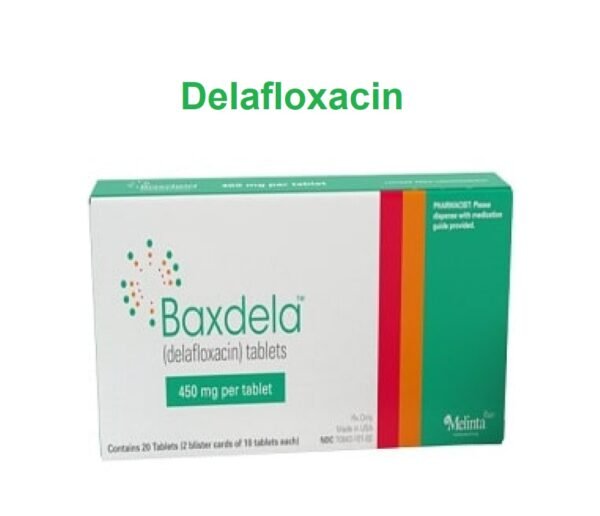
Delafloxacin (Baxdela) is an anionic fluoroquinolone antibiotic that is used in the treatment of skin and soft tissue infections. It has good gram-positive and gram-negative activity.
Delafloxacin (Baxdela) Uses:
- Skin and skin structure infections:
- Treatment of acute bacterial skin and skin structure infections (ABSSSI) caused by susceptible isolates of:
- Staphylococcus aureus (including methicillin-resistant [MRSA] and methicillin-susceptible [MSSA] isolates),
- Staphylococcus haemolyticus,
- Staphylococcus lugdunensis,
- Streptococcus agalactiae,
- Streptococcus anginosus group (including Streptococcus anginosus,
- Streptococcus intermedius, and Streptococcus constellatus),
- Streptococcus pyogenes,
- Enterococcus faecalis,
- Escherichia coli,
- Enterobacter cloacae,
- Klebsiella pneumoniae, and
- Pseudomonas aeruginosa.
- Treatment of acute bacterial skin and skin structure infections (ABSSSI) caused by susceptible isolates of:
Delafloxacin (Baxdela) Dose in Adults
Delafloxacin (Baxdela) Dose in the treatment of Skin and skin structure infections:
- Oral: 450 mg every 12 hours for 5 to 14 days
- IV: 300 mg every 12 hours for 5 to 14 days
- Missed dose:
- If ≥8 hours earlier to the next dose, the missed dose should be taken as early as possible. If <8 hours before the next dose, wait until the next scheduled dose.
Use in Children:
Not indicated.
Pregnancy Risk Category: C
- Some adverse events were seen in animal reproduction studies.
Delafloxacin use during breastfeeding:
- It is not known if breast milk contains delafloxacin.
- According to the manufacturer the decision to breastfeed during therapy should be weighed against the risks to infants, the benefits to the mother, and the benefits to the mother.
Delafloxacin (Baxdela) Dose in Kidney disease:
- Oral, IV:
- Estimated glomerular filtration rate (eGFR) 30 to 89 mL/minute/1.73 m²:
- No dosage adjustment is necessary.
- Estimated glomerular filtration rate (eGFR) 30 to 89 mL/minute/1.73 m²:
- eGFR 15 to 29 mL/minute/1.73 m²:
- Oral: No dosage adjustment is necessary.
- IV: 200 mg every 12 hours
- eGFR <15 mL/minute/1.73 m²:
- Its use is not recommended.
- ESRD on hemodialysis:
- Its use is not recommended.
Dose in Liver disease:
No dosage adjustment is necessary.
Side Effects of Delafloxacin (Baxdela):
- Cardiovascular:
- Bradycardia
- Edema
- Flushing
- Hypertension
- Hypotension
- Localized Phlebitis
- Palpitations
- Phlebitis
- Presyncope
- Sinus Tachycardia
- Syncope
- Thrombosis
- Central Nervous System:
- Headache
- Abnormal Dreams
- Anxiety
- Dizziness
- Hypoesthesia
- Insomnia
- Local Discomfort
- Paresthesia
- Vertigo
- Dermatologic:
- Dermatitis
- Localized Erythema
- Extravasation Reactions
- Pruritus
- Skin Rash
- Urticaria
- Endocrine & Metabolic:
- Hyperglycemia
- Hypoglycemia
- Gastrointestinal:
- Diarrhea
- Nausea
- Abdominal Pain
- Clostridioides Difficile
- Dysgeusia
- Dyspepsia
- Oral Candidiasis
- Vomiting
- Genitourinary:
- Vulvovaginal Candidiasis
- Hepatic:
- Increased Serum Transaminases
- Increased Serum Alkaline Phosphatase
- Hypersensitivity:
- Hypersensitivity Reaction
- Infection:
- Fungal Infection
- Local:
- Infusion Site Irritation
- Infusion Site Reaction
- Local Pain
- Local Swelling
- Neuromuscular & Skeletal:
- Increased Creatine Phosphokinase
- Myalgia
- Ophthalmic:
- Blurred Vision
- Otic:
- Tinnitus
- Renal:
- Increased Serum Creatinine
- Renal Failure
- Renal Insufficiency
Contraindications to Delafloxacin (Baxdela):
- Hypersensitivity to delafloxacin or other fluoroquinolones or any component of this formulation
Warnings and precautions
- Regulation of Glucose
- Fluoroquinolones have been associated with disturbances in glucose regulation. These include hypoglycemia and hyperglycemia.
- Patients who receive insulin or oral hypoglycemic drugs concurrently are most likely to experience these events.
- Reports have come in of severe hypoglycemia - which can lead to coma or death - cases.
- Diabetic patients need to be closely monitored for signs/symptoms that may indicate disordered glucose regulation.
- Stop using the medication if you experience hypoglycemic reactions. Get immediate treatment.
- Hypersensitivity reactions
- Fluoroquinolone therapy has been associated with severe and sometimes fatal hypersensitivity reactions.
- It can occur following first or subsequent doses.
- The first sign of hypersensitivity reactions, such as skin rash, is the time to stop therapy.
- Warning: Serious adverse reactions
- Fluoroquinolones can cause severe and possibly irreversible adverse reactions. These include tendon rupture, tendon underpin, peripheral neuropathy and CNS effects.
- Stop using delafloxacin immediately and stop using fluoroquinolones for patients who have experienced any of these severe adverse reactions.
- These reactions can occur in patients of all ages and without any preexisting risk factors.
- CNS effects
- Fluoroquinolones have been linked to an increased risk for CNS effects such as seizures, increased intracranial Pressure (including pseudotumor Cerebri), dizziness and tremors.
- This reaction may occur after the first dose. If you experience this, discontinue using fluoroquinolones immediately.
- Patients with a CNS disorder or other risk factors, such as a known or suspected CNS disorder or a seizure threshold lower or predisposing factors, should be cautious.
- Peripheral neuropathy:
- Fluoroquinolones have been linked to an increased risk for peripheral neuropathy.
- It can occur quickly after therapy has begun and may not be reversed. If symptoms of sensorimotor or sensory neuropathy develop, stop using them.
- Patients who have had peripheral neuropathy in the past should not be used.
- Psychiatric reactions
- Fluoroquinolones have been linked to an increased risk for psychiatric reactions.
- These include toxic psychosis and hallucinations or paranoia. It can also cause nervousness, anxiety, nightmares or memory impairment.
- Patients with depression history or other risk factors should be cautious.
- After the first dose, reactions may occur. If this happens, discontinue use and seek appropriate treatment.
- Tendinitis and Tendon rupture
- Fluoroquinolones have been linked to tendinitis and tendon-rupture in all ages.
- This risk can be increased in patients over 60 years old, as well as patients who are receiving solid organ transplant recipients or patients taking concurrent corticosteroids.
- However, it has also been seen in patients without these risk factors.
- Most often, rupture of the Achilles tendon has been observed. Rotator cuff, biceps and hand have all been reported.
- Both inflammation or rupture can occur bilaterally.
- Patients have reported cases within hours or days of therapy initiation and for several months following discontinuation.
- Tendon rupture can also be caused by strenuous activity, kidney failure, or previous tendon disorders.
- Stop using it immediately if you feel tendon pain, swelling or inflammation.
- Patients with tendon disorders, tendinitis, or tendon rupture should not use it.
- Superinfection
- The prolonged use of this medication can lead to fungal or bacterial overinfections, such as C. difficile-associated diarrhea(CDAD) and pseudomembranous collitis.
- CDAD was observed after >2 months of antibiotic treatment.
- Myasthenia gravis: [US Boxed Warning]:
- It can cause muscle weakness due to myasthenia Gravis. Patients with a history of myasthenia Gravis should not use it.
- There have been cases of death and severe exacerbations.
- Renal impairment
- Patients with severe renal impairment should be cautious and the dose may be reduced (estimated GFR 15 to 29 mL/minute/1.73m2).
- Patients with end-stage kidney disease (eGFR 15mL/minute/1.73m2) are not advised to use it.
- Also see the "Dosage form specific issues - Injection" section.
Delafloxacin: Drug Interaction
Note: Drug Interaction Categories:
- Risk Factor C: Monitor When Using Combination
- Risk Factor D: Consider Treatment Modification
- Risk Factor X: Avoid Concomitant Use
Risk Factor C (Monitor therapy). |
|
|
BCG Vaccine (Immunization) |
Antibiotics can decrease the therapeutic effects of BCG Vaccine (Immunization). |
|
Blood Glucose-Limiting Agents |
Quinolones can increase the hypoglycemic effects of Blood Glucose Lowing Agents. Quinolones can decrease the therapeutic effects of Blood Glucose Lowing Agents. Quinolones may cause blood sugar control problems if used in conjunction with diabetes treatment. |
|
Corticosteroids (Systemic) |
Quinolones may have an adverse/toxic effect that can be increased. Particularly, tendonitis and tendon rupture risk may be increased. |
|
Heroin |
Quinolones can increase Heroin's toxic/adverse effects. |
|
Lactobacillus & Estriol |
Antibiotics can reduce the therapeutic effects of Lactobacillus or Estriol. |
|
Mycophenolate |
Quinolones can decrease serum levels of Mycophenolate. Particularly, quinolones could decrease the concentration of active metabolite mycophenolate. |
|
Nonsteroidal Anti-Inflammatory Drugs |
May increase the neuroexcitatory or seizure potentiating effects of Quinolones. The serum concentrations of Quinolones could be increased by nonsteroidal anti-inflammatory agents. |
|
May reduce the excretion rate of Quinolones. Probenecid could decrease the renal excretion quinolone antibiotics. Quinolones may be increased by probenecid. |
|
|
Varenicline may be increased by Quinolones. Management: Watch for elevated varenicline adverse reactions when levofloxacin and other quinolone antibiotics are used concurrently, especially in patients with severe kidney impairment. There are many international product labeling guidelines. Consult appropriate labeling. |
|
|
Vitamin K antagonists (eg warfarin) |
Quinolones can increase the anticoagulant effects of Vitamin K Antagonists. |
Risk Factor D (Consider therapy modifications) |
|
|
Antacids |
Could decrease Quinolone absorption. This is only relevant to oral administration of Quinolones. Management: To minimize the effects of concurrent administration of quinolones with antacids, it is best to avoid them. The specific quinolone will have different recommendations for the optimal dose separation. Sodium Bicarbonate is an exception. |
|
Calcium Salts |
Could decrease Quinolones' absorption. Both agents can be administered orally. Calcium Chloride is an exception. |
|
Delamanid |
Quinolones can increase the QTc-prolonging effects of Delamanid. Management: Avoid concomitant use if possible. Coadministration should not be avoided. Electrocardiograms (ECGs), which are frequently monitored throughout the entire delamanid treatment duration, should be performed if necessary. Separate monographs will discuss exceptions. |
|
Quinolones can decrease Didanosine's serum concentration. Didanosine can decrease the serum Quinolones concentration. Do not take oral quinolones less than 2 hours before or 6 after didanosine. If doses are not separated as recommended, monitor for decreased therapeutic effects. This is not applicable to didanosine unbuffered and enteric coated. |
|
|
Iron Salts |
It may decrease serum Quinolones concentrations. Treatment: Take oral quinolones within a few hours of the onset (4 h if you are taking moxie or sparfloxacin; 2 h if you are taking other quinolones) or immediately after ( Ferric Carboxymaltose, Ferric Gluconate, Ferric Hydroxide polymaltose Complex, Ferric Pyrophosphate Citrate, Ferumoxytol, Ferric Gluconate, Ferric Gluconate, Iron Isomaltoside, Iron Isomaltoside, Iron Sucrose |
|
Lanthanum |
Could cause a decrease in serum Quinolones. Treatment: Take oral quinolone antibiotics one hour before or four to six hours after lanthanum. |
|
Magnesium Salts |
Can decrease serum Quinolones concentrations. Administration: Oral quinolones should be administered several hours before (four hours for moxi/pe/spar/, two hours for others), or after (8 h moxi-; 6 h cipro/dela -, 4 and 3 h lome/pe -, three and a half h lome/pe -, 3 h lome/pe -, 2 h lome/pe -, and 2 h loxin, ofloxacin, nor- or ofloxacin /n or ofloxacin /n or nalidixic - |
|
Multivitamins/Minerals (with ADEK, Folate, Iron) |
Could decrease serum Quinolones concentrations. Particularly, multivitamin products that contain polyvalent cations may reduce the absorption orally administered Quinolone antibiotics. Management: Avoiding interactions can help minimize them. Take the oral quinolone 2 hours or more before, or 6 after, the multivitamin containing polyvalent cations (e.g., calcium iron, magnesium selenium, zinc). |
|
Multivitamins/Minerals (with AE, No Iron) |
Could lower serum Quinolones concentrations. Particularly, multivitamins/mineral products may contain minerals that can impair quinolone-antibiotic absorption. Management: Avoiding interactions can be reduced by administering oral quinolone 2 hours or more before or 6 hours after a multivitamin containing polyvalent cations (i.e. calcium, iron and magnesium), |
|
Quinapril |
May cause a decrease in serum Quinolones. To reduce the chance of interactions, administer separate doses of quinapril. If these products are combined, monitor for decreased efficacy. |
|
Could decrease Quinolone absorption. Administration: Oral quinolones should be taken at least two hours before or six hours after the sevelamer. |
|
|
Sodium Picosulfate |
Antibiotics can reduce the therapeutic effects of Sodium Picosulfate. Patients who are currently using or have just finished using antibiotics should consider using an alternative product to cleanse the bowels before undergoing a colonoscopy. |
|
Could cause a decrease in serum Quinolones. Administration: Oral quinolones should be taken at least two hours before or six hours after sucralfate. A greater separation of doses could reduce the chance of a significant interaction. |
|
|
The therapeutic effects of Typhoid vaccine may be diminished by antibiotics. The only affected strain is the live attenuated Ty21a. Patients being treated with systemic antibiotics should avoid vaccination with live attenuated Typhoid vaccine (Ty21a). This vaccine should not be used until at least three days after the cessation or discontinuation of antibacterial agent treatment. |
|
|
Zinc Salts |
Can decrease serum Quinolones concentrations. Administration: Oral quinolones should be administered at least 4 hours before (for moxie and sparfloxacin) and after (8 h if you take cipro/dela, 6 h if you take cipro/dela, 4 h if your lome- dose, and 3 h a day for gemi-) and 2 h if you take oral zinc salts such as levo-. Zinc chloride is an exception. |
Risk Factor X (Avoid Combination) |
|
|
BCG (Intravesical). |
The therapeutic effects of BCG (Intravesical) may be diminished by antibiotics |
|
Cholera Vaccine |
Cholera Vaccine may be less effective if taken with antibiotics. Treatment: Cholera vaccine should be avoided in patients who have received systemic antibiotics. |
|
Nadifloxacin |
May increase the toxic/adverse effects of Quinolones |
|
Strontium Ranelate |
Could cause a decrease in serum Quinolones. Management: To minimize the potential effects of strontium Ranelate on quinolone anti-biotic concentrations, it is suggested that strontium runelate treatment not be continued during quinolone therapy. |
Monitoring parameters:
- WBC,
- signs of infection,
- serum creatinine;
- signs and symptoms of disordered glucose regulation
How to administer Delafloxacin (Baxdela)?
Oral:
- Administer it with or without food.
- Administer at least 2 hours before or 6 hours after antacids containing magnesium or aluminum, sucralfate, metal cations (e.g. iron), multivitamins containing zinc or iron, or with didanosine buffered tablets for oral suspension or pediatric powder for oral solution.
IV:
- Administer it by IV infusion over 60 minutes.
- Need not to administer with any solution containing multivalent cations (e.g. calcium and magnesium) through the same IV line.
- Do not co-infuse it with other medications.
If a common IV line is being used to administer other drugs in addition to delafloxacin, the line should be flushed before and after each infusion with NS or D5W.
Mechanism of action of Delafloxacin (Baxdela):
Delafloxacin inhibits topoisomerase II and topoisomerase III enzymes which are essential for bacterial DNA repair, replication, and recombination.
Protein binding:
- ~84%, primarily albumin
Metabolism:
- Glucuronidation by UGT1A1, UGT1A3, and UGT2B15.
Bioavailability:
- Oral: 58.8%
Half-life elimination:
- IV: 3.7 hours (single dose);
- Oral: 4.2 to 8.5 hours (multiple doses)
Time to peak:
- ~1 hour
Excretion:
- IV:
- Urine (65% as unchanged drug);
- Feces (28% as unchanged drug);
- Oral:
- Urine (50% as unchanged drug);
- Feces (48% as unchanged drug)
International Brands of Delafloxacin:
- Baxdela
Delafloxacin Brand Names in Pakistan:
No Brands are Available in Pakistan.
.png)


