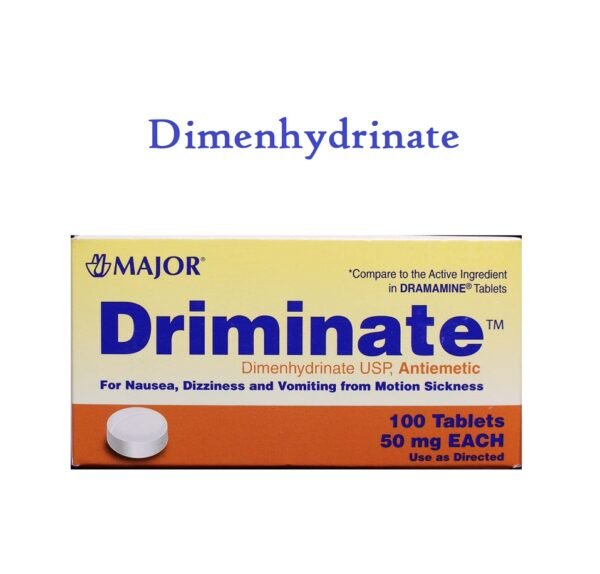
Dimenhydrinate (Gravinate) is a first-generation antihistamine that is used in the treatment of patients with nausea, vomiting, vertigo, and motion sickness.
Dimenhydrinate Uses:
-
US labeling:
- Motion sickness: Treatment and prevention of nausea, vertigo, and vomiting due to motion sickness.
-
Canadian labeling:
- Nausea, vomiting, and/or vertigo:
- Treatment and prevention of nausea, vomiting, and/or vertigo due to motion sickness, radiation sickness, postoperative recovery, use of other drugs, Mènière disease, and other complex disorders.
- Nausea, vomiting, and/or vertigo:
-
Off Label Use of Dimenhydrinate in Adults:
- Nausea and vomiting during pregnancy
Read: Meclizine (Bonine)
Dimenhydrinate (Gravinate) Dose in Adults
US labeling:
Dimenhydrinate (Gravinate) Dose in the treatment of Motion sickness, nausea/vomiting, or vertigo:
- Oral: 50 to 100 mg every 4 to 6 hours (maximum: 400 mg/day)
- IM, IV: 50 mg every 4 hours; maximum: 100 mg every 4 hours
Canadian labeling:
Dimenhydrinate (Gravinate) Dose in the treatment of Nausea/vomiting or vertigo:
-
Motion sickness:
- Oral: 50 to 100 mg every 4 hours as needed (maximum: 400 mg/day);
- Long-lasting formulation: 100 mg every 8 to 12 hours (maximum: 300 mg/day)
- Rectal: 50 to 100 mg every 6 to 8 hours as required.
-
Postoperative nausea/vomiting:
- Oral: 50 to 100 mg prior to the procedure then 50 to 100 mg post-procedure; repeat as needed (maximum: 400 mg/day)
- IM, IV: 50 mg prior to treatment then 50 mg post-procedure; repeat as required (maximum: 400 mg/day)
-
Radiation sickness:
- IM, IV: 50 to 100 mg half an hour to 1 hour before treatment; 50 mg 1.5 and 3 hours after treatment. Repeat dose as needed (maximum: 400 mg/day)
- Rectal: 50 to 100 mg half an hour to 1 hour before treatment; repeat as required (maximum: 400 mg/day)
Dimenhydrinate (Gravinate) Dose in the treatment of Nausea and vomiting of pregnancy (off-label):
- Oral, rectal:
- 50 to 100 mg every 4 to 6 hours;
- The maximum dose: 200 mg/day (when taking four doxylamine/pyridoxine tablets per day) or 400 mg/day
- IV:
- 50 mg every 4 to 6 hours
Dimenhydrinate (Gravinate) Dose in Childrens
Dimenhydrinate (Gravinate) Dose for the prophylaxis of Motion sickness, nausea/vomiting, or vertigo:
- Oral products:
- Fixed-dose: Give the first dose half an hour to an hour before travel/activity
- Children ≥2 to <6 years:
- Oral: 12.5 to 25 mg every 6 to 8 hours;
- The maximum every day dose: 75 mg per day.
- Children ≥6 years to <12 years:
- Oral: 25 to 50 mg every 6 to 8 hours;
- The maximum daily dose: 150 mg per day
- Children ≥12 years and Adolescents:
- Oral: 50 to 100 mg every 4 to 6 hours;
- The maximum daily dose: 400 mg per day
- Children ≥2 to <6 years:
-
Weight-based dosing:
- Children 2 to 12 years:
- Oral: Limited data available: 1 to 1.5 mg/kg/dose every 6 hours;
- The maximum dose: 25 mg/dose.
- The first dose should be administered an hour before travel.
- Children 2 to 12 years:
- Fixed-dose: Give the first dose half an hour to an hour before travel/activity
-
Parenteral products: IM:
-
Weight-based dosing:
- Infants, Children, and Adolescents:
- IM: 1.25 mg/kg/dose 4 times a day;
- The maximum daily dose: 300 mg/day
- Infants, Children, and Adolescents:
-
BSA-based dosing:
- Infants, Children, and Adolescents:
- IM: 37.5 mg/m /dose 4 times a day;
- The maximum daily dose: 300 mg/day
- Infants, Children, and Adolescents:
-
Canadian labeling:
-
Rectal suppository [Canadian product]:
- Children 2 to ≤5 years:
- Rectal: 12.5 mg to 25 mg once;
- If a further dosage is necessary, contact the health care provider
- Children 6 to 7 years:
- Rectal: 12.5 to 25 mg every 8 to 12 hours as required
- Children 8 to 11 years:
- Rectal: 25 to 50 mg every 8 to 12 hours as required
- Children ≥12 years and Adolescents:
- Rectal: 50 mg every 8 to 12 hours as required
- Children 2 to ≤5 years:
Dimenhydrinate (Gravinate) Dose in Postoperative nausea and vomiting (PONV):
-
Prevention:
- Infants, Children, and Adolescents:
- IV: 0.5 mg/kg/dose;
- The maximum dose: 25 mg/dose.
- Infants, Children, and Adolescents:
-
Treatment:
-
Weight-directed:
- Infants, Children, and Adolescents:
- IV: 0.5 mg/kg/dose;
- The maximum dose: 25 mg/dose;
- For treatment of PONV, use only if prophylaxis fails and dimenhydrinate is from a different pharmacologic class than prophylactic drug.
- Infants, Children, and Adolescents:
-
Fixed-dose:
- Children 6 to 7 years: IM, IV: 15 to 25 mg twice or thrice a day
- Children 8 to 12 years: IM, IV: 25 to 50 mg twice or thrice a day
- Children ≥12 years and Adolescents: IM, IV: 50 mg twice or thrice a day
-
Pregnancy Risk Factor B
- The placental barrier is crossed by Dimenhydrinate
- There was no increase in the risk of fetal defect after maternal use at any stage of pregnancy of dimenhydrinate.
- For nausea and vomiting during pregnancy, dimenhydrinate can be used as an adjunctive treatment.
- If used during labor, dimenhydrinate can have an oxytocic action.
Use during breastfeeding:
- Breast milk contains dimenhydrinate.
- Breastfed infants who were exposed to antihistamines have shown lethargy or irritability. One infant was exposed to dimenhydrinate.
- Manufacturer recommends that decision-making regarding whether to discontinue or continue breastfeeding during treatment be based on the risks to the infant as well as the benefits to the mother.
- If a baby who is breastfed has been exposed to an antihistamine of the first generation via breast milk, they should be checked for signs such as irritability and lethargy.
- Second-generation antihistamines can be used to treat a breastfeeding mother who needs an antihistamine.
- Pregnancy antihistamines can reduce maternal serum prolactin levels.
Dose in Kidney Disease:
There is no dosage modification given in the manufacturer's labeling.
Dose in Liver disease:
There is no dosage modification given in the manufacturer's labeling; Use cautiously.
Side effects of Dimenhydrinate (Gravinate):
-
Cardiovascular:
- Tachycardia
-
Central nervous system:
- Dizziness
- Drowsiness
- Excitement
- Headache
- Insomnia
- Lassitude
- Nervousness
- Restlessness
-
Dermatologic:
- Skin rash
-
Gastrointestinal:
- Anorexia
- Epigastric distress
- Nausea
- Xerostomia
-
Genitourinary:
- Dysuria
-
Ophthalmic:
- Blurred vision
-
Respiratory:
- Thickening of bronchial secretions
Contraindications to Dimenhydrinate (Gravinate):
- Sensitivity of dimenhydrinate and any other element in the formulation
- New-borns (injection contains benzyl alcohol)
Canadian labeling:
- Sensitivity of dimenhydrinate, its constituents (8chlorotheophylline or diphenhydramine), or any other element in the formulation.
- Use of monoamine oxidase inhibitors simultaneously or within two weeks;
- Glaucoma with narrow angles
- Chronic lung disease;
- Prostatic hypertrophy
- Patients younger than 2 years old.
Warnings and precautions
-
CNS depression:
- CNS depression can lead to mental or physical impairments. Patients should be aware that driving or operating machinery requires mental attention.
- Other CNS effects that may be observed, especially at higher doses, include confusion, hallucinations and paranoia.
-
Dermatologic reactions
- Rarely are there any cases of severe skin reactions, such as Stevens-Johnson Syndrome, toxic epidermal Necrolysis, or erythema multife. If you notice a skin rash, stop using the product and consult your health care provider.
-
Cardiovascular disease
- Patients with cardiovascular disease (including hypertension, arrhythmias and ischemic heart diseases) should be cautious.
-
Hepatic impairment
- Patients with severe hepatic disease should be cautious.
-
Glaucoma and increased intraocular pressure:
- Patients with high intraocular pressures or angle-closures glaucoma should be cautious.
-
Prostatic hyperplasia, urinary obstruction
- Patients with prostatic hyperplasia or GU obstruction should use caution.
-
Occlusion of the pyloroduodenum:
- Patients with pyloroduodenal obstruction (including those suffering from stenotic peptic ulcer) should be used cautiously.
-
Respiratory disease
- Patients with asthma or other symptoms of the lower respiratory tract should use this medication cautiously.
-
Seizures:
- Patients with seizure disorders should be vigilant in using this medication.
-
Thyroid dysfunction:
- Patients with thyroid dysfunction should be vigilant about using it.
Monitoring Parameters
None mentioned.
How to administer Dimenhydrinate (Gravinate)?
Oral:
- To treat motion sickness, administer half an hour to an hour before travel.
Solution for injection:
- IM: Administer undiluted
- IV: Dilute and inject over 2 minutes. When using for nausea and vomiting of pregnancy, administer dose (diluted in 50 mL of normal saline) over 20 minutes (Arsenault 2002).
- Rectal suppository [Canadian product]: To prevent motion sickness, nausea/vomiting, or vertigo, administer half an hour before travel.
Mechanism of action of Dimenhydrinate (Gravinate):
It competes against histamine to be the H-1 receptor site on effector cells of the gastrointestinal tract, blood vessels and respiratory tract. It reduces vestibular stimulation and blocks the chemoreceptor trigger area.
Notification:
- Dimenhydrinate can be a salt of Diphenhydramine (53 to 55%) or 8chlorotheophylline (44 to 47%).
The beginning of action:
- Antiemetic:
- IV: immediate; IM: 20 to 30 minutes;
- Oral: 15 to 30 minutes.
Duration:
- 4 to 6 hours.
Absorption:
- Well absorbed when administered orally.
Protein binding:
- 70% to 85%.
Metabolism:
- Extensive in the liver to metabolites (diphenyl-methoxy-ethylamine, diphenylmethoxy-acetic, diphenyl-methoxy-N-methylamine)
Half-life elimination:
- 5 to 8 hours.
Excretion:
- Renal.
International Brand Names of Dimenhydrinate:
- Dramamine
- Driminate
- Motion Sickness
- Gravol
- Agolene
- Amosyt
- Anautin
- Antemin
- Antivomit
- Asdim
- Aviomarin
- Biodramina
- Bonaling-A
- Cinfamar
- Daedalon
- Dekatravel
- Desick
- Devom
- Dimenate
- Dimenhidrinato
- Dimenidrinato
- Dimicaps
- Divonal
- Dizinil
- Doang
- Dramamine
- Dramanyl
- Dramavol
- Dramenex
- Dramin
- Dramina
- Driminate Supp
- Dromyl
- Gravamin
- Gravinate
- Gravol
- Hydrinate
- Lomarin
- Mareamin
- Menito
- Motivan
- Motozina
- Nauseol
- Nausicalm
- Navamin
- Novomin
- Paranausine
- Pasedol
- Pharmamin
- RubieMen
- Travamin
- Travel Well
- Travel-Gum
- Trawell
- Trimin
- Vagomine
- Valontan
- Vertigmine
- Vertirosan
- Vomidrine
- Vomina
- Vomisin
- Votmine
- Xamamina
- Yi Han Ning
Dimenhydrinate Brand Names in Pakistan:
Dimenhydrinate Injection 50 mg/ml in Pakistan |
|
| Corinate | Asian Agencies |
| Devom | Siza International (Pvt) Ltd. |
| Dimen | Munawar Pharma (Pvt) Ltd. |
| Dirinate | Elite Pharma |
| Drovid | Zinta Pharmaceuticals Industries |
| Emetox | Star Laboratories (Pvt) Ltd. |
| Ephadryl | Epharm Laboratories |
| Farnate | Farmaceutics International |
| Gravinate | Searle Pakistan (Pvt.) Ltd. |
| Grinit | Fumy Enterprises |
| Lawrvinate | Lawrence Pharma |
| Menate | Friends Pharma (Pvt) Ltd |
| Minate | Akson Pharmaceuticals (Pvt) Ltd. |
| Nilvom | Z-Jans Pharmaceutical (Pvt) Ltd. |
| Trivinate | Treat Pharmaceuticals |
Dimenhydrinate Syrup 12.5 mg/4ml in Pakistan |
|
| Demax | Delux Chemical Industries |
| Devinate | Polyfine Chempharma (Pvt) Ltd. |
| Dimentin | Munawar Pharma (Pvt) Ltd. |
| Dymin | Stanley Pharmaceuticals (Pvt) Ltd. |
| Gravinate | Searle Pakistan (Pvt.) Ltd. |
| Hydrinate | Lisko Pakistan (Pvt) Ltd |
| Imcomine | Imco Pharmaceuticals Laboratories |
| Mephen | Mian Brothers Laboratories (Pvt) Ltd. |
| Vomac Oral | Mac & Rans Pharmaceuticals (Pvt) Ltd |
Dimenhydrinate Syrup 12.5 mg/5ml in Pakistan |
|
| Dimate | Rock Pharmaceuticals |
| Dramine | Safe Pharmaceutical (Pvt) Ltd. |
| Sydinate | Sayyed Pharmaceuticals |
Dimenhydrinate Liquid 12.5 mg/4ml in Pakistan |
|
| Gravinate | Searle Pakistan (Pvt.) Ltd. |
Dimenhydrinate Tablets 50 mg in Pakistan |
|
| Dimentin | Munawar Pharma (Pvt) Ltd. |
| Dramine | Safe Pharmaceutical (Pvt) Ltd. |
| Dymin | Stanley Pharmaceuticals (Pvt) Ltd. |
| Emetox | Star Laboratories (Pvt) Ltd. |
| Gravinate | Searle Pakistan (Pvt.) Ltd. |
.png)


