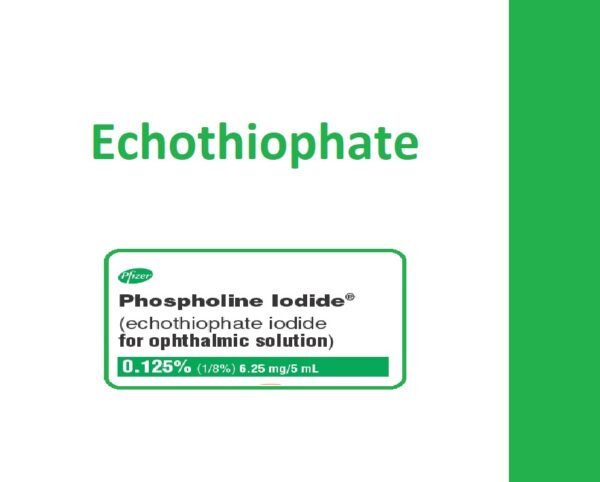
Echothiophate is a topically used long-acting cholinesterase inhibitor that is indicated for the treatment of patients with accommodative esotropia and chronic glaucoma.
Echothiophate Uses:
-
Accommodative esotropia:
- Accommodative component of concomitant esotropias.
-
Elevated intraocular pressure:
- It reduces elevated intraocular pressure.
Echothiophate Dose in Adults
Echothiophate Dose in elevated intraocular pressure: Ophthalmic:
- Initial: Instill one drop twice daily, in the morning and before sleeping, in the affected eye.
- Maintenance:
- The preferable dose is twice daily but a significant result has also been seen with a once-daily dose.
- Also, alternate doses with 1 dose prior to sleeping has been used as a treatment regimen.
Echothiophate Dose in Childrens
Echothiophate Dose in accommodative Esotropia:
-
Children and Adolescents: Ophthalmic:
- Diagnosis: Instill 1 drop once daily into both eyes before sleeping for 2-3 then taper off the dose.
- Maximum daily dose:
- 1 drop once daily in both eyes.
- Note:
- Use a lower therapeutic dose.
- The dose can be increased according to the severity of the disease.
Echothiophate Pregnancy Risk Category: C
- Studies on animal reproduction have not been done.
Use of echothiophate while breastfeeding
- It is unknown if Ecothiophate is secreted in breast milk.
- It is up to the mother to decide if it should be given to breastfeeding mothers.
- It all depends on the severity and importance of the drug for the mother's treatment.
Dose in Kidney Disease:
- There are no dosage adjustments provided in the manufacturer's labeling.
Dose in Liver disease:
- There are no dosage adjustments provided in the manufacturer's labeling.
Side effects of Echothiophate.
-
Cardiovascular:
- Bradycardia
- Cardiac Abnormality
- Flushing
- Hypotension
-
Central Nervous System:
- Brow Ache
- Myasthenia
-
Dermatologic:
- Diaphoresis
-
Gastrointestinal:
- Diarrhea
- Nausea
- Vomiting
-
Ophthalmic:
- Blepharospasm
- Blurred Vision
- Burning Sensation Of Eyes
- Cataract
- Conjunctival Abnormalities (Thickening)
- Conjunctival Erythema
- Eye Redness
- Increased Intraocular Pressure (Paradoxical)
- Iris Cyst
- Iritis (Latent)
- Lacrimal Duct Obstruction (Nasolacrimal Canal)
- Lacrimation
- Miosis
- Myopia
- Retinal Detachment
- Stinging Of Eyes
- Uveitis (Activation)
-
Respiratory:
- Dyspnea
Contraindications to Echothiophate:
- Any allergic reaction to the drug's formulation.
- Angle-closure Glaucoma is not possible without iridectomy. This is due to active inflammation and increasing angle block.
Warnings and precautions
-
Cardiac irregularities
- If you experience cardiac irregularities, discontinue use permanently
-
Cholinergic effects
- Do not take cholinergic activity symptoms (eg, urine incontinence, sweating or salivation) and discontinue use.
- Overdosage can mimic myasthenia gravis, which should be recognized.
-
Asthma
- Patients with asthma should not use this product.
-
Cardiovascular disease
- Patients with recent MI, bradycardia, or hypotension should not use this medication.
- According to the American Heart Association's scientific statement, ophthalmic cholesterol agents may increase myocardial dysfunction.
-
Gastrointestinal Disease:
- Patients with GIT disorders, e.g peptic ulcer, are not recommended.
-
Parkinsonism
- Patients with Parkinsonism should not use this product.
-
Seizure disorder:
- Patients with seizure history or epilepsy are not recommended.
-
Vagotonia
- Patients with vagotonia should not use this product.
Echothiophate: Drug Interaction
Note: Drug Interaction Categories:
- Risk Factor C: Monitor When Using Combination
- Risk Factor D: Consider Treatment Modification
- Risk Factor X: Avoid Concomitant Use
Risk Factor C (Monitor therapy). |
|
| Cyclopentolate | Echothiophate Iodide may have a less therapeutic effect. |
| Mivacurium | Echothiophate Iodide can increase serum levels of Mivacurium |
Risk Factor D (Consider therapy modifications) |
|
| Succinylcholine | Echothiophate iodide can increase the serum level of succinylcholine. Management: For patients receiving echothiophate iodide eye drops, consider using a neuromuscular-blocking agents other than succinylcholine. Consider a lower dose of succinylcholine and keep an eye out for prolonged or enhanced effects. |
Monitoring parameters:
- When treating esotropias routine lens examination is required.
- It is important to measure the anterior chamber angle and intraocular pressure at different times of the day.
How to administer Echothiophate?
Ophthalmic:
- Efficacy depends on the proper way of administration.
- After instilling the drops compress the nasolacrimal duct for 1-2 mins. Remove excess fluid by using a napkin or tissue after instillation.
Mechanism of action of Echothiophate:
- Inhibition of cholinesterase increases the activity of endogenous Acetylcholine.
- An increase in the destruction acetylcholine results in stimulation of theciliary muscle, which produces miosis.
- Other effects include potentiation and an increased aqueous humor flow that causes a decrease intraocular pressure.
The beginning of action:
- Miosis: ≤60 minutes
Peak effect: Intraocular pressure decrease:
- After 24 hours
Duration:
- Miosis: 1 to 4 weeks;
- Intraocular pressure: Days to weeks.
International Brand Names of Echothiophate:
- Phospholine Iodide
- Phospholine Jodide
- Phospholinjodid
Echothiophate Brand Names in Pakistan:
No Brands Available in Pakistan.
.png)


