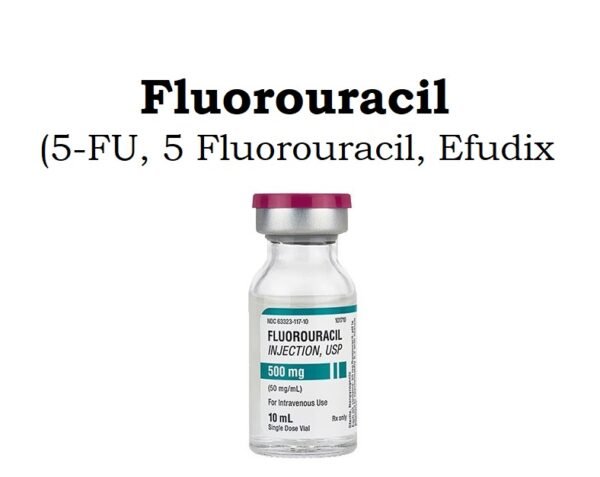
Fluorouracil (5-FU or 5 Fluorouracil, Efudix, Adrucil) is classified as an antimetabolite. It is a cytotoxic chemotherapeutic drug used to treat a variety of cancers.
Indications of 5 Fluorouracil:
-
Breast cancer:
- It is indicated for the management of breast carcinoma.
-
Colon and rectal cancer:
- Fluorouracil is used in the treatment of colon and rectal cancer.
-
Gastric cancer:
- Malignancies of the stomach can be treated by fluorouracil.
-
Pancreatic cancer:
- It is used for the management of pancreatic malignancy.
-
Off Label Use of 5 Fluorouracil in Adults:
- Anal carcinoma
- Bladder cancer
- Cervical cancer
- Advanced esophageal cancer
- Glaucoma surgery (adjunctive therapy)
- Head and neck cancer
- Advanced Hepatobiliary cancers
- Pancreatic Neuroendocrine tumors
- Advanced Penile squamous cell cancer
- Unknown primary squamous cell cancer
- Advanced Vulvar cancer
5 Fluorouracil dose in adults:
5 Fluorouracil dose in the treatment of Breast cancer:
-
CEF or FEC regimen:
- 500 mg/m² I/V on days 1 and 8 every 28 days (concurrently with cyclophosphamide and epirubicin) for 6 cycles.
-
CMF regimen:
- 600 mg/m² I/V on days 1 and 8 every 28 days (in combination with cyclophosphamide and methotrexate) for 6 cycles.
-
CAF or FAC regimen (off-label dosing):
- 500 mg/m² I/V on days 1 and 8 every 21 to 28 days (in combination with cyclophosphamide and doxorubicin) for 6 cycles.
5 Fluorouracil dose in the treatment of colorectal cancer:
- 400 mg/m² I/V bolus on day 1, followed by 1,200 to 1,500 mg/m²/day continuous infusion for 2 days (over 46 hours) every 2 weeks (in combination with leucovorin ± either oxaliplatin or irinotecan) or
-
Roswell Park regimen:
- 500 mg/m² I/V (bolus) on days 1, 8, 15, 22, 29, and 36 (1 hour after the start of leucovorin) every 8 weeks (in combination with leucovorin) for 4 cycles.
-
FOLFOX6 and mFOLFOX6 regimen:
- 400 mg/m² IV bolus on day 1, followed by 1,200 mg/m² /day continuous infusion for 2 days (over 46 hours) every 2 weeks (in combination with leucovorin and oxaliplatin) until disease progression or unacceptable toxicity occurs.
-
FOLFIRI regimen:
- 400 mg/m² I/V bolus on day 1, followed by 1,200 mg/m² /day continuous infusion for 2 days (over 46 hours) every 2 weeks (in combination with leucovorin and irinotecan) until disease progression or unacceptable toxicity occurs;
- after 2 cycles, may increase continuous infusion fluorouracil dose to 1,500 mg/m²/day (over 46 hours).
-
FLOX regimen (off-label dosing) :
- 500 mg/m² I/V bolus on days 1, 8, 15, 22, 29, and 36 (1 hour after the start of leucovorin) every 8 weeks (in combination with leucovorin and oxaliplatin) for 3 cycles.
5 Fluorouracil dose in the treatment of Gastric cancer:
- 200 to 1,000 mg/m² /day I/V as a continuous infusion over 24 hours (as part of a platinum-containing regimen);
- the duration and frequency of each cycle vary based on the dose and regimen.
-
CF regimen:
- 1,000 mg/m² /day I/V continuous infusion days 1 to 4 and days 29 to 32 of a 35-day treatment cycle (preoperative chemoradiation; in combination with cisplatin).
-
ECF regimen (resectable disease):
- 200 mg/m² /day I/V continuous infusion days 1 to 21 every 3 weeks (in combination with epirubicin and cisplatin) for 6 cycles (3 cycles preoperatively and 3 cycles postoperatively).
-
ECF or EOF regimen (advanced disease):
- 200 mg/m² /day I/V continuous infusion days 1 to 21 every 3 weeks (in combination with epirubicin and either cisplatin or oxaliplatin) for a planned duration of 24 weeks.
-
TCF or DCF regimen:
-
ToGA regimen (HER2-positive):
- 800 mg/m²/day I/V continuous infusion days 1 to 5 every 3 weeks (in combination with cisplatin and trastuzumab) until disease progression or unacceptable toxicity occurs.
5 Fluorouracil dose in the treatment of Pancreatic cancer:
-
Metastatic disease:
-
FOLFIRINOX regimen:
- 400 mg/m² I/V bolus on day 1, followed by 1,200 mg/m² /day continuous infusion for 2 days (over 46 hours) every 14 days (in combination with leucovorin, irinotecan, and oxaliplatin) until disease progression or unacceptable toxicity occurs for a recommended 12 cycles.
-
-
Adjuvant therapy (following complete resection):
-
mFOLFIRINOX regimen:
- 2,400 mg/m² I/V as a continuous infusion over 46 hours every 14 days (in combination with leucovorin, irinotecan, and oxaliplatin) for 24 weeks.
-
-
Chemoradiation therapy (off-label dosing):
- 250 mg/m²/day I/V continuous infusion for 3 weeks prior to and then throughout radiation therapy.
-
Fluorouracil-Leucovorin (off-label dosing):
- 425 mg/m² /day I/V (bolus) days 1 to 5 every 28 days (in combination with leucovorin) for 6 cycles.
5 Fluorouracil dose in the treatment of Anal carcinoma (off-label):
- 1,000 mg/m²/day I/V continuous infusion days 1 to 4 and days 29 to 32 (in combination with mitomycin and radiation therapy).
5 Fluorouracil dose in the treatment of Bladder cancer (off-label):
- 500 mg/m² /day I/V continuous infusion during radiation therapy fractions 1 to 5 and 16 to 20 (in combination with mitomycin and radiation therapy).
5 Fluorouracil dose in the treatment of Cervical cancer (off-label):
- 1,000 mg/m² /day I/V continuous infusion days 1 to 4 (in combination with cisplatin and radiation therapy) every 3 weeks for 3 cycles.
5 Fluorouracil dose in the treatment of Esophageal cancer (off-label):
-
CF regimen:
- 1,000 mg/m²/day I/V continuous infusion days 1 to 4 and days 29 to 32 of a 35-day treatment cycle (preoperative chemoradiation; in combination with cisplatin).
-
ECF regimen (resectable disease):
- 200 mg/m² /day I/V continuous infusion days 1 to 21 every 3 weeks (in combination with epirubicin and cisplatin) for 6 cycles (3 cycles preoperatively and 3 cycles postoperatively).
-
ECF or EOF regimen (advanced disease):
- 200 mg/m²/day I/V continuous infusion days 1 to 21 every 3 weeks (in combination with epirubicin and either cisplatin or oxaliplatin) for a planned duration of 24 weeks.
-
MCF regimen:
- 300 mg/m² /day I/V continuous infusion for up to 6 months (in combination with mitomycin and cisplatin).
-
TCF or DCF regimen:
5 Fluorouracil dose in the treatment of Glaucoma surgery, adjunctive therapy (off-label): Ophthalmic:
-
Intraoperative topical application:
- Apply sponge soaked in fluorouracil 50 mg/mL for 5 minutes. Additional data may be necessary to further define the role of fluorouracil in glaucoma surgery.
-
Postoperative subconjunctival injection:
- 5 mg once daily for 10 days or 5 mg once daily for 1 week, then every other day the next week for a total of 10 doses.
- Additional data may be necessary to further define the role of fluorouracil in glaucoma surgery.
5 Fluorouracil dose in the treatment of squamous cell cancer of the head and neck (off-label):
-
Platinum-Fluorouracil (CF) regimen:
- 1,000 mg/m² /day I/V continuous infusion days 1 to 4 every 3 weeks (in combination with cisplatin) for at least 6 cycles or
- 1,000 mg/m² /day continuous infusion days 1 to 4 every 4 weeks (in combination with carboplatin) or
- 600 mg/m²/day continuous infusion days 1 to 4, 22 to 25, and 43 to 46 (in combination with carboplatin and radiation).
-
TPF regimen:
- 1,000 mg/m² /day continuous infusion days 1 to 4 every 3 weeks (in combination with docetaxel and cisplatin) for 3 cycles, and
- followed by chemoradiotherapy or 750 mg/m² /day continuous infusion days 1 to 5 every 3 weeks (in combination with docetaxel and cisplatin) for up to 4 cycles, followed by radiation in patients without progressive disease.
-
Platinum, 5-FU, and cetuximab regimen:
- 1,000 mg/m² /day continuous infusion days 1 to 4 every 3 weeks (in combination with cetuximab and either cisplatin or carboplatin) for a total of up to 6 cycles.
5 Fluorouracil dose in the treatment of Hepatobiliary cancer (off-label):
- 600 mg/m² (bolus) I/V on days 1, 8, and 15 every 4 weeks (in combination with gemcitabine and leucovorin).
- Additional data may be needed to further define the role of fluorouracil in this condition.
5 Fluorouracil dose in the treatment of pancreatic Neuroendocrine tumors (off-label):
- 400 mg/m² /day I/V (bolus) days 1 to 5 every 28 days (in combination with doxorubicin and streptozocin) for at least 4 cycles and until disease progression or unacceptable toxicity occurs.
- Additional data may be necessary to further define the role of fluorouracil in the management of this condition.
5 Fluorouracil dose in the treatment of advanced Penile squamous cell cancer (off-label):
- 800 to 1,000 mg/m² /day I/V continuous infusion for 4 days every 21 days (in combination with cisplatin).
- Additional data may be needed to further define the role of fluorouracil in this condition.
5 Fluorouracil dose in the treatment of Unknown primary squamous cell cancer (off-label):
- 750 mg/m²/day as a continuous intravenous infusion for 5 days every 21 days (in combination with docetaxel and cisplatin) for 3 cycles or
- 500 mg/m² /day continuous infusion for 5 days every 21 days (in combination with paclitaxel and cisplatin) for 3 cycles or
- 400 mg/m² bolus on day 1 followed by 1,200 mg/m²/day continuous infusion for 2 days (over 46 hours) every 2 weeks (in combination with leucovorin and oxaliplatin) or
- 700 mg/m²/day continuous infusion for 5 days (in combination with cisplatin) every 28 days until disease progression or unacceptable toxicity occurs.
- Additional data may be needed to further define the role of fluorouracil in this condition.
5 Fluorouracil dose in the treatment of advanced Vulvar cancer, (off-label):
- 750 mg/m²/day I/V continuous infusion days 1 to 5 every 14 days for 2 cycles (in combination with concomitant radiation and mitomycin).
- Additional data may be needed to further define the role of fluorouracil in this condition.
5 Fluorouracil dose in children:
Note: Dose, frequency, number of doses, and/or start date may vary by protocol and treatment phase. Refer to individual protocols.
5 Fluorouracil dose in the treatment of Hepatoblastoma:
-
- 600 mg/m²/dose I/V every 3 weeks on day 2 or 3 (in combination with cisplatin, vincristine ± doxorubicin).
5 Fluorouracil dose in the treatment of Nasopharyngeal carcinoma:
Children ≥8 years and Adolescents:
-
- Continuous IV infusion:
- 1,000 mg/m² /day for 3 to 5 days every 3 to 4 weeks for 3 to 4 cycles (in combination with other chemotherapy agents).
- Continuous IV infusion:
5 Fluorouracil Pregnancy Risk Factor D
- Studies on animal reproduction revealed that there were adverse effects, including higher resorptions as well as teratogenicity.
- According to the labeling of the manufacturer, fluorouracil can cause fetal harm if given during pregnancy.
- Females of childbearing potential and male patients with female partners should use effective contraception during therapy, and for 3 months following completion.
- The first trimester should be avoided after 35 weeks gestation or 3 weeks before the planned delivery.
- Breast malignancy can be treated with chemotherapy during pregnancy. Common regimens include epirubicin, doxorubicin, cyclophosphamide and fluorouracil.
- Guidelines for treatment and follow-up for cancer in pregnancy have been published by the European Society for Medical Oncology.
- These guidelines recommend that you refer to a cancer center during pregnancy. They also encourage the use of a multidisciplinary team (oncologist, neonatologist, and obstetrician).
- It is not recommended to use chemotherapy during the first trimester of pregnancy or after 33 weeks.
- Between the last dose of chemotherapy and delivery, there should be at least three weeks.
- Female and male fertility can be affected by fluorouracil therapy.
Use 5 Fluorouracil during breastfeeding
- It is unknown if breast milk secretes fluorouracil.
- The manufacturer suggests that the mother decide whether to stop breastfeeding or discontinue fluorouracil because of the possibility of serious adverse reactions in her infant. This decision will depend on the importance to the mother.
5 Fluorouracil Dose adjustment in renal disease:
- There are no dosage adjustments provided in the manufacturer's labeling, use with caution.
-
The following adjustments have been suggested:
-
CrCl <50 mL/minute and continuous renal replacement therapy (CRRT):
- No dosage adjustment necessary.
-
Hemodialysis:
- Administer standard dose following hemodialysis on dialysis days.
- 50% reduced dose to be given following hemodialysis.
-
5 Fluorouracil Dose adjustment in liver disease:
- There are no dosage adjustments provided in the manufacturer’s labeling, use with caution.
-
The following adjustments have been suggested:
- Bilirubin >5 mg/dL:
- Avoid use.
- Hepatic impairment (degree not specified):
- Administer <50% of dose, then increase if toxicity does not occur.
- Bilirubin >5 mg/dL:
Side effects of 5 Fluorouracil
Toxicity depends on the duration of treatment and/or rate of administration.
-
Cardiovascular:
- Angina Pectoris
- Cardiac Arrhythmia
- Cardiac Failure
- Cerebrovascular Accident
- Ischemic Heart Disease
- Local Thrombophlebitis
- Myocardial Infarction
- Vasospasm
- Ventricular Ectopy
-
Central Nervous System:
- Cerebellar Syndrome (Acute)
- Confusion
- Disorientation
- Euphoria
- Headache
-
Dermatologic:
- Alopecia
- Changes In Nails (Including Nail Loss)
- Dermatitis
- Hyperpigmentation (Supravenous)
- Maculopapular Rash (Pruritic)
- Palmar-Plantar Erythrodysesthesia
- Skin Fissure
- Skin Photosensitivity
- Stevens-Johnson Syndrome
- Toxic Epidermal Necrolysis
- Xeroderma
-
Gastrointestinal:
- Anorexia
- Diarrhea
- Esophagopharyngitis
- Gastrointestinal Hemorrhage
- Gastrointestinal Ulcer
- Mesenteric Ischemia (Acute)
- Nausea
- Stomatitis
- Tissue Sloughing (Gastrointestinal)
- Vomiting
-
Hematologic & Oncologic:
- Agranulocytosis
- Anemia
- Leukopenia (Nadir: Days 9 To 14; Recovery By Day 30)
- Pancytopenia
- Thrombocytopenia
-
Hypersensitivity:
- Anaphylaxis
- Hypersensitivity Reaction (Generalized)
-
Ophthalmic:
- Lacrimal Stenosis
- Lacrimation
- Nystagmus
- Photophobia
- Visual Disturbance
-
Respiratory:
- Epistaxis
Contraindications to Injection 5 Fluorouracil:
- The US labeling of the manufacturer does not list any contraindications.
Canadian labeling
- Fluorouracil and any component of the formulation may cause hypersensitivity.
- Radiotherapy or any other anticancer treatment can cause bone marrow suppression
- Inadequate nutrition
- Patients with disabilities
- Infections that can cause death
Warnings and precautions
-
Suppression of bone marrow
- Fluorouracil therapy can cause bone marrow failure (neutropenia and thrombocytopenia) which is usually seen within 9 to 14 days.
- Before each treatment cycle begins, blood counts should be checked weekly, if the treatment is administered on a weekly basis, or as clinically indicated.
- If grade 4 hematologic toxicemia is suspected, treatment should be stopped and restarted only if blood counts return to normal.
-
Cardiotoxicity
- Fluorouracil can cause cardiotoxicity, including angina, MI/ischemia and arrhythmia.
- In such cases, therapy should be withheld.
- Pre-existing coronary artery disease or continuous infusion administration can increase the risk.
- Patients with resolved cardiotoxicity are not at risk of fluorouracil resumption.
- Fluorouracil may cause reversible myocardial toxicities or worsen underlying myocardial dysfunction, according to AHA.
-
Toxicity to the GI:
- Fluorouracil therapy can cause severe diarrhea.
- Patients with diarrhea of grade 3 or 4, should not be treated. Therapy should be stopped and resumed when the diarrhea has resolved.
- It is important to provide support, including fluids, electrolyte substitution, and/or antidiarrheal treatment.
- Fluorouracil may cause mucositis, tomatitis, and mucosal sloughing, ulceration, as well as stomatitis. Mucositis is more common with I/V Bolus Therapy.
- Therapy should be stopped for patients suffering from grade 3 or 4, mucositis. Once the condition has resolved, you can resume therapy at a lower dose.
-
Hand-foot syndrome
- Fluorouracil can cause palmar-plantar epilepsy (hand-foot syndrome, HFS), which presents with pain, swelling and tingling sensations.
- It is more common with continuous infusions and more frequent in patients who have had prior chemotherapy.
- HFS usually occurs after fluorouracil treatment for 8 to 9 weeks, but it can occur earlier.
- Therapy should be stopped with grade 2 or 3, and resume at a lower dose after HFS resolves to grade 1.
-
Hyperammonemic Encephalopathy:
- Fluorouracil can treat hyperammonemicencephalopathy without a liver disease or other identifiable cause. It can present with altered mental status and confusion, disorientation, ataxia or coma within 72 hours after infusion.
- Therapy should not be continued and ammonia-lowering therapy should instead be used.
- There are no known risks to patients with hyperammonemic or resolved hyperammonemic seizures from taking fluorouracil again.
-
Neurotoxicity:
- Therapy can be used to treat neurologic toxicity. This includes acute cerebellar syndrome, as well as other neurologic events that present with confusion, disorientation and ataxia.
- In such circumstances, THerapy should not be used.
- We don't have enough data to determine the risk of fluorouracil being reintroduced in patients with neurologic toxicity.
-
Deficiency in dihydropyrimidine hydrogenase
- Fluorouracil therapy can cause toxic reactions in patients who have selected homozygous and compound heterozygous mutations in dihydropyrimidine-dehydrogenase.
- Patients with partial DPD activity may also be at greater risk for adverse reactions from fluorouracil.
- Based on the clinical assessment of toxicology onset, duration and severity, therapy should be stopped or withheld. There may also be evidence of severe or acute early-onset toxicity. This could indicate a near complete absence or partial absence of DPD activity.
- Patients with DPD activity that is less than 100% are not safe. Data are inadequate to recommend a dose for patients with partial DPD.
Monitoring parameters:
- CBC with differential and platelet count (prior to each treatment cycle, weekly if administered on a weekly or similar schedule, and as clinically indicated)
- Prothrombin time (in patients receiving concomitant coumarin-derivative anticoagulants), INR
- LFTs
- RFTs
- Cardiotoxicity
- CNS toxicity
- Signs/symptoms of palmar-plantar erythrodysesthesia syndrome, stomatitis, diarrhea, and hyperammonemic encephalopathy.
How to administer 5 Fluorouracil?
IV:
- The IV administration rate is dependent on the protocol. Refer to the specific reference for the protocol.
- You can give it by IV push, IV Bolus, or as continuous infusion.
- Extravasation of 5 Fluorouracil, which can be irritating, should be avoided.
Ophthalmic (off label route)
- Intraoperative topical application
- For 5 minutes, fluorouracil-saturated spongies should be applied to the surgical area of glaucoma surgery.
- Subconjunctival injections after surgery were given 90 to 180 degrees from the surgical site.
Mechanism of action of 5 Fluorouracil:
- 5 Fluorouracil, an antimetabolite of pyrimidine analogs, interferes with DNA and RNA formation.
- It activates to F-UMP (an activite), which is incorporated into RNA in order to replace uracil.
- This results in inhibition of cell growth.
- The active metabolite F–dUMP causes thymidylate synthesise inhibition, leading to the depletion thymidine triphosphate, which is a vital component of DNA synthesis.
Distribution:
- Fluorouracil is distributed throughout the body including brain tissue, CSF and bone marrow.
Metabolism:
- Hepatic via a dehydrogenase enzyme. FU must then be metabolized to create active metabolites, 5-fluoroxyuridine monophosphate (5-FU-UMP) or 5-5-5-fluoro-2’-deoxyuridine-5’-Omonophosphate (5-F-dUMP).
Half-life elimination:
- Following bolus infusion: 8 to 20 minutes
Excretion:
- Urine (5% to 20% as unchanged drug within 6 hours; metabolites over 3 to 4 hours).
International Brands of Fluorouracil:
- Adrucil
- 5-Fluril
- 5-FU
- Agicil
- Curacil
- Fivoflu
- Flonida
- Fluonco
- Flurablastin
- Fluracedyl
- Fluroblastin
- Fluroblastine
- Fluroxan
- Fu Ke
- La-Fu
- Pharmauracil
- Raciwel
- Ribofluor
- Sinofuan Implant
- Triosules
- Utoral
5 Fluorouracil Brand Names in Pakistan:
Fluorouracil Injection 25 mg/ml |
|
| Pharmauracil | Pharmedic (Pvt) Ltd. |
Fluorouracil Injection 50 mg/ml |
|
| 5-Fu | Highnoon Laboratories Ltd. |
| Curacil | Shafaz Pharma International (Pvt) Ltd. |
| Fluorouracil | Atco Laboratories Limited |
| Fluracil | Bio Pharma |
| Secouracil | S. Ejazuddin & Company |
| Utoral | Al-Habib Pharmaceuticals. |
Fluorouracil Injection 100 mg/ml |
|
| Fluorouracil | Atco Laboratories Limited |
Fluorouracil Injection 250 mg/ml |
|
| Fivuflu | Atco Laboratories Limited |
Fluorouracil Injection 500 mg/ml |
|
| Fivuflu | Atco Laboratories Limited |
.png)