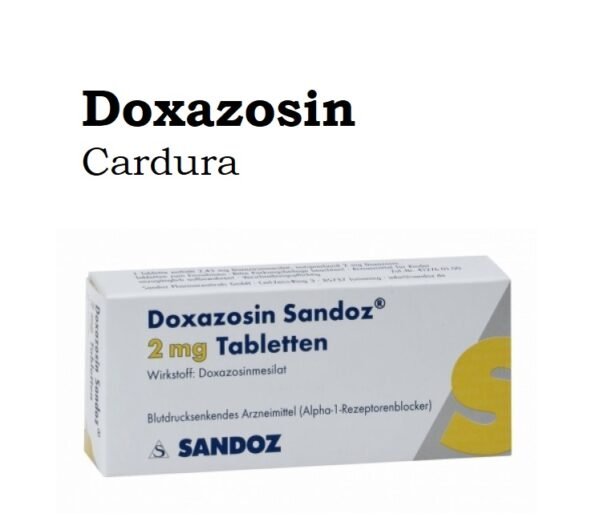
Doxazosin (Cardura) is an alpha-1 adrenergic receptor blocker that is used to treat patients with symptoms of BPH (benign prostatic hyperplasia) and hypertension.
Doxazosin (Cardura) Uses:
-
Benign prostatic hyperplasia:
- For signs and symptoms of benign prostatic hyperplasia (BPH).
-
Hypertension (immediate-release only):
- Management of hypertension.
- Note: Alpha-blockers are not recommended as first-line therapy.
-
Off Label Use of Doxazosin in Adults:
- Ureteral calculi (distal)
Adult dose:
Doxazosin (Cardura) Dose in the treatment of BPH: Oral:
-
Immediate-release tablets:
- Initial: 1 mg once a day; may titrate (by doubling the daily dose [eg, to 2 mg, then 4 mg, then 8 mg]) at 1- to 2-week intervals up to 8 mg once a day based on patient response and tolerability (maximum: 8 mg/day).
-
Re-initiation of therapy:
- If therapy is discontinued for a few days, re-initiate at 1 mg dose and titrate using the initial dosing regimen.
-
Extended-release tablets:
- 4 mg once a day;
- may titrate based on response and tolerability every 3 to 4 weeks to 8 mg once a day (maximum: 8 mg/day).
-
Re-initiation of therapy:
- If therapy is discontinued for several days, re-initiate at 4 mg dose and titrate using the initial dosing regimen.
Note:
-
Conversion to extended-release from the immediate-release:
- Do not take the final evening dose of immediate-release before starting morning dosing with the extended-release product;
- initiate the extended-release product using 4 mg once a day.
Doxazosin (Cardura) dose as an alternative agent in the treatment of Hypertension: Oral:
-
Immediate-release:
- Initial: 1 mg once a day;
- titrate as needed based on patient response up to a dose of 16 mg once a day;
- maximum dose: 16 mg/day.
-
Re-initiation of therapy:
- If therapy is discontinued for several days, re-initiate at 1 mg dose and titrate using the initial dosing regimen.
Doxazosin (Cardura) Dose in the treatment of Distal Ureteral calculi expulsion (off-label): Oral:
-
Immediate release:
- 4 mg once a day in the evening.
- Note: Patients with stones >10 mm were excluded from studies.
Dose in children:
- Note: If the drug is discontinued for more than several days, re-initiate with initial dose and titrate as needed.
Doxazosin (Cardura) Dose in the treatment of Dysfunctional voiding:
-
Children ≥3 years and Adolescents: Oral:
- Immediate release:
- Initial: 0.5 mg once every day at bedtime; some trials continued with a fixed-dose; others titrated at weekly or biweekly intervals to effect as tolerated (maximum daily dose: 2 mg/day).
- In some trials, a larger initial dose (1 mg/day) was used in patients whose weight >40 to 50 kg.
- Immediate release:
Doxazosin (Cardura) Dose in the treatment of Hypertension:
-
Children and Adolescents: Oral:
- Immediate release:
- Initial: 1 mg/day;
- The maximum daily dose: 4 mg/day
- Immediate release:
Pregnancy Risk Category: C
- In some studies on animal reproduction, adverse events were reported.
- Doxazosin crosses over the placenta (Versmissen 2016,
- Chronic maternal hypertension, if not treated, can lead to adverse outcomes in the infant, mother, and fetus.
- Other agents are preferred if hypertension is a concern during pregnancy.
Doxazosin use during breastfeeding:
- Breast milk contains doxazosin. A single case report describing a maternal dose (doxazosin 4mg every 24 hours) of doxazosin for two doses is available.
- Samples of milk were taken at different times over 24 hours starting approximately 17 hours after the first dose.
- The maternal serum samples were taken at the same time as the father's, starting approximately one hour later.
- After the first dose, the highest levels of doxazosin in serum and milk were seen within one hour.
- The highest milk concentration (4.15 mg/L) was used to calculate the infant's estimated dose. It was 1% of weight-adjusted maternal dosage.
Renal dose:
Doxazosin (Cardura) Dose in Liver disease:
- There are no dosage adjustments provided in the drug manufacturer’s labeling (however, limited data suggest renal impairment does not significantly alter pharmacokinetic parameters).
Doxazosin (Cardura) Dose in Liver disease:
-
Mild to moderate impairment (Child-Pugh class A or B):
- There are no dosage adjustments provided in the drug manufacturer’s labeling;
- use with caution.
-
Severe impairment (Child-Pugh class C):
- Use is not recommended.
Common Side Effects of Doxazosin (Cardura):
-
Central nervous system:
- Dizziness
- Malaise
- Fatigue
- Headache
Less Common Side Effects of Doxazosin (Cardura):
-
Cardiovascular:
- Edema
- Hypotension
- Orthostatic Hypotension
- Cardiac Arrhythmia
- Facial Edema
- Flushing
- Palpitations
-
Central Nervous System:
- Drowsiness
- Vertigo
- Pain
- Anxiety
- Ataxia
- Hypertonia
- Insomnia
- Movement Disorder
- Myasthenia
-
Endocrine & Metabolic:
- Sexual Disorder
-
Gastrointestinal:
- Abdominal Pain
- Nausea
- Dyspepsia
- Xerostomia
-
Genitourinary:
- Urinary Incontinence
- Urinary Tract Infection
-
Neuromuscular & Skeletal:
- Weakness
- Muscle Cramps
- Myalgia
- Arthralgia
- Arthritis
-
Ophthalmic:
- Visual Disturbance
-
Otic:
- Tinnitus
-
Renal:
- Polyuria
-
Respiratory:
- Respiratory Tract Infection
- Rhinitis
- Dyspnea
- Epistaxis
Contraindications to Doxazosin:
- Hypersensitivity/Allergy to doxazosin, other quinazolines (eg, prazosin, terazosin), or any component of the formulation.
- Canadian labeling: Additional contraindications not in US labeling
- Galactose intolerance,
- The Lapp lactase defect, or
- glucose-galactose malabsorption.
Warnings and precautions
-
Allergy reactions:
- It can cause skin rash, urticaria and pruritus as well as respiratory symptoms such as angioedema and pruritus.
-
CNS depression:
- CNS depression can lead to mental or physical impairments.
- It is important to warn patients about tasks that require mental alertness, such as driving or operating machinery.
-
Floppy iris syndrome:
- Patients undergoing cataract surgery who had been previously treated with alpha-1 blocking drugs have shown intraoperative floppy-iris syndrome.
- There is no benefit to stopping alpha-blocker treatment before surgery.
- Modifications to surgical procedures may be necessary.
-
Hematologic effect
- There have been reports of a decrease in white blood cell count (WBC), and neutrophil count. WBC and neutrophil counts returned to normal following discontinuation.
-
Orthostatic hypotension, syncope
- Orthostatic hypotension or syncope may occur within hours of dosing.
- However, it is possible to experience the same effect after therapy has been stopped for a few more days or if another antihypertensive drug is introduced, such as a PDE-5 inhibitor or nitrates.
- Patients with orthostatic hypotension symptoms should be supervised.
-
Priapism
- Rarely, priapism was associated with drug use.
- For erections that last more than four hours, seek immediate medical attention.
-
Cardiovascular disease
- Patients with angina pectoris, heart failure, and recent acute myocardial injury (within the past 6 months) should be cautious.
- Stop using the medication if you experience angina pectoris symptoms or worsening.
- The American Heart Association has stated that doxazosin may be an agent that can exacerbate myocardial dysfunction.
-
Hepatic impairment
- Patients with mild or moderate impairment (Childugh class A/B) should be used with caution. Monitor blood pressure and look for signs of hypotension.
- Not recommended for severe impairment (Child Puugh class C).
-
Prostate cancer:
- Before starting therapy, make sure you rule out prostate cancer. There are many symptoms that can be similar to BPH.
Doxazosin: Drug Interaction
Note: Drug Interaction Categories:
- Risk Factor C: Monitor When Using Combination
- Risk Factor D: Consider Treatment Modification
- Risk Factor X: Avoid Concomitant Use
Risk Factor C (Monitor therapy). |
|
| Alpha-/Beta Agonists | Alpha1-Blockers could reduce the vasoconstricting effects of Alpha/BetaAgonists. Alpha-/Beta Agonists could also decrease Alpha1-Blocker vasodilation. |
| Alpha1-Agonists | Alpha1-Blockers could reduce the vasoconstricting effects of Alpha1-1-Agonists. Alpha1-Blocker vasodilation may also be affected by Alpha1-Agonists. |
| Amphetamines | May decrease the antihypertensive effects of Antihypertensive Drugs. |
| Antipsychotic Agents, Second Generation (Atypical) | Blood Pressure Lowering Agents can increase the hypotensive effects of Antipsychotic Agents (Second Gen [Atypical]). |
| Aprepitant | High risk of Inhibitors causing an increase in serum CYP3A4 Substrates concentrations |
| Barbiturates | Might increase the hypotensive effects of Blood Pressure Lowering Agents. |
| Benperidol | Might increase the hypotensive effects of Blood Pressure Lowering Agents. |
| Beta-Blockers | Alpha1-Blockers may increase orthostatic hypotensive effects. Ophthalmic products are less likely to be a risk than systemic ones. Levobunolol and Metipranolol are exceptions. |
| Bosentan | Could lower serum concentrations of CYP3A4 substrates (High Risk with Inducers). |
| Brigatinib | May decrease the antihypertensive effects of Antihypertensive Drugs. Brigatinib could increase the bradycardic effects of Antihypertensive Drugs. |
| Brimonidine (Topical) | Might increase the hypotensive effects of Blood Pressure Lowering Agents. |
| Calcium Channel Blockers | Alpha1-Blockers could increase the hypotensive effects of Calcium Channel Blockers. |
| Clofazimine | High risk of Inhibitors causing an increase in serum CYP3A4 Substrates concentrations |
| Moderate CYP3A4 Inducers | Could lower serum concentrations of CYP3A4 substrates (High Risk with Inducers). |
| Moderate CYP3A4 inhibitors | Might decrease metabolism of CYP3A4 substrates (High Risk with Inhibitors). |
| Dapoxetine | Alpha1-Blockers may increase the orthostatic hypotensive effects. |
| Deferasirox | Could lower serum concentrations of CYP3A4 substrates (High Risk with Inducers). |
| Dexmethylphenidate | Antihypertensive agents may have a less therapeutic effect. |
| Diazoxide | Might increase the hypotensive effects of Blood Pressure Lowering Agents. |
| DULoxetine | DULoxetine may increase hypotensive effects by lowering blood pressure. |
| Duvelisib | High risk of Inhibitors causing an increase in serum CYP3A4 Substrates concentrations |
| Erdafitinib | Could lower serum concentrations of CYP3A4 substrates (High Risk with Inducers). |
| Erdafitinib | High risk of Inhibitors causing an increase in serum CYP3A4 Substrates concentrations |
| Fosaprepitant | High risk of Inhibitors causing an increase in serum CYP3A4 Substrates concentrations |
| Fosnetupitant | High risk of Inhibitors causing an increase in serum CYP3A4 Substrates concentrations |
| Herbs (Hypertensive Properties) | May decrease the antihypertensive effects of Antihypertensive Drugs. |
| Herbs (Hypotensive properties) | Might increase the hypotensive effects of Blood Pressure Lowering Agents. |
| Hypotension-Associated Agents | Blood Pressure Lowering Agents may enhance the hypotensive effect of Hypotension-Associated Agents. |
| Ivosidenib | Could lower serum concentrations of CYP3A4 substrates (High Risk with Inducers). |
| Larotrectinib | High risk of Inhibitors causing an increase in serum CYP3A4 Substrates concentrations |
| Levodopa-Containing Products | Blood Pressure Lowering Agents can increase the hypotensive effects of Levodopa - Containing Products. |
| Lormetazepam | Might increase the hypotensive effects of Blood Pressure Lowering Agents. |
| Methylphenidate | May decrease the antihypertensive effects of Antihypertensive Drugs. |
| Molsidomine | Might increase the hypotensive effects of Blood Pressure Lowering Agents. |
| Netupitant | High risk of Inhibitors causing an increase in serum CYP3A4 Substrates concentrations |
| Nicorandil | Might increase the hypotensive effects of Blood Pressure Lowering Agents. |
| Nitroprusside | The hypotensive effects of Nitroprusside may be enhanced by blood pressure lowering agents. |
| Palbociclib | High risk of Inhibitors causing an increase in serum CYP3A4 Substrates concentrations |
| Pentoxifylline | Might increase the hypotensive effects of Blood Pressure Lowering Agents. |
| Pholcodine | Pholcodine may increase hypotensive effects by lowering blood pressure. |
| Prostacyclin Analogues | Might increase the hypotensive effects of Blood Pressure Lowering Agents. |
| Quinagolide | Might increase the hypotensive effects of Blood Pressure Lowering Agents. |
| Rilmenidine | Rilmenidine may have a hypotensive effect that Alpha1-Blockers might enhance. |
| Sarilumab | Could lower serum concentrations of CYP3A4 substrates (High Risk with Inducers). |
| Siltuximab | Could lower serum concentrations of CYP3A4 substrates (High Risk with Inducers). |
| Simeprevir | High risk of Inhibitors causing an increase in serum CYP3A4 Substrates concentrations |
| Tocilizumab | Could lower serum concentrations of CYP3A4 substrates (High Risk with Inducers). |
| Yohimbine | May decrease the antihypertensive effects of Antihypertensive Drugs. |
Risk Factor D (Regard therapy modification) |
|
| Amifostine | Amifostine's hypotensive effects may be enhanced by blood pressure lowering agents. Treatment: Blood pressure lowering drugs should be stopped 24 hours before amifostine administration. Amifostine should be avoided if blood pressure lowering medication cannot be withheld. |
| Strong CYP3A4 Inducers | May increase metabolism of CYP3A4 substrates (High Risk with Inducers). Management: You may consider a different drug to replace one of the interacting drugs. Some combinations might be contraindicated. Consult appropriate manufacturer labeling. |
| Strong CYP3A4 inhibitors | Might decrease metabolism of CYP3A4 substrates (High Risk with Inhibitors). |
| Dabrafenib | High risk of Inducers causing a decrease in serum CYP3A4 substrates. Management: If possible, seek alternatives to the CYP3A4 substrate. Concomitant therapy should be avoided if possible. Monitor the clinical effects of the substrate carefully (especially therapeutic effects). |
| Enzalutamide | High risk of Inducers causing a decrease in serum concentrations of CYP3A4 substrates. Management: Avoid concurrent use of enzalutamide and CYP3A4 substrates with a narrow therapeutic index. You should exercise caution when using enzalutamide or any other CYP3A4 sub-substance. |
| Lorlatinib | High risk of Inducers causing a decrease in serum concentrations of CYP3A4 substrates. Management: Do not use lorlatinib concurrently with any CYP3A4 Substrates. Even a slight decrease in serum concentrations could cause therapeutic failure or serious clinical consequences. |
| MiFEPRIStone | High risk of Inhibitors causing an increase in serum concentrations of CYP3A4 substrates. Management: Minimize doses of CYP3A4 substrates, and monitor for increased concentrations/toxicity, during and 2 weeks following treatment with mifepristone. Avoid dihydroergotamine and ergotamine. |
| Mitotane | High risk of Inducers causing a decrease in serum concentrations of CYP3A4 substrates. Treatment: Patients receiving mitotane may require significant adjustments in the dosage of CYP3A4 Substrates. |
| Obinutuzumab | This may increase the hypotensive effects of Blood Pressure Lowering Agents. Management: You may temporarily withhold blood pressure lowering medication beginning 12 hours before obinutuzumab injection and continuing for 1 hour after infusion. |
| Phosphodiesterase 5 Inhibitors | Alpha1-Blockers (Nonselective) may increase the hypotensive effects. Management: Before initiating any combination, ensure that the patient is stable on the first agent. Concurrent alpha 1-blockers should not be used when tadalafil treatment is being administered for BPH. |
| Pitolisant | High risk of Inducers causing a decrease in serum concentrations of CYP3A4 substrates Management: Avoid combining pitolisant and a CYP3A4 substrat with a low therapeutic index. Pitolisant should not be combined with other CYP3A4 sub-substances. |
| St John's Wort | High risk of Inducers causing a decrease in serum CYP3A4 Substrates. Management: You may consider a different drug to replace one of the interacting drugs. Some combinations might be contraindicated. Consult appropriate manufacturer labeling. |
| Stiripentol | High risk of Inhibitors causing an increase in serum concentrations of CYP3A4 substrates. Management: Avoid stiripentol use with CYP3A4 Substrates that have a narrow therapeutic Index. This is to avoid adverse effects and toxicities. Monitoring of any CYP3A4 substrate that is used with stiripentol should be closely done. |
Risk Factor X (Avoid Combination) |
|
| Alpha1-Blockers | This may increase the antihypertensive effects of Alpha1-Blockers. |
| Bromperidol | Bromperidol's hypotensive effects may be enhanced by Blood Pressure Lowering agents. Bromperidol could decrease the hypotensive effects of Blood Pressure Lowering agents. |
| Conivaptan | High risk of Inhibitors causing an increase in serum CYP3A4 Substrates concentrations |
| Fusidic Acid (Systemic). | High risk of Inhibitors causing an increase in serum CYP3A4 Substrates concentrations |
| Idelalisib | High risk of Inhibitors causing an increase in serum CYP3A4 Substrates concentrations |
Monitoring parameters:
- Regular checking of Blood pressure and for at least 6 hours following the initial dose and with each dose increase (standing and sitting/supine);
- monitor patients with mild-to-moderate impairment for symptoms of hypotension.
Hypertension: Follow The 2017 Guideline for the Prevention, Detection, Evaluation, and Management of High Blood Pressure in Adults:
- Confirmed hypertension and known CVD or 10-year ASCVD risk ≥10%:
- Keep Target blood pressure <130/80 mm Hg is recommended
- Confirmed hypertension without markers of increased ASCVD risk:
- Target blood pressure <130/80 mm Hg may be reasonable
How to administer Doxazosin (Cardura)?
Oral:
- Extended-release:
- Swallow tablets whole; do not crush, cut, chew, or divide. Administer with morning meal.
- Immediate-release:
- Administer daily dose either in the morning or evening.
Mechanism of action of Doxazosin (Cardura):
- Hypertension: Competitively inhibits postsynaptic Alpha-1 adrenergic receptors, which causes vasodilation and arterioles to dilate and decreases total peripheral resistance and blood pressure.
- It is about 50% as potent on a weight by weight basis as prazosin.
BPH:
- Competitively inhibits postsynaptic beta-1 adrenergic receptors within the bladder neck and prostatic stromal tissues.
- This decreases the sympathetic tone-induced stricture in the urethral tract that causes BPH symptoms.
Duration:
- >24 hours
Protein binding:
- ~98%
Metabolism:
- Extensively hepatic to active metabolites; primarily via CYP3A4; secondary pathways involve CYP2D6 and 2C9
Bioavailability:
- Immediate release: ~65%;
- Extended-release relative to immediate release: 54% to 59%
Half-life elimination:
- Immediate-release: ~22 hours;
- Extended-release: 15 to 19 hours
Time to peak, serum:
- Immediate-release: 2 to 3 hours;
- Extended-release: 8 ± 3.7 to 9 ± 4.7 hours
Excretion:
- Feces (~63%, primarily as metabolites [4.8% as unchanged]);
- urine (9%, primarily as metabolites)
International Brands of Doxazosin:
- Cardura
- Cardura XL
- APO-Doxazosin
- Cardura-1
- Cardura-2
- Cardura-4
- DOM-Doxazosin
- Doxazosin-1
- Doxazosin-2
- Doxazosin-4
- MYLAN-Doxazosin
- PMS-Doxazosin
- TEVA-Doxazosin
- Alfadil
- Alfadil XL
- Alfamedin
- Cadex
- Cadil
- Cadlin
- Cardenalin
- Cardolin-2
- Cardular
- Cardular PP
- Cardular Uro
- Cardura
- Cardura CR
- Cardura XL
- Cardura-XL S.R.
- Carduran
- Carduran Neo
- Carduran Retard
- Carduran XL
- Cazosin
- Curcard
- Dalgen
- Dedralen
- Diblocin
- Diblocin PP
- Diblocin Uro
- Doka
- Dophilin
- Dorbantil
- Dosabin
- Dosan
- Dosin
- Dovozin
- Doxaben
- Doxaben XL
- Doxacar
- Doxacard
- Doxacin
- Doxacor
- Doxagamma
- Doxan
- Doxane
- Doxatan
- Doxazone XL SR
- Doxino
- Doxolbran
- Genzosin
- Jutalar
- Kamiren
- Kamiren XL
- Kinxaben
- Maguran
- Magurol
- Mahurol
- Pencor
- Progandol
- Prostasin
- Pzocin XL
- Saxobin
- Supressin
- Tarzos
- Tensidox
- Tonocardin
- Tonokardin
- Uriduct
- Xadosin
- Xadosin XL
- Zoxan
- Zoxan LP
- Zoxon
Doxazosin Brand Names in Pakistan:
Doxazosin 2 mg Tablets |
|
| Carducin | Hamaz Pharmaceutical (Pvt) Ltd. |
| Cardura | Pfizer Laboratories Ltd. |
| Caydor | Caylex Pharmaceuticals (Pvt) Ltd. |
| Dozax | Wilshire Laboratories (Pvt) Ltd. |
| Oxiz | Noa Hemis Pharmaceuticals |
| Oxiz | Noa Hemis Pharmaceuticals |
| Proalpha | Obsons Pharmaceuticals |
| Prosdura | Epla Laboratories (Pvt) Ltd. |
| Uripas | Searle Pakistan (Pvt.) Ltd. |
Doxazosin 4 mg Tablets |
|
| Cardura | Pfizer Laboratories Ltd. |
| Caydor | Caylex Pharmaceuticals (Pvt) Ltd. |
| Dozax | Wilshire Laboratories (Pvt) Ltd. |
| Oxiz | Noa Hemis Pharmaceuticals |
| Uripas | Searle Pakistan (Pvt.) Ltd. |
.png)


