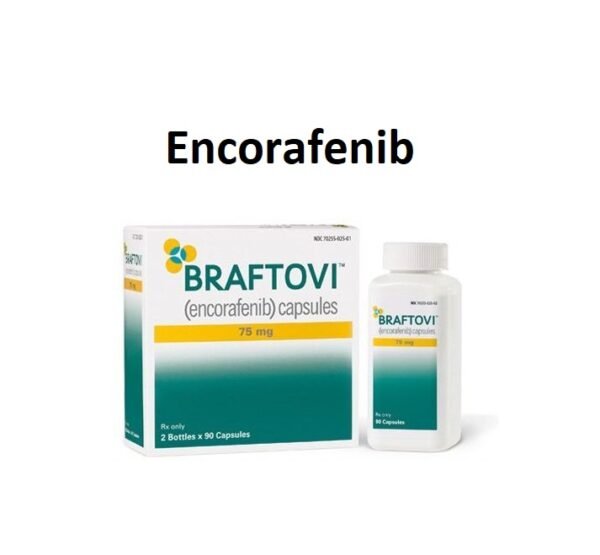
Encorafenib (Braftovi) is a targeted therapy for the treatment of patients with metastatic or unresectable melanoma. It targets cells with BRAF mutations and inhibits protein kinase B-RAF (BRAF). (see details in the section: Mechanism of action)
Encorafenib Uses:
-
Unresectable or metastatic melanoma:
- It is indicated in patients metastatic or unresectable melanoma with a BRAF V600E or V600K mutation (in combination with binimetinib)
- Limitations of use: Not used for wild-type BRAF melanoma.
Encorafenib (Braftovi) Dose in Adults
Note: Confirm BRAF V600 mutation status before starting therapy
Encorafenib (Braftovi) Dose in the treatment of unresectable or metastatic melanoma (with BRAF V600E or BRAF V600K mutation):
- Oral: 450 mg once a day (along with binimetinib).
-
Dosage adjustment for concomitant moderate or strong CYP3A4 inhibitors:
- Avoids its use with moderate or strong CYP3A4 inhibitors
- If it needs to be given reduce the dose as follows:
- Encorafenib plus strong CYP3A4 inhibitor:
- reduce the dose to one-third of the dose before concurrent use with a CYP3A4 inhibitor.
- Encorafenib plus moderate CYP3A4 inhibitor:
- reduce the dose to one-half of the dose before the concurrent use of a moderate CYP3A4 inhibitor.
- Encorafenib plus strong CYP3A4 inhibitor:
- After discontinuation of inhibitor for 3 - 5 half-lives, resume the encorafenib dose at normal dosage
-
Missed doses:
- Do not take a missed dose if <12 hours until the next dose.
- If the patient has an episode of vomiting after encorafenib administration, do not take an extra dose, take the next scheduled dose.
Dose in Children:
Not indicated.
Encorafenib Pregnancy Category: X
- Studies on animal reproduction show that the drug can cause fetal harm, so it is not recommended for use during pregnancy.
- Before you start the therapy, do a pregnancy test.
- Use a highly effective contraceptive during therapy, and at least two weeks thereafter
- It is not recommended to use hormonal contraceptives.
- It can cause male infertility.
Use Encorafenib while you are breastfeeding
- It is not known if it is present in breast milk.
- Breastfeeding infants may be at risk. Therapy is not recommended for them during or after 2 weeks.
Encorafenib (Braftovi) Dose in Kidney disease:
-
CrCl ≥30 mL/minute:
- No dosage adjustment required.
-
CrCl <30 mL/minute:
- No dose adjustments listed in the manufacturer's labeling.
-
Hemodialysis:
- It has extensive protein binding, and probably not dialyzable
Encorafenib (Braftovi) Dose in Liver disease:
-
Preexisting hepatic impairment:
- Mild impairment (Child-Pugh class A):
- No dosage adjustment required.
- Moderate to severe impairment (Child-Pugh class B or C):
- No dose adjustments listed in the manufacturer's labeling
- Mild impairment (Child-Pugh class A):
-
Hepatotoxicity during treatment:
- Grade 2 AST or ALT elevations:
- Continue encorafenib dose while monitoring
- If no improvement in 4 weeks, withhold encorafenib until improvement to mild elevation (≤ grade 1) or to pretreatment or baseline levels and then resume at the same dose.
- Grade 3 AST or ALT elevation:
- First time of grade 3 AST or ALT elevations, withhold encorafenib for 4 weeks while monitoring, if improves to mild elevations (≤ grade 1) or to pretreatment/baseline level, resume at a reduced dose. If no improvement, discontinue it permanently
- Recurrent grade 3 toxicity, permanently discontinuing encorafenib.
- Grade 4 AST or ALT elevation:
- The first occurrence of grade 4 AST or ALT elevations:
- Permanently discontinue or withhold for 4 weeks; if improves to mild elevations (≤ grade 1) or to pretreatment/baseline level, resume at a reduced dose. If no improvement, permanently discontinue it permanently.
- Recurrent grade 4 toxicity:
- permanently discontinue.
- The first occurrence of grade 4 AST or ALT elevations:
- Grade 2 AST or ALT elevations:
Incidences of adverse effects include those defined during combination therapy with binimetinib.
Common Side Effects of Encorafenib (Braftovi):
-
Central Nervous System:
- Fatigue
- Headache
- Dizziness
- Peripheral Neuropathy
-
Dermatologic:
- Hyperkeratosis
- Alopecia
- Palmar-Plantar Erythrodysesthesia
- Skin Rash
- Xeroderma
- Pruritus
- Dermatological Reaction
- Erythema
-
Endocrine & Metabolic:
- Increased Gamma-Glutamyl Transferase
- Hyperglycemia
- Hyponatremia
-
Gastrointestinal:
- Nausea
- Vomiting
- Abdominal Pain
- Constipation
- Dysgeusia
-
Hematologic & Oncologic:
- Anemia
- Hemorrhage
- Leukopenia
- Lymphocytopenia
- Neutropenia
-
Hepatic:
- Increased Serum Alanine Aminotransferase
- Increased Serum Aspartate Aminotransferase
- Increased Serum Alkaline Phosphatase
-
Neuromuscular & Skeletal:
- Arthralgia
- Myopathy
- Back Pain
- Limb Pain
-
Renal:
- Increased Serum Creatinine
-
Miscellaneous:
- Fever
Less Common Side Effects Of Encorafenib (Braftovi):
-
Central Nervous System:
- Facial Paresis
-
Dermatologic:
- Acneiform Eruption
-
Endocrine & Metabolic:
- Hypermagnesemia
-
Gastrointestinal:
- Pancreatitis
- Hematochezia
- Hemorrhoidal Bleeding
-
Hypersensitivity:
- Hypersensitivity
-
Hematologic & Oncologic:
- Squamous Cell Carcinoma Of Skin
- Malignant Melanoma
- Rectal Hemorrhage
- Keratoacanthoma
- Basal Cell Carcinoma
-
Neuromuscular & Skeletal:
- Panniculitis
-
Ophthalmic:
- Uveitis
Contraindications to Encorafenib (Braftovi):
There are no contraindications in the labeling.
Warnings and precautions
-
Dermatologic toxicities:
- Encorafenib has been linked to significant dermatologic toxicity (20%) in patients who have received it as a single agent.
- It is possible to have a lower risk of toxicity (2%) if it is used in combination with binimetinib.
-
Hemorrhage
- Combining it with binimetinib can lead to serious hemorhagic events.
- Hematochezia and rectal hemorhage are the most common hemorhagic manifestations.
- A fatal intracranial hemorhage has been reported in conjunction with brain metastasis.
-
Malignancy
- BRAF inhibitors, including encorafenib, can cause new primary malignancies, both cutaneously and non-cutaneous.
- CuSCC, also known as keratoacanthoma and basal cell carcinoma has been reported using encorafenib in combination with binimetinib or monotherapy.
- The median time it took for cuSCC/KA to manifest was 6 months, with an interval of 1 to 9 month.
- It is recommended that you have a dermatology evaluation done before starting treatment.
- This can be done every two months or up to six months after stopping therapy. Monitor for any signs or symptoms of non-cutaneous malignancies.
- For primary cutaneous malignancies, dose modification is not advised.
- Stop using encorafenib in the case of RAS mutation-positive, non-cutaneous malignancies.
-
Ocular toxicities:
- Ocular toxicities can lead to Uveitis. This includes iritis and iridocyclitis.
- Each visit should be monitored for ocular toxicities
- Recommendations for severe or new visual disturbances.
-
Extension of QT
- It can prolong the QTc interval in dose-dependent ways.
- Patients who are taking medications that have the potential to prolong QT or pose risk factors for QTc prolongation should be monitored.
- Before starting therapy, make sure you have corrected hypokalemia and hypomagnesemia.
Encorafenib: Drug Interaction
Note: Drug Interaction Categories:
- Risk Factor C: Monitor When Using Combination
- Risk Factor D: Consider Treatment Modification
- Risk Factor X: Avoid Concomitant Use
Risk Factor C (Monitor therapy) |
|
| Clofazimine | May increase the serum concentration of CYP3A4 Substrates (High risk with Inhibitors). |
| Deferasirox | May decrease the serum concentration of CYP3A4 Substrates (High risk with Inducers). |
| Erdafitinib | May decrease the serum concentration of CYP3A4 Substrates (High risk with Inducers). |
| Erdafitinib | May increase the serum concentration of CYP3A4 Substrates (High risk with Inhibitors). |
| Fosaprepitant | May increase the serum concentration of CYP3A4 Substrates (High risk with Inhibitors). |
| Haloperidol | QT-prolonging Kinase Inhibitors (Moderate Risk) may enhance the QTc-prolonging effect of Haloperidol. Management: Monitor for QTc interval prolongation and ventricular arrhythmias when these agents are combined. Patients with additional risk factors for QTc prolongation may be at even higher risk. |
| Larotrectinib | May increase the serum concentration of CYP3A4 Substrates (High risk with Inhibitors). |
| Ondansetron | May enhance the QTc-prolonging effect of QT-prolonging Kinase Inhibitors (Moderate Risk). Management: Monitor for QTc interval prolongation and ventricular arrhythmias when these agents are combined. Patients with additional risk factors for QTc prolongation may be at even higher risk. |
| Palbociclib | May increase the serum concentration of CYP3A4 Substrates (High risk with Inhibitors). |
| Pentamidine (Systemic) | May enhance the QTc-prolonging effect of QT-prolonging Kinase Inhibitors (Moderate Risk). Management: Monitor for QTc interval prolongation and ventricular arrhythmias when these agents are combined. Patients with additional risk factors for QTc prolongation may be at even higher risk. |
| QT-prolonging Antidepressants (Moderate Risk) | May enhance the QTc-prolonging effect of QTprolonging Kinase Inhibitors (Moderate Risk). Management: Monitor for QTc interval prolongation and ventricular arrhythmias when these agents are combined. Patients with additional risk factors for QTc prolongation may be at even higher risk. |
| QT-prolonging Antipsychotics (Moderate Risk) | May enhance the QTc-prolonging effect of QTprolonging Kinase Inhibitors (Moderate Risk). Management: Monitor for QTc interval prolongation and ventricular arrhythmias when these agents are combined. Patients with additional risk factors for QTc prolongation may be at even higher risk. Exceptions: Pimozide. |
| QT-prolonging Class IC Antiarrhythmics (Moderate Risk) | May enhance the QTc-prolonging effect of QT-prolonging Kinase Inhibitors (Moderate Risk). Management: Monitor for QTc interval prolongation and ventricular arrhythmias when these agents are combined. Patients with additional risk factors for QTc prolongation may be at even higher risk. |
| QT-prolonging Kinase Inhibitors (Moderate Risk) | May enhance the QTc-prolonging effect of other QT-prolonging Kinase Inhibitors (Moderate Risk). Management: Monitor for QTc interval prolongation and ventricular arrhythmias when these agents are combined. Patients with additional risk factors for QTc prolongation may be at even higher risk. |
| QT-prolonging Miscellaneous Agents (Moderate Risk) | QT-prolonging Kinase Inhibitors (Moderate Risk) may enhance the QTc-prolonging effect of QT-prolonging Miscellaneous Agents (Moderate Risk). Management: Monitor for QTc interval prolongation and ventricular arrhythmias when these agents are combined. Patients with additional risk factors for QTc prolongation may be at even higher risk. Exceptions: Domperidone. |
| QT-prolonging Quinolone Antibiotics (Moderate Risk) | May enhance the QTc-prolonging effect of QT-prolonging Kinase Inhibitors (Moderate Risk). Management: Monitor for QTc interval prolongation and ventricular arrhythmias when these agents are combined. Patients with additional risk factors for QTc prolongation may be at even higher risk. |
| Sarilumab | May decrease the serum concentration of CYP3A4 Substrates (High risk with Inducers). |
| Siltuximab | May decrease the serum concentration of CYP3A4 Substrates (High risk with Inducers). |
| Simeprevir | May increase the serum concentration of CYP3A4 Substrates (High risk with Inhibitors). |
| Tocilizumab | May decrease the serum concentration of CYP3A4 Substrates (High risk with Inducers). |
Risk Factor D (Consider therapy modification) |
|
| CYP3A4 Inhibitors (Moderate) | May increase the serum concentration of Encorafenib. Management: Avoid concomitant use of encorafenib and moderate CYP3A4 inhibitors whenever possible. If concomitant administration is unavoidable, decrease the encorafenib dose to one-half of the encorafenib dose used prior to initiation of the CYP3A4 inhibitor. |
| CYP3A4 Inhibitors (Strong) | May increase the serum concentration of Encorafenib. Management: Avoid concomitant use of encorafenib and strong CYP3A4 inhibitors whenever possible. If concomitant administration is unavoidable, decrease the encorafenib dose to one-third of the encorafenib dose used prior to initiation of the strong CYP3A4 inhibitor. |
| Domperidone | QT-prolonging Agents (Moderate Risk) may enhance the QTc-prolonging effect of Domperidone. Management: Consider alternatives to this drug combination. If combined, monitor for QTc interval prolongation and ventricular arrhythmias. Patients with additional risk factors for QTc prolongation may be at even higher risk. |
| Dronedarone | Encorafenib may enhance the QTc-prolonging effect of Dronedarone. Dronedarone may increase the serum concentration of Encorafenib. Management: Avoid using dronedarone with encorafenib if possible. If the combination must be used, reduce the encorafenib dose by 50% (to one-half of the prior dose). |
| MiFEPRIStone | May increase the serum concentration of CYP3A4 Substrates (High risk with Inhibitors). Management: Minimize doses of CYP3A4 substrates, and monitor for increased concentrations/toxicity, during and 2 weeks following treatment with mifepristone. Avoid cyclosporine, dihydroergotamine, ergotamine, fentanyl, pimozide, quinidine, sirolimus, and tacrolimus. |
| Pitolisant | May decrease the serum concentration of CYP3A4 Substrates (High risk with Inducers). Management: Combined use of pitolisant with a CYP3A4 substrate that has a narrow therapeutic index should be avoided. Other CYP3A4 substrates should be monitored more closely when used with pitolisant. |
| QT-prolonging Agents (Highest Risk) | Encorafenib may enhance the QTc-prolonging effect of QTprolonging Agents (Highest Risk). Management: Consider alternatives to this combination. Patients with other risk factors (eg, older age, female sex, bradycardia, hypokalemia, hypomagnesemia, heart disease, and higher drug concentrations) are likely at greater risk for these toxicities. Exceptions: Dronedarone. |
| QT-prolonging Moderate CYP3A4 Inhibitors (Moderate Risk) | Encorafenib may enhance the QTcprolonging effect of QT-prolonging Moderate CYP3A4 Inhibitors (Moderate Risk). QT-prolonging Moderate CYP3A4 Inhibitors (Moderate Risk) may increase the serum concentration of Encorafenib. Management: Avoid using moderate CYP3A4 inhibitors together with encorafenib if possible. If the combination must be used, reduce the encorafenib dose by 50% (to one-half of the prior dose). |
| QT-prolonging Strong CYP3A4 Inhibitors (Moderate Risk) | Encorafenib may enhance the QTcprolonging effect of QT-prolonging Strong CYP3A4 Inhibitors (Moderate Risk). QT-prolonging Strong CYP3A4 Inhibitors (Moderate Risk) may increase the serum concentration of Encorafenib. Management: Avoid using strong CYP3A4 inhibitors together with encorafenib if possible. If the combination must be used, reduce the encorafenib dose to one-third of the prior dose. |
| Stiripentol | May increase the serum concentration of CYP3A4 Substrates (High risk with Inhibitors). Management: Use of stiripentol with CYP3A4 substrates that are considered to have a narrow therapeutic index should be avoided due to the increased risk for adverse effects and toxicity. Any CYP3A4 substrate used with stiripentol requires closer monitoring. |
Risk Factor X (Avoid combination) |
|
| Conivaptan | May increase the serum concentration of CYP3A4 Substrates (High risk with Inhibitors). |
| CYP3A4 Inducers (Moderate) | May decrease the serum concentration of Encorafenib. |
| CYP3A4 Inducers (Strong) | May decrease the serum concentration of Encorafenib. |
| Estrogen Derivatives (Contraceptive) | Encorafenib may decrease the serum concentration of Estrogen Derivatives (Contraceptive). |
| Fusidic Acid (Systemic) | May increase the serum concentration of CYP3A4 Substrates (High risk with Inhibitors). |
| Idelalisib | May increase the serum concentration of CYP3A4 Substrates (High risk with Inhibitors). |
| Pimozide | May enhance the QTc-prolonging effect of QT-prolonging Agents (Moderate Risk). |
| Progestins (Contraceptive) | Encorafenib may decrease the serum concentration of Progestins (Contraceptive). |
Monitoring parameters:
- BRAFV 600K or V600E mutation status before starting therapy
- Electrolytes
- Pregnancy test before starting therapy
- Dermatologic evaluations before starting therapy, every 2 months during therapy, and up to 6 months after discontinuation to assess for new cutaneous malignancies;
- Signs/symptoms of uveitis (eg, eye pain, photophobia, vision changes)
- Monitor for hemorrhage
- Monitor adherence.
How to administer Encorafenib (Braftovi)?
Oral: Once a day and can be taken with or without food.
Mechanism of action of Encorafenib (Braftovi):
- Encorafenib, an inhibitor of protein kinase BRAF (BRAF), acts as a suppressor of the MAPK pathway.
- Encorafenib inhibits BRAF V600E and V600 D.
- This results in sustained inhibition. BRAF V600 mutations cause activation of BRAF, which stimulates tumor growth.
- BRAF inhibition results is inhibition of tumor cell proliferation.
- Combining encorafenib with binimetinib results in greater antitumor activity for BRAF V600-mutant cell lines.
- It also delays resistance development in BRAF V600 mutant human melanoma xenografts. (Observed in mice).
Absorption:
- It has good absorption. 86% of the dose is absorbed.
Protein binding:
- Most of the drug is plasma protein bound (86%).
Metabolism:
- N-dealkylation is the primary metabolic pathway
- CYP3A4 (primary contributor), CYP2C19, and CYP2D6 (minor) contribute to total oxidative clearance in human liver microsomes
Half-life elimination:
- 3.5 hours
Time to peak:
- 2 hours
Excretion: Through both feces and urine
- Feces (47%; 5% as unchanged drug)
- Urine (47%; 2% as unchanged drug)
International Brand Names of Encorafenib:
- Braftovi
Encorafenib Brand Names in Pakistan:
No Brands Available in Pakistan.
.png)


