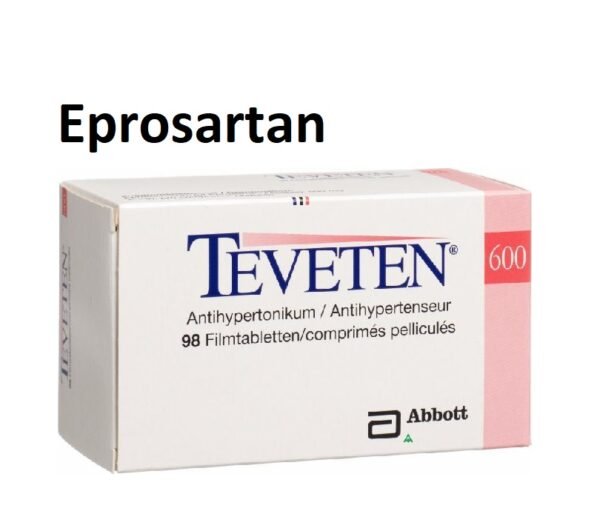
Eprosartan (Teveten) is an angiotensin-converting-enzyme inhibitor that is used as monotherapy or in combination with other antihypertensive medications to reduce the blood pressure in hypertensive patients.
Eprosartan Uses:
-
Hypertension:
- It is used for the treatment of hypertension
-
Off Label Use of Eprosartan in Adults:
- Acute coronary syndrome for secondary prevention
- Stable coronary artery disease
Eprosartan (Teveten) Dose in Adults
Eprosartan (Teveten) Dose in the treatment of Hypertension:
Note: For initial treatment:
-
- ≥20/10 mm Hg above goal, may be used in combination therapy with other agents (eg, a long-acting dihydropyridine calcium channel blocker or thiazide diuretic).
- <20/10 mm Hg above goal, can be given as monotherapy; however, over time, many need combination therapies.
- Oral:
- Initial: 600 mg once a day
- Evaluate response every 4 - 6 weeks and adjust dose accordingly
- Up to 800 mg/day in 1 - 2 divided doses can be given.
Dose in Children:
Not indicated.
Pregnancy Risk Factor D
- [US Boxed Warning]Drugs that affect the renin-angiotensin pathway can cause harm and even death for the developing foetus.
- Once you are told that you are pregnant, it is important to stop using the drug..
- Drugs that act in the RAAS system can cause oligohydramnios, which may lead to fetal lung hypoplasia or skeletal malformations.
- Exchange transfusions may be required for infants who are exposed in utero. The second and third trimesters are when most complications occur in neonates.
- Monitoring the exposed fetus for growth, amniotic fluid volume and formation of organs is important.
- These complications are caused by maternal use during the second and third trimesters.
Eprosartan use during breastfeeding:
- It is unknown if breast milk contains eprosartan.
- The benefits of valsartan for the mother and the benefits of breastfeeding the infant should be considered by the clinician.
Eprosartan (Teveten) Dose in Kidney disease:
-
Mild impairment:
- No dose adjustment required.
-
Moderate to severe impairment:
- The manufacturer has not recommended any dosage adjustment in severe renal disease
- maximum dose: 600 mg daily.
-
Hemodialysis:
- The manufacturer has not recommended any dosage adjustment in severe renal disease; eprosartan is poorly removed by hemodialysis (Cl <1 L/hour)
Dose in Liver disease:
No dosage adjustment required.
Less Common Side Effects of Eprosartan (Teveten):
-
Cardiovascular:
- Chest Pain
-
Central Nervous System:
- Fatigue
- Dizziness
- Headache
- Depression
-
Endocrine & Metabolic:
- Dependent Edema
- Hypertriglyceridemia
-
Gastrointestinal:
- Abdominal Pain
- Diarrhea
- Dyspepsia
-
Genitourinary:
- Urinary Tract Infection
-
Infection:
- Viral Infection
-
Neuromuscular & Skeletal:
- Arthralgia
- Myalgia
-
Renal:
- Increased Blood Urea Nitrogen
-
Respiratory:
- Upper Respiratory Tract Infection
- Pharyngitis
- Rhinitis
- Cough
- Bronchitis
- Sinusitis
-
Miscellaneous:
- Accidental Injury
Contraindications to Eprosartan (Teveten):
- Hypersensitivity
- Use of a direct renin inhibitor in conjunction
Because of the similarities in structure/function, it is impossible to rule out the possibility of cross-sensitivity between angiotensin receptor blockers and angiotensin 2, but this cannot be excluded.
Canadian labeling: Additional contraindications not in US labeling
- Renovascular disease on both sides, or severe stenosis in one functioning kidney
- Galactose intolerance or glucose-galactose malabsorption, also known as Lapp lactase deficiencies, or Galactose intolerance
- Combination use of aliskiren for severe renal impairment (GFR 60mL/minute/1.73m2)
- Combination with ACEi for patients with diabetic nephropathy
- Pregnancy
- Breastfeeding
Warnings and precautions
-
Angioedema
- Angioedema can occur (rarely) during any treatment.
- Patients who have angioedema that is associated with ACE inhibitors, idiopathic or hereditary may be at greater risk.
- It is possible to have abdominal pain due to involvement of the head, neck, or intestine.
- If patients experience swelling in the larynx, glottis or face, it is important to monitor them.
- If angioedema develops, stop taking medication immediately. Do not restart therapy for future uses
- It is important to treat the patient immediately and aggressively. Intramuscular (IM), administration of epinephrine might be necessary.
-
Hyperkalemia:
- Hyperkalemia is a more common risk. Risk factors include:
- Renal dysfunction
- DM
- Concomitant use ACEi, aliskiren and potassium-sparing uriters
- Potassium supplementation, potassium-containing Salts
- Hyperkalemia is a more common risk. Risk factors include:
-
Hypotension
- Hypotension is a risk factor for patients who are salt- and volume-depleted (e.g. Patients taking high-dose diuretics. The patient must be well hydrated before initiating treatment.
-
Renal function deterioration:
- Patients suffering from low renal blood flow (e.g. Acute renal impairment may occur in patients with heart disease and renal artery narrowing.
- After initiation, small increases in serum creatinine can occur; discontinuation will result in significant or progressive deterioration in renal function.
-
Aortic/mitral stenosis:
- Patients with severe aortic/mitralstenosis should be cautious.
-
Ascites:
- Patients with cirrhosis should not use it as there is a risk of rapid decline in renal function.
-
Renal artery stenosis
- Patients with unilateral or bilateral renal arterial stenosis should not use it
- High risk of renal dysfunction deterioration
-
Renal impairment
- Prevent severe renal impairment and renal insufficiency.
Eprosartan: Drug Interaction
Note: Drug Interaction Categories:
- Risk Factor C: Monitor When Using Combination
- Risk Factor D: Consider Treatment Modification
- Risk Factor X: Avoid Concomitant Use
Risk Factor C (Monitor therapy) |
|
| Alfuzosin | May enhance the hypotensive effect of Blood Pressure Lowering Agents. |
| Amphetamines | May diminish the antihypertensive effect of Antihypertensive Agents. |
| Angiotensin II | Receptor Blockers may diminish the therapeutic effect of Angiotensin II. |
| Antipsychotic Agents (Second Generation [Atypical]) | Blood Pressure Lowering Agents may enhance the hypotensive effect of Antipsychotic Agents (Second Generation [Atypical]). |
| Barbiturates | May enhance the hypotensive effect of Blood Pressure Lowering Agents. |
| Benperidol | May enhance the hypotensive effect of Blood Pressure Lowering Agents. |
| Brigatinib | May diminish the antihypertensive effect of Antihypertensive Agents. Brigatinib may enhance the bradycardic effect of Antihypertensive Agents. |
| Brimonidine (Topical) | May enhance the hypotensive effect of Blood Pressure Lowering Agents. |
| CycloSPORINE (Systemic) | Angiotensin II Receptor Blockers may enhance the hyperkalemic effect of CycloSPORINE (Systemic). |
| Dapoxetine | May enhance the orthostatic hypotensive effect of Angiotensin II Receptor Blockers. |
| Dexmethylphenidate | May diminish the therapeutic effect of Antihypertensive Agents. |
| Diazoxide | May enhance the hypotensive effect of Blood Pressure Lowering Agents. |
| Drospirenone | Angiotensin II Receptor Blockers may enhance the hyperkalemic effect of Drospirenone. |
| DULoxetine | Blood Pressure Lowering Agents may enhance the hypotensive effect of DULoxetine. |
| Eplerenone | May enhance the hyperkalemic effect of Angiotensin II Receptor Blockers. |
| Heparin | May enhance the hyperkalemic effect of Angiotensin II Receptor Blockers. |
| Heparins (Low Molecular Weight) | May enhance the hyperkalemic effect of Angiotensin II Receptor Blockers. |
| Herbs (Hypertensive Properties) | May diminish the antihypertensive effect of Antihypertensive Agents. |
| Herbs (Hypotensive Properties) | May enhance the hypotensive effect of Blood Pressure Lowering Agents. |
| Hypotension-Associated Agents | Blood Pressure Lowering Agents may enhance the hypotensive effect of Hypotension-Associated Agents. |
| Levodopa-Containing Products | Blood Pressure Lowering Agents may enhance the hypotensive effect of Levodopa-Containing Products. |
| Lormetazepam | May enhance the hypotensive effect of Blood Pressure Lowering Agents. |
| Methylphenidate | May diminish the antihypertensive effect of Antihypertensive Agents. |
| Molsidomine | May enhance the hypotensive effect of Blood Pressure Lowering Agents. |
| Naftopidil | May enhance the hypotensive effect of Blood Pressure Lowering Agents. |
| Nicergoline | May enhance the hypotensive effect of Blood Pressure Lowering Agents. |
| Nicorandil | May enhance the hyperkalemic effect of Angiotensin II Receptor Blockers. |
| Nicorandil | May enhance the hypotensive effect of Blood Pressure Lowering Agents. |
| Nitroprusside | Blood Pressure Lowering Agents may enhance the hypotensive effect of Nitroprusside. |
| Nonsteroidal Anti-Inflammatory Agents | Angiotensin II Receptor Blockers may enhance the adverse/toxic effect of Nonsteroidal Anti-Inflammatory Agents. Specifically, the combination may result in a significant decrease in renal function. Nonsteroidal Anti-Inflammatory Agents may diminish the therapeutic effect of Angiotensin II Receptor Blockers. The combination of these two agents may also significantly decrease glomerular filtration and renal function. |
| Pentoxifylline | May enhance the hypotensive effect of Blood Pressure Lowering Agents. |
| Pholcodine | Blood Pressure Lowering Agents may enhance the hypotensive effect of Pholcodine. |
| Phosphodiesterase 5 Inhibitors | May enhance the hypotensive effect of Blood Pressure Lowering Agents. |
| Potassium Salts | May enhance the hyperkalemic effect of Angiotensin II Receptor Blockers. |
| Potassium-Sparing Diuretics | Angiotensin II Receptor Blockers may enhance the hyperkalemic effect of Potassium-Sparing Diuretics. |
| Prostacyclin Analogues | May enhance the hypotensive effect of Blood Pressure Lowering Agents. |
| Quinagolide | May enhance the hypotensive effect of Blood Pressure Lowering Agents. |
| Ranolazine | May enhance the adverse/toxic effect of Angiotensin II Receptor Blockers. |
| Tacrolimus (Systemic) | Angiotensin II Receptor Blockers may enhance the hyperkalemic effect of Tacrolimus (Systemic). |
| Tolvaptan | May enhance the hyperkalemic effect of Angiotensin II Receptor Blockers. |
| Trimethoprim | May enhance the hyperkalemic effect of Angiotensin II Receptor Blockers. |
| Yohimbine | May diminish the antihypertensive effect of Antihypertensive Agents. |
Risk Factor D (Consider therapy modification) |
|
| Aliskiren | May enhance the hyperkalemic effect of Angiotensin II Receptor Blockers. Aliskiren may enhance the hypotensive effect of Angiotensin II Receptor Blockers. Aliskiren may enhance the nephrotoxic effect of Angiotensin II Receptor Blockers. Management: Aliskiren use with ACEIs or ARBs in patients with diabetes is contraindicated. Combined use in other patients should be avoided, particularly when CrCl is less than 60 mL/min. If combined, monitor potassium, creatinine, and blood pressure closely. |
| Amifostine | Blood Pressure Lowering Agents may enhance the hypotensive effect of Amifostine. Management: When amifostine is used at chemotherapy doses, blood pressure lowering medications should be withheld for 24 hours prior to amifostine administration. If blood pressure lowering therapy cannot be withheld, amifostine should not be administered. |
| Angiotensin-Converting Enzyme Inhibitors | Angiotensin II Receptor Blockers may enhance the adverse/toxic effect of Angiotensin-Converting Enzyme Inhibitors. Angiotensin II Receptor Blockers may increase the serum concentration of Angiotensin-Converting Enzyme Inhibitors. Management: In US labeling, use of telmisartan and ramipril is not recommended. It is not clear if any other combination of an ACE inhibitor and an ARB would be any safer. Consider alternatives to the combination when possible. |
| Lithium | Angiotensin II Receptor Blockers may increase the serum concentration of Lithium. Management: Lithium dosage reductions will likely be needed following the addition of an angiotensin II receptor antagonist. |
| Obinutuzumab | May enhance the hypotensive effect of Blood Pressure Lowering Agents. Management: Consider temporarily withholding blood pressure lowering medications beginning 12 hours prior to obinutuzumab infusion and continuing until 1 hour after the end of the infusion. |
| Sodium Phosphates | Angiotensin II Receptor Blockers may enhance the nephrotoxic effect of Sodium Phosphates. Specifically, the risk of acute phosphate nephropathy may be enhanced. Management: Consider avoiding this combination by temporarily suspending treatment with ARBs, or seeking alternatives to oral sodium phosphate bowel preparation. If the combination cannot be avoided, maintain adequate hydration and monitor renal function closely. |
Risk Factor X (Avoid combination) |
|
| Bromperidol | May diminish the hypotensive effect of Blood Pressure Lowering Agents. Blood Pressure Lowering Agents may enhance the hypotensive effect of Bromperidol. |
Monitoring parameters:
- Blood pressure
- serum potassium
- serum creatinine
- BUN, and eGFR (before and after change in dose and at least annually thereafter)
Hypertension: The 2017 guideline for the Prevention, Detection, Evaluation, and Management of High Blood Pressure in Adults.
- Less than 130/80 mmHg in hypertensive patients with known cardiovascular disease or a 10-year ASCVD risk of more than 10%.
- Less than 130/80 mmHg may be reasonable in hypertensive patients without markers of ASCVD risk.
Blood pressure targets in Diabetic patients: (ADA 2019):
-
Less than 140/90 in patients with co-morbid diabetes and hypertension and age less than 65 years
-
Less than 130/80 in patients less than 65 years of age with diabetes and at high risk of cardiovascular disease.
-
Less than 140/90 mmHg in patients older than 65 years of age with Diabetes.
-
Less than 150/90 mmHg in patients older than 65 years of age with Diabetes and poor health status.
How to administer Eprosartan (Teveten)?
Oral: May be taken with or without food.
Mechanism of action of Eprosartan (Teveten):
- Eprosartan is an inhibitor of angiotensin II.
- It blocks selectively the binding of angiotensin II to the AT1 receptor
The following mechanisms can be used to lower blood pressure:
- Vasodilation
- Inhibition of aldosterone production
- Catecholamine inhibition
- Blocking the release arginine vasopressin
- Hypertrophic and water intake can be inhibited.
ACEi blocks the biosynthesis angiotensin II (angiotensin 1) and causes bradykinin to be degraded. Eprosartan is not an inhibitor of ACE and does not alter the bradykinin response. It also has fewer side effect than ACEi.
Protein binding:
- 98%
Metabolism:
- Minimally hepatic
Bioavailability:
- 300 mg dose: 13%
Half-life elimination:
- Terminal: 5 - 9 hours
Time to peak, serum:
- Fasting: 1 - 2 hours
Excretion: mainly through feces
- Feces (90%)
- Urine (7%, mostly as unchanged drug)
International Brand Names of Eprosartan:
- Teveten
- Cosarnomid
- Epratenz
- Futuran
- Tangio
- Tensrelive
- Teveten
- Tevetens
- Tevetenz
Eprosartan Brand Names in Pakistan:
Eprosartan Tablets 400 mg in Pakistan |
|
| Level | Wilsons Pharmaceuticals |
Eprosartan Tablets 600 mg in Pakistan |
|
| Teveten | Abbott Laboratories (Pakistan) Limited. |
.png)


