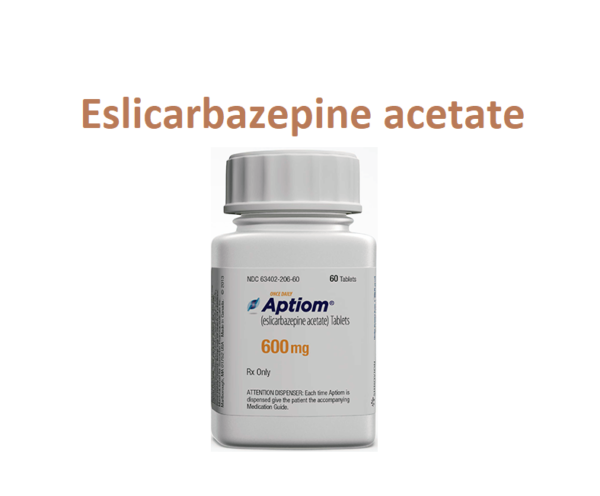
Eslicarbazepine acetate (Aptiom) is converted to its active form Eslicarbazepine that is used as monotherapy or as an adjunct to other medicines in the treatment of partial-onset seizures.
Eslicarbazepine (Aptiom) Uses:
-
Partial-onset seizures (epilepsy):
- Used in monotherapy or adjunctive therapy in the treatment of partial-onset seizures in adults and pediatric patients of 4 years or more than 4 years of age
Eslicarbazepine (Aptiom) Dose in Adults
Eslicarbazepine (Aptiom) Dose in the Partial-onset seizures (epilepsy):
-
Monotherapy:
- Oral: Initial: 400 mg once in a day;
- may initiate treatment at 800 mg once in a day if seizure reduction outweighs the risk of adverse reactions during initiation.
- Increase in weekly increments of 400 mg to 600 mg based on clinical response and tolerability.
- Maintenance: 800 mg to 1,600 mg once in a day.
- Note: Consider 800 mg once in a day for maintenance therapy in patients not tolerating 1,200 mg once daily.
-
Adjunctive therapy:
- Oral: Initial: 400 mg once in a day;
- may initiate treatment at 800 mg once in a day if seizure reduction outweighs the risk of adverse reactions during initiation.
- Increase in weekly increments of 400 mg to 600 mg, based on clinical response and tolerability.
- Maintenance: 800 mg to 1,600 mg once in a day.
- Note: Consider 1,600 mg once in a day for maintenance therapy in patients not achieving response on 1,200 mg daily dosage.
Dosage adjustment with concomitant antiepileptic drugs (AEDs):
-
Adjunctive therapy:
- Carbamazepine:
- Dose adjustment of eslicarbazepine or carbamazepine may be needed dependent on efficacy or tolerability.
- Other enzyme-inducing antiepileptic drugs (eg, primidone, phenobarbital, phenytoin):
- The dosage of eslicarbazepine may need to be increased.
- Oxcarbazepine:
- Concomitant use is not recommended.
- Carbamazepine:
Eslicarbazepine (Aptiom) Dose in Childrens
Eslicarbazepine (Aptiom) Dose in partial-onset Seizures (monotherapy or adjunctive):
-
Children ≥4 years and Adolescents ≤17 years: Oral:
- 11 to 21 kg:
- Initial: 200 mg once in a day;
- may increase in weekly increments of no more than 200 mg per day, titrate based on clinical response and tolerability;
- maintenance dose: 400 to 600 mg once in a day;
- maximum daily dose: 600 mg per day
- 22 to 31 kg:
- Initial: 300 mg once in a day;
- may increase in weekly increments of no more than 300 mg per day, titrate based on clinical response and tolerability;
- maintenance dose: 500 to 800 mg once in a day;
- maximum daily dose: 800 mg per day
- 32 to 38 kg:
- Initial: 300 mg once in a day;
- may increase in weekly increments of no more than 300 mg per day, titrate based on clinical response and tolerability;
- maintenance dose: 600 to 900 mg once in a day;
- maximum daily dose: 900 mg per day
- >38 kg:
- Initial: 400 mg once in a day;
- may increase in weekly increments of no more than 400 mg per day, titrate based on clinical response and tolerability;
- maintenance dose: 800 to 1,200 mg once in a day;
- maximum daily dose: 1,200 mg per day
- 11 to 21 kg:
-
Adolescents ≥18 years:
- Oral: Initial: 400 mg once in a day, may initiate at 800 mg once in a day if seizure reduction outweighs the risk of adverse reactions during initiation.
- May increase in weekly increments of 400 to 600 mg per day, titrate dose based on clinical response and tolerability;
- The maintenance dose: 800 to 1,600 mg once in a day;
- The maximum dose: 1,600 mg per day.
Eslicarbazepine (Aptiom) Dosage adjustment with concomitant antiepileptic drugs (AEDs):
-
Children ≥4 years and Adolescents:
-
Adjunctive therapy:
- Carbamazepine:
- Dose adjustment of eslicarbazepine or carbamazepine may be needed based on efficacy and tolerability.
- Other enzyme-inducing antiepileptic drugs (eg, primidone, phenobarbital, phenytoin):
- The dosage of eslicarbazepine may need to be increased.
- Oxcarbazepine:
- Concomitant use is not recommended.
- Carbamazepine:
-
Eslicarbazepine (Aptiom) Pregnancy Risk Category: N (Not defined)
- Animal reproduction studies have shown that adverse events can be observed.
- Eslicarbazepine can lower plasma levels of hormonal contraceptives. Women with reproductive potential should consider alternative or additional nonhormonal contraceptives.
Use of eslicarbazepine while breastfeeding
- It is excreted from breast milk.
- According to the manufacturer breastfeeding during therapy is a decision that should be made after considering the risks to infants and the benefits to mothers.
Eslicarbazepine (Aptiom) Dose in Kidney Disease:
-
Mild impairment (CrCl = 50 to 80 mL/minute).
- The manufacturer's labeling does not contain any dosage adjustments. Systemic exposure rose to 62% after a single 800mg dose.
-
Moderate to severe renal impairment (CrCl = 50mL/minute).
- Reducing initial, maintenance, and titration dosages by 50%; may base titration or maintenance dosage adjustments on clinical responses.
-
End-stage renal disease (ESRD), hemodialysis.
- The manufacturer's labeling does not provide any dosage adjustments; be careful. Repeated dialysis will remove metabolites.
Eslicarbazepine (Aptiom) Dose in Liver disease:
-
Mild to moderate hepatic impairment:
- No dosage adjustment required.
-
Severe hepatic impairment:
- Use is not recommended (has not been studied).
Common Side Effects of Eslicarbazepine (Aptiom):
-
Central Nervous System:
- Dizziness
- Drowsiness
- Headache
-
Gastrointestinal:
- Nausea
-
Ophthalmic:
- Diplopia
Less Common Side Effects Of Eslicarbazepine (Aptiom):
-
Cardiovascular:
- Hypertension
- Peripheral Edema
-
Central Nervous System:
- Fatigue
- Cognitive Dysfunction
- Ataxia
- Vertigo
- Depression
- Equilibrium Disturbance
- Falling
- Abnormal Gait
- Insomnia
- Dysarthria
- Memory Impairment
-
Dermatologic:
- Skin Rash
-
Endocrine & Metabolic:
- Hyponatremia
-
Gastrointestinal:
- Vomiting
- Diarrhea
- Abdominal Pain
- Constipation
- Gastritis
-
Genitourinary:
- Urinary Tract Infection
-
Neuromuscular & Skeletal:
- Tremor
- Weakness
-
Ophthalmic:
- Blurred Vision
- Decreased Visual Acuity
- Nystagmus
-
Respiratory:
- Cough
Side effects of Eslicarbazepine (Aptiom) (Frequency not defined):
-
Endocrine & Metabolic:
- Hypercholesterolemia
- Hypochloremia (Concurrent With Hyponatremia)
- Increased LDL Cholesterol
- Increased Serum Triglycerides
-
Hematologic & Oncologic:
- Decreased Hematocrit
- Decreased Hemoglobin
-
Neuromuscular & Skeletal:
- Increased Creatine Phosphokinase
Contraindications to Eslicarbazepine (Aptiom):
- Hypersensitivity to oxcarbazepine or eslicarbazepine or any other component of the formulation
Canadian labeling: Additional contraindications not in US labeling
- Carmazepine hypersensitivity
- A history of or presence of second- or third degree atrioventricular blocks
Warnings and precautions
-
CNS effects
- Dose-dependent CNS-related adverse effects have been reported with use. The most severe were cognitive symptoms (eg amnesia and confusional state, speech disorder and memory impairment, disturbance of attention, slowness in thought, disorientation and psychomotor retardation), dizziness or fatigue, somnolence, fatigue, dizziness, coordination abnormalities (eg balance disorder, gait disorder, ataxia and vertigo), and visual changes (eg diplopia, blurred vision, and impaired vision
- Patients over 60 years old and those who have been taking carbamazepine concurrently were at greater risk for visual changes, dizziness, and coordination abnormalities during titration.
- Patients taking eslicarbazepine or carbamazepine concurrently should consider dosage changes.
- Patients should be cautious when performing tasks that require mental alertness, such as operating machinery or driving.
-
Dermatologic reactions
- There have been reports of potentially fatal and sometimes deadly dermatologic reactions, including Stevens-Johnson syndrome. Monitor for skin reactions and discontinue or convert to alternative therapy if necessary.
- Patients with previous dermatologic reactions to carbamazepine or eslicarbazepine should not use this product.
-
Hematologic effects
- Reports have included cases of leukopenia, pancytopenia and agranulocytosis.
- If you have hematologic abnormalities, consider quitting eslicarbazepine.
-
Hepatic effects
- Reports have indicated hepatic effects that range from mild to moderate transaminase elevations (more than 3x the upper limit normal) to rare concomitant elevations total bilirubin levels (more than 2x the upper limit normal).
- Do baseline liver laboratory tests.
- Patients with jaundice, or any other sign of liver injury should be stopped.
-
Hypersensitivity reactions
- If symptoms persist, discontinue use immediately.
- Rare cases of anaphylaxis or angioedema have been documented.
- Patients who have had anaphylactic reactions to eslicarbazepine or Oxcarbazepine in the past should be avoided.
-
Hyponatremia
- Hyponatremia can be clinically significant (serum sodium less that 125 mg/L) or concurrent hypochloremia.
- Controlled trials showed that effects were dose-related and occurred within the first 8 weeks (as soon as 3 days after treatment began) and disappeared without further treatment within a few days.
- The severity of hyponatremia may dictate whether or not eslicarbazepine should be decreased or stopped.
- Monitoring serum sodium and/or chloride levels is a good idea, especially for patients at high risk of hyponatremia.
-
Multiorgan hypersensitivity reactions
- Reports of potentially fatal, sometimes deadly drug reactions with eosinophilia or systemic symptoms (DRESS), also known collectively as multiorgan hypersensitivity reactions (MOH), have been made.
- Watch out for any signs or symptoms, such as fever, rash and lymphadenopathy. This could also be a sign of other organ involvement, such as hepatitis (hepatitis), nephritis (hematological abnormalities), myocarditis (or myositis).
- Patients who have had a DRESS reaction to oxcarbazepine or carbamazepine in the past should not use this medication.
- If you notice any symptoms, it is important to immediately seek medical attention.
- It may be necessary to discontinue treatment and convert to an alternate form of therapy.
-
Suicidal thoughts:
- A pooled analysis of antiepileptics trials (regardless if they were indicated) revealed an increase in suicidal thoughts/behavior. The incidence rate was 0.43 percent for patients who received the drug, and 0.24 percent for patients who received placebo.
- The risk was evident as soon as the trial began and continued for at least one week. Most trials last 24 weeks.
- Patients should be monitored for any changes in behavior that could indicate depression or suicidal thoughts. If symptoms are present, patients should immediately notify their healthcare provider.
-
Thyroid function
- We have observed dose-dependent drops in serum T-3 (free and total), and T-4 (total and total) levels.
- These changes were not seen in conjunction with any other abnormal thyroid function tests, suggesting hypothyroidism.
-
Renal impairment
- Clearance is reduced in patients with impaired renal function.
- Patients with CrCl less than 50 mL per hour will need to adjust their dosage.
-
Hepatic impairment
- Patients with severe hepatic impairment should not use this product.
Eslicarbazepine: Drug Interaction
Note: Drug Interaction Categories:
- Risk Factor C: Monitor When Using Combination
- Risk Factor D: Consider Treatment Modification
- Risk Factor X: Avoid Concomitant Use
Risk Factor C (Monitor therapy) |
|
| Benzhydrocodone | CYP3A4 Inducers (Moderate) may decrease the serum concentration of Benzhydrocodone. Specifically, the serum concentrations of hydrocodone may be reduced. |
| CarBAMazepine | May enhance the adverse/toxic effect of Eslicarbazepine. CarBAMazepine may decrease the serum concentration of Eslicarbazepine. |
| Cladribine | BCRP/ABCG2 Inducers may decrease the serum concentration of Cladribine. |
| CloZAPine | CYP3A4 Inducers (Moderate) may decrease the serum concentration of CloZAPine. |
| Codeine | CYP3A4 Inducers (Moderate) may decrease serum concentrations of the active metabolite(s) of Codeine. |
| CYP3A4 Substrates (High risk with Inducers) | CYP3A4 Inducers (Moderate) may decrease the serum concentration of CYP3A4 Substrates (High risk with Inducers). |
| Doravirine | CYP3A4 Inducers (Moderate) may decrease the serum concentration of Doravirine. |
| Estriol (Systemic) | CYP3A4 Inducers (Moderate) may decrease the serum concentration of Estriol (Systemic). |
| Estriol (Topical) | CYP3A4 Inducers (Moderate) may decrease the serum concentration of Estriol (Topical). |
| FentaNYL | CYP3A4 Inducers (Moderate) may decrease the serum concentration of FentaNYL. |
| Fosphenytoin | May decrease the serum concentration of Eslicarbazepine. (based on studies with phenytoin) Eslicarbazepine may increase the serum concentration of Fosphenytoin. (based on studies with phenytoin) |
| Glecaprevir and Pibrentasvir | CYP3A4 Inducers (Moderate) may decrease the serum concentration of Glecaprevir and Pibrentasvir. |
| HYDROcodone | CYP3A4 Inducers (Moderate) may decrease the serum concentration of HYDROcodone. |
| Ibrutinib | CYP3A4 Inducers (Moderate) may decrease the serum concentration of Ibrutinib. |
| Ifosfamide | CYP3A4 Inducers (Moderate) may decrease serum concentrations of the active metabolite(s) of Ifosfamide. CYP3A4 Inducers (Moderate) may increase serum concentrations of the active metabolite(s) of Ifosfamide. |
| Lacosamide | Antiepileptic Agents (Sodium Channel Blockers) may enhance the adverse/toxic effect of Lacosamide. Specifically the risk for bradycardia, ventricular tachyarrhythmias, or a prolonged PR interval may be increased. |
| Mianserin | May diminish the therapeutic effect of Anticonvulsants. |
| Mirodenafil | CYP3A4 Inducers (Moderate) may decrease the serum concentration of Mirodenafil. |
| Naldemedine | CYP3A4 Inducers (Moderate) may decrease the serum concentration of Naldemedine. |
| NiMODipine | CYP3A4 Inducers (Moderate) may decrease the serum concentration of NiMODipine. |
| Orlistat | May decrease the serum concentration of Anticonvulsants. |
| PHENobarbital | May decrease the serum concentration of Eslicarbazepine. |
| Phenytoin | May decrease the serum concentration of Eslicarbazepine. Eslicarbazepine may increase the serum concentration of Phenytoin. |
| Primidone | May decrease the serum concentration of Eslicarbazepine. (based on studies with phenobarbital) |
| Rolapitant | CYP3A4 Inducers (Moderate) may decrease the serum concentration of Rolapitant. |
| Rosuvastatin | Eslicarbazepine may decrease the serum concentration of Rosuvastatin. |
| Simvastatin | Eslicarbazepine may decrease the serum concentration of Simvastatin. |
| Warfarin | Eslicarbazepine may decrease the serum concentration of Warfarin. Specifically, Swarfarin serum concentrations may be decreased. |
| Zolpidem | CYP3A4 Inducers (Moderate) may decrease the serum concentration of Zolpidem. |
Risk Factor D (Consider therapy modification) |
|
| Brigatinib | CYP3A4 Inducers (Moderate) may decrease the serum concentration of Brigatinib. Management: Avoid concurrent use of brigatinib with moderate CYP3A4 inducers when possible. If combined, increase the daily dose of brigatinib in 30 mg increments after 7 days of treatment with the current brigatinib dose, up to maximum of twice the dose. |
| Clarithromycin | CYP3A4 Inducers (Moderate) may increase serum concentrations of the active metabolite(s) of Clarithromycin. CYP3A4 Inducers (Moderate) may decrease the serum concentration of Clarithromycin. Management: Consider alternative antimicrobial therapy for patients receiving a CYP3A inducer. Drugs that enhance the metabolism of clarithromycin into 14-hydroxyclarithromycin may alter the clinical activity of clarithromycin and impair its efficacy. |
| Daclatasvir | CYP3A4 Inducers (Moderate) may decrease the serum concentration of Daclatasvir. Management: Increase the daclatasvir dose to 90 mg once daily if used with a moderate CYP3A4 inducer. |
| Erdafitinib | CYP3A4 Inducers (Moderate) may decrease the serum concentration of Erdafitinib. Management: Dose modifications of erdafitinib may be required. See full monograph for details. |
| Estrogen Derivatives (Contraceptive) | Eslicarbazepine may decrease the serum concentration of Estrogen Derivatives (Contraceptive). Management: Alternative non-hormonal means of birth control should be considered for women of child-bearing potential. |
| GuanFACINE | CYP3A4 Inducers (Moderate) may decrease the serum concentration of GuanFACINE. Management: Increase the guanfacine dose by up to double when initiating guanfacine in a patient taking a moderate CYP3A4 inducer. Increase guanfacine dose gradually over 1 to 2 weeks if initiating a moderate CYP3A4 inducer in a patient already taking guanfacine. |
| Lorlatinib | CYP3A4 Inducers (Moderate) may enhance the hepatotoxic effect of Lorlatinib. CYP3A4 Inducers (Moderate) may decrease the serum concentration of Lorlatinib. Management: Avoid use of lorlatinib with moderate CYP3A4 inducers. If such a combination must be used, monitor AST, ALT, and bilirubin within 48 hours of starting the combination and at least three times within the first week of combined use. |
| Lurasidone | CYP3A4 Inducers (Moderate) may decrease the serum concentration of Lurasidone. Management: Monitor for decreased lurasidone effects if combined with moderate CYP3A4 inducers and consider increasing the lurasidone dose if coadministered with a moderate CYP3A4 inducer for 7 or more days. |
| Mefloquine | May diminish the therapeutic effect of Anticonvulsants. Mefloquine may decrease the serum concentration of Anticonvulsants. Management: Mefloquine is contraindicated for malaria prophylaxis in persons with a history of convulsions. Monitor anticonvulsant concentrations and treatment response closely with concurrent use. |
| Palbociclib | CYP3A4 Inducers (Moderate) may decrease the serum concentration of Palbociclib. Management: The US label does not provide specific recommendations concerning use with moderate CYP3A4 inducers, but the Canadian label recommends avoiding use of moderate CYP3A4 inducers. |
| Perampanel | CYP3A4 Inducers (Moderate) may decrease the serum concentration of Perampanel. Management: Increase the perampanel starting dose to 4 mg/day when perampanel is used concurrently with moderate and strong CYP3A4 inducers. |
| Progestins (Contraceptive) | Eslicarbazepine may decrease the serum concentration of Progestins (Contraceptive). Management: Alternative, non-hormonal means of birth control should be considered for women of child-bearing potential. |
Risk Factor X (Avoid combination) |
|
| Abemaciclib | CYP3A4 Inducers (Moderate) may decrease the serum concentration of Abemaciclib. |
| Antihepaciviral Combination Products | CYP3A4 Inducers (Moderate) may decrease the serum concentration of Antihepaciviral Combination Products. |
| Asunaprevir | CYP3A4 Inducers (Moderate) may decrease the serum concentration of Asunaprevir. |
| Axitinib | CYP3A4 Inducers (Moderate) may decrease the serum concentration of Axitinib. |
| Bedaquiline | CYP3A4 Inducers (Moderate) may decrease the serum concentration of Bedaquiline. |
| Bosutinib | CYP3A4 Inducers (Moderate) may decrease the serum concentration of Bosutinib. |
| Cobimetinib | CYP3A4 Inducers (Moderate) may decrease the serum concentration of Cobimetinib. |
| Dasabuvir | CYP3A4 Inducers (Moderate) may decrease the serum concentration of Dasabuvir. |
| Deflazacort | CYP3A4 Inducers (Moderate) may decrease serum concentrations of the active metabolite(s) of Deflazacort. |
| Elbasvir | CYP3A4 Inducers (Moderate) may decrease the serum concentration of Elbasvir. |
| Encorafenib | CYP3A4 Inducers (Moderate) may decrease the serum concentration of Encorafenib. |
| Flibanserin | CYP3A4 Inducers (Moderate) may decrease the serum concentration of Flibanserin. |
| Grazoprevir | CYP3A4 Inducers (Moderate) may decrease the serum concentration of Grazoprevir. |
| Neratinib | CYP3A4 Inducers (Moderate) may decrease the serum concentration of Neratinib. |
| Nisoldipine | CYP3A4 Inducers (Moderate) may decrease the serum concentration of Nisoldipine. |
| Olaparib | CYP3A4 Inducers (Moderate) may decrease the serum concentration of Olaparib. |
| OXcarbazepine | Eslicarbazepine may enhance the adverse/toxic effect of OXcarbazepine. |
| Ranolazine | CYP3A4 Inducers (Moderate) may decrease the serum concentration of Ranolazine. |
| Simeprevir | CYP3A4 Inducers (Moderate) may decrease the serum concentration of Simeprevir. |
| Sonidegib | CYP3A4 Inducers (Moderate) may decrease the serum concentration of Sonidegib. |
| Velpatasvir | CYP3A4 Inducers (Moderate) may decrease the serum concentration of Velpatasvir. |
| Venetoclax | CYP3A4 Inducers (Moderate) may decrease the serum concentration of Venetoclax. |
Monitoring parameters:
- Seizure frequency
- Baseline liver enzymes
- Patients receiving maintenance therapy, especially if they are taking other medications that decrease sodium levels or have hyponatremia symptoms, should have their serum sodium and/or chloride measured.
- CNS depression symptoms include disturbances in gait and coordination as well as dizziness and somnolence.
- Visual changes
- Hypersensitivity reactions.
- Suicidality monitoring (eg suicidal thoughts and behavioral changes, depression).
- As adjunctive therapy, the serum levels of any concomitant antiepileptic drug should be monitored during titration.
How to administer Eslicarbazepine (Aptiom)?
Administer with or without food; The tablets may be swallowed whole or crushed.
Mechanism of action of Eslicarbazepine (Aptiom):
- Eslicarbazepine acetate can be extensively converted into eslicarbazepine.
- This is what is responsible for its therapeutic effects.
- Although a precise mechanism is not known, it is believed to involve inhibition voltage-gated sodium channels.
Protein binding:
- less than 40 percent
Metabolism:
- Rapidly and extensively metabolized by hydrolytic first-pass metabolism to the major active metabolite eslicarbazepine and minor active metabolites (R)-licarbazepine and oxcarbazepine; active metabolites are further metabolized to inactive glucuronides.
Bioavailability:
- more than 90 percent
Half-life elimination:
- Pediatric patients 4 to 17 years: 10 to 16 hours;
- Adults: 13 to 20 hours
Time to peak:
- Eslicarbazepine:
- Pediatric patients 4 to 17 years: 1 to 3 hours;
- Adults: 1 to 4 hours
Excretion:
- Urine (90 percent; ~66 percent eslicarbazepine, ~33 percent glucuronide conjugate forms, ~10% other minor metabolites)
International Brand Names of Eslicarbazepine:
- Aptiom
- Deprexazin
- Exalief
- Lepsylief
- Normictal
- Zebinix
- Zefretol
- Episabazin
- Eslicar
- Eslicarba
- Eslify
- Eslizen
Eslicarbazepine Brand Names in Pakistan:
There is no brand available in Pakistan.
.png)


