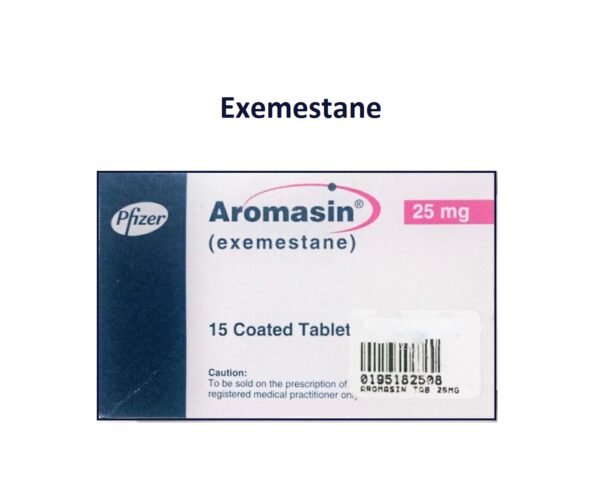
Exemestane (Aromasin) is an irreversible steroidal aromatase inhibitor that is used in the treatment of breast cancer in postmenopausal women.
Exemestane (Aromasin) Uses:
-
Breast cancer:
- It is used for the treatment of advanced breast cancer in postmenopausal women whose disease has progressed following tamoxifen therapy;
- adjuvant treatment of postmenopausal women with estrogen receptor-positive early breast cancer following 2 to 3 years of tamoxifen (for a total of 5 consecutive years of adjuvant therapy).
-
Off Label Use of Exemestane in Adults:
- Used for the first-line adjuvant treatment of estrogen receptor-positive early breast cancer in postmenopausal women.
- Used in postmenopausal women for Risk reduction for invasive breast cancer.
Exemestane (Aromasin) Dose in Adults
Exemestane (Aromasin) Dose in the treatment of advanced Breast cancer:
-
Postmenopausal females:
- Oral: 25 mg once in a day; continue until tumor progression
Exemestane (Aromasin) Dose in the treatment of Early-stage Breast cancer (adjuvant treatment):
-
Postmenopausal females:
- Oral: 25 mg once in a day (continue 2 to 3 years of tamoxifen therapy) for a total time period of 5 years of endocrine therapy (in the absence of recurrence or contralateral breast cancer).
-
Duration of therapy:
- Required a maximum Time period of 5 years of aromatase inhibitor (AI) therapy for postmenopausal women, American Society of Clinical Oncology (ASCO) guidelines for Adjuvant Endocrine Therapy of Hormone Receptor-Positive Breast Cancer (Focused Update)
- AIs may be combined with tamoxifen for a total duration of up to 10 years of endocrine therapy.
- Refer to the guidelines for specific recommendations based on menopausal status and tolerability.
- In a phase III study with another AI (letrozole), treatment with an additional 5 years of AI therapy (for a total of 10 years of aromatase inhibitor therapy) demonstrated a significantly improved rate of disease-free survival and a decreased risk of disease recurrence and contralateral breast cancer (when compared to placebo), although overall survival was not significantly different between groups and bone-related adverse events occurred more frequently with letrozole versus placebo.
Exemestane (Aromasin) Dose in the treatment of Early-stage Breast cancer, (first-line adjuvant treatment; off-label):
-
Postmenopausal females:
- Oral: 25 mg for 5 years once in a day.
-
Duration of therapy:
- For postmenopausal women, ASCO guidelines for Adjuvant Endocrine Therapy of Hormone Receptor-Positive Breast Cancer (Focused Update) recommend a maximum Time period of 5 years of aromatase inhibitor (AI) therapy.
- AIs may be combined with tamoxifen for a total Time period of up to 10 years of endocrine therapy.
- Refer to the guidelines for specific recommendations based on menopausal status and tolerability.
- In a phase III study with another AI (letrozole), treatment with an additional Time period of 5 years of AI therapy ( Total of 10 years of aromatase inhibitor therapy) demonstrated a significantly improved rate of disease-free survival and a decreased risk of disease recurrence and contralateral breast cancer (when compared to placebo), although overall survival was not significantly different between groups and bone-related adverse events occurred more frequently with letrozole versus placebo.
Exemestane (Aromasin) Dose in the treatment of Breast cancer, risk reduction (off-label):
-
Postmenopausal females ≥35 years:
- Oral: 25 mg for 5 years once in a day.
- Dosage adjustment with strong CYP3A4 inducers:
- 50 mg once in a day when used with potent inducers (eg, rifampin, phenytoin)
Use in Children:
Not indicated.
Exemestane (Aromasin) Pregnancy Risk Category: X
- Premenopausal women should not use it.
- Exemestane can cause fetal harm depending on its Phenomenon and animal data. It is likely to cause fetal harm to pregnant women if it is administered.
- Effective contraception should be used by women with reproductive potential during treatment, and for one month after the last dose.
- Pregnancy testing is highly recommended for females with reproductive potential within 7 days of therapy initiation.
Breastfeeding:
- It is only used in women who are postmenopausal.
- Breast-feeding is recommended for 1 month following the last dose. This is because of the risk of serious adverse reactions in breast-feeding infants.
Exemestane (Aromasin) Dose in Kidney Disease:
No adjustment required (although the safety of chronic doses in patients with moderate-to-severe renal impairment has not been studied, dosage adjustment does not appear necessary).
Exemestane (Aromasin) Dose in Liver disease:
No adjustment required (although the safety of chronic doses in patients with moderate-to-severe renal impairment has not been studied, dosage adjustment does not appear necessary).
Side Effects of Exemestane (Aromasin):
-
Cardiovascular:
- Hypertension
- Edema
- Ischemic Heart Disease
- Chest Pain
-
Central Nervous System:
- Fatigue
- Insomnia
- Pain
- Headache
- Depression
- Dizziness
- Anxiety
- Paresthesia
- Carpal Tunnel Syndrome
- Confusion
- Hypoesthesia
-
Dermatological:
- Hyperhidrosis
- Alopecia
- Dermatitis
- Pruritus
- Skin Rash
-
Endocrine & Metabolic:
- Hot Flash
- Weight Gain
- Increased Follicle-Stimulating Hormone
- Increased Luteinizing Hormone
- Increased Sex Hormone Binding Globulin
-
Gastrointestinal:
- Nausea
- Abdominal Pain
- Diarrhea
- Vomiting
- Anorexia
- Constipation
- Increased Appetite
- Dyspepsia
-
Genitourinary:
- Urinary Tract Infection
-
Hematologic & Oncologic:
- Lymphedema
-
Hepatic:
- Increased Serum Alkaline Phosphatase
- Increased Serum Bilirubin
-
Infection:
- Infection
-
Neuromuscular & Skeletal:
- Arthralgia
- Back Pain
- Limb Pain
- Myalgia
- Osteoarthritis
- Weakness
- Osteoporosis
- Pathological Fracture
- Muscle Cramps
-
Ophthalmic:
- Visual Disturbance
-
Renal:
- Increased Serum Creatinine
-
Respiratory:
- Dyspnea
- Cough
- Flu-Like Symptoms
- Bronchitis
- Pharyngitis
- Rhinitis
- Sinusitis
- Upper Respiratory Tract Infection
-
Miscellaneous:
- Fever
Contraindications to Exemestane (Aromasin):
- Hypersensitivity to exemestane and any component of the formulation
Warnings and precautions
-
Reduced bone mineral density
- Exemestane can cause a decrease in bone mineral density due to decreased estrogen levels.
- In studies that did not allow the simultaneous use of calcium, bisphosphonates and vitamin D, there were decreases in the lumbar spine (from baseline), and in the femoral neck (from placebo).
- Patients with osteoporosis or at-risk of it should be assessed at baseline.
- If necessary, exemestane therapy can be used to monitor bone mineral density and start osteoporosis treatment.
-
Lymphopenia
- Exemestane has been shown to cause grade 3 and 4 lymphopenia.
- However, most patients had lower-grade lymphopenia. Some patients were able to recover or improve while on exemestane.
- Lymphopenia didn't cause a significant increase of viral infections and there were no opportunistic infection.
-
Parameters for the lab
- Patients with advanced breast cancer may have elevated levels of AST, ALT and alkaline phosphatase.
- These elevations are rare and could be due to the underlying liver or bone metastases.
- Patients with early breast cancer had higher levels of bilirubin, alkalinephosphatase and serum creatinine when they received exemestane than those who received Tamoxifen, or placebo.
Exemestane: Drug Interaction
Note: Drug Interaction Categories:
- Risk Factor C: Monitor When Using Combination
- Risk Factor D: Consider Treatment Modification
- Risk Factor X: Avoid Concomitant Use
Risk Factor C (Monitor therapy) |
|
| Bosentan | May decrease the serum concentration of CYP3A4 Substrates (High risk with Inducers). |
| CYP3A4 Inducers (Moderate) | May decrease the serum concentration of CYP3A4 Substrates (High risk with Inducers). |
| Deferasirox | May decrease the serum concentration of CYP3A4 Substrates (High risk with Inducers). |
| Erdafitinib | May decrease the serum concentration of CYP3A4 Substrates (High risk with Inducers). |
| Ivosidenib | May decrease the serum concentration of CYP3A4 Substrates (High risk with Inducers). |
| Levomethadone | Aromatase Inhibitors may increase the serum concentration of Levomethadone. |
| Methadone | Aromatase Inhibitors may increase the serum concentration of Methadone. |
| Sarilumab | May decrease the serum concentration of CYP3A4 Substrates (High risk with Inducers). |
| Siltuximab | May decrease the serum concentration of CYP3A4 Substrates (High risk with Inducers). |
| Tocilizumab | May decrease the serum concentration of CYP3A4 Substrates (High risk with Inducers). |
Risk Factor D (Consider therapy modification) |
|
| CYP3A4 Inducers (Strong) | May decrease the serum concentration of Exemestane. Management: Exemestane U.S. product labeling recommends using an increased dose (50 mg/day) in patients receiving concurrent strong CYP3A4 inducers. The Canadian product labeling does not recommend a dose adjustment with concurrent use of strong CYP3A4 inducers. |
| Dabrafenib | May decrease the serum concentration of CYP3A4 Substrates (High risk with Inducers). Management: Seek alternatives to the CYP3A4 substrate when possible. Ifconcomitant therapy cannot be avoided, monitor clinical effects of the substrate closely (particularly therapeutic effects). |
| Enzalutamide | May decrease the serum concentration of CYP3A4 Substrates (High risk with Inducers). Management: Concurrent use of enzalutamide with CYP3A4 substrates that have a narrow therapeutic index should be avoided. Use of enzalutamide and any other CYP3A4 substrate should be performed with caution and close monitoring. |
| Lorlatinib | May decrease the serum concentration of CYP3A4 Substrates (High risk with Inducers). Management: Avoid concurrent use of lorlatinib with any CYP3A4 substrates for which a minimal decrease in serum concentrations of the CYP3A4 substrate could lead to therapeutic failure and serious clinical consequences. |
| Mitotane | May decrease the serum concentration of CYP3A4 Substrates (High risk with Inducers). Management: Doses of CYP3A4 substrates may need to be adjusted substantially when used in patients being treated with mitotane. |
| Pitolisant | May decrease the serum concentration of CYP3A4 Substrates (High risk with Inducers). Management: Combined use of pitolisant with a CYP3A4 substrate that has a narrow therapeutic index should be avoided. Other CYP3A4 substrates should be monitored more closely when used with pitolisant. |
| St John's Wort | May decrease the serum concentration of Exemestane. Management: Exemestane US product labeling recommends using an increased dose (50 mg/day) in patients receiving St Johns Wort or strong CYP3A4 inducers. The Canadian product labeling does not recommend a dose adjustment with this combination. |
Risk Factor X (Avoid combination) |
|
| Estrogen Derivatives | May diminish the therapeutic effect of Exemestane. |
Monitoring parameters:
- 25-hydroxy vitamin D levels (at baseline);
- bone mineral density
How to administer Exemestane?
Administer after a meal.
Mechanism of action of Exemestane (Aromasin):
- Exemestane acts as an irreversible, steroidal inactivator of the aromatase enzyme.
- It is structurally similar to androstenedione.
- The intermediate converts it to an inhibitor that irreversibly blocks active site of aromatase enzyme.
- This causes inactivation ("suicide inhibition"), and prevents the conversion of androgens into estrogens in peripheral tissues.
- In breast cancers that are estrogen-dependent, the circulating estrogens are significantly lower in women who have postmenopausal estrogens.
Absorption:
- Rapid and moderate (~42%) following oral administration;
- AUC and C increased by 59% and 39%, respectively, following a high-fat breakfast (compared to fasted state)
Distribution:
- Extensive into tissues
Protein binding:
- 90%, primarily to albumin and α -acid glycoprotein
Metabolism:
- Extensively hepatic; oxidation (CYP3A4) of methylene group, reduction of 17-keto group with formation of many secondary metabolites; metabolites are inactive
Half-life elimination:
- ~24 hours
Time to peak:
- Women with breast cancer: 1.2 hours
Excretion:
- Urine (<1% as unchanged drug, 39% to 45% as metabolites);
- feces (36% to 48%)
International Brand Names of Exemestane:
- Aromasin
- ACT Exemestane
- APO-Exemestane
- MED-Exemestane
- TEVA-Exemestane
- Aromasil
- Aromasin
- Aromasine
- Aromastan
- Emestane
- Escepran
- Exaccord
- Exetas
- Linkotax
- Orapec
- Xtane
Exemestane Brand Names in Pakistan:
Exemestane Tablets 25 mg |
|
| Aromasin | Pfizer Laboratories Ltd. |
.png)


