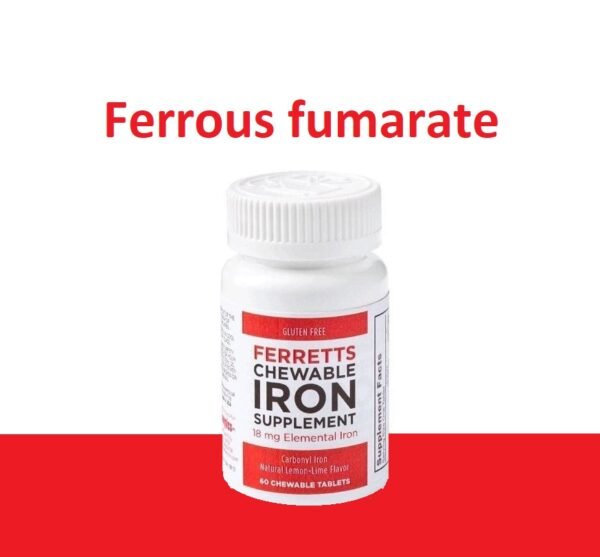
Ferrous fumarate (Ferretts) is an iron formulation that contains 33% of elemental iron. It is used in the treatment and prevention of iron deficiency anemia.
Ferrous fumarate Uses:
-
Iron-deficiency anemia:
- It is indicated for the treatment and prevention anemia due to iron deficiency.
Ferrous fumarate (Ferretts) Dose in Adults
Note:
- Doses given here are expressed in terms of elemental iron.
- Sustained-release or slow-release iron formulations should be avoided when treating iron-deficiency anemia because of poor absorption.
Ferrous fumarate (Ferretts) Dose in the prevention of Iron-deficiency anemia in areas where the prevalence of anemia exceeds 40% (off-label):
- Menstruating women (non-pregnant females):
- 30 to 60 mg orally once a day for three consecutive months in a year.
Ferrous fumarate (Ferretts) Dose in the treatment of Iron-deficiency anemia:
- 65 to 200 mg/day orally in one to three divided doses.
Note:
- It is important to note that alternate-day dosing may result in greater absorption.
- Patients who can adhere to alternate-day dosing may be advised the drug on alternate days.
Ferrous fumarate (Ferretts) Dose in Childrens
Note:
- Doses given here are expressed as elemental iron.
- It contains 33% elemental iron.
Ferrous fumarate (Ferretts) Dose in the prevention of Iron deficiency anemia where prevalence exceeds 40%:
-
Infants ≥6 months and Children <2 years:
- 10 to 12.5 mg orally daily for three consecutive months in a year.
-
Children 2 years to <5 years:
- 30 mg orally daily for three consecutive months in a year.
-
Children ≥5 to 12 years:
- 30 to 60 mg orally daily for three consecutive months in a year.
-
Adolescent menstruating females (non-pregnant females of reproductive potential):
- 30 to 60 mg orally daily for three consecutive months in a year.
Ferrous fumarate (Ferretts) Dose in the treatment of Iron deficiency:
-
Children and Adolescents:
- 3 to 6 mg/kg/day orally in three divided doses.
- The suggested maximum daily dose is 200 mg/day.
Pregnancy Risk Category: A
- The maternal iron needs increase during pregnancy.
- The iron concentration in mild to moderate iron deficiency is maintained for the fetus. However, severe maternal iron deficiency may cause the iron concentration to drop.
- Anemia of maternal iron may lead to adverse outcomes such as low birth weight, preterm delivery, and higher perinatal mortality.
- Iron deficiency is anemia can be treated in women regardless of whether they are pregnant.
- However, oral iron replacement may not be sufficient for patients suffering from gastrointestinal disorders such as malabsorption, or those suffering from severe iron deficiency, who require a rapid rise in hemoglobin, intravenous iron (or iron sucrose) may also be administered.
- Multiple pregnancy studies have shown that ferrous fumarate is safe and effective. However, enteric-coated and slow-release formulations of ferrous fumarate should be avoided.
Ferrous fumarate use during breastfeeding:
- Human breastmilk contains iron. Breastfeeding can increase maternal iron needs.
- Normally, iron levels in breastmilk are maintained for lactating mothers with mild to moderate iron deficiencies. However, severe iron deficiency may cause breastmilk concentrations to drop.
- According to the WHO, iron salts are compatible with breastfeeding.
- The WHO recommends that postpartum women supplement with iron (with or not folic acid), for six to twelve week regardless of whether they are breastfeeding.
Dose in renal disease:
No dosage adjustment mentioned in patients with kidney disease.
Dose in liver disease:
No dosage adjustment mentioned in patients with liver disease.
Side Effects of Ferrous fumarate (Ferretts):
-
Gastrointestinal:
- Constipation
- Darkening of stools
- Nausea
- Stomach cramps
- Vomiting
Less Common Side Effects of Ferrous fumarate (Ferretts):
-
Gastrointestinal:
- Dental discoloration
- Diarrhea
- Heartburn
-
Genitourinary:
- Urine discoloration
Contraindications to Ferrous fumarate (Ferretts):
- Allergy reactions to iron salts and any component of the formulation
- Hemochromatosis
- Hemolytic anemia
Warnings and precautions
-
Gastrointestinal Disease:
- Iron salts should be avoided by patients with ulcerative colitis, enteritis, peptic ulcer disease and/or enteritis.
Ferrous fumarate: Drug Interaction
Note: Drug Interaction Categories:
- Risk Factor C: Monitor When Using Combination
- Risk Factor D: Consider Treatment Modification
- Risk Factor X: Avoid Concomitant Use
Risk Factor C (Monitor therapy) |
|
| Proton Pump Inhibitors | May decrease the absorption of Iron Salts. |
| Histamine H2 Receptor Antagonists | May decrease the absorption of Iron Salts. |
Risk Factor D (Consider therapy modification) |
|
| Alpha-Lipoic Acid | Iron Salts may decrease the absorption of Alpha-Lipoic Acid. Alpha-Lipoic Acid may decrease the absorption of Iron Salts. |
| Antacids | May decrease the absorption of Iron Salts. |
| Bictegravir | Iron Salts may decrease the serum concentration of Bictegravir. Management: Bictegravir, emtricitabine, and tenofovir alafenamide can be administered with iron salts underfed conditions, but coadministration with or 2 hours after an iron salt is not recommended under fasting conditions. |
| Bisphosphonate Derivatives | Polyvalent Cation Containing Products may decrease the serum concentration of Bisphosphonate Derivatives. Management: Avoid administration of oral medications containing polyvalent cations within: 2 hours before or after tiludronate/clodronate/etidronate; 60 minutes after oral ibandronate; or 30 minutes after alendronate/risedronate. Exceptions: Pamidronate; Zoledronic Acid. |
| Cefdinir | Iron Salts may decrease the serum concentration of Cefdinir. Red-appearing, nonbloody stools may also develop due to the formation of an insoluble iron-cefdinir complex. Management: Avoid concurrent cefdinir and oral iron when possible. Separating doses by several hours may minimize interaction. Iron-containing infant formulas do not appear to interact with cefdinir. |
| Deferiprone | Polyvalent Cation Containing Products may decrease the serum concentration of Deferiprone. Management: Separate administration of deferiprone and oral medications or supplements that contain polyvalent cations by at least 4 hours. |
| Dolutegravir | Iron Salts may decrease the serum concentration of Dolutegravir. Management: Administer dolutegravir at least 2 hours before or 6 hours after oral iron. Administer dolutegravir/rilpivirine at least 4 hours before or 6 hours after oral iron salts. Alternatively, dolutegravir and oral iron can be taken together with food. |
| Eltrombopag | Polyvalent Cation Containing Products may decrease the serum concentration of Eltrombopag. Management: Administer eltrombopag at least 2 hours before or 4 hours after oral administration of any polyvalent cation containing product. |
| Entacapone | Iron Salts may decrease the serum concentration of Entacapone. Management: Consider separating doses of the agents by 2 or more hours to minimize the effects of this interaction. Monitor for decreased therapeutic effects of levodopa during concomitant therapy, particularly if doses cannot be separated. |
| Ferric Hydroxide Polymaltose Complex | May decrease the serum concentration of Iron Salts. Specifically, the absorption of oral iron salts may be reduced. Management: Do not administer intravenous (IV) ferric hydroxide polymaltose complex with other oral iron salts. Therapy with oraliron salts should begin 1 week after the last dose of IV ferric hydroxide polymaltose complex. |
| Iron Isomaltoside | May decrease the serum concentration of Iron Salts. Specifically, absorption of oral iron salts may be reduced. Management: Do not administer intravenous (IV) iron isomaltoside with other oral iron salts. Therapy with oral iron salts should begin 5 days after the last dose of IV iron isomaltoside. |
| Levodopa | Iron Salts may decrease the serum concentration of Levodopa. Only applies to oral iron preparations. Management: Consider separating doses of the agents by 2 or more hours to minimize the effects of this interaction. Monitor for decreased therapeutic effects of levodopa during concomitant therapy, particularly if doses cannot be separated. |
| Levothyroxine | Iron Salts may decrease the serum concentration of Levothyroxine. Management: Separate oral administration of iron salts and levothyroxine by at least 4 hours. Separation of doses is not required with parenterally administered iron salts or levothyroxine. |
| Methyldopa | Iron Salts may decrease the serum concentration of Methyldopa. |
| PenicillAMINE | Polyvalent Cation Containing Products may decrease the serum concentration of PenicillAMINE. Management: Separate the administration of penicillamine and oral polyvalent cation containing products by at least 1 hour. |
| Phosphate Supplements | Iron Salts may decrease the absorption of Phosphate Supplements. Management: Administer oral phosphate supplements as far apart from the administration of an oral iron salt as possible to minimize the significance of this interaction. Exceptions: Sodium Glycerophosphate Pentahydrate. |
| Quinolones | Iron Salts may decrease the serum concentration of Quinolones. Management: Give oral quinolones at least several hours before (4 h for moxi- and sparfloxacin, 2 h for others) or after (8 h for moxi-, 6 h for cipro/dela-, 4 h for lome-, 3 h for gemi-, and 2 h for levo-, nor-, oflox-, pefloxacin, or nalidixic acid) oral iron salts Exceptions: LevoFLOXacin (Oral Inhalation). |
| Tetracyclines | May decrease the absorption of Iron Salts. Iron Salts may decrease the serum concentration of Tetracyclines. Exceptions: Eravacycline. |
| Trientine | Polyvalent Cation Containing Products may decrease the serum concentration of Trientine. Management: Avoid concomitant administration of trientine and oral products that contain polyvalent cations. If oral iron supplements are required, separate the administration by 2 hours. If other oral polyvalent cations are needed, separate administration by 1 hour. |
Risk Factor X (Avoid combination) |
|
| BaloxavirMarboxil | Polyvalent Cation Containing Products may decrease the serum concentration of BaloxavirMarboxil. |
| Dimercaprol | May enhance the nephrotoxic effect of Iron Salts. |
Monitoring parameters:
Iron-deficiency anemia:
- Hemoglobin and hematocrit
- May also need to monitor RBC count, RBC indices, transferrin saturation, serum ferritin, total iron-binding capacity, serum iron concentration, and erythrocyte protoporphyrin concentration in some cases.
Cancer and chemotherapy-induced anemia:
- Serum iron, transferrin saturation, total iron-binding capacity, or ferritin levels at baseline and periodically thereafter.
CKD associated anemia in patients who are not on dialysis:
- Monitor the response to iron therapy by measuring Hemoglobin, serum ferritin, and transferrin saturation.
How to administer Ferrous fumarate (Ferretts)?
It should be administered on an empty stomach with water or juice.
Mechanism of action of Ferrous fumarate (Ferretts):
- Iron is essential for oxygen transport and is an important component of hemoglobin.
- It can also be found in enzymes and muscles (myoglobin).
The beginning of action:
- After receiving iron salts or oral parenterally, it takes approximately 3-10 days to see a hemologic response.
Peak effect:
- In 5-10 days, you can see reticulocytosis. A rise in hemoglobin could be observed in 2-4 weeks.
Absorption:
- It is absorbed by the duodenum, upper part of the jejunum and the spleen. Food and achlorhydria decrease absorption.
- 10% of the drug can be absorbed normaly, but iron-deficient patients absorb 20% to 30% more.
Protein binding:
- It binds to serum transferrin
Excretion:
- It is excreted in the urine, sweat, sloughing of intestinal mucosal cells, and during menstruation.
International Brand Names of Ferrous fumarate:
- Ferretts
- Ferrimin 150
- Hemocyte
- Anschlarin
- Ercofer
- Femarate
- Feroson
- Ferrate
- Ferraton
- FerroTab
- Ferrobet
- Ferrokapsul
- Ferroklinge
- Ferronat
- Ferronil
- FerroTab
- Ferrum Hausmann
- Fersaday
- Ferumat
- Ferval
- Fumafer
- Fumiron
- Galfer
- Heferol
- Hema F
- Hierro
- Neo-Fer
- Rulofer N
Ferrous fumarate Brand Names in Pakistan:
Ferrous Fumarate Tablets 150 mg |
|
| Ferall | Nimrall Laboratories |
| Figaro | Fassgen Pharmaceuticals |
| Olifol | Olive Laboratories |
Ferrous Fumarate Tablets 200 mg |
|
| Ferovis | Global Pharmaceuticals |
.png)


