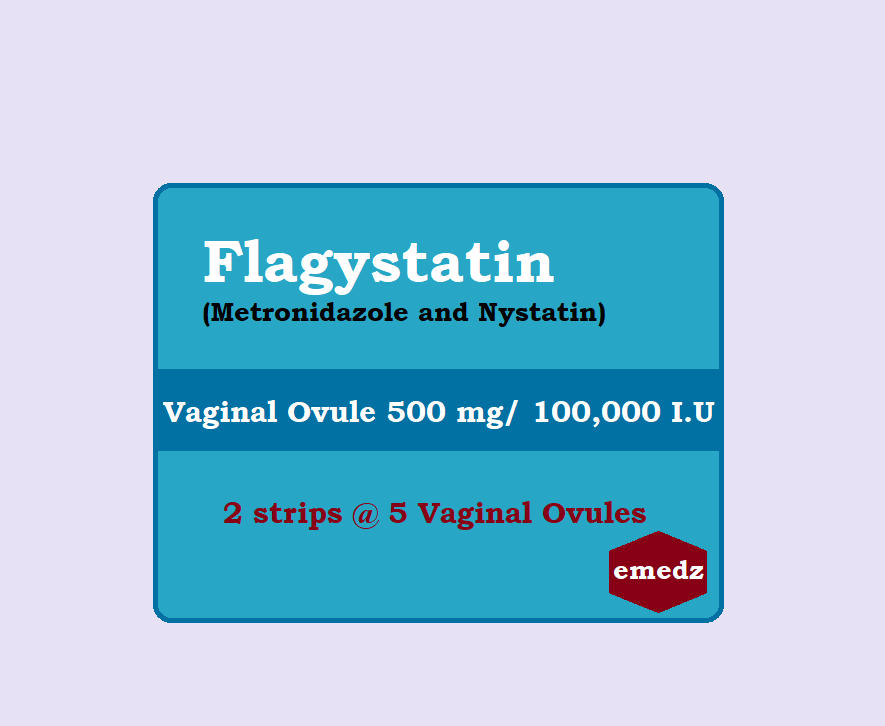
Flagystatin (Metronidazole and Nystatin) is used as a topical intravaginal ovule for the treatment of mixed vaginal infections.
Metronidazole and nystatin Uses:
-
Mixed vaginal infection:
- It is indicated for the treatment of mixed vaginal infections caused by Trichomonas vaginalis and Candida albicans.
Metronidazole and nystatin Dose in Adults:
Flagystatin (Metronidazole and Nystatin) Dose in the treatment of mixed vaginal infection:
-
Females:
- Vaginal tablet (ovule):
- Insert one tablet daily intravaginally at bedtime for ten consecutive days.
- The tablet may be repeated for an additional ten days if the infection persists.
- Vaginal tablet (ovule):
Note: The applicator should not be used after the seventh month of pregnancy. Oral treatment with metronidazole may be given if T. vaginalis infection is not completely eliminated.
Use in Children:
Not indicated.
Pregnancy Risk Category: C/ D
- Metronidazole passes the placental boundary. Although data on nystatin usage during pregnancy are limited, it is likely to cause systemic absorption.
- Manufacturers recommend that you avoid metronidazole in the first trimester and use the combination product intravaginally only after the seventh month.
- Patients with reproductive potential should be advised that effective contraception is used.
- The topical application of this product can decrease the effectiveness of condoms or vaginal diaphragms.
Use of nystatin and metronidazole during breastfeeding
- Breastmilk contains Metronidazole.
- Although data regarding Nystatin's use while breastfeeding is not available, it is possible to absorb the drug systemically.
- This product is not recommended for lactating women, according to the manufacturer.
Dose in Kidney Disease:
There are no dosage adjustments provided in the manufacturer’s labeling.
Dose in Liver disease:
No specific dosage adjustments have been provided in the manufacturer’s labeling. Dose reduction in severe hepatic impairment is recommended.
Side effects of Flagystatin (Metronidazole and Nystatin):
-
Central nervous system:
- Bitter taste
- Fatigue
- Headache
-
Dermatologic:
- Pruritus
- Skin rash (located around the knee)
- Urticaria
-
Gastrointestinal:
- Coated tongue
- Nausea
- Vomiting
-
Genitourinary:
- Vaginal discomfort (granular sensation)
- Vulvovaginal burning
-
Neuromuscular & skeletal:
- Arthralgia (including ankles, wrists)
- Joint swelling (including ankles, wrists)
Contraindication to Flagystatin (Metronidazole and Nystatin):
- Allergy reactions to metronidazole or nystatin, imidazoles, or any component of this formulation
- Patients with active CNS disorders, patients who have had blood dyscrasia, hypothyroidism, or adrenal insufficiency, and patients who have received combined oral and vaginal metronidazole treatment should avoid this.
Caution and Alert
-
CNS effects
-
- Patients receiving metronidazole treatment may have core neurological symptoms as well as peripheral neuropathy.
- If the patient exhibits ataxia or any other neurological problems, the medication should be halted.
- Patients who have neurological problems should exercise caution.
-
Hematologic effects
- Clinical trials have not shown persistent abnormalities.
- Monitor total and differential leukocyte count before and after treatment, especially if you need a second dose of metronidazole.
-
Carcinogenic:
- Metronidazole was found to have carcinogenic potential in animal data.
-
Hypersensitivity
- Allergic responses, such as Stevens-Johnson syndrome and toxic epidermal necrolysis, have been reported.
- It is possible to develop local skin irritations and sensitivities.
- It is important to stop using the treatment and get appropriate treatment as soon as possible.
-
Superinfection
- Chronic treatment may be necessary for superinfections caused by bacteria and fungi that are resistant to the drug. CDAD (clostridium difficile-associated diarrhea) can occur after prolonged treatment. It might occur up to two months following the final dosage.
- Two treatment courses lasting 10 days each should not be used to treat the infection. Cultures should be taken and antibiotics should be discontinued.
- If superinfections occur, it is important to stop treatment and seek alternative treatment.
-
Systemic effects
- Systemic absorption may occur from topical vaginal applications. This could lead to a systemic adverse drug reaction.
-
Urine discoloration:
- To avoid anxiety and discomfort, it is important to inform patients that their urine might turn brown before they begin treatment.
-
Cockayne syndrome:
- Patients with Cockayne syndrome should not use it. Fatal hepatotoxicity could occur.
- After treatment, hepatotoxicity can occur in a short time. It is important to stop the treatment immediately.
- Cockayne syndrome, a rare condition that affects children in their early years of life, is very rare.
- Cockayne syndrome is a rare disease that causes mental disabilities, short stature, early aging, and other complications.
-
Hepatic impairment
- Patients with liver disease should use it with caution. Dosage adjustment is advised to prevent drug accumulation.
- In patients with a history of metronidazole-associated liver injury or encephalopathy, it should be avoided or used with extreme caution.
Metronidazole and nystatin (United States: Not available): Drug Interaction
|
Risk Factor C (Monitor therapy) |
|
|
Lopinavir |
The harmful or unpleasant effects of lopinavir may be increased by metroNIDAZOLE (Topical). In particular, lopinavir/ritonavir solution (which includes 42% alcohol) and topical metronidazole may cause a disulfiram-like response. |
|
Tipranavir |
The toxic/unfavorable effects of Tipranavir may be exacerbated by MetroNIDAZOLE (Topical). |
|
Risk Factor D (Consider therapy modification) |
|
|
Alcohol (Ethyl) |
Alcohol's negative or toxic effects may be exacerbated by MetroNIDAZOLE (Topical) (Ethyl). There might be a response like disulfiram. Management: If patients drink while using topical metronidazole, warn them and keep an eye out for any signs and symptoms of a disulfiram-like response. Alcohol usage between 24 to 72 hours of using vaginal metronidazole is prohibited by several manufacturers of the medication. |
|
Disulfiram |
MetroNIDAZOLE (Topical) may intensify Disulfiram's harmful or hazardous effects. In particular, there may be an elevated risk for CNS toxicities including psychosis. Management: If topical metronidazole is administered in a patient on disulfiram, alert patients and keep an eye out for the emergence of significant CNS effects. Disulfiram usage within two weeks is prohibited by several manufacturers of vaginal metronidazole products. |
|
Risk Factor X (Avoid combination) |
|
|
Progesterone |
Vaginal antifungal agents may reduce progesterone's therapeutic efficacy. |
Monitoring Parameters:
None mentioned. Monitor the response to treatment.
How to administer Flagystatin (Metronidazole and Nystatin)?
Intravaginal:
- It is formulated for vaginal use only. It should be applied via the applicator provided with the product.
- The tablet is inserted into the applicator by pulling the plunger back about one inch and then inserting the tablet into the cup at the end of the tube.
- After application, place the applicator as deep into the vagina as it can go without hurting yourself while lying on your back with your knees drawn up.
- After insertion, then press the plunger and withdraw the applicator.
- The applicator should be washed in warm water after use.
- During the treatment, advise the patient not to use intravaginal products such as tampons, douches, or other treatments during the treatment.
Mechanism of action of Flagystatin (Metronidazole and Nystatin):
See individual agents (Nystatin and Metronidazole)
International Brand Names of Metronidazole and nystatin:
- Flagystatin
- Amrizole N
- Bio-Vagin
- Colpatrin
- Etron nistatina
- Farm-X Duo
- Fladystin
- Flagyl Comp
- Flagyl Nistatina
- Flagystatin
- Flagystatin V
- Flagystatine
- Linfol
- Metanis
- Metrocaps N
- Metrozin Nistatina
- Neo Gynoxa
- Nistatina Metronidazol L.C.H.
- Nystazole
- Provagin
- Tratomax
- Vagistin
- Vanestrin
- Vaxi
Metronidazole and Nystatin Brand Names in Pakistan:
No Brands Available in Pakistan.
.png)


