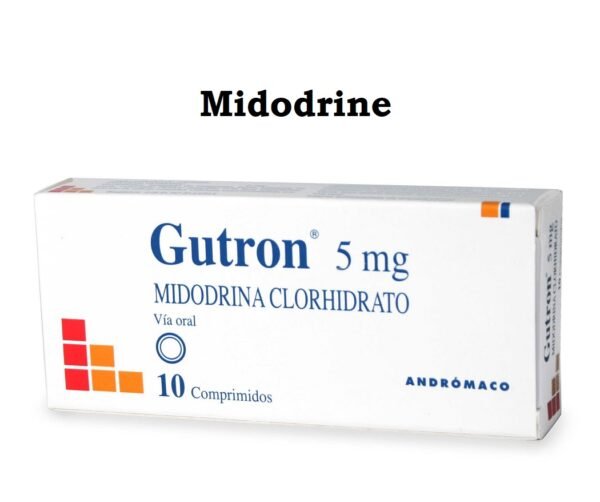
Midodrine (gutron) is an alpha-1 receptor agonist. It causes vasoconstriction resulting in the elevation of blood pressure.
Midodrine (gutron) Uses:
-
Hypotension, symptomatic orthostatic:
- Treatment of symptomatic orthostatic hypotension.
-
Off Label Use of Midodrine in Adults:
- Refractory Ascites
- Hepatorenal Syndrome
- As a vasopressor-sparing drug to treat Hypotension in the ICU
- For the prevention of hemodialysis-induced Hypotension
- Vasovagal syncope
Midodrine Dose in Adults:
Note:
- One hour after taking a 10 mg dosage, it may result in a 15–30 mmHg increase in systolic blood pressure.
- The effects may persist for 2 - 3 hours.
Midodrine (gutron) Dose in the treatment of refractory ascites (off-label):
- 5 to 7.5 mg orally, three times a day.
Treatment of hepatorenal syndrome with midodrine (gutron) (off-label):
- At first, it must be given 3 times per day with a dose of 5 to 10 mg, orally
- To increase the MAP (mean arterial pressure) by a minimum of 15 mm Hg from the baseline, the dosage must be increased to 12.5 mg or 15 mg 3 times per
Treatment of hypotension with midodrine (gutron) dose in the intensive care unit using vasopressor sparing agents:
- At first, it must be given 3 times per day with a dose of 5 to 20 mg, orally
- Before stopping the intravenous vasopressors, the dosage may be raised incrementally.
Doses of midodrine (gutron) used off-label to counteract hypotension brought on by hemodialysis
- 2.5 to 10 mg orally given 15 - 30 minutes before the start of the dialysis session.
Midodrine (gutron) Dose in the treatment of Hypotension, symptomatic orthostatic:
- 2.5 to 10 milligrams are taken orally three times daily, every three to four hours, while the patient is upright.
- The daily dosage cap is 40 mg.
- Note:
- To prevent supine hypertension, avoid it at bedtime (at least four hours before bedtime).
- Patients who develop supine hypertension should discontinue the treatment.
Midodrine (gutron) Dose in the treatment of Vasovagal syncope (off-label):
- If necessary, the dosage can be raised to 15 mg each dose.
- Initially, 2.5 to 10 mg orally thrice per day during morning hours, administered 6hrs apart.
Use in Children:
The drug's effectiveness and safety in children have not been shown.
Pregnancy Risk Factor C
- Its use in pregnancy is not known.
- In animal reproduction studies, however, negative fetal outcomes were found.
Use of midodrine during lactation
- Whether the drug gets released into the breastmilk or not, is not known yet.
- It is recommended that you use it with caution if you are lactating.
Midodrine (gutron) Dose in Kidney Disease:
- Be careful when using it for patients with renal disease.
- Depending on the clinical response, the dose can be increased
- A typical dose is 5mg which is given 3 times per day
- Hemodialysis:
- Dialyzable
Midodrine (gutron) Dose in Liver disease:
In the manufacturer's labeling dose adjustment has not been provided. Precautions must be taken when using the drug for patients with hepatic disease.
Common Side Effects of Midodrine (gutron):
-
Genitourinary:
- Dysuria
- Urinary retention
- Urinary urgency
-
Central nervous system:
- Paresthesia
-
Dermatologic:
- Piloerection
- Pruritus
-
Renal:
- Polyuria
-
Cardiovascular:
- Supine hypertension
Less Common Side Effects of Midodrine (gutron):
-
Central nervous system:
- Chills
- Pain
-
Gastrointestinal:
- Abdominal pain
-
Dermatologic:
- Skin rash
Contraindications to Midodrine (gutron):
- Pheochromocytoma
- Urinary retention
- Thyrotoxicosis
- Grave organic heart disease
- Supine hypertension patients
- Hypertension that is not well controlled.
- Acute renal failure
Warnings and precautions
-
Bradycardia
- A vagal reflex may cause Bradycardia. Avoid concurrent administration of beta-blockers or digoxin.
- Bradycardia must be treated immediately.
-
Hypertension:
- It can cause an increase in both systolic as well as diastolic blood pressure.
- Supine hypertension is a condition that can be fatal. Patients with a baseline blood pressure of 180 mmHg or more must stop taking the treatment.
- These patients can benefit from non-pharmacologic treatments, fluid expansion, and compression stockings to avoid hypotension.
- Concomitant administration with other drugs that cause vasoconstriction such as phenylephrine, ephedrine, phenylpropanolamine, dihydroergotamine, and pseudoephedrine should be avoided.
-
Diabetes:
- Precautions must be taken when used by patients with DM
-
Hepatic impairment
- It should not be used in patients suffering from liver disease.
-
Renal impairment
- The active metabolite, desglymidodrine, is primarily eliminated through the kidneys.
- Assessing renal function is crucial before beginning therapy.
- It has not been used to treat renal disease patients.
- These people ought to start out with a lesser dosage.
- It should not be used by those with severe renal impairment.
-
Visual problems
- Patients with visual issues, especially those on fludrocortisone, should use it with care.
Midodrine: Drug Interaction
|
Risk Factor C (Monitor therapy) |
|
|
Alpha1-Blockers |
May diminish the vasoconstricting effect of Alpha1-Agonists. Similarly, Alpha1Agonists may antagonize Alpha1-Blocker vasodilation. |
|
AtoMOXetine |
May enhance the hypertensive effect of Sympathomimetics. AtoMOXetine may enhance the tachycardic effect of Sympathomimetics. |
|
Bradycardia-inducing Agents |
Midodrine may intensify the bradycardic effect of bradycardia-inducing substances. |
|
Cannabinoid-Containing Products |
May enhance the tachycardic effect of Sympathomimetics. Exceptions: Cannabidiol. |
|
Doxofylline |
Sympathomimetics may enhance the adverse/toxic effect of Doxofylline. |
|
Droxidopa |
Midodrine may enhance the hypertensive effect of Droxidopa. |
|
Guanethidine |
Might make sympathomimetics more arrhythmogenic. Guanethidine could make sympathomimetic drugs more hypertensive. |
|
Solriamfetol |
Sympathomimetics may intensify Solriamfetol's hypertensive effects. |
|
Sympathomimetics |
Might intensify the hazardous or harmful effects of other sympathomimetics. |
|
Tedizolid |
Might make sympathomimetics' hypertensive effects stronger. The tachycardic impact of sympathomimetics may be increased by tedizolid. |
|
Tricyclic Antidepressants |
Alpha1-Agonists' potential therapeutic effects could be improved. Tricyclic antidepressants may reduce the therapeutic effectiveness of Alpha1-Agonists |
|
Risk Factor D (Consider therapy modification) |
|
|
Benzylpenicilloyl Polylysine |
Alpha1-Agonists may diminish the diagnostic effect of Benzylpenicilloyl Polylysine. Management: Consider the use of a histamine skin test as a positive control to assess a patient's ability to mount a wheal and flare response. |
|
Cocaine (Topical) |
May enhance the hypertensive effect of Sympathomimetics. Management: Consider alternatives to the use of this combination when possible. Monitor closely for substantially increased blood pressure or heart rate and for any evidence of myocardial ischemia with concurrent use. |
|
Linezolid |
Might make sympathomimetics' hypertensive effects stronger. Reduce initial sympathomimetic dosages and keep a careful eye out for individuals taking linezolid who exhibit an elevated pressor response. There are currently no suggestions for specific dosage adjustments. |
|
Risk Factor X (Avoid combination) |
|
|
Ergot Derivatives |
May enhance the hypertensive effect of Alpha1-Agonists. Ergot Derivatives may enhance the vasoconstricting effect of Alpha1-Agonists. Exceptions: Ergoloid Mesylates; Nicergoline. |
|
Iobenguane Radiopharmaceutical Products |
Iobenguane radiopharmaceutical products' therapeutic effects may be reduced by alpha1-agonists. Treatment: Before administering iobenguane, stop taking any medications that might impede or interfere with catecholamine transport or absorption for at least five biological half-lives. After each dosage of iobenguane, wait at least 7 days before administering these medications. |
|
Monoamine Oxidase Inhibitors |
Alpha1-Agonists' hypertensive effects could be amplified. Although this is the predicted mode of action for linezolid, treatment guidelines are different from those for other monoamine oxidase inhibitors. Details can be found in monographs that are particular to linezolid. Linezolid is an exception. |
Monitoring parameters:
- Renal function tests.
- Blood pressure while sitting, standing, and supine.
- Liver function tests.
How to administer Midodrine (gutron)?
- It is administered orally. The drug can be administered at three to four-hour intervals.
- It can be administered upon rising in the morning or just shortly before getting out of bed, and at midday.
- To avoid supine hypertension, the medication shouldn't be given after 6 o'clock or within four hours of going to bed.
Mechanism of action of Midodrine (gutron):
- The body creates desglymidodrine, an alpha-1 agonist and active metabolite of midodrine. Alpha-1 receptors are found primarily in vessel walls. It activates the alpha-1 receptors in vessel walls, increasing arteriolar tone and venous tone, which results in an increase in blood pressure.
- Orthostatic hypotension patients may experience an increase in their diastolic and systolic blood pressures when they sit, stand, or supine.
The onset of action:
- About 1 hour
Protein binding:
- It is minimally bound to proteins.
Absorption:
- It is rapidly absorbed.
Distribution:
- It does not cross the blood-brain barrier.
Duration of action:
- 2 to 3 hours
Metabolism:
- The liver and other tissues metabolize it.
- It starts out as a prodrug and quickly deglycinates to desglymidodrine to create the active metabolite.
Bioavailability:
- Desglymidodrine: 93%
Half-life elimination:
- Desglymidodrine: About 3 to 4 hours;
- Midodrine: 25 minutes
Excretion:
- 80% of the metabolite, Desglymidodrine, is actively secreted in the urine.
International Brands of Midodrine:
- Amatine
- APO-Midodrine
- MAR-Midodrine
- Bramox
- Gutron
- Metligine
- Midodrine Hydrochloride
- Midon
- Midorine
- Midron
- Morepress
Midodrine Brand Names in Pakistan:
Midodrine is available in some hospitals. It is not freely available in the market.
For availability, kindly call or text via WhatsApp @ 03455109348
.png)


