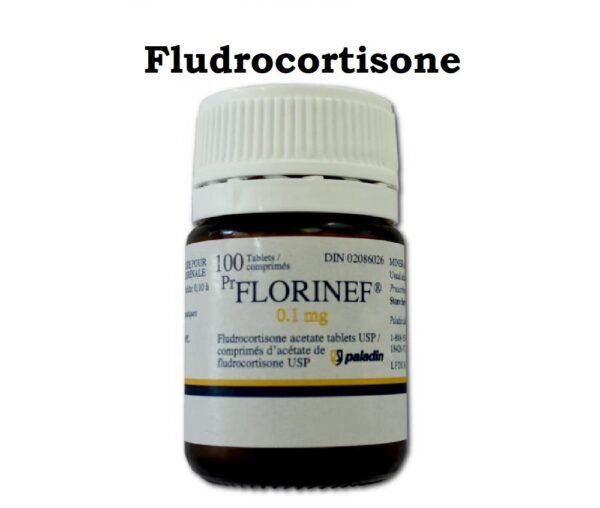
Fludrocortisone (Florinef) is a synthetic mineralo-corticosteroid that is used in the treatment of salt-wasting adrenogenital syndrome and adrenal insufficiency.
Indications of Fludrocortisone:
-
Addison disease (Adrenal insufficiency):
- It is indicated as partial replacement therapy for primary adrenocortical insufficiency.
-
Classic congenital adrenal hyperplasia (salt-losing adrenogenital syndrome):
- It is used for the treatment of classic congenital adrenal hyperplasia (salt-losing adrenogenital syndrome).
-
Off Label Use of Fludrocortisone in Adults:
- Idiopathic orthostatic hypotension.
- Septic shock.
Fludrocortisone dose in adults:
Fludrocortisone (Florinef) dose in the treatment of Addison disease (adrenal insufficiency):
- Initial: 0.05 to 0.1 mg per oral once daily in the morning (in combination with hydrocortisone or cortisone).
- The usual maintenance dose: 0.05 to 0.2 mg once daily.
- Dose reduction is required in case of hypertension.
- In the case of uncontrolled hypertension, antihypertensive may be necessary.
-
Manufacturer's labeling:
- Dosing in the prescribing information may not reflect current clinical practice.
- 0.1 mg daily.
- Dose reduction to 0.05 mg daily if transient hypertension develops.
- Maintenance dosage range: 0.1 mg 3 times weekly to 0.2 mg daily.
Fludrocortisone (Florinef) dose in the treatment of classic congenital adrenal hyperplasia (salt-losing adrenogenital syndrome):
- 0.05 to 0.2 mg/day per oral in 1 or 2 divided doses (in combination with glucocorticoid therapy).
Fludrocortisone (Florinef) dose in the treatment of orthostatic hypotension (off-label):
- Initial: 0.1 mg daily per oral in conjunction with a high-salt diet and adequate fluid intake; may be increased in increments of 0.1 mg per week.
- maximum dose: 1 mg daily.
Note: Doses exceeding 0.3 mg daily may not be beneficial and predispose patient to unwanted side effects (eg, hypertension, hypokalemia).
Fludrocortisone (Florinef) Treatment dose of Septic shock (off-label):
Note: Corticosteroids should only be used for septic shock that is not responsive to volume resuscitation and vasopressors.
- 0.05 mg per oral once daily (via nasogastric tube) for 7 days (in combination with IV hydrocortisone).
Fludrocortisone dose in children:
Note: Dosing should be individualized to lowest effective dose.
Fludrocortisone (Florinef) dose in the treatment of autoimmune adrenal insufficiency:
- 0.05 to 0.2 mg per oral daily.
Fludrocortisone (Florinef) dose in the treatment of congenital adrenal hyperplasia (salt losers) (eg, 21-hydroxylase deficiency):
Note:
- It should be given in combination with glucocorticoid therapy (eg, hydrocortisone).
- Concurrent sodium replacement therapy may be required, particularly in young infants.
-
Maintenance therapy:
-
Infants, Children, and Adolescents (actively growing):
- Usual range: 0.05 to 0.2 mg daily in 1 or 2 divided doses;
- doses as high as 0.3 mg/day may be necessary.
-
Adolescents (fully grown):
- 0.05 to 0.2 mg once daily.
-
Pregnancy Risk Factor C
- Studies on animal reproduction showed adverse results when corticosteroids were used. However, fludrocortisone has not been studied.
- Some studies have shown a correlation between oral clefts and first-trimester corticosteroid usage.
- Systemic steroids can affect fetal growth (decreased birthweight).
- Corticosteroids can cause hypoadrenalism in pregnancy.
- If necessary, it is advised to use the lowest effective dose systemic steroids for the shortest time possible during pregnancy
- It is not a good idea to prescribe systemic steroids during the first trimester.
- Fludrocortisone can be used to treat congenital adrenal hyperplasia and primary adrenal insufficiency during pregnancy.
Fludrocortisone use during breastfeeding:
- Although fludrocortisone secretion is unknown in breast milk, corticosteroids can be excreted from breast milk.
- Fludrocortisone should not be given to nursing mothers without caution, as stated by the manufacturer.
Fludrocortisone (Florinef) Dose adjustment in kidney disease:
There are no dosage adjustments provided in the manufacturer's labeling; use with caution.
Fludrocortisone (Florinef) Dose adjustment in liver disease:
There are no dosage adjustments provided in the manufacturer's labeling; use with caution.
Side effects of Fludrocortisone (Florinef):
-
Cardiovascular:
- Cardiac Failure
- Cardiomegaly
- Edema
- Hypertension
-
Central Nervous System:
- Delirium
- Depression
- Emotional Lability
- Euphoria
- Hallucination
- Headache
- Increased Intracranial Pressure
- Insomnia
- Malaise
- Nervousness
- Personality Changes
- Pseudotumor Cerebri
- Psychiatric Disturbance
- Psychosis
- Seizure
- Vertigo
-
Dermatologic:
- Acne Vulgaris
- Atrophic Striae
- Diaphoresis
- Erythema
- Hyperpigmentation
- Maculopapular Rash
- Skin Atrophy
- Skin Rash
- Suppression Of Skin Test Reaction
- Urticaria
-
Endocrine & Metabolic:
- Cushing’s Syndrome
- Diabetes Mellitus
- Glycosuria
- Growth Suppression
- Hirsutism
- HPA-Axis Suppression
- Hyperglycemia
- Hypokalemia
- Hypokalemic Alkalosis
- Impaired Glucose Tolerance
- Menstrual Disease
- Negative Nitrogen Balance
-
Gastrointestinal:
- Abdominal Distention
- Esophageal Ulcer
- Pancreatitis
- Peptic Ulcer
-
Hematologic & Oncologic:
- Bruise
- Petechia
- Purpura
-
Hypersensitivity:
- Anaphylaxis (Generalized)
-
Local:
- Lipoatrophy At Injection Site
-
Neuromuscular & Skeletal:
- Amyotrophy
- Bone Fracture
- Myasthenia
- Myopathy
- Osteonecrosis (Femoral And Humeral Heads)
- Osteoporosis
- Vertebral Compression Fracture
-
Ophthalmic:
- Cataract
- Exophthalmos
- Glaucoma
- Increased Intraocular Pressure
-
Miscellaneous:
- Wound Healing Impairment
Contraindications to Fludrocortisone (Florinef):
- Hypersensitivity to fludrocortisone and any component of the formulation
- Systemic fungal infections
- There is not much evidence of cross-reactivity between corticosteroids and allergens.
- Cross-sensitivity is possible due to similarities in chemical structure and pharmacologic effects. However, this cannot be ruled out.
Warnings and precautions
-
Suppression of the adrenals:
- Younger children and patients having high doses of steroids can have hypercortisolism or suppression of hypothalamic-pituitary-adrenal (HPA) axis which can result in an adrenal crisis.
- In such cases, corticosteroids must be slowly withdrawn.
-
Anaphylactoid reactions
- Rarely, anaphylactoid reactions can occur in patients who take corticosteroids.
-
Immunosuppression:
- An increased risk of infection is present, including mask acute infection (including fungal infection), prolonged or exacerbated virus infections, and limited response to long-term steroid therapy.
- Avoid exposure to measles or chickenpox.
- It is not recommended for use in viral hepatitis or cerebral malaria.
- Active TB is not a place for steroids. Only fulminating and disseminated TB can be used in conjunction with antituberculosis treatments.
- Close monitoring is required for patients with latent tuberculosis and TB reactivity.
- Patients who have had diarrhea or a history of traveling to tropical climates should be evaluated for amebiasis before starting corticosteroid treatment.
- Strongyloides infection can lead to hyperinfection, dissemination and even death.
-
Kaposi Sarcoma:
- Patients who have received long-term corticosteroid treatment can develop Kaposi Sarcoma.
- These events should not be treated as therapy.
-
Myopathy
- Patients with neuromuscular diseases, particularly high dose corticosteroids, can develop acute myopathy in the eye and/or respiratory muscles. This may lead to delayed recovery.
- It is important to monitor creatine kinase closely.
-
Psychiatric disorders:
- Corticosteroid therapy may cause insomnia, mood swings and personality changes. It can also lead to euphoria, mood swings or psychotic manifestations.
-
Cardiovascular disease
- Patients with heart failure or hypertension may experience fluid retention, electrolyte disturbances, hypertension, and hypotension.
- Patients with MI may experience myocardial rupture if they take corticosteroids. Extreme caution is advised.
-
Diabetes:
- Glucose production/regulation might be altered leading to hyperglycemia, therefore it should be cautiously used in patients with diabetes mellitus.
-
Gastrointestinal Disease:
- Perforation risk is higher in GI diseases (diverticulitis and fresh intestinal anastomoses), active or latent pepticul, ulcerative colitis or abscess or other pyogenic infections). Therefore, it should be used with caution.
-
Hepatic impairment
- Long-term corticosteroid treatment can lead to fluid retention. Patients with cirrhosis and hepatic impairment should be cautious.
-
Myasthenia gravis:
- Patients with myasthenia Gravis should not receive corticosteroid treatment as it can cause severe symptoms.
-
Ocular disease:
- Steroid therapy should not be used for long periods as it can lead to increased intraocular pressure, open angle glaucoma and cataracts.
- Ocular herpes simplex patients may experience corneal perforation.
- In active ocular herpes, simplex, it is not recommended.
- A regular eye exam is necessary for chronic therapy.
-
Osteoporosis
- High doses or prolonged therapy can cause osteoporotic fractures and bone loss.
-
Renal impairment
- Patients with impaired renal function may experience fluid retention.
-
Seizure disorders:
- Patients with a history or seizure disorder should be cautious about triggering an adrenal crisis.
-
Thyroid disease:
- With changes in thyroid function, dosage adjustment is necessary.
- The metabolism of corticosteroids is higher in hyperthyroid patients than in hypothyroid.
Fludrocortisone: Drug Interaction
|
Risk Factor C (Monitor therapy) |
|
|
Acetylcholinesterase Inhibitors |
Corticosteroids (Systemic) may enhance the adverse/toxic effect of Acetylcholinesterase Inhibitors. Increased muscular weakness may occur. |
|
Amphotericin B |
Corticosteroids (Systemic) may enhance the hypokalemic effect of Amphotericin B. |
|
Androgens |
Corticosteroids (Systemic) may enhance the fluid-retaining effect of Androgens. |
|
Antidiabetic Agents |
Hyperglycemia-Associated Agents may diminish the therapeutic effect of Antidiabetic Agents. |
|
Bile Acid Sequestrants |
May decrease the absorption of Corticosteroids (Oral). |
|
Calcitriol (Systemic) |
Corticosteroids (Systemic) may diminish the therapeutic effect of Calcitriol (Systemic). |
|
Coccidioides immitis Skin Test |
Immunosuppressants may diminish the diagnostic effect of Coccidioides immitis Skin Test. |
|
Corticorelin |
Corticosteroids may diminish the therapeutic effect of Corticorelin. Specifically, the plasma ACTH response to corticorelin may be blunted by recent or current corticosteroid therapy. |
|
Cosyntropin |
Corticosteroids (Systemic) may diminish the diagnostic effect of Cosyntropin. |
|
CYP3A4 Inducers (Strong) |
May decrease the serum concentration of Corticosteroids (Systemic). |
|
CYP3A4 Inhibitors (Strong) |
May increase the serum concentration of Corticosteroids (Systemic). |
|
Deferasirox |
Corticosteroids (Systemic) may enhance the adverse/toxic effect of Deferasirox. Specifically, the risk for GI ulceration/irritation or GI bleeding may be increased. |
|
Deferasirox |
Corticosteroids may enhance the adverse/toxic effect of Deferasirox. Specifically, the risk for GI ulceration/irritation or GI bleeding may be increased. |
|
Denosumab |
May enhance the adverse/toxic effect of Immunosuppressants. Specifically, the risk for serious infections may be increased. |
|
DilTIAZem |
May increase the serum concentration of Corticosteroids (Systemic). |
|
Estrogen Derivatives |
May increase the serum concentration of Corticosteroids (Systemic). |
|
Indacaterol |
May enhance the hypokalemic effect of Corticosteroids (Systemic). |
|
Isoniazid |
Corticosteroids (Systemic) may decrease the serum concentration of Isoniazid. |
|
Loop Diuretics |
Corticosteroids (Systemic) may enhance the hypokalemic effect of Loop Diuretics. |
|
Nicorandil |
Corticosteroids (Systemic) may enhance the adverse/toxic effect of Nicorandil. Gastrointestinal perforation has been reported in association with this combination. |
|
Nonsteroidal Anti-Inflammatory Agents (COX-2 Selective) |
Corticosteroids (Systemic) may enhance the adverse/toxic effect of Nonsteroidal Anti-Inflammatory Agents (COX-2 Selective). |
|
Nonsteroidal Anti-Inflammatory Agents (Nonselective) |
Corticosteroids (Systemic) may enhance the adverse/toxic effect of Nonsteroidal Anti-Inflammatory Agents (Nonselective). |
|
Ocrelizumab |
May enhance the immunosuppressive effect of Immunosuppressants. |
|
Pidotimod |
Immunosuppressants may diminish the therapeutic effect of Pidotimod. |
|
Quinolones |
Corticosteroids (Systemic) may enhance the adverse/toxic effect of Quinolones. Specifically, the risk of tendonitis and tendon rupture may be increased. |
|
Ritodrine |
Corticosteroids may enhance the adverse/toxic effect of Ritodrine. |
|
Salicylates |
May enhance the adverse/toxic effect of Corticosteroids (Systemic). These specifically include gastrointestinal ulceration and bleeding. Corticosteroids (Systemic) may decrease the serum concentration of Salicylates. Withdrawal of corticosteroids may result in salicylate toxicity. |
|
Sargramostim |
Corticosteroids (Systemic) may enhance the therapeutic effect of Sargramostim. Specifically, corticosteroids may enhance the myeloproliferative effects of sargramostim. |
|
Siponimod |
Immunosuppressants may enhance the immunosuppressive effect of Siponimod. |
|
Somatropin |
Corticosteroids (Systemic) may diminish the therapeutic effect of Somatropin. |
|
Tacrolimus (Systemic) |
Corticosteroids (Systemic) may decrease the serum concentration of Tacrolimus (Systemic). Conversely, when discontinuing corticosteroid therapy, tacrolimus concentrations may increase. |
|
Tertomotide |
Immunosuppressants may diminish the therapeutic effect of Tertomotide. |
|
Thiazide and Thiazide-Like Diuretics |
Corticosteroids (Systemic) may enhance the hypokalemic effect of Thiazide and Thiazide-Like Diuretics. |
|
Trastuzumab |
May enhance the neutropenic effect of Immunosuppressants. |
|
Urea Cycle Disorder Agents |
Corticosteroids (Systemic) may diminish the therapeutic effect of Urea Cycle Disorder Agents. More specifically, Corticosteroids (Systemic) may increase protein catabolism and plasma ammonia concentrations, thereby increasing the doses of Urea Cycle Disorder Agents needed to maintain these concentrations in the target range. |
|
Warfarin |
Corticosteroids (Systemic) may enhance the anticoagulant effect of Warfarin. |
|
Risk Factor D (Consider therapy modification) |
|
|
Antacids |
May decrease the bioavailability of Corticosteroids (Oral). Management: Consider separating doses by 2 or more hours. Budesonide enteric coated tablets could dissolve prematurely if given with drugs that lower gastric acid, with unknown impact on budesonide therapeutic effects. |
|
Aprepitant |
May increase the serum concentration of Corticosteroids (Systemic). Management: No dose adjustment is needed for single 40 mg aprepitant doses. For other regimens, reduce oral dexamethasone or methylprednisolone doses by 50%, and IV methylprednisolone doses by 25%. Antiemetic regimens containing dexamethasone reflect this adjustment. |
|
Axicabtagene Ciloleucel |
Corticosteroids (Systemic) may diminish the therapeutic effect of Axicabtagene Ciloleucel. Management: Avoid use of corticosteroids as premedication before axicabtagene ciloleucel. Corticosteroids may, however, be required for treatment of cytokine release syndrome or neurologic toxicity. |
|
Baricitinib |
Immunosuppressants may enhance the immunosuppressive effect of Baricitinib. Management: Use of baricitinib in combination with potent immunosuppressants such as azathioprine or cyclosporine is not recommended. Concurrent use with antirheumatic doses of methotrexate or nonbiologic disease modifying antirheumatic drugs (DMARDs) is permitted. |
|
Desirudin |
Corticosteroids (Systemic) may enhance the anticoagulant effect of Desirudin. More specifically, corticosteroids may increase hemorrhagic risk during desirudin treatment. Management: Discontinue treatment with systemic corticosteroids prior to desirudin initiation. If concomitant use cannot be avoided, monitor patients receiving these combinations closely for clinical and laboratory evidence of excessive anticoagulation. |
|
Echinacea |
May diminish the therapeutic effect of Immunosuppressants. |
|
Fingolimod |
Immunosuppressants may enhance the immunosuppressive effect of Fingolimod. Management: Avoid the concomitant use of fingolimod and other immunosuppressants when possible. If combined, monitor patients closely for additive immunosuppressant effects (eg, infections). |
|
Fosaprepitant |
May increase the serum concentration of Corticosteroids (Systemic). The active metabolite aprepitant is likely responsible for this effect. |
|
Hyaluronidase |
Corticosteroids may diminish the therapeutic effect of Hyaluronidase. Management: Patients receiving corticosteroids (particularly at larger doses) may not experience the desired clinical response to standard doses of hyaluronidase. Larger doses of hyaluronidase may be required. |
|
Leflunomide |
Immunosuppressants may enhance the adverse/toxic effect of Leflunomide. Specifically, the risk for hematologic toxicity such as pancytopenia, agranulocytosis, and/or thrombocytopenia may be increased. Management: Consider not using a leflunomide loading dose in patients receiving other immunosuppressants. Patients receiving both leflunomide and another immunosuppressant should be monitored for bone marrow suppression at least monthly. |
|
Mitotane |
May decrease the serum concentration of Corticosteroids (Systemic). |
|
Neuromuscular-Blocking Agents (Nondepolarizing) |
May enhance the adverse neuromuscular effect of Corticosteroids (Systemic). Increased muscle weakness, possibly progressing to polyneuropathies and myopathies, may occur. |
|
Nivolumab |
Immunosuppressants may diminish the therapeutic effect of Nivolumab. |
|
Roflumilast |
May enhance the immunosuppressive effect of Immunosuppressants. |
|
Sipuleucel-T |
Immunosuppressants may diminish the therapeutic effect of Sipuleucel-T. Management: Evaluate patients to see if it is medically appropriate to reduce or discontinue therapy with immunosuppressants prior to initiating sipuleucel-T therapy. |
|
Tisagenlecleucel |
Corticosteroids (Systemic) may diminish the therapeutic effect of Tisagenlecleucel. Management: Avoid use of corticosteroids as premedication or at any time during treatment with tisagenlecleucel, except in the case of life-threatening emergency (such as resistant cytokine release syndrome). |
|
Tofacitinib |
Immunosuppressants may enhance the immunosuppressive effect of Tofacitinib. Management: Concurrent use with antirheumatic doses of methotrexate or nonbiologic disease modifying antirheumatic drugs (DMARDs) is permitted, and this warning seems particularly focused on more potent immunosuppressants. |
|
Vaccines (Inactivated) |
Immunosuppressants may diminish the therapeutic effect of Vaccines (Inactivated). Management: Vaccine efficacy may be reduced. Complete all age-appropriate vaccinations at least 2 weeks prior to starting an immunosuppressant. If vaccinated during immunosuppressant therapy, revaccinate at least 3 months after immunosuppressant discontinuation. |
|
Vaccines (Live) |
Corticosteroids (Systemic) may enhance the adverse/toxic effect of Vaccines (Live). Corticosteroids (Systemic) may diminish the therapeutic effect of Vaccines (Live). Management: Doses equivalent to less than 2 mg/kg or 20 mg per day of prednisone administered for less than 2 weeks are not considered sufficiently immunosuppressive to create vaccine safety concerns. Higher doses and longer durations should be avoided. |
|
Risk Factor X (Avoid combination) |
|
|
Aldesleukin |
Corticosteroids may diminish the antineoplastic effect of Aldesleukin. |
|
BCG (Intravesical) |
Immunosuppressants may diminish the therapeutic effect of BCG (Intravesical). |
|
Cladribine |
May enhance the immunosuppressive effect of Immunosuppressants. |
|
Desmopressin |
Corticosteroids (Systemic) may enhance the hyponatremic effect of Desmopressin. |
|
Indium 111 Capromab Pendetide |
Corticosteroids (Systemic) may diminish the diagnostic effect of Indium 111 Capromab Pendetide. |
|
Macimorelin |
Corticosteroids (Systemic) may diminish the diagnostic effect of Macimorelin. |
|
Mifamurtide |
Corticosteroids (Systemic) may diminish the therapeutic effect of Mifamurtide. |
|
MiFEPRIStone |
May diminish the therapeutic effect of Corticosteroids (Systemic). MiFEPRIStone may increase the serum concentration of Corticosteroids (Systemic). Management: Avoid mifepristone in patients who require long-term corticosteroid treatment of serious illnesses or conditions (e.g., for immunosuppression following transplantation). Corticosteroid effects may be reduced by mifepristone treatment. |
|
Natalizumab |
Immunosuppressants may enhance the adverse/toxic effect of Natalizumab. Specifically, the risk of concurrent infection may be increased. |
|
Pimecrolimus |
May enhance the adverse/toxic effect of Immunosuppressants. |
|
Tacrolimus (Topical) |
May enhance the adverse/toxic effect of Immunosuppressants. |
Monitoring parameters:
- Weight
- BP
- Growth and development in children
- Blood glucose level
- Serum electrolytes
- HPA axis suppression.
How to administer Fludrocortisone (Florinef)?
It should be given orally without regard to food, however, it is advised to take with food in case of GI upset. It should be given via a nasogastric tube in patients with septic shock.
Mechanism of action of Fludrocortisone (Florinef):
- Fludrocortisone, a powerful mineralocorticoid that has high glucocorticoid activities, is used primarily for its mineralocorticoid properties.
- It increases the reabsorption and loss of sodium from the renal distal tubules.
Metabolism:
- Hepatic.
Half-life elimination:
- Plasma: ≥3.5 hours.
- Biological: 18 to 36 hours.
International Brands of Fludrocortisone:
- Florinef
- Astonin
- Astonin H
- Astonin-H
- Cortineff
- Floricot
- Florinef
- Florinefe
- Lonikan
Fludrocortisone Brand Names in Pakistan:
Florinef 0.1 mg (100 mcg)
.png)


