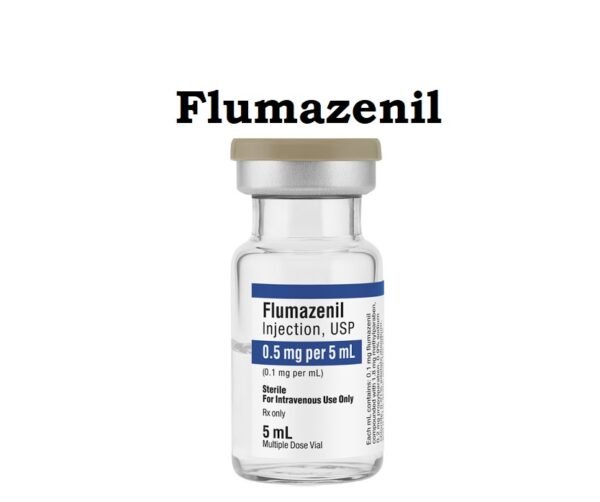
Flumazenil is a GABA-A receptor antagonist that is used to reverse the effects of benzodiazepines (It is used as an antidote for Benzodiazepine overdose).
Indications of Flumazenil:
-
Benzodiazepine reversal when used in conscious sedation or general anesthesia:
- It is effective in complete or partial reversal of the sedative effects of benzodiazepines used in conscious sedation and general anesthesia.
-
Management of benzodiazepine overdose:
- It is indicated for the treatment of benzodiazepine overdose.
Flumazenil dosage in adults:
Flumazenil dose in Benzodiazepine reversal when used in conscious sedation or general anesthesia:
- Initial dose: 0.2 mg IV over 15 seconds
-
Repeat doses (maximum: 4 doses):
- If the desired level of consciousness is not obtained, 0.2 mg may be repeated at 1-minute intervals.
-
Maximum total cumulative dose:
- 1 mg IV (usual total dose: 0.6 to 1 mg).
-
In the event of resedation:
- Repeat doses may be given at 20-minute intervals as needed at 0.2 mg per minute to a maximum of 1 mg total dose and 3 mg in 1 hour.
Flumazenil dose in the management of benzodiazepine overdose:
- Initial dose: 0.2 mg IV over 30 seconds;
- if the desired level of consciousness is not obtained 30 seconds after the dose, 0.3 mg can be given over 30 seconds.
-
Repeat doses of flumazenil:
- 5 mg IV over 30 seconds repeated at 1-minute intervals.
-
The maximum total cumulative dose of flumazenil:
- 3 mg IV (usual total dose: 1 to 3 mg).
- Additional titration up to a total dose of 5 mg can be done in patients with a partial response with a 3 mg dose (although doses >3 mg do not reliably produce additional effects).
- If a patient has not responded 5 minutes after a cumulative dose of 5 mg, the major cause of sedation is not likely due to benzodiazepines or may be due to exposure to additional CNS depressants (eg, opioids).
- In the event of resedation, repeat doses may be given at 20-minute intervals if needed, at 0.5 mg per minute to a maximum of 1 mg total dose and 3 mg in 1 hour.
Flumazenil dosage in children:
Flumazenil dose in benzodiazepine reversal when used in conscious sedation or general anesthesia:
-
Infants, Children, and Adolescents:
- Initial dose: 0.01 mg/kg IV (maximum dose: 0.2 mg) given over 15 seconds
- may repeat 0.01 mg/kg (maximum dose: 0.2 mg) after 45 seconds, and then every minute to a maximum total cumulative dose of 0.05 mg/kg or 1 mg, whichever is lower;
- The usual total dose: 0.08 to 1 mg (mean: 0.65 mg).
Flumazenil dose in suspected benzodiazepine overdose: Limited data available:
-
Infants, Children, and Adolescents:
- Initial dose: 0.01 mg/kg (maximum dose: 0.2 mg) with repeat doses of 0.01 mg/kg (maximum dose: 0.2 mg) given every minute to a maximum total cumulative dose of 1 mg;
- as an alternative to repeat bolus doses, follow up continuous infusions of 0.005-0.01 mg/kg/hour have been used.
Pregnancy Risk Factor C
- Studies on animal reproduction did not show any adverse results.
- Higher doses may cause embryocidal effects.
- It is not recommended that you use it during labor and delivery.
- Antidotes that are used to treat a mother's health should be considered.
- Antidotes should only be administered to pregnant women if they are indicated for use. They should not be withheld due to fear of harm to the fetus.
Flumazenil use during breastfeeding:
- It is unknown if breast milk secretes flumazenil.
- Flumazenil should not be given to women who are breast-feeding.
Flumazenil Dose adjustment in kidney disease:
No dosage adjustment provided in the manufacturer's labeling, however, pharmacokinetics are not significantly affected by renal failure (CrCl <10 mL/minute) or hemodialysis.
Flumazenil Dose adjustment in liver disease:
Initial reversal: No dosage adjustment necessary. Repeat doses: Dose or frequency reduction is required.
Common Side Effects of Flumazenil:
-
Gastrointestinal:
- Vomiting
Rare Side Effects of Flumazenil:
-
Cardiovascular:
- Palpitation
- Flushing
- Thrombophlebitis
- Vasodilatation
-
Central Nervous System:
- Ataxia
- Dizziness
- Vertigo
- Agitation
- Anxiety
- Insomnia
- Nervousness
- Depersonalization
- Depression
- Dysphoria
- Emotional Lability
- Euphoria
- Fatigue
- Headache
- Hypoesthesia
- Malaise
- Paranoia
- Paresthesia
-
Dermatologic:
- Dermatological Disease
- Diaphoresis
- Skin Rash
-
Endocrine & Metabolic:
- Hot Flash
-
Gastrointestinal:
- Xerostomia
- Nausea
-
Local:
- Pain At Injection Site
- Injection Site Reaction
-
Neuromuscular & Skeletal:
- Weakness
- Tremor
-
Ophthalmic:
- Blurred Vision
- Lacrimation
- Visual Disturbance
-
Respiratory:
- Dyspnea
- Hyperventilation
Contraindications to Flumazenil:
- Hypersensitivity to flumazenil, the benzodiazepines or any component of this formulation
- Patients who have taken or are experiencing symptoms of cyclic antidepressants
- For the treatment of fatal conditions, such as intracranial pressure control or epilepticus, patients are prescribed benzodiazepines.
Warnings and precautions
-
Amnesia
- Flumazenil is not able to reverse amnesia. Patients may not recall verbal instructions after Flumazenil.
-
CNS depression:
- CNS depression can lead to impairment of physical or mental capabilities.
- Patients should be warned not to drive or operate machinery for 24 hours following discharge.
-
Resedation
- In patients having a large single dose or cumulative dose of a benzodiazepine in addition to a neuromuscular-blocking agent and multiple anesthetic agents, resedation can frequently occur.
-
Respiratory depression
- As flumazenil cannot replace oxygenation, the first step to overdose management should be to create an airway and assist ventilation.
- It should not be relied upon for reversing respiratory depression/hypoventilation.
-
Seizures: [US Boxed Warning]:
- Seizures may occur when benzodiazepine is reversed.
- Patients with myoclonic activity, seizure activity, or myoclonic jerking before flumazenil therapy, benzodiazepines for long-term sedation, or after tricyclic antidepressant overload, recent therapy with multiple doses of parenteral and major sedative-hypnotic drugs withdrawal, or with recent therapy with repeated dosages of benzodiazepines.
- Individual doses are used to treat seizures. Practitioners should be trained to manage seizures.
- In patients using benzodiazepine for seizure control, caution must be used.
-
Head injury
- Flumazenil may cause cerebral blood flow alteration in patients taking benzodiazepine. Convulsions can also be precipitated in patients who have suffered a head injury.
-
Hepatic impairment
- Patients with hepatic dysfunction should be advised to reduce their doses or to take smaller amounts of repeat doses. However, it is important that they exercise caution.
-
Panic disorder
- Flumazenil can cause panic attacks. Patients with a history or panic disorder should not use it.
Monitoring parameters:
Respiratory depression Monitoring for return of sedation, benzodiazepine withdrawal, and other residual effects of benzodiazepines for at least 2 hours and until the patient is stable and resedation is unlikely.
How to administer Flumazenil?
Flumazenil should be given intravenously into a large vein.
Management of benzodiazepine overdose:
- Administer over 30 seconds.
Reversal of benzodiazepine when used in conscious sedation:
- Administer over 15 seconds.
Mechanism of action of Flumazenil:
- Flumazenil is a competitive inhibitor of the activity at the benzodiazepine receptor site on the GABA/benzodiazepine complex.
- Drugs that affect GABA-ergic neuronal cells are not able to block their CNS effects. Flumazenil cannot reverse the effects of opioids.
Notice:
- This is a two-compartment, open model. Clearance and V per kilogram are the same for adults and children. Children show more variability.
The beginning of action:
- 1-2 minutes, 80% response in 3 minutes.
Peak effect:
- 6-10 minutes.
Duration:
- Resedation occurs after 1 hour (range: 19-50 minutes);
- The duration related to the dose is given and benzodiazepine plasma concentrations;
- reversal effects of flumazenil may wear off before the effects of the benzodiazepine.
Distribution:
- Initial V : 0.5 L/kg; V : 0.9-1.1 L/kg.
Protein binding:
- 50% (67% of which is bound to albumin).
Metabolism:
- Hepatic; dependent upon hepatic blood flow.
Half-life elimination:
- Children: Terminal: 20-75 minutes (mean: 40 minutes)
- Adults: Alpha: 4-11 minutes; Terminal: 40-80 minutes
- Moderate hepatic dysfunction: 1.3 hours
- Severe hepatic impairment: 2.4 hours
Excretion:
- Feces; urine (<1% as unchanged drug)
- Clearance: Dependent upon hepatic blood flow; Adults: 0.8-1 L/hour/kg
International Brands of Flumazenil:
- Anexat
- Anexate
- Antabenz
- Antadona
- Anzenil
- Fadaflumaz
- Flumage
- Flumil
- Flunexate
- Flunexil
- Flunil
- Fluoxem
- Lai Yi
- Lanexat
- Outnestin
Flumazenil Brand Names in Pakistan:
Flumazenil Injection 100 mcg/ml |
|
| Anexate | Martin Dow Pharmaceuticals (Pak) Ltd. |
.png)