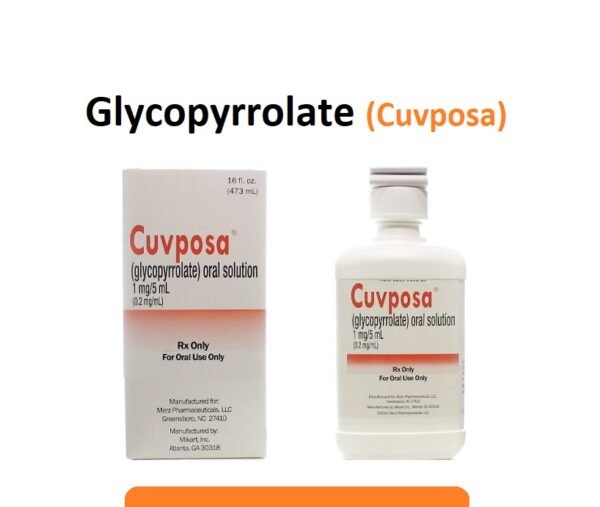
Glycopyrrolate (Cuvposa) or Glycopyrronium is an anticholinergic medicine that does not cross the blood-brain barrier and hence does not cause central nervous system-related adverse effects. It is used to control respiratory secretion as in the perioperative settings and in patients with chronic drooling of the saliva. It is also used to reverse the cholinergic side effects of anesthetic agents and muscarinic agents like neostigmine and pyridostigmine.
Glycopyrrolate Uses:
-
Chronic drooling (Cuvposa only):
- Glycopyrronium is used in management to decrease chronic, severe drooling in the child age group of patients from 3 to 16 years with CNS abnormalities (eg includes cerebral palsy).
-
Reduction of secretions (injection only):
- It is also used during the induction of anesthesia via reducing tracheobronchial and pharyngeal secretions. It is also helpful in reducing the volume and pH of gastric secretions thus reducing the chances of aspiration during intubation.
-
Reversal of bradycardia, vagal reflexes (injection only):
- This drug can also be used to inhibit negative feedback reflexes from the vagus nerve to the cardiac plexus during the induction phase of Anesthesia.
- Intraoperative cardiac arrhythmias secondary to drugs or surgically induced or from vagal reflexes can also be controlled.
-
Reversal of muscarinic effects of cholinergic agents (injection only):
- Bradycardia and excessive secretions can be protected by using Glycopyrronium.
- In short, it helps to antagonize muscarinic effects of cholinergic agents (like pyridostigmine and neostigmine).
- Muscarinic agonists are usually given to reverse neuromuscular blockade caused by non-depolarizing muscular relaxants.
-
Off Label Use of Glycopyrrolate in Adults:
- For excessive facial, palm, and axillary sweating.
Glycopyrrolate (Cuvposa) Dose in Adults
Glycopyrrolate (Cuvposa) Dose in the treatment of primary focal hyperhidrosis (off- label):
- Oral: It can be given as 1 to 2 mg once or twice a day. It might show a typical effective dosage range.
- Titrate the dose as per the response and tolerability of the patient.
- Glycopyrronium can be given up to 6 to 8 mg per day in 2 or 3 divided doses have been used in some patients.
Glycopyrrolate (Cuvposa) Dose in the treatment of Reduction of secretions (preoperative):
- IM: It can be given as 4 mcg/kg over 30 to 60 minutes before anesthesia or with the pre-anesthetic opioid along with a sedative.
Glycopyrrolate (Cuvposa) Dose in the treatment of Reversal of bradycardia, vagal reflexes (intraoperative):
- IV: 0.1 mg intravenously as a single dose.
- The dose can be repeated as per requirement i.e, at 2- to 3-minute intervals
Glycopyrrolate (Cuvposa) Dose in the treatment of Reversal of muscarinic effects of cholinergic agents:
- IV: 0.2 mg for each 1 mg of neostigmine or per 5 mg of pyridostigmine administered
Glycopyrrolate (Cuvposa) Dose in Childrens
Glycopyrrolate (Cuvposa) Dose in the treatment of Chronic drooling:
-
Children ≥3 years and Adolescents ≤16 years:
- Oral solution (Cuvposa): The usual dose is 20 mcg/kg/dose thrice daily and can be titrated up in increments of 20 mcg/kg/dose every week as tolerated up to a maximum dose of 100 mcg/kg/dose thrice daily.
- However, it should not exceed 1,500 to 3,000 mcg/dose.
Glycopyrrolate (Cuvposa) Dose to control respiratory secretions, palliative care:
-
Children:
- Oral: It can be given as 40 to 100 mcg/kg/dose every 4 to 8 hours (Kliegman 2016).
Glycopyrrolate (Cuvposa) Dose in the treatment of Reduction of secretions (preoperative):
-
Infants and Children ≤2 years:
- IM: In infants, it can be given as 4 to 9 mcg/kg/dose, 30 to 60 minutes before the commencement of the procedure.
-
Children >2 years and Adolescents:
- IM: For children greater than 2 years of age, the recommended dose is 4 mcg/kg/dose, i.e 30 to 60 minutes before the intervention.
Glycopyrrolate (Cuvposa) Dose in the reversal of bradycardia, vagal reflexes (intraoperative):
-
Infants, Children, and Adolescents:
- IV: Recommended dose is 4 mcg/kg/dose at 2 to 3 minute intervals. It can be maximized up to 100 mcg/dose.
Glycopyrrolate (Cuvposa) Dose in the reversal of muscarinic effects of cholinergic agents:
-
Infants, Children, and Adolescents:
- IV: 0.2 mg of glycopyrronium can be given for each 1 mg of neostigmine or 5 mg of pyridostigmine.
Pregnancy Risk Factor B (injection)
- The drug appears to not cross the placental barriers in any significant way.
- Glycoperinum should not be given at a dosage exceeding 4 mcg/kg to maintain fetal heart rate and variability.
Glycopyrrolate use during breastfeeding:
- It is unknown if breast milk secretes it.
- Glycoperrolate should not be administered to a mother who is breastfeeding. Its benefits must outweigh its risks.
- It could also cause milk to stop flowing.
Dose in Kidney disease:
There are no specific dosage adjustments provided in the manufacturer's labeling; elimination is severely impaired in renal failure; use with caution; dosage adjustment may be necessary.
Dose in Liver disease:
No specific dose reduction is required as per the manufacturer. however, physicians should use it with caution and may reduce its dose depending upon clinical judgment.
Side effects of Glycopyrrolate (Cuvposa):
-
Cardiovascular:
- Flushing
- Pallor
- Cardiac Arrhythmias
- Heart Block
- Hypertension
- Hypotension
- Palpitation
- Tachycardia
-
Central Nervous System:
- Headache
- Aggressiveness
- Agitation
- Crying
- Irritability
- Mood Changes
- Pain
- Restlessness
- Confusion
- Dizziness
- Drowsiness
- Excitement
- Insomnia
- Nervousness
-
Dermatologic:
- Dry Skin
- Pruritus
- Rash
- Hypohidrosis
- Urticaria
-
Endocrine & Metabolic:
- Dehydration
-
Gastrointestinal:
- Vomiting
- Xerostomia
- Constipation
- Abdominal Distention
- Abdominal Pain
- Flatulence
- Retching
- Intestinal Obstruction
- Loss Of Taste
- Nausea
- Pseudo-Obstruction
-
Genitourinary:
- Urinary Retention
- Urinary Tract Infection
- Decreased Lactation
- Impotence
- Urinary Hesitancy
-
Neuromuscular & Skeletal:
- Weakness
-
Ophthalmic:
- Nystagmus
- Blurred Vision
- Cycloplegia
- Increased Intraocular Pressure
- Mydriasis
-
Respiratory:
- Nasal Congestion
- Sinusitis
- Upper Respiratory Tract Infection
- Bronchial Secretion
- Nasal Dryness
- Pneumonia
Contraindications to Glycopyrrolate (Cuvposa):
- A documented hypersensitivity reaction is possible, so it is important to not give glycopyrrolate or any of its components after it has been established.
- There are some medical conditions that anticholinergics may not be prescribed for.
- These include Ulcerative colitis and toxic megacolon. This can cause paralytic ileus, pseudo-obstruction, or paralytic ileus. It can also lead to stenosis and achalasia of the stomach.
- It has been reported that patients with severe disabilities or elderly suffer from intestinal dysmotility.
- Glycopyrrolate contraindicated for patients with glaucoma, impaired cardiovascular status, acute hemorhage, and obstructive urinary tract disease (BPH) or bladder neck obstruction.
- Myasthenia Gravis can also be included in contraindications.
- In solid oral form, Glycopyrronium should not be taken with potassium chloride.
Warnings and precautions
-
CNS effects
- It can cause blurry vision and drowsiness, which can lead to impairment of mental or physical abilities.
- Patients should be aware that they may not be able to perform daily tasks that require mental exertion, such as driving or operating machinery.
-
Transit GI:
- It can lead to decreased motility in the gut, which can result in constipation and intestinal pseudo-obstruction.
- Constipation can be a dose-limiting factor. Abdominal dysmotility may cause abdominal distension, nausea and pain.
- Vomiting can ensue. If any adverse reactions occur, the drug should be stopped immediately.
-
Heat prostration:
- If there is fever or an increase in the temperature or physical exertion, heat prostration may occur. It is more common in younger and older people. These conditions warrant caution.
-
Incomplete mechanical obstruction
- Diarrhea, particularly in patients who have an ileostomy (or colostomy), may be an indication of incomplete intestinal obstruction.
- These patients should be avoided. If you suspect that there is an incomplete or permanent intestinal obstruction, stop using the medication.
-
Cardiovascular disease
- Patients with heart disease, coronary artery disease, heart failure or arrhythmias, hypertension or tachycardia should be cautious.
- Before administering the drug, it is important to evaluate for tachycardia.
-
Hepatic impairment
- Patients with hepatic impairment should be cautious and may need to reduce dosage.
-
Hiatal hernia
- Patients with hiatal hernia and reflux esophagitis should be cautious. Reduction of dose is advised.
-
Hyperthyroidism:
- Patients with hyperthyroidism should be cautious.
-
Neuropathy:
- Patients with autonomic neuropathy should be cautious. Reduce the dose.
-
Bladder neck obstruction/prostatic hyperplasia:
- This could make it more difficult to treat the symptoms of bladder neck obstruction and prostatic hyperplasia.
- It is important to exercise caution. Patients with prostatic hypertrophy should consider reducing their dosage.
-
Renal impairment
- Patients with impaired renal function should exercise caution.
- Patients with renal impairment should adjust their doses as the majority of the drug is excreted through their kidneys.
-
Ulcerative colitis
- In ulcerative colitis, large doses of medication should be avoided as they can cause intestinal obstruction.
- To prevent toxic megacolon, dose reduction is recommended.
- Patients with severe ulcerative colitis should not be used.
Glycopyrrolate (glycopyrronium): Drug Interaction
|
Risk Factor C (Monitor therapy) |
|
|
Acetylcholinesterase Inhibitors |
May diminish the therapeutic effect of Anticholinergic Agents. Anticholinergic Agents may diminish the therapeutic effect of Acetylcholinesterase Inhibitors. |
|
Amantadine |
May enhance the anticholinergic effect of Glycopyrrolate (Systemic). |
|
Anticholinergic Agents |
May enhance the adverse/toxic effect of other Anticholinergic Agents. |
|
Atenolol |
Glycopyrrolate (Systemic) may increase the serum concentration of Atenolol. |
|
Botulinum Toxin-Containing Products |
May enhance the anticholinergic effect of Anticholinergic Agents. |
|
Cannabinoid-Containing Products |
Anticholinergic Agents may enhance the tachycardic effect of Cannabinoid-Containing Products. Exceptions: Cannabidiol. |
|
Chloral Betaine |
May enhance the adverse/toxic effect of Anticholinergic Agents. |
|
Digoxin |
Glycopyrrolate (Systemic) may increase the serum concentration of Digoxin. |
|
Gastrointestinal Agents (Prokinetic) |
Anticholinergic Agents may diminish the therapeutic effect of Gastrointestinal Agents (Prokinetic). |
|
Glucagon |
Anticholinergic Agents may enhance the adverse/toxic effect of Glucagon. Specifically, the risk of gastrointestinal adverse effects may be increased. |
|
Itopride |
Anticholinergic Agents may diminish the therapeutic effect of Itopride. |
|
Levodopa-Containing Products |
Glycopyrrolate (Systemic) may decrease the serum concentration of Levodopa-Containing Products. |
|
MetFORMIN |
Glycopyrrolate (Systemic) may increase the serum concentration of MetFORMIN. |
|
Mianserin |
May enhance the anticholinergic effect of Anticholinergic Agents. |
|
Mirabegron |
Anticholinergic Agents may enhance the adverse/toxic effect of Mirabegron. |
|
Nitroglycerin |
Anticholinergic Agents may decrease the absorption of Nitroglycerin. Specifically, anticholinergic agents may decrease the dissolution of sublingual nitroglycerin tablets, possibly impairing or slowing nitroglycerin absorption. |
|
Opioid Agonists |
Anticholinergic Agents may enhance the adverse/toxic effect of Opioid Agonists. Specifically, the risk for constipation and urinary retention may be increased with this combination. |
|
Ramosetron |
Anticholinergic Agents may enhance the constipating effect of Ramosetron. |
|
Thiazide and Thiazide-Like Diuretics |
Anticholinergic Agents may increase the serum concentration of Thiazide and Thiazide-Like Diuretics. |
|
Topiramate |
Anticholinergic Agents may enhance the adverse/toxic effect of Topiramate. |
|
Risk Factor D (Consider therapy modification) |
|
|
Haloperidol |
Glycopyrrolate (Systemic) may decrease the serum concentration of Haloperidol. Management: Monitor patients closely for signs/symptoms of reduced clinical response to haloperidol if concurrent use with glycopyrrolate is required. When possible, consider avoiding concurrent use. |
|
Pramlintide |
May enhance the anticholinergic effect of Anticholinergic Agents. These effects are specific to the GI tract. |
|
Secretin |
Anticholinergic Agents may diminish the therapeutic effect of Secretin. Management: Avoid concomitant use of anticholinergic agents and secretin. Discontinue anticholinergic agents at least 5 half-lives prior to administration of secretin. |
|
Risk Factor X (Avoid combination) |
|
|
Aclidinium |
May enhance the anticholinergic effect of Anticholinergic Agents. |
|
Cimetropium |
Anticholinergic Agents may enhance the anticholinergic effect of Cimetropium. |
|
Eluxadoline |
Anticholinergic Agents may enhance the constipating effect of Eluxadoline. |
|
Glycopyrrolate (Oral Inhalation) |
Anticholinergic Agents may enhance the anticholinergic effect of Glycopyrrolate (Oral Inhalation). |
|
Glycopyrronium (Topical) |
May enhance the anticholinergic effect of Anticholinergic Agents. |
|
Ipratropium (Oral Inhalation) |
May enhance the anticholinergic effect of Anticholinergic Agents. |
|
Levosulpiride |
Anticholinergic Agents may diminish the therapeutic effect of Levosulpiride. |
|
Oxatomide |
May enhance the anticholinergic effect of Anticholinergic Agents. |
|
Potassium Chloride |
Glycopyrrolate (Systemic) may enhance the adverse/toxic effect of Potassium Chloride. This is specific to solid oral dosage forms of potassium chloride. |
|
Potassium Citrate |
Anticholinergic Agents may enhance the ulcerogenic effect of Potassium Citrate. |
|
Revefenacin |
Anticholinergic Agents may enhance the anticholinergic effect of Revefenacin. |
|
Tiotropium |
Anticholinergic Agents may enhance the anticholinergic effect of Tiotropium. |
|
Umeclidinium |
May enhance the anticholinergic effect of Anticholinergic Agents. |
Monitoring parameters:
- Heart rate for anticholinergic effects.
- bowel sounds and bowel movements.
- Effects on drooling
How to administer Glycopyrrolate (Cuvposa)?
IM:
- May administer undiluted.
IV:
- It can be given intravenously with or without dilution.
- If in a perioperative setting, it is usually administered over 1 to 2 minutes (eg, in adults: 0.2 mg over 1 to 2 minutes).
- It can also be administered via the tubing of a running IV infusion of a NS.
- It can be administered IV in the same syringe with neostigmine or pyridostigmine for reversal of neuromuscular blockade.
Oral:
- If given orally then should be administered with oral solution 1 hour before or 2 hours after meals.
- The oral solution can be measured with the proper device or measuring cups.
Mechanism of action of Glycopyrrolate (Cuvposa):
- It works by blocking the action acetylcholine in parasympathetic levels of smooth muscle, secretory and CNS.
- This indirectly decreases salivation rate by blocking stimulation of acetylcholine receptors.
The beginning of action:
-
- IM: 15-30 minutes
- In less than 1 minute
Peak effect:
- IM: Within ~30 to 45 minutes
Duration:
- Vagal effect: 2 to 3 hours;
- Inhibition of salivation: Up to 7 hours;
- Parenteral: 7 hours
Absorption:
- Oral tablet: Poor (~3%); variable and erratic;
- Oral solution: 23% lower compared to tablet; high-fat meal markedly reduces the oral bioavailability
Bioavailability: Tablet:
- 3%
Half-life elimination:
- IV: Infants: 21.6 to 130 minutes. Children: 19.2 to 99.2 minutes.
- IM: Adults: 0.55 to 1.25 hours. IV: 0.83 ± 0.27 hour;
- Oral solution: Adults: 3 hours
Time to peak, plasma:
- 3.1 hours
Excretion:
- Urine (as unchanged drug, IM: >80%, IV: 85%).
- Via bile (as unchanged drug, <5%)
International Brand Names of Glycopyrrolate:
- Cuvposa
- Glycate
- Glyrx-PF
- Robinul
- Robinul-Forte
- Androl
- Glyco-P
- Glycopyrrola
- Glyprolate
- Pyrolate
- Robinul
- Robinul Forte
- Robinunl
- Supotaria
- Tabinul
Glycopyrrolate Brand Names in Pakistan:
Glycopyrrolate Injection 0.2 mg/ml in Pakistan |
|
| Pyrolate | Brookes Pharmaceutical Laboratories (Pak.) Ltd. |
Correct Spellings: Glycopyrrolate, Cuvposa Incorrect spellings: Glycopyrolate, Cuposa, Glycopyrolat, Cvposa
.png)


