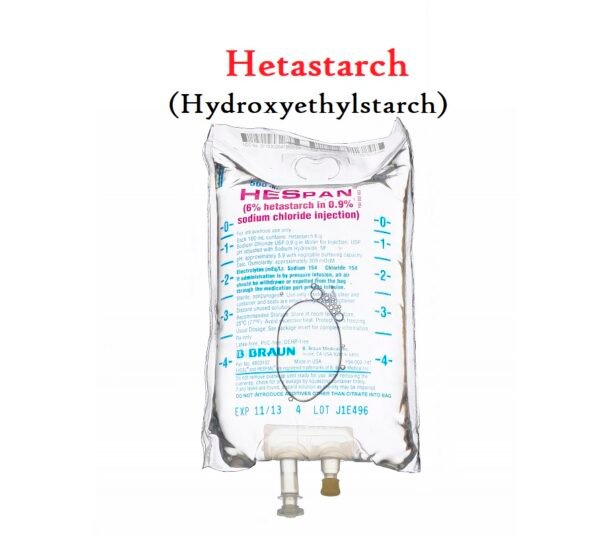
Hetastarch (Hydroxyethyl Starch) is a starch derivative that is used as a volume expander in patients with hypovolemia, hypotension, and shock. It should be avoided in patients with liver and kidney disease and those who are critically ill.
Hetastarch (Hydroxyethyl Starch) Uses:
-
Granulocyte yield increase (Hespan only):
- It is indicated as an adjunct in leukapheresis. It improves harvesting and increases granulocytes yield by centrifugation.
-
Plasma volume expansion:
- It is indicated as volume expander in case of hypovolemia.
Hetastarch (Hydroxyethyl Starch) Dose in Adults
Granulocyte yield increase (Hespan):
- 250 - 700 mL
Note: Citrate anticoagulant is added before use and then the mixture is administered to the input line of the centrifuge apparatus.
Plasma volume expansion:
- IV: 500 - 1,000 mL or ~20 mL/kg once
- Can be repeated if required based on hemodynamics, and hydration status
- The maximum dose should not be more than 33 - 50 mL/kg/day, there is a risk of accumulation
Hetastarch (Hydroxyethyl Starch) Dose in Childrens
Note:
- Use crystalloid fluid first in case of severe dehydration.
- Give colloids according to hemodynamics, and hydration status.
- Do not use in critically ill patients, those undergoing open-heart surgery with cardiopulmonary bypass, or those with preexisting renal dysfunction, those undergoing open-heart surgery with cardiopulmonary bypass.
- According to Critical Care Medicine societies (ACCM, SCCM) use of hydroxyethyl starch (HES) solutions for fluid resuscitation of severe sepsis and septic shock in neonatal and pediatric patients
Volume expansion: Very limited data available: IV infusion:
-
Children ≥1 year and Adolescents:
- 10 mL/kg/dose
Pregnancy Risk Factor C
- Animal reproduction studies show adverse effects.
Hetastarch use during breastfeeding:
- Its presence in breast milk is not known.
- Use cautiously in lactating mother
Dose in Kidney Disease:
- Avoid in patients with preexisting renal disease
- Contraindicated if the patient has oliguria or anuria (not related to hypovolemia).
Dose in Liver disease:
-
Mild to moderate impairment:
- The manufacturer has not provided any adjustment in labeling. Use cautiously.
-
Severe impairment:
- Contraindicated in severe liver disease.
Side effects of Hetastarch (Hydroxyethyl Starch):
-
Cardiovascular:
- Bradycardia
- Cardiac Failure
- Increased Plasma Volume
- Peripheral Edema
- Tachycardia
-
Central Nervous System:
- Chills
- Headache
- Intracranial Hemorrhage
-
Dermatologic:
- Pruritus (Dose-Dependent; May Be Delayed)
- Skin Rash
-
Endocrine & Metabolic:
- Hypervolemia
- Increased Amylase (Transient)
- Metabolic Acidosis (Hyperchloremic)
-
Gastrointestinal:
- Parotid Gland Enlargement
- Vomiting
-
Hematologic & Oncologic:
- Anemia
- Blood Coagulation Disorder (Factor VIII Deficiency, Acquired Von Willebrand's Like Syndrome, Dilutional Coagulopathy)
- Disseminated Intravascular Coagulopathy (Rare)
- Hemolysis (Rare)
- Hemorrhage
- Prolonged Bleeding Time
- Prolonged Partial Thromboplastin Time
- Prolonged Prothrombin Time
- Thrombocytopenia
- Wound Hemorrhage
-
Hepatic:
- Increased Serum Bilirubin (Indirect)
-
Hypersensitivity:
- Anaphylactoid Reaction
- Hypersensitivity
-
Neuromuscular & Skeletal:
- Myalgia
-
Respiratory:
- Bronchospasm
- Flu-Like Symptoms (Mild)
- Non-Cardiogenic Pulmonary Edema
-
Miscellaneous:
- Fever
Contraindications to Hetastarch (Hydroxyethyl Starch):
- Hypersensitivity to hetastarch, or hydroxyethylstarch (HES), any component of the formulation
- Patients who are critically ill, such as
- Sepsis
- Grave liver disease
- Renal disease with oliguria and anuria (not connected to hypovolemia).
- Any fluid overload condition (eg pulmonary edema or heart failure).
- Pre-existing bleeding or coagulation disorders
Hextend: Other contraindications
- Treatment for lactic acidosis
- leukapheresis
Warnings and precautions
-
Anaphylactoid reactions
- There have been reports of a variety anaphylactoid reactions, including death.
- If the patient experiences hypersensitivity, discontinue immediately.
- Hetastarch may cause allergic reactions in patients who are allergic to corn.
-
Bleeding
- Avoid using cardiac bypass pump prime while the patient is receiving cardiopulmonary bypass or shortly after.
- These patients have experienced excessive bleeding from HES solutions. Monitor their coagulation status and discontinue any bleeding immediately.
- If it is used for a prolonged period, it may cause a reversible, acquired von Willebrand syndrome or factor VIII deficiency.
- It takes several days for coagulopathies to recover.
- Intracranial bleeding and death were reported to prevent cerebral vasospasm from subarachnoid hemorhage.
-
Fluid overload:
- Fluid overload may result from its use
- If the patient is at high risk for fluid overload, be cautious
- Contraindicated for heart failure and other conditions that cause fluid overload
-
Hematologic:
- It can cause hemodilution, which may lead to a decrease in hemoglobin, coagulation factor and plasma proteins.
- Monitor clinically for leukapheresis. Also, monitor with complete blood count (CBC) and PT/APTT.
- It is possible to have impaired coagulation or a transient increase in bleeding time
-
Hepatic impairment
- You should be cautious if you have mild or moderate hepatic impairment
- In severe hepatic impairment, contraindicated
- Monitoring liver function.
-
Renal impairment
- Preexisting renal disease should be avoided. Contraindicated for patients with oliguria or anuria unrelated to hypovolemia
- Monitor fluid status, urine output and infusion rate. Stop at the first sign that there is a renal injury.
- If the patient has glomerular disease, it can raise the urine specific gravity.
-
Thrombocytopenia:
- Large volumes interfere with platelet function and temporarily prolong bleeding time
- Avoid thrombocytopenia, as large volumes can interfere with platelet functions
- It temporarily prolongs bleeding time.
Hetastarch (Hydroxyethyl starch; Hespan, Hextend): Drug Interaction
|
Risk Factor X (Avoid combination) |
|
|
Arbekacin |
Hetastarch may enhance the nephrotoxic effect of Arbekacin. |
Monitoring parameters:
- Plasma volume expansion: Blood pressure, heart rate, capillary refill time, CVP, RAP, MAP, urine output
- if pulmonary artery catheter in place, monitor cardiac index, PCWP, SVR, and PVR
- Hemoglobin
- Hematocrit
- Serum electrolytes
- Renal function (continue to monitor for at least 90 days after administration)
- Acid-base balance
- Coagulation parameters
- Liver function tests
Granulocyte yield increase:
- CBC, total leukocyte and platelet counts, leukocyte differential count, hemoglobin, hematocrit, PT, PTT
How to administer Hetastarch (Hydroxyethyl Starch)?
- It is intended for Intravenous administration only;
- The rate of infusion depends upon various factors including the extent of blood loss, age, and clinical condition of the patient but, in general, should not be greater than 1.2 g/kg/hour (20 mL/kg/hour).
- The patient may develop a severe hypersensitivity reaction, Resuscitation equipment should be available
- It can be administered by pressure infusion, air should be removed from the bag before the infusion to avoid air embolism
- Avoid administration of Hextend with blood through the same transfusion set. Change IV tubing or flush with normal saline abundantly before administering blood through the same line.
- Replace IV tubing at least every 24 hours. Do not use if crystalline precipitates or is a turbid deep brown.
Granulocyte yield increase:
- Mix Hespan and citrate well. Administer to the input line of the centrifuge apparatus at a ratio of 1:8 to 1:13 to venous whole blood.
Mechanism of action of Hetastarch (Hydroxyethyl Starch):
It is a colloid starch structure that is used to produce volume expansion.
Duration:
- 3 - 36 hours
Excretion:
- It is mainly excreted in urine (~33% within 24 hours)
International Brand Names of Hetastarch:
- Hespan
- Hextend
- Elohaes
- Elohaest
- Farhes
- Haes Steril
- HAES-steril
- Haes-Steril
- Hemohes
- Hespander
- Hestar-200
- Hydroksyetyloskrobia
- Hyper HAES
- HyperHAES
- Hyperhes
- Infukoll HES
- Plasmasteril
- StarQuin
- Temo
- Widahes
- Widahes-130
Hetastarch Brand Names in Pakistan:
Hydroxyethyl Starch Injection 6 %w/v in Pakistan |
|
| Hetasel Iv | Marions Laboratories Pakistan |
Hydroxyethyl Starch Infusion 3 G in Pakistan |
|
| Sterimaize | Frontier Dextrose Ltd |
Hydroxyethyl Starch Infusion 3 %W/V in Pakistan |
|
| Haes Steril | Medipak Limited |
Hydroxyethyl Starch Infusion 6 %W/V in Pakistan |
|
| Haes Steril | Medipak Limited |
| Plexel-S | Searle Pakistan (Pvt.) Ltd. |
Hydroxyethyl Starch Infusion 10 %W/V in Pakistan |
|
| Haes Steril | Medipak Limited |
.png)


