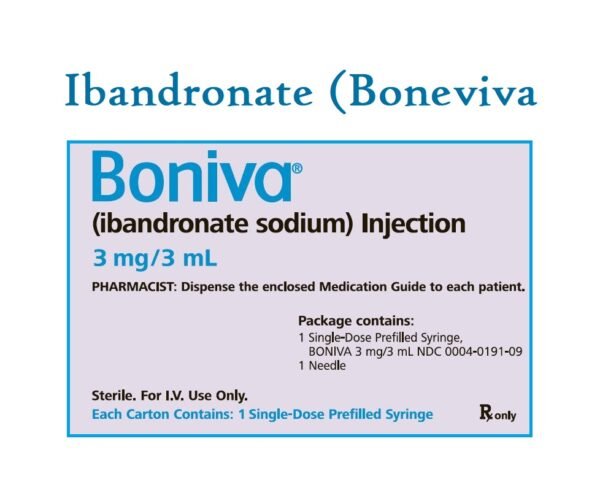
Ibandronate (Bonviva) is a bisphosphonate that is used in the treatment and prevention of osteoporosis. It is primarily used in the treatment of vertebral osteoporosis. Evidence to treat non-vertebral fractures is limited.
Ibandronate (Bonviva) Uses:
-
Osteoporosis:
- Treatment and prevention of osteoporosis in postmenopausal females.
Note:
- Because of the lack of evidence for the prevention of hip or nonvertebral fracture, ibandronate is not an ideal preliminary agent compared to other offered bisphosphonates; however, initiation in patients needing vertebral efficiency may be fitting.
-
Off Label Use of Ibandronate in Adults:
- Breast cancer, metastatic bone disease (treatment)
- Hypercalcemia of malignancy
- Bone pain due to metastatic prostate cancer (alternative agent)
Read:
- Zometa/ Aclasta (Zoledronic acid)
- Pamidronate (Aredia) Injection
- Romosozumab (Evenity)
- Prolia, Xgeva (Denosumab)
Ibandronate (Bonviva) Dose in Adults:
Note: osteoporosis patients should take calcium and vitamin D supplements if dietary intake is inadequate.
Ibandronate (Bonviva) Dose in the treatment of metastatic bone disease in patients with breast cancer (off-label):
- IV: 6 mg over 1 to 2 hours every 3 to 4 weeks for 4 years.
Ibandronate (Bonviva) Dose in the treatment of Hypercalcemia of malignancy (off-label):
- IV: 2 to 6 mg as a single dose over 1 to 2 hours.
Ibandronate (Bonviva) Dose as an alternative agent in the treatment of osteoporosis and prevention of fractures in postmenopausal females:
Note: Due to lack of proof for prevention of hip or nonvertebral fractures, ibandronate is generally not a favored bisphosphonate.
- High fracture risk patients, involving those with a history of frailty fracture, or postmenopausal females with a T-score ≤−2.5, or a T-score between −1 and −2.5 at high fracture risk according to an estimation.
-
Treatment:
- Oral: 150 mg one time every month.
- IV: 3 mg every 3 months.
- Patients with T-scores between −1 and −2.5 and not at high fracture risk; patient preferences may lead to the decision to begin therapy.
-
Prevention:
- Oral: 150 mg one time every month.
- Duration of therapy:
- The ideal duration of treatment has not been determined.
- If there is a high risk of fracture (e.g., fragility fracture before or during therapy) after the first 3 years (IV) or 5 years (oral), think about prolonging IV bisphosphonate treatment for up to 6 years and oral bisphosphonate treatment for up to 10 years (based on data with other bisphosphonates) or shifting to some other treatment.
- On the Other Hand, if bone mineral density (BMD) is stable, there have been no previous fragility fractures, and short-term fracture risk is low, consider suspending (ie, drug holiday) after the initial 3 years (IV) or 5 years (oral).
- The ideal length of taking a break from the medicine has not been established, although it is mostly for a period of up to 5 years.
- The decision to resume treatment after a drug holiday is based on multiple factors, including a decline in BMD and risk factors for fracture.
-
Ibandronate (Bonviva) Dose in the treatment of bone pain due to metastatic prostatic cancer, (alternative agent if radiation therapy is not an option; off-label)
- IV: 6 mg as a single dose over 15 minutes.
-
Missed doses:
- Oral (once a month):
- If an oral dose is missed, take it the next morning if the next month's scheduled dose is more than 7 days away.
- If the next month's scheduled dose is within 7 days, wait until the next month's dose. Then return to the originally scheduled day of the month on the one time a month schedule; however, do not administer >150 mg within 7 days.
- IV (once every 3 months):
- If an IV dose is missed, take it as soon as it can be rescheduled. After that, administer every 3 months from the date of the last injection.
- Oral (once a month):
Use in Children:
Not indicated.
Ibandronate (Bonviva) Pregnancy Risk Category: C
- Although it isn't known if bisphosphonates cross into the placenta or not, it is possible that fetal exposure to them is probable based on their lower molecular mass.
- Limited data are available on the effects of ibandronate during pregnancy.
- Bisphosphonates are slowly released from the bone matrix as they are assimilated.
- The amount of drugs, the dose and the duration of treatment can affect the quantity in the systemic circulation.
- Some cases have shown that fetal hypocalcemia, low birthweight, and decreased gestation were seen. However, the available data has not proved that exposure to bisphosphonates during pregnancy increases the risk of causing harm to the fetus.
- Hypocalcemia must be checked on exposed infants after birth.
- Most sources recommend that bisphosphonate treatment be stopped in females with reproductive capabilities as soon as possible to avoid a planned pregnancy.
- Premenopausal women should not use this bisphosphonate unless there are exceptional circumstances, such as rapid bone loss.
Use during breastfeeding:
- It is unknown if breast milk contains ibandronate.
Dose in Kidney Disease:
- Osteoporosis: Oral, IV:
- CrCl ≥30 mL/minute:
- No dosage adjustment is necessary.
- CrCl <30 mL/minute:
- Use is not recommended.
- CrCl ≥30 mL/minute:
Dose in Liver Disease:
There are no dosage adjustments provided in the manufacturer's labeling (has not been studied); however, ibandronate does not undergo hepatic metabolism.
Common Side Effects of Ibandronate (Bonviva):
- Gastrointestinal:
- Dyspepsia
- Neuromuscular & skeletal:
- Back pain
- Respiratory:
- Upper respiratory tract infection
Less Common Side Effects of Ibandronate (Bonviva):
- Cardiovascular:
- Hypertension
- Central Nervous System:
- Headache
- Dizziness
- Fatigue
- Insomnia
- Depression
- Dermatologic:
- Skin Rash
- Gastrointestinal:
- Abdominal Pain
- Diarrhea
- Nausea
- Dental Disease
- Constipation
- Vomiting
- Gastritis
- Gastroenteritis
- Genitourinary:
- Urinary Tract Infection
- Cystitis
- Hypersensitivity:
- Acute Phase Reaction-Like Symptoms
- Hypersensitivity Reaction
- Infection:
- Influenza
- Local:
- Injection Site Reaction
- Neuromuscular & Skeletal:
- Limb Pain
- Arthralgia
- Myalgia
- Arthropathy
- Weakness
- Localized Osteoarthritis
- Muscle Cramps
- Respiratory:
- Bronchitis
- Pneumonia
- Nasopharyngitis
- Flu-Like Symptoms
- Pharyngitis
Contraindications to Ibandronate (Bonviva):
- There have been no known allergic reactions to ibandronate, or any component of the formulation.
- hypocalcemia;
- Oral tablets should not be taken by patients who are unable to stand or sit down for more than 60 minutes or patients with esophageal abnormalities that delay the oesophageal emptyings (e.g. dressing-down, achalasia).
- There is not much data on allergenic cross-reactivity of bisphosphonates.
- Cross-sensitivity is possible and should be avoided for patients who are allergic to other bisphosphonates.
Warnings and precautions
- Bone fractures:
- Patients receiving bisphosphonates may experience atypical femur fractures (AFF).
- The subtrochanteric and diaphyseal fractures are located below the hip joint.
- Prodromic pain can be experienced by patients even before the fracture occurs.
- These fractures may be caused by bisphosphonate therapy.
- However, AFFs have been reported in patients who do not use bisphosphonates or those who receive glucocorticoids.
- Patients who receive prolonged bisphosphonate therapy (>3 to 5) may be at greater risk.
- However, the benefits of treatment (when used in osteoporosis treatment) are greater than the risk of AFF during the first 5 years.
- This is mostly true for patients with high fracture risk.
- Patients suffering from groin or thigh pain and a history of taking bisphosphonates should be evaluated for femur fracture.
- Consider suspending bisphosphonate therapy for patients with femoral shaft fractures; examine the contralateral limb for fractures.
- Bone/joint/muscle pain:
- Bisphosphonate treatment can sometimes cause severe (and often fatal) pain in the bone, joints, and/or muscles.
- The pain lasts from a few days to several months.
- Patients with severe symptoms should discontinue intravenous Ibandronate Therapy. Symptoms usually resolve upon discontinuation.
- Patients who have had relapses after receiving the same drug or another bisphosphonate may experience them again.
- GI mucosa irritation:
- It can cause irritation to the upper GI mucosa.
- Patients who are unable to follow dosing instructions may experience esophagitis, dysphagia and esophageal injuries.
- Patients with dysphagia or esophageal disease, ulcers, duodenitis, gastritis, or stomach problems should be restrained. This may worsen the condition.
- If symptoms worsen or new symptoms develop, discontinue use of the product.
- Hypersensitivity
- Anaphylactic shock (some fatal), angioedema and worsening asthma symptoms, rash, Stevens Johnson syndrome, erythema multifetale, and dermatitis Bullous, have all been reported.
- Hypocalcemia:
- Bisphosphonates have been linked to hypocalcemia.
- Hypocalcemia must first be addressed before treatment can begin. Make sure you get enough calcium and vitamin D.
- Influenza-like illness, acute-phase reaction
- A temporary severe phase reaction, such as fever, chills or pain/myalgia or other influenza-like symptoms, may occur.
- Usually, the symptoms resolve within 48 hours. However, it is rare for them to last longer than 7 days.
- Ocular effects
- Ibandronate has been used to treat uveitis and scleritis. Patients with signs of ocular inflammation or uveitis may need further evaluation.
- Osteonecrosis in the jaw:
- Patients who have received bisphosphonates have been known to develop osteonecrosis (ONJ) in their jaws.
- MRONJ is most commonly caused by invasive dental procedures, such as tooth extraction, implant surgery, and boney surgery), cancer diagnosis, concurrent therapy (eg chemotherapy, corticosteroids or angiogenesis inhibitors), poor hygiene, poorly fitting dentures, and comorbid conditions (anemia.coagulopathy. infection.
- Long-term bisphosphonate use can increase the risk.
- A position paper from the American Association of Maxillofacial Surgeons states that MRONJ is linked with bisphosphonates, other antiresorptive drugs (denosumab) and antiangiogenic medications (eg bevacizumab and sunitinib).
- The risk of cancer patients receiving antiresorptive therapy is significantly higher than patients receiving osteoporosis treatments (regardless of the medication used or the dosing schedule).
- MRONJ risk is also higher with monthly IV antiresorptive therapy than with oral bisphosphonate therapy.
- However, risk seems to rise with oral bisphosphonate therapy when therapy lasts more than 4 years.
- According to the manufacturer's labeling, patients undergoing invasive dental procedures should stop taking bisphosphonates.
- This could reduce the risk of ONJ. A physician and/or an oral surgeon should use clinical judgment.
- The AAOMS suggests that patients who receive oral bisphosphonate therapy for less than four years and have not experienced any clinical risk factors should not be interrupted. Special considerations must be made for patients who are receiving dental implants.
- The AAOMS recommends that patients who have been receiving oral bisphosphonates more than 4 years, or patients who have taken antiangiogenic or corticosteroids concomitantly, consider a 2-month drug-free period before undergoing any invasive dental procedures. This is based on theoretical benefits.
- A dentist should be consulted if a patient develops ONJ from therapy.
- The manufacturer suggests that patients with ONJ should consider discontinuing oral bisphosphonate treatment based on the risk/benefit analysis.
- Bariatric surgery
- Modified absorption risk and ulceration risk: Do not take oral bisphosphates following bariatric surgery.
- Ineffective oral absorption, and possibly anastomotic or bowel ulceration, may occur.
- If IV-administered bisphosphonates are recommended,
- Renal impairment
- Not recommended for severe kidney impairment (CrCl >30 mL/minute).
- IV bisphosphonate administration has been linked to acute renal failure and renal deterioration.
Ibandronate: Drug Interaction
|
Risk Factor C (Monitor therapy) |
|
|
Aminoglycosides |
May enhance the hypocalcemic effect of Bisphosphonate Derivatives. |
|
Angiogenesis Inhibitors (Systemic) |
May enhance the adverse/toxic effect of Bisphosphonate Derivatives. Specifically, the risk for osteonecrosis of the jaw may be increased. |
|
Deferasirox |
Bisphosphonate Derivatives may enhance the adverse/toxic effect of Deferasirox. Specifically, the risk for GI ulceration/irritation or GI bleeding may be increased. |
|
Nonsteroidal Anti-Inflammatory Agents |
enhance the adverse/toxic effect of Bisphosphonate Derivatives. Both an increased risk of gastrointestinal ulceration and an increased risk of nephrotoxicity are of concern. |
|
Proton Pump Inhibitors |
May diminish the therapeutic effect of Bisphosphonate Derivatives. |
|
Risk Factor D (Consider therapy modification) |
|
|
Polyvalent Cation Containing Products |
May decrease the serum concentration of Bisphosphonate Derivatives. Management: Avoid administration of oral medications containing polyvalent cations within: 2 hours before or after tiludronate/clodronate/etidronate; 60 minutes after oral ibandronate; or 30 minutes after alendronate/risedronate. |
Monitoring parameters:
Osteoporosis:
- Serial bone mineral density (BMD) must be assessed at baseline and every 1 to 3 years on treatment (usually at ~2 years after starting of therapy, then more or less frequently depending on patient-specific factors and stability of BMD).
- Assess BMD every 2 to 4 years during a drug break.
- Serum creatinine prior to each IV dose;
- Annual measurements of height and weight,
- Assessment of chronic back pain;
- Serum calcium and 25(OH)D;
- May consider measuring biochemical markers of bone turnover (eg, fasting serum CTX or urinary NTX) at baseline, 3 months, and 6 months, to assess treatment response, adherence to therapy, and/or possible malabsorption.
How to administer Ibandronate (Bonviva)?
Oral:
- It should be taken 60 minutes before the first food or drink of the day (except water) and before taking any oral medications or supplements (e.g., calcium, antacids, vitamins).
- It should be taken in a sitting straight position with a full glass (6 to 8 oz) of plain water and the patient should not lie down for 60 minutes to minimize the possibility of GI side effects.
- Mineral water with a high calcium content should be avoided. The tablet should be swallowed whole; do not chew or suck.
- Do not eat or drink anything (except water) for 60 minutes after administration of ibandronate.
IV:
- Administer as a 15 to 30-second bolus IV; avoid paravenous or intraarterial administration (may cause tissue damage).
- Do not mix with calcium-containing solutions or other drugs. For osteoporosis, do not administer more frequently than every 3 months.
Off-label rates:
- Infuse over 1 to 2 hours for metastatic bone disease due to breast cancer and for hypercalcemia of malignancy. Infuse over 15 minutes for metastatic bone pain due to prostate cancer.
Mechanism of action of Ibandronate (Bonviva):
- It is a bisphosphonate.
- It acts on osteoclasts and osteoclast precursors to inhibit bone resorption.
- It reduces bone resorption and indirectly increases bone mineral density.
Distribution:
-
- Up to 40% to 50% of the circulating ibandronate binds with bone
Protein binding:
- 85.7% to 99.5%
Metabolism:
- Not metabolized
Bioavailability: Oral:
- Minimal;
- reduced by about 90% following standard breakfast
Half-life elimination:
- Oral: 150 mg dose: Terminal: 37 to 157 hours
- IV: Terminal: ~5 to 25 hours
Time to peak, plasma:
- Oral: 0.5 to 2 hours
Excretion:
- Urine (50% to 60% of absorbed dose, excreted as unchanged drug);
- feces (unabsorbed drug)
International Brand Names of Ibandronate:
- Boniva
- Abrion
- Ai Ben
- Anabon
- Bandrobon
- Bandroxylate
- Bondex
- Bondria
- Bondronat
- Bondronat IV
- Bondrova
- Boni-M
- Bonprove
- Bonviva
- Drofen
- Etanorden
- Fosfonat
- Ibabon
- Iban
- Ibandro
- Ibonate
- Ibrac
- Idena
- Ipexal
- Oseban
- Ostex
- Pelnexon
- Ribonne
- Tefal
Ibandronate Brand Names in Pakistan:
|
Ibandronic Acid Injection 3 Mg in Pakistan |
|
|
Adronil |
Searle Pakistan (Pvt.) Ltd. |
|
Bonviva |
Roche Pakistan Ltd. |
|
Ibandronic Acid Tablets 150 Mg in Pakistan |
|
|
Adronil |
Searle Pakistan (Pvt.) Ltd. |
|
Bionic |
S.J. & G. Fazul Ellahie (Pvt) Ltd. |
|
Bonetone |
Pharmix Laboratories (Private) Limited. |
|
Bonheal |
Nova Med Pharmaceuticals |
|
Bonish |
Global Pharmaceuticals |
|
Bonvir |
Shrooq Pharmaceuticals |
|
Bonviva |
Roche Pakistan Ltd. |
|
Bonviva |
Roche Pakistan Ltd. |
|
Boonest |
Barrett Hodgson Pakistan (Pvt) Ltd. |
|
Brexell Plus |
Haji Medicine Co. |
|
Filbone |
Wilshire Laboratories (Pvt) Ltd. |
|
Ibandro |
Pharmevo (Pvt) Ltd. |
|
Ibelac |
Maq Pharma |
|
Ibnate |
Genix Pharma (Pvt) Ltd |
|
Osfit |
Scotmann Pharmaceuticals |
.png)


