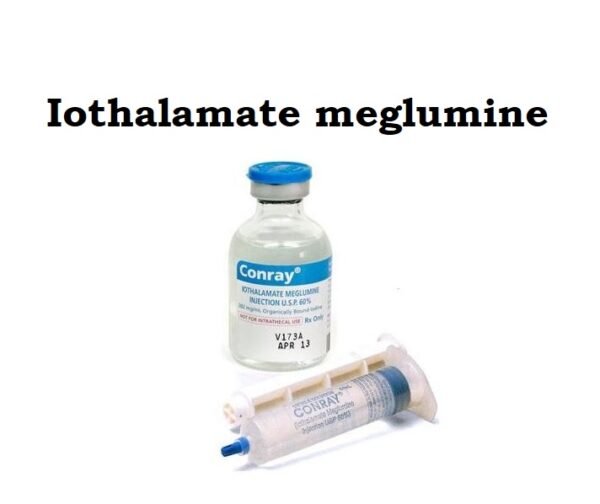
Iothalamate meglumine (Cornay) is an organic iodine compound that blocks x-rays as they cross the tissues. Tissues not containing the dye are therefore visualized.
Iothalamate meglumine Uses:
-
Imaging:
- Conray:
- direct cholangiography
- peripheral arteriography
- arterial digital subtraction angiography
- venography
- arthrography
- Excretory urography
- cerebral angiography
- endoscopic retrograde cholangiopancreatography
- cranial computerized angio-tomography
- improvements made to CT scans used for the identification and assessment of lesions in the liver, pancreas, kidneys, abdominal aorta, mediastinum, abdominal cavity, and retroperitoneal space
- IV digital subtraction angiography
-
Conray 30:
- Urography using IV infusion, cerebral computed tomography (CT) with contrast enhancement, and arterial digital subtraction angiography.
-
Conray 43:
- Venography of the lower extremities
- CT brain pictures with IV urography contrast enhancement
- Arterial digital subtraction angiography enhancement of CT images is utilised for the detection and evaluation of lesions in the liver, pancreas, kidneys, abdominal aorta mediastinum, abdominal cavity, and retroperitoneal region retrograde cystography, cystourethrography, and retrograde pyelography.
-
Cysto-Conray II:
- Retrograde cystography and cystourethrography.
- Conray:
Iothalamate meglumine dose in adults:
Note:
- Concentration, volume, and rate may depend on the equipment, condition of the injected vessel, size/condition of the patient, and imaging technique used.
Iothalamate meglumine dose in Intravascular imaging:
-
Arterial digital subtraction angiography:
- Conray 30, Conray 43: Usual dose:
- Aortic arch: 15 to 30 mL subclavian and brachial arteries: 3 to 10 mL Carotid or vertebral arteries: main aortic branches, 5 to 15 mL: Abdominal aorta, 5–30 mL: 10 to 30 mL maximum: 200 mL or 250 mL (Conray 30) (Conray 43)
- Conray: Usual dose:
- Carotid or vertebral arteries: 3 to 8 mL
- subclavian and brachial arteries: 5 to 15 mL
- aortic arch: 15 to 25 mL
- major branches of the aorta: 5 to 20 mL
- lumbar aorta (bifurcation): 10 to 25 mL
- Conray 30, Conray 43: Usual dose:
-
Arthrography:
- Conray: Usual dose:
- 5-15 mL (knee, hip)
- 1-4 mL (other)
- 5-10 mL (shoulder, ankle)
- Conray: Usual dose:
-
Carotid and vertebral angiography:
- Conray: Usual dose: 6 to 10 mL; repeat as indicated
-
Contrast enhancement of body CT:
- Conray 43: Usual dose:
-
By bolus injection, fast infusion, or both, 200 to 250 mL
-
When using the combined bolus and infusion technique, a 50 to 100 mL bolus injection followed by a 100 to 150 mL rapid infusion may be used.
-
- Conray:
- Vascular opacification: inject 25 to 50 mL in a bolus and repeat as required.
- Fast infusion of 150 mL; a 100–150 mL infusion may be used to pinpoint the area of interest, followed by 20–50 mL boluses to clarify specific scans. prolonged amplification and enhancement of some lesions during the arterial or venous phases.
- Conray 43: Usual dose:
-
Contrast enhancement of brain CT:
- Conray 30: Usual dose: 200 to 300 mL; for patients weighing <45 kg, 4 mL/kg
- Conray 43: Usual dose: 3 mL/kg (maximum dose: 200 mL)
- Conray: Usual dose: 2 mL/kg (maximum: 150 mL)
-
Cranial computerized angio-tomography:
- Conray: Usual dose:
- Bolus injections (0.5 to 1 mL/kg at a rate of 2 mL/second; repeat dosage as necessary; maximum total dose per procedure: 200 mL) are an option for administration.
- OR via IV infusion and bolus injection (50 mL bolus injection followed by a rapid infusion of 150 mL OR 100 mL bolus injection followed by a rapid infusion of 100 mL).
- Conray: Usual dose:
-
Direct cholangiography:
- Operative/postoperative: Conray: Usual dose: 10 to 25 mL
- Transhepatic cholangiography with needle: Conray: Usual dose: 20–40 mL; repeat as necessary for exposures in various planes.
-
Endoscopic retrograde cholangiopancreatography:
- Conray: Usual dose:
- 10 to 100 mL (common bile duct);
- 2 to 10 mL (pancreatic duct);
- administer under fluoroscopic control
- Excretory urography: Conray: Usual dose: 30 to 60 mL.
- Conray: Usual dose:
-
Intravenous digital subtraction angiography:
- Conray: Usual dose: 20 to 40 mL; repeat as needed
-
Peripheral arteriography:
- Conray: Usual dose: 20 to 40 mL.
-
Retrograde brachial cerebral angiography:
- Conray: Usual dose: 35-50 mL into the right brachial artery.
-
Urography:
- Conray 30: Usual dose: 200 to 300 mL (4 mL/kg) (maximum dose: 300 mL)
- Conray 43: Usual dose: 3 mL/kg (maximum dose: 200 mL)
-
Venography:
- Conray: Usual dose: 20 to 40 mL.
- Conray 43: Usual dose: 30-125 mL per lower extremity
-
Iothalamate meglumine dose in Urographic imaging:
- Retrograde cystography and cystourethrography: Conray 43 and Cysto-Conray II:
- Usual dose: 200 to 400 mL
- Retrograde pyelography: Conray 43: Usual dose:
- For bilateral and unilateral pyelograms, use 25 and 15 mL, respectively.
- Typically, 5 to 6 mL are given for each exposure.
- Retrograde cystography and cystourethrography: Conray 43 and Cysto-Conray II:
Iothalamate meglumine dose in children:
Note:
- Concentration, volume, and rate may depend on the equipment, condition of the injected vessel, size/condition of the patient, and imaging technique used.
Iothalamate meglumine for Intravascular imaging:
-
Arthrography, cerebral angiography, cranial computerized angio-tomography, peripheral arteriography/venography: Conray:
- Children and Adolescents:
- Refer to adult dosing;
- Depending on your age and weight, lower your dosage.
- Children and Adolescents:
-
Lower extremity venography: Conray 43:
- Reduce the dosage for children and adolescents in accordance with their age and body weight when compared to the adult dose.
-
Contrast enhancement of brain CT:
- Conray 30:
- Children and Adolescents <12 years and <45 kg:
- Usual dose: at 4 mL/kg
- Children and Adolescents ≥12 years and ≥45 kg:
- Refer to adult dosing.
- Children and Adolescents <12 years and <45 kg:
- Conray 43:
- Children and Adolescents:
- Refer to adult dosing.
- Children and Adolescents:
- Conray:
- Children and Adolescents: Usual dose:
- 2 mL/kg (maximum: 150 mL)
- Children and Adolescents: Usual dose:
- Conray 30:
-
Contrast enhancement of body CT: Conray 43:
-
- Children and Adolescents:
- Refer to adult dosing;
- reduce dosage in approximate proportion to age and body weight.
- Children and Adolescents:
-
-
Excretory urography: Conray:
- Infants, Children, and Adolescents <14 years: Usual dose: at 0.5 mL/kg (up to 30 mL)
- Adolescents ≥14 years: Refer to adult dosing.
-
Urography:
- Conray 30:
- Children ≥12 years and Adolescents: Refer to adult dosing.
- Conray 43:
- Children and Adolescents: Refer to adult dosing.
- Conray 30:
Iothalamate meglumine in Urographic imaging:
-
Retrograde cystography and cystourethrography: Conray 43 and Cysto-Conray II:
- Children and Adolescents: Usual dose: 30 to 300 mL
-
Retrograde pyelography: Conray 43:
- Children and Adolescents:
- Refer to adult dosing;
- reduce dosage in approximate proportion to body weight.
- Children and Adolescents:
Pregnancy Risk Category: C
- Contrast media agents containing iodinated contrast may cross the placenta.
- The theory is that exposure to free iodide could adversely affect the fetus.
- If necessary to determine if the pregnancy is safe, it should not be used.
Use of Iothalamate meglumine during breastfeeding
- Breast milk contains iothalamate salts.
- Breastfeeding may continue after discontinuation due to the low expected excretion of breast milk and low absorption by infants' GI tract.
- Theoretically speaking, milk's taste could be affected if it contains contrast media.
- Women who choose to temporarily stop breastfeeding can express breast milk or discard it from one breast for 12-24 hours after administration of contrast media.
- They can store and pump milk before the procedure, then bottle-feed the milk stored during that time.
Iothalamate meglumine Dose in Kidney Disease:
- There are no dosage adjustments provided in the drug manufacturer’s labeling.
- Use caution in severe impairment and in the setting of combined renal and hepatic disease.
Iothalamate meglumine Dose in Liver disease:
- There are no dosage adjustments provided in the drug manufacturer’s labeling.
- Use caution in patients with combined hepatic and renal disease.
Side effects of Iothalamate meglumine:
Reactions may be class effects rather than specific to this product.
-
Cardiovascular:
- Bradycardia
- Cardiac Arrhythmia
- Cardiac Fibrillation
- Cerebrovascular Accident
- Chest Tightness
- Coronary Insufficiency
- Decreased Blood Pressure
- Duodenal Wall Intravasation
- Facial Edema
- Facial Flushing
- Flushing
- Hypotensive Shock
- Peripheral Edema
- Syncope
- Tachycardia
- Thrombophlebitis
- Thrombosis
- Vasoconstriction
- Vasodilation
- Venospasm
-
Central Nervous System:
- Amnesia
- Aphasia
- Chills
- Choking Sensation
- Coma
- Convulsions
- Dizziness
- Flushing Sensation
- Headache
- Localized Burning Paresthesia
-
Dermatologic:
- Acute Generalized Exanthematous Pustulosis
- Diaphoresis
- DRESS Syndrome
- Ecchymoses
- Erythema
- Gangrene
- Maculopapular Rash
- Pruritus
- Skin Discoloration
- Stevensjohnson Syndrome
- Toxic Epidermal Necrolysis
- Urticaria
-
Endocrine & Metabolic:
- Altered Thyroid Hormone Levels (Transient Suppression; Premature Infants And Infants With Underlying Medical Conditions May Be More Vulnerable; FDA Safety Alert 2015)
- Hypothyroidism
-
Gastrointestinal:
- Nausea
- Pancholangitis
- Pancreatitis
- Severe Abdominal Pain
- Vomiting
- Xerostomia
-
Hematologic & Oncologic:
- Abnormal Erythropoiesis
- Disseminated Intravascular Coagulation
- Erythrocyte Agglutination
- Hematoma
- Hemorrhage
- Interference In Clot Formation
-
Hepatic:
- Hepatic Abscess
-
Hypersensitivity:
- Anaphylaxis
- Angioedema
-
Infection:
- Septicemia
-
Local:
- Extravasation
-
Neuromuscular & Skeletal:
- Arthralgia
- Brachial Plexus Injury
- Laryngospasm
- Muscle Spasm
- Tremor
-
Ophthalmic:
- Conjunctival Abnormalities
-
Renal:
- Renal Disease
- Renal Failure
-
Respiratory:
- Apnea
- Bronchospasm
- Cough
- Cyanosis
- Dyspnea
- Exacerbation Of Asthma
- Nasal Congestion
- Pulmonary Edema
- Sneezing
- Wheezing
-
Miscellaneous:
- Fever
- Tissue Necrosis
Contraindications to Iothalamate meglumine:
- hypersensitivity to any ingredient in the formulation, including iothalamate
- Intrathecal administration
- Intravascular administration (solution to instillation);
- myelography (solution for injection)
- For product- and procedure-specific contraindications, refer to the product labeling
Warnings and precautions
-
Contrast media reactions
- Contrast media containing iodine have been known to cause adverse reactions, including delayed reactions.
- Although most cases are mild, severe and potentially life-threatening reactions can occur at any time. These reactions often look like allergic-type reactions.
- A patient is more likely to experience an allergic reaction if they have a history of bronchial asthma, allergies (including food allergies), or a family history of allergies.
- Before administering, obtain allergy and hypersensitivity information.
- It is possible to not accurately predict the potential reaction by pre-testing for allergic reactions.
- Patients at high risk of allergic reactions (strong allergy history or prior contrast media reaction) should consider taking antihistamines or corticosteroids to lessen the severity and incidence of reactions.
- Start corticosteroids as soon as you can before using contrast media. Continue for 24 hours following administration.
- Within 30 minutes of administering the contrast agent, antihistamines should be given.
- If you experience a severe reaction, monitor closely for between 30 and 60 minutes.
- You can slow down or stop the infusion until minor reactions subside.
- Patients who received general anesthesia had a higher rate of adverse reactions.
-
Dermatological effects
- Some severe cutaneous adverse reactions have been reported, including Stevens-Johnson syndrome [SJS], toxic Epidermal Necrolysis [TEN], acute exanthematous pustulosis [AGEP], drug reactivity with eosinophilia [DRESS]).
- These reactions can occur from 1 hour to several days after administration.
- The severity of the reaction and the time it takes to manifest may vary with repeated administration.
- Patients who have had a severe adverse reaction to iothalamate on the skin should be avoided.
-
Extravasation:
- Vesicant (higher volumes and osmolar contrast media have a higher risk): ensure that the needle/catheter/line is properly placed before and during administration.
- Monitor infusion site.
- Avoid infiltration
- Hypertonic is Ioxaglate meglumine.
- Extravasation has been associated with burning pain, hematomas, bruising as well as tissue necrosis.
-
Neurotoxicity:
- Serious neurologic consequences, including lifelong paralysis, may follow cerebral arteriography, selective spinal arteriography, and arteriography vessels supplying the spine cord.
- Contrast media should not be injected after vasopressors have been administered. This could cause neurologic effects.
-
Failure of the renal system:
- Patients with severe hepatic impairment have been diagnosed with acute renal failure.
- They were treated with oral cholecystographic and intravascular radiocontrast agents.
- This was done in diabetic patients with diabetes, patients with preexisting kidney disease, and patients with occult kidney disease.
- These patients should avoid fluid restriction and be hydrated as normal.
- In newborns, children, and elderly patients, as well as those who already have renal impairment, multiple myeloma, severe vascular disease, and diabetes, preparatory dehydration can result in acute renal failure.
-
Events that are thromboembolic:
- Both non-ionic and ionic contrast media used in angiographic procedures have caused significant, although rarely fatal, thromboembolic events that can end in MI and stroke.
- Contrast media containing ionic iodinated contrast media can inhibit blood coagulation more than nonionic media.
- When performing angiographic procedures, ensure that you use meticulous intravascular administration techniques.
- Clotting can be caused by in vitro blood remaining in contact with nonionic contrast media.
- Plastic syringes can be used in place of glass to reduce the risk of in vitro Clotting.
-
Cardiovascular disease
- If patients with severe vascular disease are dehydrated, they run the risk of developing acute renal failure.
- These patients should avoid fluid restrictions and keep their hydration normal.
-
Cerebral lesions:
- Patients with primary or metastatic cerebral lesions have been known to experience seizures after receiving contrast agents for CT brain imaging.
-
Diabetes:
- Patients with diabetes may be at risk from pre-dialysis. It is important to avoid fluid restriction and to maintain normal hydration.
-
Endotoxemia:
- Endotoxemia patients should exercise caution when comparing media.
-
Hepatic impairment
- Patients with combined renal and liver disease should be cautious; excretion could be impaired.
-
Homocystinuria
- Patients with homocystinuria should avoid angiography; they may be at high risk of embolism and thrombosis.
-
Hyperthermia
- Patients with high body temperatures should exercise caution when comparing media.
-
Hyperthyroidism:
- Patients with hyperthyroidism, or with a functioning thyroid nodule, have experienced a thyroid storm after intravascular administrations of iodinated contrast medium.
-
Hypothyroidism:
- Thyroid function tests that indicate hypothyroidism (or transient thyroid suppression) have been reported in both pediatric and adult patients, including infants.
- Hypothyroidism was treated in some cases.
-
Multiple myeloma
- Patients with multiple myeloma should be cautious when using intravascular contrast agents.
- They can cause irreversible anuria, renal impairment, and even death.
- The cause of myeloma may be dehydration. Partial dehydration during preparation for procedures can precipitate myeloma proteins in the renal tubules.
- This is why it is not recommended for myeloma patients.
-
Pheochromocytoma:
- Patients with pheochromocytoma (known, suspected) should be used with caution.
- Reduce intravascular administration of contrast agent and closely monitor blood pressure throughout the procedure.
- It is important to have access to therapy for hypertension.
-
Renal impairment
- Patients with advanced renal disease should be cautious.
- Excretion can be affected; only use if absolutely necessary.
- Impaired excretion is more likely to occur in patients with recent kidney transplants, combined renal and liver disease, severe hypertension, or heart failure.
- Patients who undergo preparatory dehydration may be at risk of developing acute renal failure if they already have renal impairment.
-
Sickle cell disease:
- Patients with homozygous sickle cells should be cautious; administering drugs could cause disease exacerbation.
- Fluid restriction is not advised.
-
Subarachnoid hemorrhage:
- Contrast administration can cause deterioration of clinical status in patients suffering from subarachnoid hemorrhage (including seizures and fatalities).
- Use extreme caution when administering.
-
Infection of the urinary tract:
- Patients with acute UTIs should be cautious when using the solution for instillation.
Iothalamate meglumine: Drug Interaction
|
Aldesleukin |
Iodinated contrast agents may be more likely to cause allergic or hypersensitive reactions. |
|
MetFORMIN |
Iodinated contrast agents may intensify MetFORMIN's unfavorable/toxic effects. Lactic acidosis associated with metformin can be brought on by renal impairment that may be brought on by iodinated contrast agents. Management: The guidance on management differs. For more information, consult the medication interaction monograph in its entirety. |
Monitoring parameters:
- Renal function,
- blood pressure,
- hydration;
- monitor for extravasation during IV administration;
- monitor for hypersensitivity reactions for ≥30 to 60 minutes.
- Direct cholangiography: To guarantee quick detection of bile leakage and bleeding, keep an eye on the patient for at least 24 hours.
- Endoscopic retrograde cholangiopancreatography: Monitor patient for 24 hours.
- Peripheral arteriography/venography: Monitor blood pressure for 10 minutes following injection.
How to administer Iothalamate meglumine?
Solution for injection:
- Not for intrathecal use.
- Administration recommendations vary by product and indication; refer to prescribing information for detailed administration information.
- When injected, contrast material ought to be at or nearly at body temperature. The meal that comes before the exam should not be consumed by the patient.
- Before the exam, the proper premedication (such as a barbiturate, sedative, or an analgesic) may be given.
- Exceptionally allergic patients may also be given corticosteroids before and for 24 hours after the contrast agent, as well as an antihistamine within 30 minutes of its administration.
- Vesicant (higher osmolar contrast media and higher volumes are associated with a higher risk);
- ensure proper needle or catheter placement prior to and during infusion; avoid extravasation.
Extravasation management:
- If extravasation occurs, stop infusion immediately and disconnect; remove needle/cannula and elevate the extremity.
- Aspiration of extravasated contrast media is not recommended. Information conflicts regarding the use of hyaluronidase; the American College of Radiology (ACR) Manual on Contrast Media does not recommend hyaluronidase in the management of contrast media extravasation, other sources suggest its utility in extravasation management.
If using hyaluronidase: Intradermal or SubQ:
- Inject a total of 1 to 1.7 mL (15 units/mL) as five separate 0.2 to 0.3 mL injections (using a 25-gauge needle) into the area of extravasation at the leading edge in a clockwise manner or injection of a total of 5 mL (150 units/mL) as five separate 1 mL injections around the extravasation site has been also used successfully.
Solution for instillation:
- Not for intrathecal or intravascular use.
- Use a suitable venoclysis set or a syringe to administer by gravity flow into the urine bladder.
- Avoid pressure.
- A laxative should be given the night before the exam, unless it is contraindicated.
- In individuals with a history of severe allergies, premedication with an antihistamine and/or a corticosteroid is a possibility before the administration of the contrast agent.
Mechanism of action of Iothalamate meglumine:
- Radiopaque contrast agent;
- Vessels become opaque due to the contrast medium's flow.
- It is possible to see inside body structures with radiography.
Distribution:
- Rapid (following intravascular administration)
Half-life elimination:
- 90 minutes
Excretion:
- Urine (primarily and as an unchanged drug); feces (minor)
International Brands of Iothalamate meglumine:
- Conray 30
- Conray 43
- Conray
- Cysto-Conray II
Iothalamate meglumine Brand Names in Pakistan:
No Brands Available in Pakistan.
.png)


