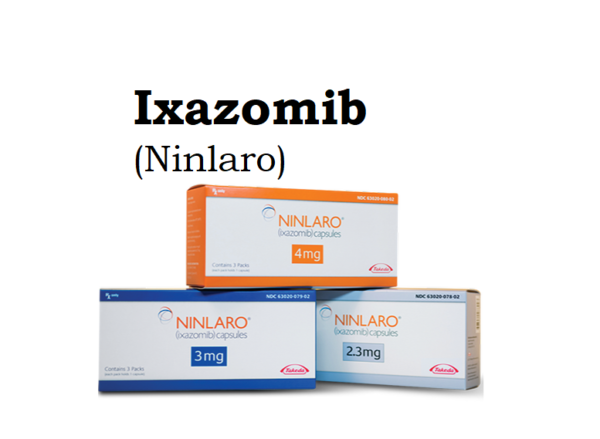
Ixazomib (Ninlaro) is the first orally available proteasome inhibitor that is used to treat patients with multiple myeloma.
Ixazomib (Ninlaro) Indications:
-
Multiple myeloma:
- Used in the treatment of multiple myeloma (combined with lenalidomide and dexamethasone)
- Patients should who have received at least one prior chemotherapy
Ixazomib (Ninlaro) Dose in Adults:
Note: Following are the pre-requisites
- ANC should be ≥1,000/mm³
- platelets should be ≥75,000/mm
- Nonhematologic toxicities should be at baseline or ≤ grade 1 (per prescriber discretion) prior to initiating a new cycle of therapy
- Antiviral prophylaxis should be considered to decrease the risk of herpes zoster reactivation.
Ixazomib (Ninlaro) Dose in the treatment of Multiple myeloma:
- P/O: 4 mg weekly on day 1st, 8th, and 15th of a 28-day treatment cycle (with a combination of lenalidomide and dexamethasone);
- continue until disease progression or patient develop unacceptable toxicity.
-
Missed doses:
- If a dose is missed or delayed, give only if the subsequent scheduled dose is ≥72 hours away.
- Don't take a missed dose within 3 days of the next scheduled dose
- Don't take twice the dosage to make up for the missed dose.
- If experience vomiting, dose repetition is not recommended; instead resume dosing at the next scheduled dose.
-
Ixazomib (Ninlaro) use in children:
Not indicated.
Pregnancy Risk Category: Not assigned
- Evidence from animal reproduction studies and the mechanism of action suggest that ixazomib exposure in utero may cause fetal harm.
- Effective contraception is recommended for both males and women with reproductive potential. It should be used during treatment and for at least 90 days following the last dose.
- It is recommended that women who use hormonal contraception also use a barrier method.
- When used to treat multiple myeloma ixazomib is recommended to be used in conjunction with dexamethasone and lenalidomide.
- Lenalidomide contraindicated during pregnancy
Use of Ixazomib while breastfeeding
- It is unknown if the drug will be excreted into breastmilk.
- The manufacturer suggests that nursing babies stop breastfeeding while on therapy, and that they discontinue breastfeeding for at least 90 days following the last dose of ixazomib.
Ixazomib (Ninlaro) Dose in Kidney Disease:
The International Myeloma Working Group (IMWG) has recommended the use of the Chronic Kidney Disease Epidemiology Collaboration (CKD-EPI) equation (preferred) or the Modification of Diet in Renal Disease (MDRD) formula for evaluation of renal function estimation in multiple myeloma patients with stable serum creatinine.
-
Preexisting renal impairment:
-
CrCl ≥30 mL/minute:
- The IMWG has suggested that ixazomib (in combination with lenalidomide and dexamethasone) may be administered safely to patients if CrCl ≥30 mL/minute.
-
CrCl <30 mL/minute:
- Dose reduction is recommended to 3 mg once a week on day 1st, 8th, and 15th of a 28day treatment cycle
-
ESRD requiring dialysis:
- Reduce initial dose to 3 mg once a week on day 1st, 8th, and 15th of a 28-day treatment cycle;
- ixazomib is not dialyzable and administration with regard to dialysis timings is not necessary.
-
-
Renal toxicity during treatment:
-
Grade 3 or 4 toxicity:
- Ixazomib should be withheld until recovery to baseline or improvement to ≤ grade 1 (at the prescriber's discretion).
- If attributable to ixazomib, ixazomib should be resumed at the next lower dose.
-
Ixazomib (Ninlaro) Dose in Liver disease:
-
Preexisting hepatic impairment:
-
Mild impairment (total bilirubin ≤ Upper Limit of Normal and AST > Upper Limit of Normal or total bilirubin >1 to 1.5 times Upper Limit of Normal and any AST):
- Dosage adjustment is not necessary.
-
Moderate (total bilirubin >1.5 to 3 times Upper Limit of Normal ) or severe (total bilirubin >3 times Upper Limit of Normal ) impairment:
- The initial dose should be reduced to 3 mg once a week on day 1st, 8th, and 15th of a 28-day treatment cycle
-
-
Hepatotoxicity during treatment:
- Grade 3 or 4 toxicity:
- Ixazomib should be withheld until recovery to baseline or improvement to ≤ grade 1 (at the prescriber's discretion).
- If attributable to ixazomib, ixazomib should be resumed at the next lower dose.
- Grade 3 or 4 toxicity:
Adverse reaction percentages reported as part of a combination regimen with lenalidomide and dexamethasone.
Common Side Effects of Ixazomib (Ninlaro):
-
Cardiovascular:
- Peripheral Edema
-
Central Nervous System:
- Peripheral Neuropathy
- Peripheral Sensory Neuropathy
-
Dermatologic:
- Skin Rash
-
Gastrointestinal:
- Diarrhea
- Constipation
- Nausea
- Vomiting
-
Hematologic & Oncologic:
- Thrombocytopenia
- Neutropenia
-
Neuromuscular & Skeletal:
- Back Pain
-
Ophthalmic:
- Eye Disease
-
Respiratory:
- Upper Respiratory Tract Infection
Less Common Side Effects Of Ixazomib (Ninlaro):
-
Hepatic:
- Hepatic Insufficiency
-
Infection:
- Herpes Zoster
-
Ophthalmic:
- Blurred Vision
- Conjunctivitis
- Xerophthalmia
Contraindication to Ixazomib Include:
Hypersensitivity to ixazomib and any component of the formulation
Warnings and precautions
-
Suppression of bone marrow
- In clinical trials, thrombocytopenia and neutropenia were frequently reported.
- The platelet nadirs usually occur between days 14 and twenty one of each cycle, with recovery to baseline occurring by the beginning of the next cycle.
- You should monitor platelet counts at minimum once a month during treatment.
- It is possible to interrupt therapy, reduce doses and/or transfuse platelets.
- Monitor CBC (with differential) for neutropenia. It is possible to interrupt therapy or modify dosage.
-
Dermatologic toxicities:
- Rash was reported after the administration of ixazomib. Most cases were grade one to two, but a few patients experienced grade three.
- Most commonly reported cutaneous reactions are maculopapular and macular rashes.
- Dermatologic toxicity should be monitored and treated with supportive care. For grade 2 and higher toxicities, dosage modification should be considered.
-
Gastrointestinal toxicities:
- There have been reports of nausea, constipation and diarrhea.
- To manage toxicities, you may need antidiarrheal, antiemetics, or supportive care.
- Grade 3 and 4 symptoms may require dosage adjustment.
-
Hepatotoxicity
- Clinical trials rarely report drug-induced liver injury (DILI), hepatocellular injuries, hepatic Steatosis and hepatitis.
- It is important to monitor liver enzymes regularly. Dosage adjustments may be necessary for grades 3 and 4.
-
Infection with herpes zoster:
- Reports of herpes zoster have been made
- Patients who received antiviral prophylaxis had a lower incidence of infection.
- To reduce the chance of herpes zoster activation, it is important to consider antiviral prophylaxis during ixazomib therapy.
-
Peripheral edema
- One-quarter of patients who received the ixazomib treatment (generally, grade 1 or 2) reported peripheral edema.
- Peripheral edema should be treated with supportive care if it occurs.
- Grade 3 and 4 symptoms may need to be treated with dexamethasone or ixazomib.
-
Peripheral neuropathy
- Peripheral neuropathy was mostly grade one or two.
- Peripheral sensory neuropathy was the most common symptom, but peripheral motor neuropathy was rare.
- For signs/symptoms of Neuropathy, it is important to monitor closely.
- It may be necessary to adjust the dosage (of ixazomib or lenalidomide) and/or to discontinue treatment.
-
Hepatic impairment
- Patients with severe or moderate hepatic impairment should be given lower initial doses (exposure is higher).
-
Renal impairment
- Patients with creatinine clearance 30 mL/minute, or ESRD requiring dialysis are advised to take lower initial doses (exposure is higher).
- Dosage reduction may be necessary for concomitant use of lenalidomide.
Ixazomib: Drug Interaction
|
Risk Factor C (Monitor therapy) |
|
|
Bosentan |
May decrease the serum concentration of CYP3A4 Substrates (High risk with Inducers). |
|
Chloramphenicol (Ophthalmic) |
May enhance the adverse/toxic effect of Myelosuppressive Agents. |
|
CloZAPine |
Myelosuppressive Agents may enhance the adverse/toxic effect of CloZAPine. Specifically, the risk for neutropenia may be increased. |
|
CYP3A4 Inducers (Moderate) |
May decrease the serum concentration of CYP3A4 Substrates (High risk with Inducers). |
|
Deferasirox |
May decrease the serum concentration of CYP3A4 Substrates (High risk with Inducers). |
|
Erdafitinib |
May decrease the serum concentration of CYP3A4 Substrates (High risk with Inducers). |
|
Ivosidenib |
May decrease the serum concentration of CYP3A4 Substrates (High risk with Inducers). |
|
Mesalamine |
May enhance the myelosuppressive effect of Myelosuppressive Agents. |
|
Promazine |
May enhance the myelosuppressive effect of Myelosuppressive Agents. |
|
Sarilumab |
May decrease the serum concentration of CYP3A4 Substrates (High risk with Inducers). |
|
Siltuximab |
May decrease the serum concentration of CYP3A4 Substrates (High risk with Inducers). |
|
Tocilizumab |
May decrease the serum concentration of CYP3A4 Substrates (High risk with Inducers). |
|
Risk Factor D (Consider therapy modification) |
|
|
Dabrafenib |
May decrease the serum concentration of CYP3A4 Substrates (High risk with Inducers). Management: Seek alternatives to the CYP3A4 substrate when possible. If concomitant therapy cannot be avoided, monitor clinical effects of the substrate closely (particularly therapeutic effects). |
|
Deferiprone |
Myelosuppressive Agents may enhance the neutropenic effect of Deferiprone. Management: Avoid the concomitant use of deferiprone and myelosuppressive agents whenever possible. If this combination cannot be avoided, monitor the absolute neutrophil count more closely. |
|
Estrogen Derivatives (Contraceptive) |
Ixazomib may decrease the serum concentration of Estrogen Derivatives (Contraceptive). More specifically, use of ixazomib with dexamethasone may decrease the serum concentrations of estrogen derivative contraceptives. Management: Patients of childbearing potential should use a nonhormonal barrier contraceptive during and 90 days following ixazomib treatment. |
|
Lorlatinib |
May decrease the serum concentration of CYP3A4 Substrates (High risk with Inducers). Management: Avoid concurrent use of lorlatinib with any CYP3A4 substrates for which a minimal decrease in serum concentrations of the CYP3A4 substrate could lead to therapeutic failure and serious clinical consequences. |
|
Risk Factor X (Avoid combination) |
|
|
BCG (Intravesical) |
Myelosuppressive Agents may diminish the therapeutic effect of BCG (Intravesical). |
|
Cladribine |
May enhance the myelosuppressive effect of Myelosuppressive Agents. |
|
CYP3A4 Inducers (Strong) |
May decrease the serum concentration of Ixazomib. |
|
Dipyrone |
May enhance the adverse/toxic effect of Myelosuppressive Agents. Specifically, the risk for agranulocytosis and pancytopenia may be increased |
|
Progestins (Contraceptive) |
Ixazomib may decrease the serum concentration of Progestins (Contraceptive). More specifically, use of ixazomib with dexamethasone may decrease the serum concentrations of contraceptive progestins. Management: Patients of childbearing potential should use a nonhormonal barrier contraceptive during and 90 days following ixazomib treatment. |
|
St John's Wort |
May decrease the serum concentration of Ixazomib. |
Monitoring parameters:
- Platelet counts should be monitored at least monthly during treatment (consider more frequent monitoring in the first 3 cycles)
- CBC (with differential) as clinically necessary, renal and liver function tests
- Signs and symptoms of GI & dermatologic toxicity;
- Signs and symptoms of peripheral neuropathy and peripheral edema.
How to administer Ixazomib (Ninlaro)?
P/O:
- It should not be administered on the same or similar day of the week.
- Consume at least one hour before and two hours after meals.
- The whole capsule should be swallowed.
- Avoid contact with the skin or eyes to capsule contents.
- Wash it with soap and water if it comes into contact with your skin.
- Flush with water if you come in contact.
Mechanism of action of Ixazomib (Ninlaro):
- Ixazomib induces reversible inhibition in proteasomes, enzyme compounds that regulate protein homeostasis.
- It causes the reversible inhibition chymotrypsin like activity of beta 5 subunits of the 20S proteasome.
- This results in activation of signaling pathways, arrest of cell cycle and apoptosis.
Absorption: Meals with high-fat content decreased AUC by 28 percent C by 69 percent Distribution: 543 Litres Protein binding: 99 percent binding to plasma proteins Metabolism: Most likely hepatic via multiple CYP enzymes and non-CYP proteins. At clinically relevant concentrations, none of the specific CYP isoforms contributes to metabolism predominantly; possible CYP isoforms which are involved in metabolism include the following
- CYP3A4,
- 1A2,
- 2B6,
- 2C8,
- 2D6,
- 2C19, and
- 2C9.
Bioavailability: 58 percent Half-life elimination: Terminal: Nine and half days Time to peak: Median: 1 hr
Excretion:
- Urine (62 percent; <3.5% as unchanged drug);
- Feces (22 percent)
International Brands of Ixazomib:
- Ninlaro
Ixazomib Brands Names in Pakistan:
No Brands Available in Pakistan.
.png)


