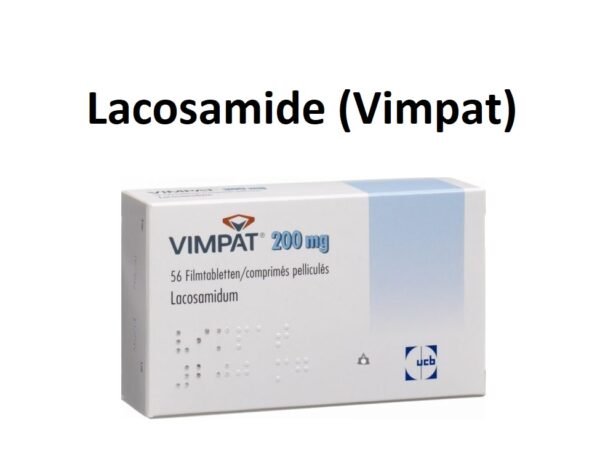
Lacosamide (Vimpat) is an anticonvulsant drug that is used in the treatment of partial-onset seizures and patients with painful diabetic neuropathy.
Lacosamide (Vimpat) Uses:
-
Focal (partial) onset seizures:
- Monotherapy or adjunctive therapy to treat focal (partial) onset seizures in children ≥4 years of age and adults.
-
Off Label Use of Lacosamide in Adults:
- Refractory status epilepticus
It is also used as an off-label drug for the treatment of painful diabetic neuropathy, however, experts recommend against its use for this indication. Pregabalin and duloxetine are considered the first line of therapies.
Lacosamide (Vimpat) Dose in Adults:
Lacosamide (Vimpat) Dose in the Focal (partial) onset seizure:
-
Monotherapy: Oral, IV:
- Initial: 100 mg twice daily;
- Depending on response and tolerance, the dose may be increased by 50 mg twice daily at weekly intervals.
- Alternative initial dosage:
- 200 mg as the loading dose, then 100 mg twice daily for seven days after that.
- Depending on response and tolerance, the dose may be increased by 50 mg twice daily at weekly intervals.
- Note: Administer loading doses under medical supervision because of the increased incidence of CNS adverse reactions.
- Maintenance:
- 150 to 200 mg twice daily;
- Some patients may require a further increase up to 300 mg twice daily for the best results.
Note:
- For patients already on a single antiepileptic and converting to lacosamide monotherapy, maintain the maintenance dose for 3 days before beginning withdrawal of the concomitant antiepileptic drug.
- Gradually taper the concomitant antiepileptic drug over ≥6 weeks.
-
Adjunctive therapy: Oral, IV:
- Initial:
- 50 mg twice daily;
- The dose may be increased at weekly intervals by 50 mg twice daily based on response and tolerability.
- Alternative initial dosage:
- A loading dose of 200 mg followed approximately 12 hours later by 100 mg twice daily for 1 week;
- Depending on response and tolerance, the dose may be increased by 50 mg twice daily at weekly intervals.
- Note: Administer loading doses under medical supervision because of the increased incidence of CNS adverse reactions.
- Maintenance dose: 100 to 200 mg twice daily.
- Initial:
Note:
- Based on clinical trials using oral formulations, doses up to 600 mg/day may offer further benefit in some people (e.g., with subsequent generalised tonic-clonic seizures); nevertheless, the risk of side effects is higher.
Lacosamide (Vimpat) Dose in Refractory Status epilepticus (off-label):
- IV: 200 to 400 mg, then 200 to 400 mg divided into 2 doses per day as a maintenance dose.
- For the best outcome, some people may need as much as 600 mg per day.
Note:
- The Neurocritical Care Society recommends an administration rate of 200 mg over 15 minutes;
- however, some experts administer IV push or infusion doses up to 400 mg at a rate of ≤80 mg/minute.
-
Dosing conversion:
- Between oral and IV dosing:
- Convert using the same total daily dose. Use IV therapy only temporarily;
- clinical trial experience of IV lacosamide is limited to 5 days of consecutive treatment.
- Between oral and IV dosing:
-
Discontinuation of therapy:
- In patients receiving lacosamide long term, unless safety concerns require a more rapid withdrawal, lacosamide should be withdrawn gradually over a few weeks to several months to minimize the potential of seizures or other withdrawal symptoms.
Lacosamide (Vimpat) Dose in Childrens:
Lacosamide (Vimpat) Dose in Partial-Onset Seizures:
Note:
- For patients already on a single antiepileptic and converting to lacosamide monotherapy, maintain the maintenance dose for 3 days before beginning withdrawal of the concomitant antiepileptic drug.
- Gradually taper the concomitant antiepileptic drug over ≥6 weeks.
-
Children ≥4 to 17 years:
-
Monotherapy and adjunctive therapy:
- 11 to <30 kg: Oral:
- Initial: 1 mg/kg/dose twice daily;
- Depending on response and tolerance, the dose may be increased twice daily by 1 mg/kg/dose at weekly intervals.
- Maintenance: 3 to 6 mg/kg/dose twice daily
- 30 to <50 kg: Oral:
- Initial: 1 mg/kg/dose twice daily;
- Depending on response and tolerance, the dose may be increased twice daily by 1 mg/kg/dose at weekly intervals.
- Maintenance: 2 to 4 mg/kg/dose twice daily
- ≥50 kg: Oral:
- Initial (monotherapy and adjunctive therapy): 50 mg twice daily;
- Depending on response and tolerance, the dose may be increased at weekly intervals by 50 mg twice daily.
- Maintenance:
- Monotherapy:
- 150 to 200 mg twice daily
- Adjunctive therapy:
- 100 to 200 mg twice daily.
- Note: In adjunctive clinical trials in adults, doses higher than 400 mg/day were not more effective and were associated with more adverse reactions.
- Monotherapy:
- 11 to <30 kg: Oral:
-
-
Adolescents ≥17 years:
Note:
- The total daily dose and frequency should remain the same when transitioning from oral to IV formulations; IV therapy should only be used as a last resort.
- Clinical study experience of IV lacosamide is limited to 5 days of consecutive treatment.
-
Monotherapy: Oral, IV:
- Initial:
- 100 mg twice daily;
- Depending on response and tolerance, the dose may be increased by 50 mg twice daily at weekly intervals.
- Alternate initial dosage:
- Loading dose: 200 mg followed approximately 12 hours later by 100 mg twice daily for 1 week;
- Depending on response and tolerance, the dose may be increased by 50 mg twice daily at weekly intervals.
- Note: Administer loading doses under medical supervision because of the increased incidence of CNS adverse reactions.
- Maintenance:
- 150 to 200 mg twice daily.
- Note: In adjunctive clinical trials in adults, doses higher than 400 mg/day were not more effective and were associated with more adverse reactions.
- Initial:
-
Adjunctive therapy: Oral, IV:
- Initial:
- 50 mg twice daily;
- Depending on response and tolerance, the dose may be increased by 50 mg twice daily at weekly intervals.
- Alternative initial dosage:
- A loading dose of 200 mg followed approximately 12 hours later by 100 mg twice daily for 1 week; may be increased at weekly intervals by 50 mg twice daily based on response and tolerability.
- Initial:
-
Note: Administer loading doses under medical supervision because of the increased incidence of CNS adverse reactions.
- Maintenance dose:
- 100 to 200 mg twice daily.
- Note: In adjunctive clinical trials in adults, doses higher than 400 mg/day were not more effective and were associated with more adverse reactions.
Lacosamide (Vimpat) Dose in Severe and Refractory Seizures:
-
Infants ≥6 months, Children, and Adolescents <17 years:
- Oral: Initial:
- 1 to 2 mg/kg/day divided twice daily (usual maximum initial dose: 50 mg/dose);
- may titrate by 1 to 2 mg/kg/day weekly to effect.
- Range of reported mean maintenance doses: 4.7 to 15.2 mg/kg/day.
- Oral: Initial:
Lacosamide (Vimpat) Pregnancy Risk Category: C
- Lacosamide crosses over the placenta.
- Some pharmacokinetic properties may be affected by pregnancy-induced physiological changes.
- Limited information is available on pregnancy outcomes after maternal lacosamide use.
- Congenital abnormalities are more likely to occur in pregnant women who get many antiepileptic medications. It is suggested to use monotherapy at the lowest dose.
- Antiepileptic medication-treated newborns may be at greater risk for adverse events.
Use of lacosamide while breastfeeding
- Breast milk contains lacosamide.
- A breastfeeding baby who had been given lacosamide by her mother in combination with other medications during pregnancy and after delivery was diagnosed with drowsiness and poor nutrition.
- According to the manufacturer of the product, when deciding whether to discontinue or continue breastfeeding during therapy, it should be considered the risks to the infant as well as the benefits to the mother.
Lacosamide (Vimpat) Dose in Kidney Disease:
Notice:The Cockcroft-Gault formula can be used to estimate renal function.
- CrCl >=30mL/minute
- There is no need to adjust the dosage.
- Patients with severe renal impairment may need to be prescribed a dose reduction if they are taking strong CYP3A4 or CYP2C9 inhibits.
- CrCl 30mL/minute
- Reduce the dose to 75% of maximum dose.
- Concomitant use strong CYP3A4 or CYP2C9 inhibitors may require further dosage reduction/limitation.
- End-stage renal disease (ESRD), which requires hemodialysis
- Limit the dose to 75% of maximum dosage. Concomitant use strong CYP3A4 or CYP2C9 inhibitors may require further dosage reduction/limitation.
- Hemodialysis is used to remove the kidney stones. After a 4-hour treatment, you can consider a 50% supplemental dose.
Lacosamide (Vimpat) Dose in Liver disease:
- Mild to moderate hepatic impairment:
- Reduce dose to 75% of the maximum dose.
- Patients taking concurrently powerful CYP3A4 and/or CYP2C9 inhibitors may need to further reduce or limit their dosage.
- Severe hepatic impairment:
- Use is not recommended.
Side Effects of Lacosamide (Vimpat):
-
Central nervous system:
- Headache
- Dizziness
-
Gastrointestinal:
- Nausea
Less Common Side Effects of Lacosamide (Vimpat):
-
Central Nervous System:
- Vertigo
- Fatigue
- Equilibrium Disturbance
- Ataxia
- Abnormal Gait
- Depression
- Drowsiness
-
Dermatologic:
- Pruritus
-
Gastrointestinal:
- Vomiting
- Diarrhea
-
Hematologic & Oncologic:
- Bruise
-
Local:
- Pain At Injection Site
- Local Irritation
-
Neuromuscular & Skeletal:
- Tremor
- Asthenia
-
Ophthalmic:
- Diplopia
- Blurred Vision
- Nystagmus
-
Miscellaneous:
- Laceration
Rare side effects of Lacosamide (Vimpat):
-
Cardiovascular:
- Palpitations
- Syncope
-
Central Nervous System:
- Cerebellar Syndrome
- Cognitive Dysfunction
- Confusion
- Disturbance In Attention
- Dysarthria
- Falling
- Hypoesthesia
- Intoxicated Feeling
- Irritability
- Mood Changes
- Paresthesia
- Suicidal Ideation
- Suicidal Tendencies
-
Gastrointestinal:
- Constipation
- Dyspepsia
- Oral Hypoesthesia
- Xerostomia
-
Hematologic & Oncologic:
- Anemia
- Neutropenia
-
Neuromuscular & Skeletal:
- Muscle Spasm
-
Otic:
- Tinnitus
-
Miscellaneous:
- Fever
Contraindications to Lacosamide (Vimpat):
US labeling:
- No contraindications listed on label.
Canadian labeling:
- Any component of lacosamide hypersensitivity; second- or third-degree atrioventricular block (current or historical).
Warnings and precautions
-
Cardiovascular effects
- Lacosamide can prolong PR interval. Cardiac arrhythmias such as bradycardia and AV block and ventricular tachyarrhythmias are also reported.
- These have rarely led to cardiac arrest, death, or asystole.
- Patients with proarrhythmic conditions such as those with an underlying condition or concomitant use medication that alters cardiac conduction or prolongs the PR interval were more likely to experience this occurrence. IV and oral administration was also common.
- Care should be taken with patients who have cardiac conduction issues, such as first- or second-degree atrioventricular blocks, sick sinus syndrome with pacemaker, sodium channelopathies, myocardial ischemia, heart failure, or concurrent use of other medications that affect cardiac conduction and prolong PR intervals.
- An ECG is recommended for these patients prior to starting therapy or when taking the steady-state maintenance dose.
- You should monitor closely during IV administration. Bradycardia or AV block may occur, as well as ventricular tachyarrhythmias.
- If patients experience conduction problems, such as a low or irregular pulse, lightheadedness or fainting, instruct them to consult their healthcare provider immediately.
- Patients with diabetes and/or heart disease experienced syncope or atrial fibrillation/flutter slightly more frequently in short-term trials.
- Open-label studies also showed that syncope was associated with history of heart disease risk factors, and drugs that slow AV Conduction.
-
CNS effects
- During therapy, dizziness or ataxia can occur. Patients should be cautious about driving or operating machinery that requires alertness.
-
Multiorgan hypersensitivity reactions (drug response with eosinophilia or systemic symptoms [DRESS]).
- Lacosamide and other antiepileptic medications have occasionally been associated with multiorgan hypersensitivity events that have the potential to be deadly (or life-threatening).
- Monitor for possible manifestations of lymphatic, hepatic and renal disorders.
- It is possible to transition to an alternate therapy or gradual discontinuation.
-
Ophthalmic effects
- Therapy may cause blurred vision or diplopia.
- Patients suffering from persistent visual impairments may require further evaluation.
- Patients with vision-related or preexisting conditions should be monitored more closely.
-
Suicidal thoughts:
- A pooled analysis of antiepileptics trials (regardless if they were indicated) revealed an increase in suicidal thoughts/behavior.
- Patients who received treatment experienced an incidence rate of 0.43% compared to patients who got a placebo at 0.2%.
- The risk can be observed as soon as one week after the initiation of the trial and continues throughout the duration of the trials (most trials last less than 24 weeks).
- Watch out for any changes in behavior or thoughts that could indicate depression or suicidal thoughts. Notify your health care provider immediately if you notice these symptoms.
-
Hepatic impairment
- Extreme hepatic impairment patients shouldn't use this product.
- Patients who are using potent CYP3A4 or CYP2C9 inhibitors and have hepatic impairment may need to change their dosage.
-
Renal impairment
- Patients with severe renal impairment should be cautious. Dosage adjustment is required (CrCl =30mL/minute). Supplementation may also be required in hemodialysis.
- Patients suffering from any level of renal impairment may need to adjust their dosages if they are taking strong CYP3A4 or CYP2C9 inhibits.
Lacosamide: Drug Interaction
|
Antiarrhythmic Agents (Class III) |
Could make Lacosamide's harmful or hazardous effects worse. Particularly, there may be an increased risk for bradycardia, ventricular tachyarrhythmias, or a longer PR interval. |
|
Antiepileptic Agents (Sodium Channel Blockers) |
Could make Lacosamide's harmful or hazardous effects worse. Particularly, there may be an increased risk for bradycardia, ventricular tachyarrhythmias, or a longer PR interval. |
|
Bradycardia-Causing Agents |
Could make Lacosamide's AV-blocking effect stronger. |
|
CYP3A4 Inhibitors (Strong) |
Lacosamide serum concentration can rise. |
|
Lidocaine (Systemic) |
Could make Lacosamide's harmful or hazardous effects worse. Particularly, there may be an increased risk for bradycardia, ventricular tachyarrhythmias, or a longer PR interval. |
|
Mexiletine |
Could make Lacosamide's harmful or hazardous effects worse. Particularly, there may be an increased risk for bradycardia, ventricular tachyarrhythmias, or a longer PR interval. |
|
Mianserin |
May reduce an anticonvulsant's therapeutic impact. |
|
Orlistat |
Could lower the serum level of anticonvulsants. |
|
QT-prolonging Class IA Antiarrhythmics (Highest Risk) |
Could make Lacosamide's harmful or hazardous effects worse. Particularly, there may be an increased risk for bradycardia, ventricular tachyarrhythmias, or a longer PR interval. |
|
QT-prolonging Class IC Antiarrhythmics (Moderate Risk) |
Could make Lacosamide's harmful or hazardous effects worse. Particularly, there may be an increased risk for bradycardia, ventricular tachyarrhythmias, or a longer PR interval. |
|
Mefloquine |
May reduce an anticonvulsant's therapeutic impact. Anticonvulsant serum concentrations may be reduced by mefloquine. Treatment: Mefloquine should not be used to prevent malaria in those who have a history of convulsions. With concurrent use, closely monitor anticonvulsant concentrations and therapeutic response. |
Monitoring parameters:
- Patients with severe conduction problems, sodium channelopathies or concomitant medication that alter cardiac conduction interval or prolong PR interval need ECG tracing before starting therapy.
- These patients should be closely monitored during IV infusions. Bradycardia or AV block may occur, as well as ventricular tachyarrhythmias.
- Suicidality monitoring (eg suicidal thoughts and depression, behavioral changes).
How to administer Lacosamide (Vimpat)?
IV:
- Infusion:
- Administer over 15 to 60 minutes;
- infusions over 30 to 60 minutes are preferred to minimize adverse effects.
- IV administration has been used for up to 5 days.
- Can be administered without further dilution or may be mixed with compatible diluents (NS, LR, D5W).
- Bolus (off label):
- Doses up to 400 mg may be administered undiluted at ≤80 mg/minute.
Oral solution, tablets:
- May be administered with or without food.
- The oral solution should be administered with a calibrated measuring device (not a household teaspoon or tablespoon).
- Oral solution may also be administered via a nasogastric or gastrostomy tube.
- Swallow tablets whole; do not divide.
Mechanism of action of Lacosamide (Vimpat):
- Lacosamide can stabilise hyperexcitable neuronal membranes, prevent recurrent neuronal firing, and improve delayed inactivation sodium channels, according to in vitro research.
- They have no effect on fast inactivation sodium channels.
Absorption:
- Oral: Completely
Protein binding:
- <15%
Metabolism:
- Hepatic via CYP3A4, CYP2C9, and CYP2C19; forms metabolite, O-desmethyllacosamide (inactive)
Bioavailability:
- ~100%
Half-life elimination:
- Children ≥4 years and Adolescents:
- Mean weight 11 kg: 7.4 hours
- Mean weight 28.9 kg: 10.6 hours
- Mean weight 70 kg: 14.8 hours
- Adults: ~13 hours
Time to peak, plasma:
- Oral: 1 to 4 hours
Excretion:
- Urine (95%; 40% as unchanged drug, 30% as inactive metabolite, 20% as uncharacterized metabolite);
- feces (<0.5%)
International Brand Names of Lacosamide:
- Vimpat
- APO-Lacosamide
- Auro-Lacosamide
- MAR-Lacosamide
- MINT-Lacosamide
- Pharma-Lacosamide
- SANDOZ Lacosamide
- TEVA-Lacosamide
- Vimpat
- Aldinam
- Andovimpamide
- Copinate
- Cosamide
- Fedolacosa
- Lacasa
- Lacosam
- Lacosamet
- Lacoset
- Lacotem
- Lacovimp
Lacosamide Brand Names in Pakistan:
Lacosamide Tablets 50 Mg in Pakistan |
|
| Lacolep | Hilton Pharma (Pvt) Limited |
| Lalap | Genix Pharma (Pvt) Ltd |
| Vimpex | Maq Pharma |
| Vimpex | Maq Pharma |
| Xamogine | Mass Pharma (Private) Limited |
Lacosamide Tablets 100 Mg in Pakistan |
|
| Lacolep | Hilton Pharma (Pvt) Limited |
| Lalap | Genix Pharma (Pvt) Ltd |
| Vimpex | Maq Pharma |
Lacosamide Tablets 150 Mg in Pakistan |
|
| Lacolep | Hilton Pharma (Pvt) Limited |
Lacosamide Tablets 200 Mg in Pakistan |
|
| Lalap | Genix Pharma (Pvt) Ltd |
.png)