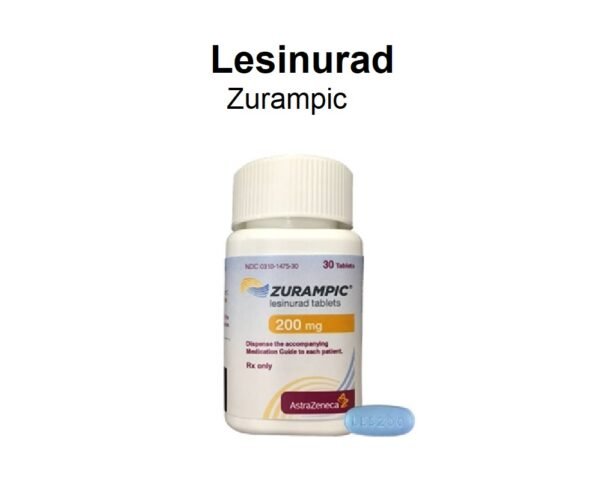
Lesinurad (Zurampic) is a urate-lowering drug. It inhibits the reabsorption of uric acid from the renal tubules promoting the excretion of uric acid from the body.
Lesinurad (Zurampic) Uses:
-
Hyperuricemia associated with gout:
- It is indicated for the treatment of hyperuricemia associated with gout in patients who have an inadequate response to xanthine oxidase inhibitors monotherapy (Allopurinol).
- Limitations of use:
- It is not indicated for the treatment of asymptomatic hyperuricemia.
- Monotherapy is not recommended.
Lesinurad is available in combination with allopurinol by the brand name of Duzallo.
Lesinurad (Zurampic) Dose in Adults:
Lesinurad (Zurampic) Dose in the treatment of Hyperuricemia associated with gout:
- 200 mg orally once a day in combination with a xanthine oxidase inhibitor such as allopurinol or febuxostat.
- The maximum daily dose is 200 mg once a day.
Note:
- Patients who discontinue or interrupt treatment with a xanthine oxidase inhibitor, should also withhold lesinurad treatment.
Use in Children:
Not indicated
Lesinurad (Zurampic) pregnancy Risk Category: N (not assigned)
- In animal reproduction studies, no adverse fetal events have been observed. The data on human pregnancies are limited.
- All forms of hormonal contraceptives, oral, injectable and topical, are affected by treatment.
- While on treatment, you should consider other nonhormonal methods to contraceptive.
Lesinurad use during breastfeeding:
- It is unknown if the drug will be excreted into breastmilk.
- Manufacturer suggests weighing the advantages of treatment for the mother against the potential risks to the infant from drug exposure.
Lesinurad (Zurampic) Dose in Kidney disease:
-
Patients with a preexisting renal impairment:
- Estimated CrCl ≥60 mL/minute:
- Adjustment in the dose is not necessary.
- Estimated CrCl 45 to <60 mL/minute:
- Adjustment is not necessary, however, frequent monitoring of renal function should be done.
- Estimated CrCl 30 to <45 mL/minute:
- Treatment should not be initiated as it may be less effective.
- Estimated CrCl <30 mL/minute:
- The drug is contraindicated in patients with a CrCl of less than 30 ml/minute.
- End-stage renal disease (ESRD) or patients on dialysis:
- The drug is contraindicated in patients on dialysis and ESRD.
- Estimated CrCl ≥60 mL/minute:
-
Patients who develop renal toxicity during treatment:
- Estimated CrCl persistently <45 mL/minute:
- Discontinue treatment if the creatinine clearance drops to less than 45 ml/minute.
- Estimated CrCl persistently <45 mL/minute:
Lesinurad (Zurampic) Dose in Liver disease:
- Mild to moderate impairment (Child-Pugh class A and B):
- Adjustment in the dose is not necessary.
- Severe impairment (Child-Pugh class C):
- Avoid using the drug in patients with advanced liver disease.
Incidence reported in combination with a xanthine oxidase inhibitor.
Side Effects of Lesinurad (Zurampic):
-
Central nervous system:
- Headache
-
Gastrointestinal:
- Gastroesophageal reflux disease
-
Infection:
- Influenza
-
Renal:
- Increased serum creatinine
- Renal failure
Uncommon Side effects of Lesinurad (Zurampic):
-
Cardiovascular:
- Cerebrovascular accident
- Myocardial infarction
-
Renal:
- Acute renal failure
Contraindications to Lesinurad (Zurampic):
- Patients with severe renal impairment (CrCl 30 mL/minute), end stage renal disease (ESRD) and/or dialysis
- Kidney transplant recipients
- Tumor lysis syndrome (or)
- Lesch-Nyhan syndrome
Warnings and precautions
-
Cardiovascular events
- Patients receiving lesinurad treatment were found to have MACE (major adverse cardiovascular events), which included deaths due to a cardiovascular cause, non-fatal myocardial injury, and strokes.
- However, it was not possible to establish a clear causal relationship.
-
Gout flare
- Gout can flare up due to the mobilization of uric acids from the tissues.
- Before you start treatment, it is a good idea to prevent acute flare-ups of goutyarthritis.
- The treatment with lesinurad can be continued during a gouty attack or while you manage the flare-up of gouty arthritis.
-
Nephrotoxicity:
- A combination therapy with a xanthine oxide inhibitor can lead to an increase in serum creatinine levels. Treatment discontinuation will usually reverse the effect.
- [US Boxed Warning]: Monotherapy can lead to acute renal failure.
- Patients taking concomitant xanthine oxide inhibitors have been known to be at risk for acute and chronic kidney failure, as well as the development of nephrolithiasis.
- Nephrotoxicity is more common when the drug was taken in a higher dose than recommended.
-
Renal impairment
- It is important to evaluate the renal function before starting treatment and then periodically thereafter, if clinically indicated.
- People with a CrCl less than 60 ml/minute, or elevated creatinine levels 1.5 to 2 times the baseline level, should have their renal functions monitored more often.
- Patients with an eGFR below 45 ml/minute should not receive treatment. Treatment is also contraindicated for patients with a CrCl lower than 30 ml/minute.
- Treatment may not work for those who have a CrCl below 30 ml/minute or those on dialysis.
- Patients with serum creatinine levels greater than 2x the baseline level must be stopped from receiving treatment.
- Patients with acute urate neuropathy, such as nausea, vomiting, flank pain or nausea, should be treated immediately.
-
Secondary hyperuricemia
- Patients with secondary hyperuricemia, such as transplant recipients, have not been treated with the drug.
- Patients with cancer, tumor lysis syndrome, or Lesch-Nyhan syndrome should avoid it.
Lesinurad: Drug Interaction
|
Alpelisib |
May decrease the serum concentration of CYP2C9 Substrates (High risk with Inducers). |
|
Aspirin |
May diminish the therapeutic effect of Lesinurad. |
|
CloZAPine |
CYP3A4 Inducers (Weak) may decrease the serum concentration of CloZAPine. |
|
CYP2C9 Inducers (Moderate) |
May decrease the serum concentration of Lesinurad. |
|
CYP2C9 Inhibitors (Moderate |
May increase the serum concentration of Lesinurad. |
|
Lumacaftor |
May decrease the serum concentration of CYP2C9 Substrates (High Risk with Inhibitors or Inducers). Lumacaftor may increase the serum concentration of CYP2C9 Substrates (High Risk with Inhibitors or Inducers). |
|
NiMODipine |
CYP3A4 Inducers (Weak) may decrease the serum concentration of NiMODipine. |
|
Rifapentine |
May decrease the serum concentration of CYP2C9 Substrates (High risk with Inducers). |
|
Dabrafenib |
May decrease the serum concentration of CYP2C9 Substrates (High risk with Inducers). Management: Seek alternatives to the CYP2C9 substrate when possible. If concomitant therapy cannot be avoided, monitor clinical effects of the substrate closely (particularly therapeutic effects). |
|
Enzalutamide |
May decrease the serum concentration of CYP2C9 Substrates (High risk with Inducers). Management: Concurrent use of enzalutamide with CYP2C9 substrates that have a narrow therapeutic index should be avoided. Use of enzalutamide and any other CYP2C9 substrate should be performed with caution and close monitoring. |
|
Estrogen Derivatives (Contraceptive) |
Lesinurad may decrease the serum concentration of Estrogen Derivatives (Contraceptive). Management: Use of an additional, nonhormonal contraceptive is recommended in patients being treated with lesinurad who desire effective contraception. |
|
MiFEPRIStone |
May increase the serum concentration of CYP2C9 Substrates (High risk with Inhibitors). Management: Use CYP2C9 substrates at the lowest recommended dose, and monitor closely for adverse effects, during and in the 2 weeks following mifepristone treatment. |
|
Progestins (Contraceptive) |
Lesinurad may decrease the serum concentration of Progestins (Contraceptive). Management: Use of an additional, nonhormonal contraceptive is recommended in patients being treated with lesinurad who desire effective contraception. |
|
Ubrogepant |
CYP3A4 Inducers (Weak) may decrease the serum concentration of Ubrogepant. Management: Use an initial ubrogepant dose of 100 mg and second dose (if needed) of 100 mg when used with a weak CYP3A4 inducer. |
|
Valproate Products |
May increase the serum concentration of Lesinurad. |
Monitoring parameters:
- Serum creatinine and estimated CrCl before the start of therapy and periodically thereafter as clinically indicated.
- Serum creatinine and estimated CrCl should be more frequently monitored in patients with a baseline creatinine of 1.5 to 2 times the upper limits of normal or a CrCl of less than 60 ml/minute.
- Monitor serum uric acid levels at 2 to 5 weeks intervals while titrating the dose and then every 6 monthly.
How to administer Lesinurad (Zurampic)?
- It is administered orally, preferably in the morning with food and water.
- The drug should be taken at the same time each morning.
- Patients should be advised to maintain hydration.
- A minimum of 2 litres of fluid intake is recommended daily.
Mechanism of action of Lesinurad (Zurampic):
- Lesinurad (Zurampic), is a uricosuric medication.
- It inhibits uric acid absorption and promotes its excretion. It prevents the absorption uric acids by blocking two important transporter proteins (uric Acid Transporter 1 [URAT1]) and Organic Anion Transporter 4 [OAT4]), which are involved in the reabsorption uric acid from your kidneys.
Absorption:
- Rapid
Protein binding:
- >98% (It is bound primarily to albumin)
Metabolism:
- It is primarily metabolized oxidatively via CYP2C9
- Metabolites of the drug do not contribute to the drug activity and their plasma exposure is minimal.
Bioavailability:
- ~100%
Half-life elimination:
- ~5 hours
Time to peak:
- Within 1 to 4 hours
Excretion:
- Urine (63%; ~30% as unchanged drug);
- feces (32%)
International Brand Names of Lesinurad:
- Zurampic
Lesinurad Brand Names in Pakistan:
No Brands Available in Pakistan.
.png)