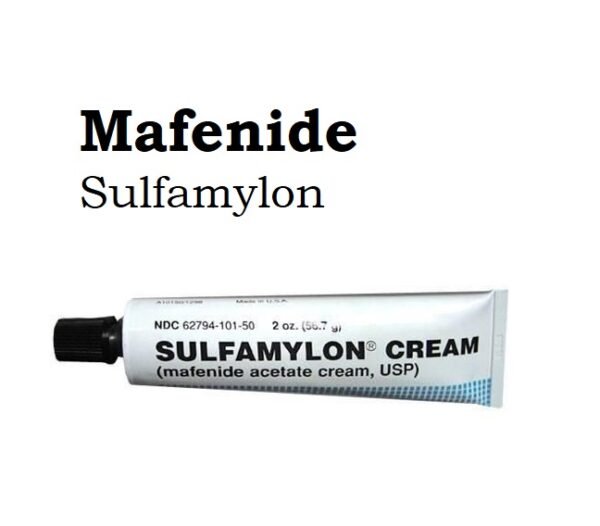
Mafenide (Sulfamylon) is a broad-spectrum antibiotic with activity against gram-positive and gram-negative bacteria including Pseudomonas aeruginosa. It is used as a topical solution or cream in patients with second or third-degree burns.
Mafenide (Sulfamylon) Uses:
-
Burn treatment:
- It is used as an adjunctive treatment in patients with second-degree or third-degree burns as a topical antimicrobial cream to control bacterial infection.
- It is used over meshed autografts on excised burn wounds (powder for solution) under moist dressings.
Mafenide (Sulfamylon) Dose in Adults:
Mafenide (Sulfamylon) Dose in the treatment of Burn: Topical:
- Cream:
- Apply the cream with a sterile-gloved hand once or twice a day.
- Apply as a thin layer over the burned area.
- Cover the burned area at all times until healing or the burned site is ready for grafting.
- Powder for solution:
- Cover the graft area with an 8-ply burn dressing soaked in the solution.
- The dressings should be kept wet using an irrigation tubing or a syringe every four hours as necessary.
- The treatment should be continued until revascularization of the autograft occurs and healing is progressing.
- The dressing may be kept in place not exceeding five days.
Mafenide (Sulfamylon) Dose in the treatment of Burns: Topical:
-
Infants, Children, and Adolescents:
- Cream:
- Apply the cream with a sterile-gloved hand once or twice a day.
- Apply as a thin layer that covers the burned surface at all times.
- Cream:
-
Infants ≥3 months, Children, and Adolescents:
- Solution (5%):
- The burned area should be covered with a layer of meshed gauze piece.
- The graft area should be covered with an 8-ply burn dressing soaked in the solution.
- The dressing should be kept wet using an irrigation tubing or a wet syringe every four hours or as necessary.
- The dressing may be kept in place not exceeding five days and should be secured and wrapped with bolster dressing as appropriate.
- Solution (5%):
Pregnancy Risk Category: C
- Animal reproduction studies did not show any adverse reactions when the drug was given orally.
- The cream should not be used by women under the age of 20 years.
Use Mafenide while breastfeeding
- It is unknown if the drug will be excreted into breastmilk.
- The manufacturer suggests that infants not be breastfed due to the potential for serious adverse drug reactions.
Mafenide (Sulfamylon) Dose in Kidney Disease:
- In the manufacturer's labeling, there are no contraindications mentioned.
- It should, however, be used with caution in patients with renal failure because of drug accumulation and metabolic acidosis.
Mafenide (Sulfamylon) Dose in Liver disease:
In the manufacturer's labeling, there are no contraindications mentioned.
Side effects of Mafenide (Sulfamylon):
-
Cardiovascular:
- Edema
- Facial Edema
-
Dermatologic:
- Erythema
- Maceration
- Pruritus
- Rash
- Urticaria
-
Endocrine & Metabolic:
- Hyperchloremia
- Metabolic Acidosis
-
Gastrointestinal:
- Diarrhea (Following Accidental Ingestion)
-
Hematologic:
- Bleeding
- Bone Marrow Suppression
- DIC
- Eosinophilia
- Hemolytic Anemia
- Porphyria
-
Local:
- Blisters
- Burning Sensation,
- Excoriation
- Pain
-
Respiratory:
- Dyspnea
- Hyperventilation
- Pco Decreased
- Tachypnea
-
Miscellaneous:
- Hypersensitivity
Contraindications to Mafenide (Sulfamylon):
Allergy to mafenide, or any component of this formulation
Warnings and precautions
-
Acid-base imbalance
- The inhibitory effect of the drug upon the enzyme carbonic anihydrase may cause metabolic acidosis.
- Patients with impaired renal function may experience metabolic acidosis more often.
- Metabolic acidosis symptoms are subtle and may manifest only as an increase of the respiratory rate (due compensatory hyperventilation).
- Patients with severe burns and patients with renal dysfunction or pulmonary dysfunction should be closely monitored for venous or arterial PH.
-
Allergy to sulfonamide
- Patients who are allergic to sulfonamides or sulfonylureas, thiazide diuretics, thiazide diuretics or loop diuretics (except for ethacrynic acids), should not use it.
- Patients who have had an allergic reaction in the past should not use the drug.
-
Superinfection
- Long-term use of the drug can lead to superinfection, including serious bacterial or fungal infections.
- The risk of antibiotic-associated pseudomembranous colitis may occur as later as two months after the last dose of antibiotics.
-
G6PD deficiency:
- G6PD deficiency can lead to acute hemolytic crises and DIC (disseminated intravascular coagulation), which may prove fatal.
- These patients should use it with caution.
-
Renal impairment
- Patients with acute renal impairment should not be given the drug.
- Due to drug accumulation and carbonic anhydrase inhibitor, the risk of metabolic acidosis could increase.
Mafenide: Drug Interaction
|
BCG Vaccine (Immunization) |
Antibiotics may diminish the therapeutic effect of BCG Vaccine (Immunization). |
|
Dapsone (Topical) |
May enhance the adverse/toxic effect of Methemoglobinemia Associated Agents. |
|
Local Anesthetics |
Methemoglobinemia Associated Agents may enhance the adverse/toxic effect of Local Anesthetics. Specifically, the risk for methemoglobinemia may be increased. |
|
Nitric Oxide |
May enhance the adverse/toxic effect of Methemoglobinemia Associated Agents. Combinations of these agents may increase the likelihood of significant methemoglobinemia. |
|
Prilocaine |
Methemoglobinemia Associated Agents may enhance the adverse/toxic effect of Prilocaine. Combinations of these agents may increase the likelihood of significant methemoglobinemia. Management: Monitor patients for signs of methemoglobinemia (e.g., hypoxia, cyanosis) when prilocaine is used in combination with other agents associated with development of methemoglobinemia. Avoid lidocaine/prilocaine in infants receiving such agents. |
|
Sodium Nitrite |
Methemoglobinemia Associated Agents may enhance the adverse/toxic effect of Sodium Nitrite. Combinations of these agents may increase the likelihood of significant methemoglobinemia. |
|
Sodium Picosulfate |
Antibiotics may diminish the therapeutic effect of Sodium Picosulfate. Management: Consider using an alternative product for bowel cleansing prior to a colonoscopy in patients who have recently used or are concurrently using an antibiotic. |
|
BCG (Intravesical) |
Antibiotics may diminish the therapeutic effect of BCG (Intravesical). |
Monitoring parameters:
- Acid base balance
- Monitor for superimposed infections and healing
How to administer Topical Mafenide (Sulfamylon)?
Cream:
- It is intended for topical (external) use only. The burn area should be covered with the medicated cream at all times.
- Dressings are not required but a thin layer of dressings may be used.
- The cream should be applied using a sterile gloved hand to a clean area that has been debrided. A thin layer of the drug should be applied.
- If the possibility of infection persists, treatment must not be discontinued. To help in the debridement of the wound, the patient should be bathed daily.
Powder for solution:
- It is intended for external use only.
- The graft area should be covered with one layer of fine mesh gauze.
- An 8-ply burn dressing should be soaked with the solution until leaking is noticeable and the graft area should be covered with it.
- The dressings should be kept wet using a syringe or irrigation tubing or by moistening dressing.
- Irrigation tubing should be placed over the burn dressing in contact with the wound;
- An additional 8-ply dressing should be used to cover the area.
- The irrigation dressing should be secured with bolster dressing and wrapped as appropriate.
Mechanism of action of Mafenide (Sulfamylon):
- It is a sulfonamide anti-biotic that competes against para-aminobenzoic acids and interferes with bacterial folic acid synthesis.
- It is effective against both gram positive and gram negative organisms, including pseudomonas Aeruginosa as well as anaerobic and anaerobic diseases.
Absorption:
- It absorbs quickly from the burnt surface and diffuses through devascularized areas.
Metabolism:
- It is metabolized to para-carboxybenzene sulfonamide.
- Mafenide and metabolite are carbonic anhydrase inhibitors
The time to peak serum concentration:
- Cream 11%: 2 to 4 hours
- Burn tissue:
- Cream 11%: 2 hours,
- Solution 5%: 4 hours
Excretion:
- Urine (as metabolites)
International Brands of Mafenide:
- Sulfamylon
- Homonal
- Mafatate
- Mefede
- Sulfamylon
- Sulfomyl
Mafenide Brands Names in Pakistan:
No Brands Available in Pakistan.
.png)