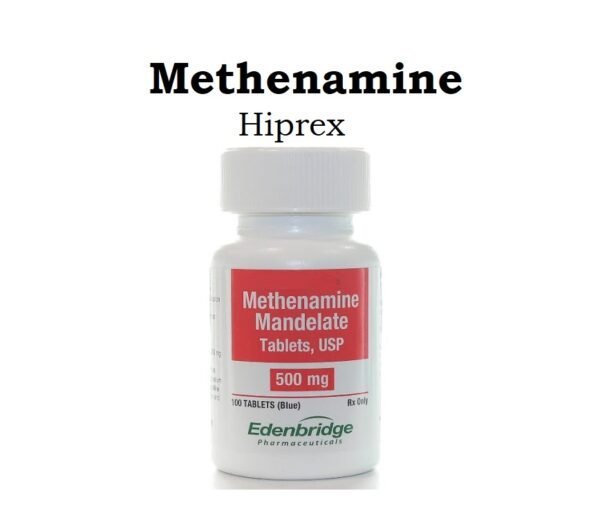
Methenamine (Hiprex) is available as Methenamine Hippurate and Mandelate. It is hydrolyzed in urine to formaldehyde that has bactericidal effects.
Methenamine (Hiprex) Uses:
-
Prophylaxis and suppressive treatment of Urinary tract infection:
- It is used in the prophylactic and suppressive treatment of recurrent urinary tract infections when long-term therapy is indicated after the infection has been eradicated by appropriate antimicrobial treatment.
Methenamine (Hiprex) Dose in Adults:
Methenamine (Hiprex) Dose in the prophylactic and suppressive treatment of Urinary tract infection:
- Hippurate:
- 1,000 mg orally two times a day.
- Mandelate:
- 1,000 mg orally four times a day.
Methenamine (Hiprex) Dose in Childrens:
- The Urine should be acidic with a PH preferably less than 5.5 for optimal efficacy.
Methenamine (Hiprex) Dose in the prophylaxis and suppression of Urinary tract infection:
-
Methenamine hippurate:
- Children 6 to 12 years:
- 500 to 1,000 mg orally two times a day.
- Adolescents:
- 1,000 mg orally two times a day.
- Children 6 to 12 years:
-
Methenamine mandelate:
- Children <6 years:
- 50 to 75 mg/kg/day orally in three to four equally divided doses (every 6 to 8 hours)
- The maximum dose is 500 mg/dose
- Children 6 to 12 years:
- 500 mg orally four times a day.
- Adolescents:
- 1,000 mg orally four times a day.
- Children <6 years:
Pregnancy Risk Factor C (methenamine mandelate)
- Methenamine mandelate was not tested in humans or animals.
- Animal reproduction with methenamine hippurate has not been shown to have any adverse drug reactions.
- It crosses the placental boundary and is then distributed into the amniotic liquid.
- There is no evidence to suggest that there is an increased risk of adverse effects in fetuses, according to the available research.
- If the acid hydrolysis test is used, it may cause interference with laboratory measurements of estriol levels.
- This laboratory interference is prevented by enzyme hydrolysis.
Use of methenamine during lactation
- It is excreted from breast milk.
- The manufacturer suggests that you stop breastfeeding because of possible adverse drug reactions in infants.
Methenamine (Hiprex) Dose in Kidney Disease:
- Mild to severe impairment:
- It is contraindicated in renal impairment.
Methenamine (Hiprex) Dose in Liver disease:
- Mild to moderate liver impairment:
- In the manufacturer's labeling, adjustments in the dose have not been provided. However, use the drug with caution.
- Severe liver impairment:
- It is contraindicated in patients with severe hepatic impairment.
Large doses that exceed the recommended doses may result in bladder irritation resulting in dysuria, frequent and painful urination, albuminuria, and hematuria.
Side Effects of Methenamine (Hiprex):
-
Dermatologic:
- Pruritus
- Skin rash
-
Gastrointestinal:
- Dyspepsia
- Nausea
- Vomiting
Contraindications to Methenamine (Hiprex):
- Allergy reactions to methenamine and any component of this formulation
- Severe dehydration
- Renal impairment
- Hepatic impairment severe
- Concurrent treatment using sulfonamides
Warnings and precautions
-
Gout
- It can cause crystallization of uric acid. Patients with gout should avoid it.
-
Hepatic impairment
- Patients with severe hepatic impairment should avoid it.
- It can be given to patients with mild or moderate renal dysfunction and normal liver function, provided that the liver function is monitored regularly.
- Treatment may cause temporary reversible elevations of liver enzymes.
Monitoring parameters:
- Urinalysis (monitor urinary PH and pyouria)
- Lver function tests should be monitored periodically
How to administer Methenamine (Hiprex)?
- Patients should be advised to restrict medications and food that alkalinize urine so as to maintain a urinary PH of 5.5 or less. Monitor urinary PH while on treatment.
- Hippurate:
- It should be administered two times a day (morning and night).
- Mandelate:
- It should be administered four times a day (after each meal and at bedtime).
Mechanism of action of Methenamine (Hiprex):
- Hydrolyzed to formaldehyde and ammonia in acidic urine, it is then hydrolyzed.
- Formaldehyde is a bactericidal agent.
- Other ingredients, such as mandelic acid or hippuric acid, may also help to acidify the urine and suppress bacterial growth.
Absorption:
-
- It is easily absorbed by the gastrointestinal tract.
- Without an enteric coating protecting the drug, 10% to 30% will be hydrolyzed by the stomach using gastric juices.
Metabolism:
- It is hydrolyzed to formaldehyde and ammonia in the urine;
- About 10% to 25% in the liver
Half-life elimination:
- About 4 hours
Time to peak:
- 1 to 2 hours.
Excretion:
- About 70% to 90% is excreted in urine as unchanged drug within 24 hours
International Brands of Methenamine:
- Hiprex
- Mandelamine
- Antihydral
- Haiprex
- Hexamandin
- Hipeksal
- Hiprex
- Mandehexan
- Mandelamine
- Pedipur
- Reflux
- Stoppot
- Urotractan
Methenamine Brands Names in Pakistan:
No Brands Available in Pakistan.
.png)


