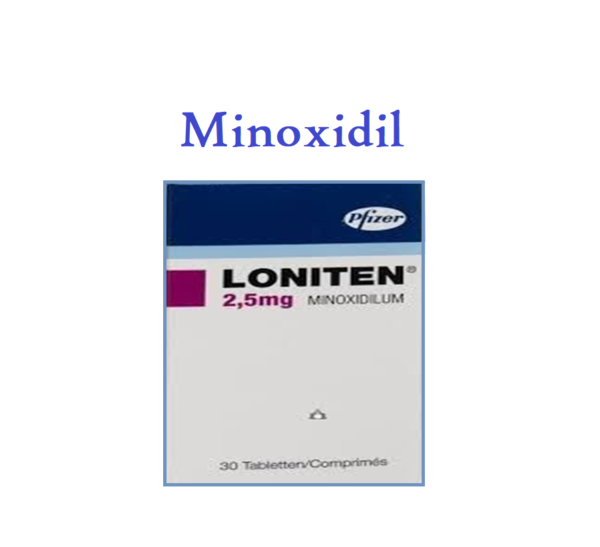
Minoxidil (Loniten) is a drug that causes vasodilation. It is rarely used in the management of hypertension in patients resistant to a diuretic and two other antihypertensive medications.
Minoxidil (Loniten) Uses:
-
Hypertension:
- It is suggested for the treatment of symptomatic hypertension or that which is linked to target organ damage, resistance to a diuretic, and the use of two additional antihypertensives.
- Not recommended in milder hypertension because the benefit-risk ratio is not defined.
Note: It is not suggested to be used as an initial treatment for high blood pressure.
Minoxidil Dose in Adults:
Minoxidil (Loniten) Dose as an alternative agent in the treatment of Hypertension:
- Oral: Initial:5 mg once a day, which may be gradually increased every three days or more in dosages of 1 to 3. (or every 6 hours with careful monitoring if rapid management is required)
- Maximum dose: 100 mg/day
Note: When adding the medication as a concurrent therapy, adjust the dosage. Give the dose once daily if the patient's supine diastolic pressure is below 30 mm Hg; give the dose in two equally spaced doses if it is above 30 mm Hg.
Minoxidil Dose in Children:
Minoxidil (Loniten) Dose in the therapy of extremely high blood pressure; resistant to multiple drugs:
-
Children <12 years:
- The usual effective dosage is 0.25 to 1 mg/kg/day, split into 1 to 3 doses.
- Initial: 0.2 mg/kg/dose once a daily
- Maximum initial dose: 5 mg/dose; titrate to effect, may increase the daily dose by 50% to 100% every 3 days;
- Can be divided up to 1 - 3 times daily
- Maximum daily dose: 50 mg/day
Note: In situations where rapid blood pressure management is required, the dose can be increased every 6 hours with careful monitoring.
-
Children ≥12 years and Adolescents:
- The usual effective dosage range is 10 to 40 mg per day, split into 1 to 3 doses.
- Initial: 5 mg once a day, titrate to effect, can be increased every 3 days by doubling the daily dose (10 mg/day, 20 mg/day, and then 40 mg/day)
- Can be divided up to 1 - 3 times daily
- Maximum dose: 100 mg/day
Note: In situations where rapid blood pressure management is required, the dose can be increased every 6 hours with careful monitoring.
Pregnancy Risk Factor C
- Studies on animals have shown adverse effects.
- Neonatal hypertrichosis is possible
Use during breastfeeding:
- Breast milk can contain minoxidil.
- Due to possible side effects, the manufacturer doesn't recommend breastfeeding.
Dose in Kidney Disease:
The manufacturer has not provided any dose adjustment in labeling However, reduce the dose in renal failure and/or receiving dialysis.
Dose in Liver disease:
The manufacturer has not provided any dose adjustment in labeling Use cautiously and titrates gradually (minoxidil AUC increased by 50% and its clearance decreased in mildly cirrhotic patients.
Side effects of Minoxidil (Loniten):
-
Dermatologic:
- Toxic Epidermal Necrolysis
- Skin Rash
- Hypertrichosis
- Bullous Rash
- Stevens-Johnson Syndrome
-
Cardiovascular:
- ECG Changes
- Edema
- Pericardial Effusion
- Angina Pectoris
- Cardiac Failure
- Pericarditis
- Tachycardia
-
Endocrine & Metabolic:
- Sodium Retention
- Water Retention
- Weight Gain
-
Gastrointestinal:
- Nausea
- Vomiting
-
Hematologic & Oncologic:
- Hemoglobin
- Leukopenia
- Decreased Hematocrit
- Decreased Red Blood Cells
- Thrombocytopenia
-
Respiratory:
- Pulmonary Edema
-
Hepatic:
- Ascites
- Increased Serum Alkaline Phosphatase
-
Renal:
- Increased Blood Urea Nitrogen
- Increased Serum Creatinine
Contraindications to Minoxidil (Loniten):
- Hypersensitivity to any formulation's component
- Pheochromocytoma
Canadian labeling: Additional contraindications not in US labeling
- Pulmonary hypertension due to mitral stenosis (MS),
- Hepatic impairment severe
Warnings and precautions
-
Fluid retention:
- Salt and water retention can result from their use
- To avoid fluid overload, use loop diuretics or diuretic diuretics
- Patients with heart failure should exercise extreme caution
-
Pericardial effusion/tamponade [US Boxed Warn]
- Its use can cause pericarditis or pericardial effusion, which could lead to tamponade.
- Patients at greater risk of renal impairment are those with higher incomes.
- In the event of heart failure, be cautious
- Pay attention to the patient
- Minoxidil should be stopped if there is persistent effusion.
-
Control blood pressure quickly
- Syncope, cerebrovascular accident, myocardial infarction, and ischemia of any other organs, which can cause visual or hearing loss, can all happen from abruptly dropping blood pressure.
- Minoxidil may cause ischemic episodes in organs if it is used with compromised circulation and cryoglobulinemia.
-
Sinus tachycardia [US Boxed Warning]
- Its use can increase oxygen demand and worsen angina pectoris.
- If there is no contraindication, a beta-blocker should also be taken with it.
- Ischemic heart disease: Use caution
-
Acute myocardial injury (MI)
- Its use can increase oxygen demand and reflex Tachycardia. Avoid its use for at least one month following a myocardial Infarction event
- It is a good idea to take extreme caution. Before starting therapy, ensure that the patient has taken a beta-blocker.
-
Heart failure:
- Minoxidil caused an increase in diuretics, angina, and ventricular arrhythmias. It also increased the risk of death.
- Minoxidil, according to the American Heart Association (AHA), can cause myocardial dysfunction.
-
Renal impairment
- Avoid renal impairment. In renal failure or dialysis, a smaller dose may be required.
- To prevent further kidney damage, monitor closely.
Minoxidil (topical): Drug Interaction
|
Risk Factor C (Monitor therapy) |
|
|
CycloSPORINE (Systemic) |
May intensify the negative or harmful effects of minoxidil (Topical). Particularly, there may be an increased risk of hypertrichosis. |
Monitoring parameters:
- Fluid and electrolyte balance
- Signs/symptoms of pericardial effusion
- Bodyweight monitoring.
- When starting treatment, keep track of any abnormal results from tests such as renal function tests, ECGs, echocardiograms, and chest X-rays. Repeat the tests first every 1 to 3 months, then every 6 to 12 months until the condition is stabilized.
- Blood pressure, standing and sitting/supine
According to the 2017 Guideline for the Prevention, Detection, Evaluation, and Management of High Blood Pressure in Adults :
- Confirmed hypertension and known CVD or 10-year ASCVD risk ≥10%: Target blood pressure <130/80 mm Hg is recommended
- Confirmed hypertension without markers of increased ASCVD risk: Target blood pressure <130/80 mm Hg may be reasonable
Mechanism of action of Minoxidil (Loniten):
- It directly acts on the arterial smooth muscles, relaxes them, and induces vasodilation.
- It does not affect veins. The cyclic AMP is responsible for its action.
- Vasodilation is responsible for stimulating hair growth.
- This increases cutaneous blood flow and stimulates resting hair cells.
The beginning of action:
- Hypotensive: ~30 minutes
Peak effect:
- 2 - 3 hours
Half-life elimination:
- 3.5 - 4.2 hours
Duration:
- Up to 2 - 5 days
Protein binding:
- None
Metabolism:
- About 90%, mainly via glucuronidation
Bioavailability:
- 90%
Excretion:
- Urine (12% excretes unchanged)
International Brand Names of Minoxidil:
- Loniten
- Guayaten
- Loniten
- Lonnoten
- Lonolox
- Lonoten
- Manoxidil
- Midil
- Noxidil
- Noxidil Forte
Minoxidil Brands Names in Pakistan:
Systemic minoxidil is not available in Pakistan. The common formulation is the topical solution and sprays used for hair growth.
Minoxidil Solution 2 % in Pakistan |
|
| Higrow | Shaigan Pharmaceuticals (Pvt) Ltd |
| Regro | Seatle Pharma Pakistan (Pvt) Ltd. |
Minoxidil Solution 5 % in Pakistan |
|
| Regro | Seatle Pharma Pakistan (Pvt) Ltd. |
Minoxidil Solution 5 %W/V in Pakistan |
|
| Hair Max Plus | Sante (Pvt) Limited |
| Minoxin Plus | Brookes Pharmaceutical Laboratories (Pak.) Ltd. |
| Regrow | Derma Techno Pakistan |
Minoxidil Lotion 2 % in Pakistan |
|
| Minoxy | Danas Pharmaceuticals (Pvt) Ltd |
Minoxidil Lotion 5 %W/W in Pakistan |
|
| Minoxy Plus | Danas Pharmaceuticals (Pvt) Ltd |
.png)


