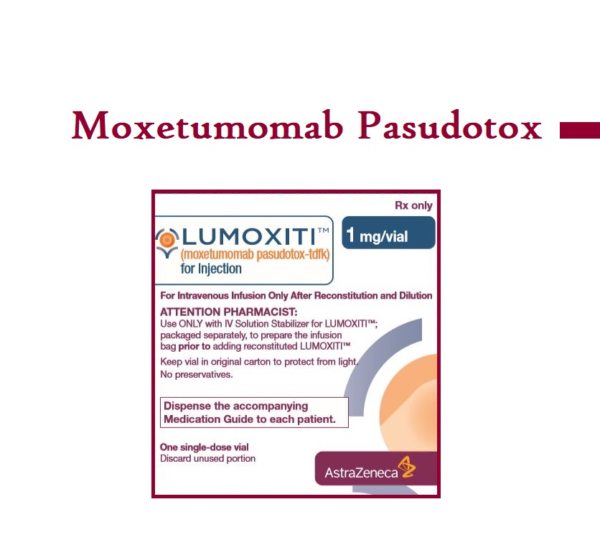
Moxetumomab Pasudotox (Lumoxiti) is a CD22-directed cytotoxin that consists of the binding fragment of an anti-CD22 antibody fused to a toxin, PE38. It is used in the management of adult patients with hairy cell leukemia.
Moxetumomab Pasudotox (Lumoxiti) Uses:
-
Hairy cell leukemia (relapsed or refractory):
- Therapy of relapsed or refractory hairy cell leukemia (HCL) in adult patients who have received at least two prior systemic therapies, including medication with a purine nucleoside analog.
- Limitations of use: Moxetumomab pasudotox is not recommended in patients with acute renal impairment (CrCl ≤29 mL/minute).
Moxetumomab Pasudotox Dose in Adults:
Note: Use real bodyweight prior to the initial dose of the initial treatment cycle to calculate the dose. A switch in dose should only be made between cycles when the weight changes by >10% from the weight used to calculate the first dose of the first treatment cycle; do not change a dose during a specific cycle.
Moxetumomab Pasudotox (Lumoxiti) Dose in the treatment of relapsed or refractory cell leukemia:
- IV: 0.04 mg/kg on days 1, 3, and 5 of each 28-day treatment cycle;
- Continue treatment for a maximum of 6 cycles, or until disease progression or unacceptable toxicity.
- Concomitant treatments:
- Hydration:
- Dispense 1 L (500 mL for patients <50 kg) of isotonic IV solution over 2 to 4 hours prior to and after each moxetumomab pasudotox infusion.
- Patients should amply hydrate with up to 3 L (2 L for patients <50 kg) of oral fluids (e.g., water, milk, or juice) per 24 hours on days 1 through 8 of every 28-day treatment cycle.
- Observe fluid balance and serum electrolytes to avoid fluid excess and/or electrolyte imbalance.
- Premedication:
- Administer an antihistamine (e.g., hydroxyzine or diphenhydramine), an antipyretic (acetaminophen), and a histamine H-1 receptor antagonist (e.g., ranitidine, famotidine, or cimetidine) 30 to 90 minutes prior to each moxetumomab pasudotox infusion.
- Post-infusion medications:
- Administer an oral corticosteroid (e.g., dexamethasone 4 mg) to decrease nausea and vomiting.
- Consider oral antihistamines and antipyretics for up to 24 hours after infusion. Maintain sufficient liquid consumption.
- Thromboprophylaxis:
- Consider low-dose aspirin on days 1 through 8 of every 28-day treatment cycle.
- Hydration:
Moxetumomab Pasudotox dose in Children:
Not indicated.
Pregnancy Risk Category: N
- If a pregnancy is affected, it may be possible to expect harmful maternal or fetal outcomes.
- Before using, check for pregnancy.
- According to the manufacturer, pregnant women of reproductive potential should use effective contraception throughout treatment and for at most 30 days following the last dose of moxetumomab Pasudotox.
Use of Moxetumomab during breastfeeding:
- It isn't if breast milk contains moxetumomab Pasudotox.
- The manufacturer does not recommend breastfeeding. It is important to weigh the benefits to the mother and the risks to the infant when making the decision to stop moxetumomab Pasudotox.
Moxetumomab Pasudotox (Lumoxiti) Dose in Kidney Disease:
-
Renal impairment prior to treatment initiation:
- CrCl ≥30 mL/minute:
- There are no dosage alterations provided in the manufacturer's labeling; however, no clinically substantial disparities in the pharmacokinetics of moxetumomab pasudotox were observed in patients with CrCl 30 to 89 mL/minute.
- CrCl ≤29 mL/minute:
- Use is not advised.
- CrCl ≥30 mL/minute:
-
Renal toxicity during treatment:
-
- Grade 2 or higher creatinine increases (>1.5 times baseline or the upper limit of normal [ULN]):
- If baseline serum creatinine was within normal limits, postpone infusion.
- Upon improvement to grade 1 (1 to 1.5 times baseline or between ULN to 1.5 times ULN), resume moxetumomab pasudotox treatment.
- Grade 3 or higher creatinine increases (>3 times baseline or ULN):
- If baseline serum creatinine was grade 1 or 2, delay infusion.
- Upon recovery to baseline grade or lower, continue moxetumomab pasudotox treatment.
- Grade 2 or higher creatinine increases (>1.5 times baseline or the upper limit of normal [ULN]):
-
Moxetumomab Pasudotox (Lumoxiti) Dose in Liver disease:
- Mild impairment (total bilirubin ≤ ULN and AST > ULN or total bilirubin >1 to 1.5 times ULN and any AST):
- There are no dosage modifications offered in the manufacturer's labeling; however, no clinically noteworthy differences in the pharmacokinetics of moxetumomab pasudotox were detected in patients with mild hepatic impairment.
- Moderate to severe impairment (total bilirubin >1.5 times ULN):
- There are no dosage modifications offered in the manufacturer's labeling (it has not been studied).
Common Side Effects of Moxetumomab Pasudotox (Lumoxiti):
-
Cardiovascular:
- Peripheral Edema
- Capillary Leak Syndrome
- Facial Edema
-
Central Nervous System:
- Fatigue
- Headache
-
Endocrine & Metabolic:
- Hypoalbuminemia
- Fluid Retention
- Electrolyte Disorder
- Hypocalcemia
- Hypophosphatemia
- Hyponatremia
- Hypokalemia
- Increased Gamma-Glutamyl Transferase
- Hypomagnesemia
- Hyperuricemia
-
Gastrointestinal:
- Nausea
- Constipation
- Diarrhea
- Abdominal Distention
-
Genitourinary:
- Nephrotoxicity
-
Hematologic & Oncologic:
- Decreased Hemoglobin
- Neutropenia
- Anemia
- Decreased Platelet Count
-
Hepatic:
- Increased Serum Alanine Aminotransferase
- Increased Serum Aspartate Aminotransferase
- Increased Serum Bilirubin
- Increased Serum Alkaline Phosphatase
-
Renal:
- Increased Serum Creatinine
-
Miscellaneous:
- Infusion-Related Reaction
- Fever
Less Common Side Effects Of Moxetumomab Pasudotox (Lumoxiti):
-
Cardiovascular:
- Edema
- Pericardial Effusion
-
Endocrine & Metabolic:
- Weight Gain
- Hypervolemia
-
Genitourinary:
- Proteinuria
-
Hematologic & Oncologic:
- Hemolytic-Uremic Syndrome
- Febrile Neutropenia
-
Hepatic:
- Ascites
-
Local:
- Localized Edema
-
Ophthalmic:
- Blurred Vision
- Xerophthalmia
- Cataract
- Eye Discomfort
- Eye Pain
- Ocular Edema
- Periorbital Edema
- Conjunctival Hemorrhage
- Conjunctivitis
- Eye Discharge
-
Renal:
- Acute Renal Failure
- Renal Insufficiency
-
Respiratory:
- Pleural Effusion
-
Immunologic:
- Antibody Development
Contraindications to Moxetumomab Pasudotox (Lumoxiti):
The manufacturer's labeling does not contain any contraindications.
Warnings and precautions
-
Capillary leak syndrome: [US-Boxed Warning]
- Patients who have had moxetumomab Pasudotox have experienced capillary leak syndrome (CLS), which can lead to life-threatening cases.
- Before each infusion, weigh and monitor blood pressure. If CLS is suspected, check labs including albumin.
- It is possible to delay or discontinue treatment.
- CLS can be characterised by hypoalbuminemia and hypotension, fluid overload symptoms and hemoconcentration.
- Although grades 3 and 4 CLS were seen more often, Grade 2 CLS was more frequently observed.
- Most CLS cases were diagnosed within the first 8 days of treatment. However, some cases can be found throughout the treatment process.
- CLS took on average 12 days to finish (range: 1 - 53 days).
- Monitor for hypoalbuminemia and elevated hematocrit. Leukocytosis and thrombocytosis.
- Also, look out for signs/symptoms such as CLS (weight gain [increased by 2.5 kg or >=5% since day 1 of the current cycle], hypotension and peripheral edema.
- CLS symptoms can be fatal or life-threatening so patients should seek immediate medical attention.
- Correctly manage CLS, including intravenous or oral corticosteroids and hospitalization if clinically necessary.
- Supress moxetumomab paudotox grade 2 CLS until resolution. Permanently terminate for grade 3 and higher CLS.
-
An electrolyte anomaly:
- More than half of patients who received moxetumomab Pasudotox (including grades 3 and 4) had electrolyte abnormalities.
- Hypocalcemia was the most common electrolyte disorder.
- In most cases, electrolyte abnormalities occur in the same treatment as HUS, CLS, fluid retention or renal toxicities.
- Monitor serum electrolytes prior to each dose, and on the 8th day of each treatment cycle. Monitoring mid-cycle is also recommended.
-
Hemolytic Uremic Syndrome: [US Boxed Warn]
- Moxetumomab Pasudotox treatment has led to life-threatening hemolytic kidney disease. This is characterized by progressive renal failure, microangiopathic hemolytic and thrombocytopenia.
- Patients receiving the treatment should have their hemoglobin, platelet counts and serum creatinine regularly monitored.
- HUS is a serious condition that should be treated immediately. HUS can occur at any stage of treatment. However, most cases occur within the first nine days.
- The HUS takes approximately 11.5 days to resolve (ranging between 2 and 44 days).
- Patients who have had a history of severe thrombotic miopathy or HUS should not take the drug.
- To prevent HUS, intravenous fluids can be used to prophylactically hydrate.
- Patients with platelet counts greater than 100,000/ul, especially in the first week of treatment, have had aspirin administered to prophylaxis.
- At baseline and day 8, complete blood counts should always be checked. Mid-cycle CBC should also be monitored if clinically indicated.
- If the patient has hemolytic anemia, worsening hemocytopenia, elevated bilirubin LDH, creatinine or schistocytes, HUS should be diagnosed. It is possible to become fatal if the diagnosis is delayed. Dialysis may be required for patients with progressive renal disease.
- If HUS is suspected, it is important to initiate appropriate supportive treatment. These include fluid repletion and hemodynamic monitoring.
-
Infusion reactions
- Half of patients who received moxetumomab Pasudotox have experienced infusion-related reactions; a grade 3 reaction has been reported.
- During any treatment period, infusion-related reactions could occur.
- Infusion reactions include nausea, vomiting and nausea.
- Before each moxetumomab Pasudotox dose, take antihistamines or antipyretics.
- Infusion-related reactions can be severe. Disrupt the infusion and administer an oral or IV corticosteroid within 30 minutes of the end of the infusion.
-
Toxicity in the renal system:
- Patients treated with moxetumomab Pasudotox have reported renal toxicity.
- This includes serious kidney injury (including grade 3-events), renal impairment, high serum creatinine and proteinuria.
- The majority of renal toxicities were mild in severity.
- During treatment, serum creatinine rose by at least 2 grades (from baseline), including some grade 3 rises in some patients.
- In a small number of patients, serum creatinine was elevated (1.5-3 times more than normal) after treatment.
- Patients over 65 years old with baseline renal impairment or HUS may be at greater risk of worsening their renal function after moxetumomab Pasudotox treatment.
- Monitor renal function before each infusion, and as clinically indicated during treatment.
- Patients with serum creatinine levels above 3 or greater or who are experiencing severe renal impairments beyond 2 grades should be delayed.
Moxetumomab pasudotox: Drug Interaction
|
Chloramphenicol (Ophthalmic) |
May enhance the adverse/toxic effect of Myelosuppressive Agents. |
|
CloZAPine |
Myelosuppressive Agents may enhance the adverse/toxic effect of CloZAPine. Specifically, the risk for neutropenia may be increased. |
|
Mesalamine |
May enhance the myelosuppressive effect of Myelosuppressive Agents. |
|
Promazine |
May enhance the myelosuppressive effect of Myelosuppressive Agents. |
|
Deferiprone |
Myelosuppressive Agents may enhance the neutropenic effect of Deferiprone. Management: Avoid the concomitant use of deferiprone and myelosuppressive agents whenever possible. If this combination cannot be avoided, monitor the absolute neutrophil count more closely. |
|
BCG (Intravesical) |
Myelosuppressive Agents may diminish the therapeutic effect of BCG (Intravesical). |
|
Cladribine |
May enhance the myelosuppressive effect of Myelosuppressive Agents. |
|
Dipyrone |
May enhance the adverse/toxic effect of Myelosuppressive Agents. Specifically, the risk for agranulocytosis and pancytopenia may be increased |
Monitoring parameters:
- Before each dose, examine the CBC and serum chemistries on the 8 th days of each treatment cycle.
- Monitoring midcycle is also possible.
- Before each infusion, examine your kidney function and follow the clinical recommendations throughout the treatment.
- Before therapy begins in females with reproductive potential, check for pregnancy.
- If CLS is suspected, monitor weight and blood pressure before each infusion.
- Watch out for signs/symptoms such as CLS, weight gain (increase of 2.5kg or >=5% since day 1), hypotension, serosal effusions, shortness/cough, pulmonary embolisms, and/or peripheral edema.
- Monitor for elevated serum creatinine, LDH, and/or bilirubin in patients with HUS. Also, look for hemolysis evidence based on peripheral bloodsmear schistocytes.
- Be on the lookout for signs and symptoms of fluid overload, thrombosis, or infusion reactions.
How to administer Moxetumomab Pasudotox (Lumoxiti)?
- Infuse intravenously over 30 minutes.
- Do not infuse with other medicines.
- Flush the infusion line with normal salt water (at the same rate as the infusion) in the wake of the infusion to make sure the full dose is given.
- Premedicate 30 to 90 minutes prior to each moxetumomab pasudotox infusion with an antihistamine, acetaminophen, and a histamine-2 receptor antagonist. Maintain adequate hydration.
Mechanism of action of Moxetumomab Pasudotox (Lumoxiti):
- Moxetumomab Pasudotox, a CD22-directed Cytotoxin made of a recombinant mouse immunoglobulin that has been genetically fused with a Pseudomonas exotoxin truncated (PE38), is composed of a CD22 directed cytotoxin. It binds to CD22 on B-cell cell surfaces and is then internalized.
- Internalization causes ADP-ribosylation (elongation factor 2), inhibition of protein synthesis and apoptotic cells death.
Onset:
- Achievement of hematologic remission: About 1 month.
- Day 8 circulating CD19+ B cells (surrogate assay for CD22) were reduced 89% (from baseline) in the wake of the first 3 infusions.
Duration:
- The average duration of full response (for patients with negligible residual disease): 5.9 months. B cell reduction is sustained for at least 1 month after medication.
Half-life elimination:
- 1.4 hours (range: 0.8 to 1.8 hours)
International Brand Names of Moxetumomab pasudotox:
- Lumoxiti
Moxetumomab pasudotox Brand Names in Pakistan:
No Brands Available in Pakistan.
.png)


