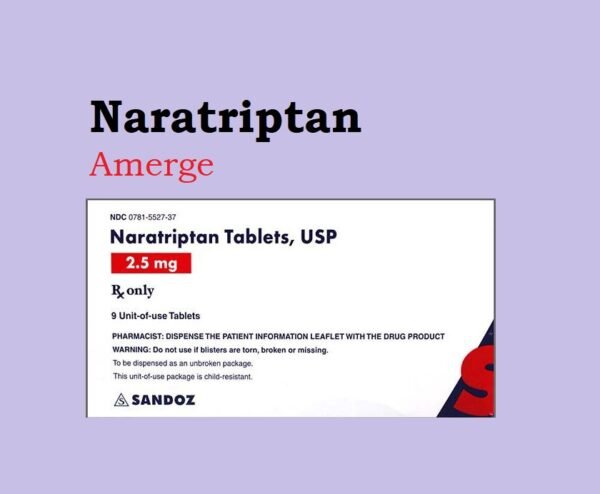
Naratriptan (Amerge) is a serotonin receptor agonist, specifically for 5-HT1 receptors. It is available as 1 mg and 2.5 mg tablets for the treatment of migraine headaches.
Naratriptan (Amerge) Uses:
-
Migraines:
- use for the acute treatment of migraine attacks in adults with or without aura.
-
Off Label Use of Naratriptan in Adults:
- Menstrual migraine prevention
Naratriptan (Amerge) Dose in Adults
Note:
- If the first dose is ineffective, diagnosis needs to be re-considered/re-evaluated.
- The safety of treating >4 migraines/month has not been established.
Naratriptan (Amerge) Dose in the treatment of Acute migraine:
- Oral:
- Initial: 1 to 2.5 mg;
- if headache recurs or does not fully resolve,
- a second dose may be administered after 4 hours of initial dose (maximum: 5 mg in a 24-hour period)
Naratriptan Dose in the prevention of Menstrual migraine (off-label use):
- Oral:
- 1 mg twice a day beginning 2 to 3 days before the expected onset of symptoms;
- continue for 5 to 6 days total.
Naratriptan (Amerge) Dose in Childrens
Not indicated in Children.
Pregnancy Risk Category: C
- GlaxoSmithKline sponsors a pregnancy registry that provides information about the outcome of a pregnancy.
- Data were available as of September 2012 for 57 infants/fetuses who had been exposed to naratriptan in pregnancy or post-partum, and seven children who were exposed to sumatriptan and naratriptan.
- One infant was born with a birth defect after naratriptan was given to him. This infant was also exposed during the first trimester of sumatriptan.
- The manufacturer can provide additional information.
- For the initial treatment, pregnant women with migraine should consult other agents until more information becomes available.
Use of Naratriptan while breastfeeding
- It is unknown if naratriptan can be found in breast milk.
- According to the drug manufacturer the decision to discontinue or continue breastfeeding while on therapy should consider the risks to infants, the benefits to the mother, and the benefits to the mother.
Naratriptan Dose in Kidney Disease:
-
Mild to moderate renal impairment:
- Initial: 1 mg; maximum dose: 2.5 mg in 24 hours
-
Severe renal impairment (CrCl <15 mL/minute):
- Use is contraindicated.
Naratriptan Dose in Liver disease:
-
Mild to moderate hepatic impairment (Child-Pugh grade A or B):
- Initial: 1 mg;
- maximum dose: 2.5 mg in 24 hours
-
Severe hepatic impairment (Child-Pugh grade C):
- Use is contraindicated.
Side Effects of Naratriptan (Amerge):
-
Central Nervous System:
- Pain
- Fatigue
- Dizziness
- Drowsiness
- Paresthesia
- Hot And Cold Flashes
- Sensation Of Pressure
- Vertigo
-
Gastrointestinal:
- Nausea
- Vomiting
- Xerostomia
-
Neuromuscular & Skeletal:
- Neck Pain
-
Ophthalmic:
- Photophobia
-
Respiratory:
- Constriction Of The Pharynx
- ENT Infection
Contraindications to Naratriptan (Amerge):
- Ischemic coronary artery disorder (CAD): angina pectoris, history or myocardial injury [MI] or documented silent ischemia; coronary artery vasosm; Prinzmetal's Angina; Wolff Parkinson White syndrome or arrhythmias that are associated with cardiac accessory conduction path disorders;
- History of stroke
- Transient ischemic Attack (TIA)
- History of basilar or hemiplegic migraine;
- Peripheral vascular disease
- Ischemic bowel disease
- Hypertension uncontrolled
- Recent use (within 24hrs) of another 5-HT agonist
- Methysergide or dihydroergotamine are ergotamine-containing medications.
- Grave renal impairment (CrCl 15 mg/minute)
- Grave hepatic impairment
- Hypersensitivity to naratriptan and any component of the formulation
Canadian labeling
- Additional contraindications not listed in the US labeling:
- Hypertension severe
- Cardiac arrhythmias, especially tachycardias;
- Valvular heart disease is also known as
- congenital heart disease
- atherosclerotic Disease;
- Management of ophthalmoplegic headache
NOTE:
- There is not much evidence of triptan allergenic cross-reactivity.
- Cross-sensitivity can be possible due to similarities in chemical structure or pharmacologic effects.
Warnings and precautions
-
Anaphylactic reactions
- Angioedema and angioedema can occur; they may prove to be fatal or life-threatening.
- Patients with known hypersensitivity to Naratriptan are advised not to use it.
-
Cardiac events
- With 5-HT agonist administration, coronary artery vasospasm and transient ischemia have been reported. Some events occurred within hours.
- If these events occur, you should discontinue.
- Patients experiencing chest pain, pressure/tightness or other symptoms that suggest angina should be evaluated. If dosing is resumed and the symptoms recur again, an ECG can be used to monitor.
- Patients with vasospastic or ischemic CAD, Wolff-Parkinson White syndrome, or arrhythmias related to other cardiac accessory conduction pathways disorders are not recommended for use.
-
Cerebrovascular events
- 5-HT agonist administration has been linked to strokes and subarachnoid hemorhage (some fatal).
- Patients with a history or stroke are not advised to use this medication.
-
Depression in the CNS:
- CNS depression can cause dizziness, weakness or drowsiness.
- This may lead to impairment of physical or mental abilities. Patients should be cautious about driving or operating machinery that requires mental alertness.
-
High blood pressure
- Rarely, patients without or with a history hypertension have experienced significant elevations in blood pressure.
- Patients with uncontrolled hypertension should monitor their blood pressure.
-
Headaches
- Chronic migraine agents, such as triptans, opioids and ergotamine may cause headaches to worsen if they are used for more than 10 days in a month (medication overuse headache).
- For overuse, withdrawal treatment may be required.
-
Vasospasm-related events
- With 5-HT agonist administration, Raynaud syndrome, colonic ischemia and peripheral vascular ischemia have all been reported.
-
Visual effects
- The use of 5-HT agonists has been associated with partial vision loss and blindness, both transient and permanent.
- It is not clear if these events are related to 5-HT agonist administration.
-
Coronary artery disease
- Patients with risk factors for CAD such as hypertension, hypercholesterolemia or smoking, obesity, diabetes and strong family history of the disease, men >40 years old, or those who are at high risk of developing it should not receive treatment.
- If there are signs of CAD, or vasospasm in the coronary arteries, it is not recommended to use.
- Patients who suspect CAD should undergo a cardiovascular evaluation. If the evaluation is positive, the patient should receive the first dose in the office of a health care provider (eg monitoring).
- All patients should undergo a cardiovascular assessment every other month.
-
Hepatic impairment
- Patients with severe hepatic impairment (ChildPugh grade C) are not recommended to use this medication.
-
Renal impairment
- Patients with severe renal impairment (CrCl 15mL/minute) are not advised to use this medication.
Naratriptan: Drug Interaction
Note: Drug Interaction Categories:
- Risk Factor C: Monitor When Using Combination
- Risk Factor D: Consider Treatment Modification
- Risk Factor X: Avoid Concomitant Use
Risk Factor C (Monitor therapy) |
|
| Antiemetics (5HT3 Antagonists) | May enhance the serotonergic effect of Serotonin Modulators. This could result in serotonin syndrome. |
| Antipsychotic Agents | Serotonin Modulators may enhance the adverse/toxic effect of Antipsychotic Agents. Specifically, serotonin modulators may enhance dopamine blockade, possibly increasing the risk for neuroleptic malignant syndrome. Antipsychotic Agents may enhance the serotonergic effect of Serotonin Modulators. This could result in serotonin syndrome. |
| Droxidopa | Serotonin 5-HT1D Receptor Agonists may enhance the hypertensive effect of Droxidopa. |
| Metaxalone | May enhance the serotonergic effect of Serotonin Modulators. This could result in serotonin syndrome. |
| Methylphenidate | May enhance the adverse/toxic effect of Serotonin Modulators. Specifically, the risk of serotonin syndrome or serotonin toxicity may be increased. |
| Metoclopramide | Serotonin Modulators may enhance the adverse/toxic effect of Metoclopramide. This may be manifest as symptoms consistent with serotonin syndrome or neuroleptic malignant syndrome. |
| Opioid Agonists | May enhance the serotonergic effect of Serotonin Modulators. This could result in serotonin syndrome. |
| Serotonin Modulators | May enhance the adverse/toxic effect of other Serotonin Modulators. The development of serotonin syndrome may occur. Exceptions: Nicergoline; Tedizolid. |
| Tedizolid | May enhance the serotonergic effect of Serotonin Modulators. This could result in serotonin syndrome. |
| TraMADol | Serotonin Modulators may enhance the adverse/toxic effect of TraMADol. The risk of seizures may be increased. TraMADol may enhance the serotonergic effect of Serotonin Modulators. This could result in serotonin syndrome. |
Risk Factor D (Consider therapy modification) |
|
| Anti-Parkinson Agents (Monoamine Oxidase Inhibitor) | May enhance the serotonergic effect of Serotonin Modulators. This could result in serotonin syndrome. Management: Monitor for signs and symptoms of serotonin syndrome/serotonin toxicity if selegiline, rasagiline, or safinamide is combined with a serotonin modulator. Use of transdermal selegiline with serotonin modulators is contraindicated. |
| Linezolid | May enhance the serotonergic effect of Serotonin Modulators. This could result in serotonin syndrome. Management: Due to a risk of serotonin syndrome/serotonin toxicity, discontinue serotonin modulators 2 weeks prior to the administration of linezolid. If urgent initiation of linezolid is needed, discontinue serotonin modulators immediately and monitor closely. |
Risk Factor X (Avoid combination) |
|
| Dapoxetine | May enhance the adverse/toxic effect of Serotonin Modulators. |
| Ergot Derivatives | May enhance the vasoconstricting effect of Serotonin 5-HT1D Receptor Agonists. Serotonin 5-HT1D Receptor Agonists may enhance the vasoconstricting effect of Ergot Derivatives. Exceptions: Nicergoline. |
| Methylene Blue | May enhance the serotonergic effect of Serotonin Modulators. This could result in serotonin syndrome. |
| SUMAtriptan | Serotonin 5-HT1D Receptor Agonists may enhance the adverse/toxic effect of SUMAtriptan. |
Monitoring parameters:
- Headache severity
- Blood pressure
- Signs and symptoms that indicate angina
- Perform a cardiovascular assessment in triptan-naive individuals who have multiple cardiovascular risk factors (eg increased age, diabetes and hypertension, smoking, obesity or strong family history of CAD).
- Patients with multiple cardiovascular risk factors should monitor their ECG at the first dose. If they are long-term, intermittent users, it is worth considering periodic cardiovascular evaluation.
- Serotonin syndrome symptoms and hypersensitivity reactions.
How to administer Naratriptan (Amerge)?
Oral:
- Administer orally as soon as symptoms appear;
- may take with or without food.
- Do not crush or chew the tablet;
- swallow whole with water.
Mechanism of action of Naratriptan (Amerge):
- Selective agonists for serotonin (5–HT-1B and 5-HT-1D) in the cranial arteries
- Reduces vasoconstriction, sterile inflammation and antidromic neuronal transmitsion correlating to the relief of migraines
The onset of action:
- ~1 to 2 hours.
Absorption:
- Well absorbed
Protein binding, plasma:
- 28% to 31%
Metabolism:
- Hepatic via CYP
Bioavailability:
- ~70%
Half-life elimination:
- 6 hours;
- Increased in renal impairment (moderate impairment; mean: 11 hours; range: 7 to 20 hours);
- Increased in hepatic impairment (moderate impairment: 8 to 16 hours)
Time to peak:
- 2 to 3 hours
Excretion:
- Urine (50% of total dose as unchanged drug; 30% of total dose as metabolites)
International Brands of Naratriptan:
- Amerge
- SANDOZ Naratriptan
- TEVA-Naratriptan
- Antimigrin
- Naragran
- Naramig
- Naratrex
- Naraverg
- Naredrix
- Royamigran
Naratriptan Brand Names in Pakistan:
Naratriptan 1 mg Tablets |
|
| Naran | S.J. & G. Fazul Ellahie (Pvt) Ltd. |
Naratriptan 2.5 mg Tablets |
|
| Naran | S.J. & G. Fazul Ellahie (Pvt) Ltd. |
.png)


