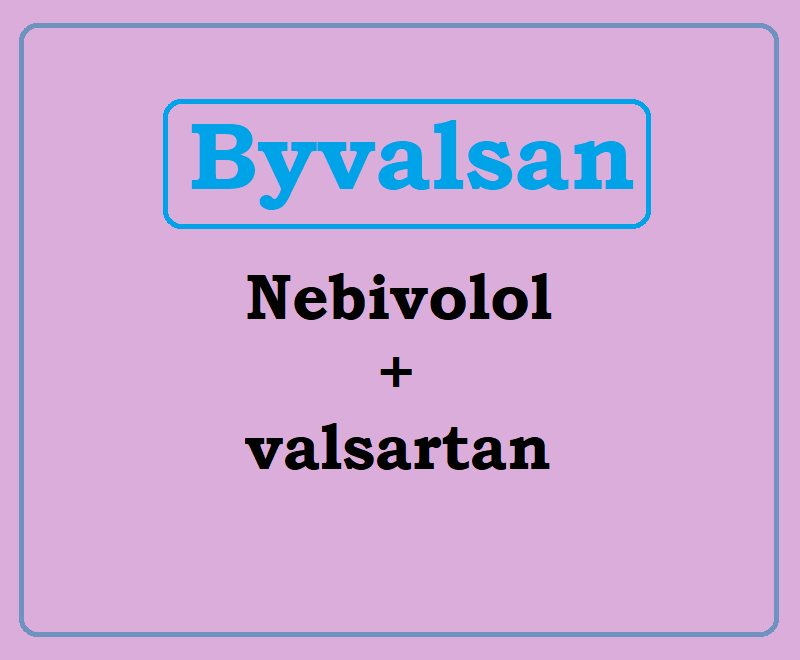
Nebivolol and valsartan in combination are available as Byvalsan and Nebicard-V. Nebivolol is a selective beta-1 blocker while valsartan is an angiotensin receptor blocker.
Nebivolol and valsartan (Byvalsan) Uses:
-
Hypertension:
- Hypertension Management.
Nebivolol and valsartan (Byvalsan) Dose in Adults
Nebivolol and valsartan Dose in the treatment of Hypertension:
-
P/O:
- Initial therapy and patients not controlled on valsartan 80 milligram or nebivolol ≤10 milligram: Nebivolol 5 milligram/valsartan 80 milligram once everyday.
Note:
- May be replaced for individual components in patients so far receiving nebivolol 5 milligrams and valsartan 80 milligrams.
Nebivolol and valsartan (Byvalsan) Dose in Childrens
Not indicated for use in children.
Pregnancy Risk Category: D
- [US Boxed Warning]
- Drugs that affect the renin-angiotensin pathway can cause harm and even death for the developing foetus.
- Refer to the individual monographs. Once you are aware that you are pregnant, discontinue use as soon as possible.
Use of valsartan and nebivolol during lactation:
- It is unknown if nebivolol and valsartan are breastmilk components.
- Manufacturers do not recommend breastfeeding due to the risk of serious adverse reactions in infants who are breastfed. Refer to the individual monographs.
Byvalsan Dose in Kidney Disease:
-
CrCl 30 to 80 millilitre per minute:
- No dosage adjustment is necessary.
-
CrCl <30 millilitre per minute:
- Not recommended as initial treatment.
Byvalsan Dose in Liver disease:
-
Mild impairment (Child-Pugh class A):
- No requirement of initial dosage adjustment.
-
Moderate impairment (Child-Pugh class B):
- Not recommended as initial treatment.
-
Severe impairment (Child-Pugh class C):
- Use is contraindicated.
Nebivolol and valsartan (Byvalsan) Side effects
See individual agents for reactions (Nebivolol and Valsartan).
Contraindications to Nebivolol and valsartan (Byvalsan):
- Hypersensitivity to valsartan, nebivolol or any other component of the formulation
- Bradycardia severe
- Heart block is more severe than the first-degree.
- Cardiogenic shock
- Heart failure that has been decompensated
- Sinusitis (unless a permanent pacemaker has been installed)
- Severe hepatic impairment (Child Puugh class C).
- Patients with diabetes mellitus should use aliskiren concurrently
Warnings and precautions
-
Anaphylactic reactions
- If you have a history of severe allergic reactions to many allergens, be careful when using nebivolol.
- Beta-blockers can make patients more sensitive to repeated challenges.
- Patients taking beta-blockers may have anaphylaxis (e.g., epinephrine), which can lead to ineffective treatment or undesirable side effects.
-
Angioedema
- Angioedema is a rare side effect of some angiotensin II receptor inhibitors (ARBs). It can occur anytime during treatment, especially after the first dose.
- It could involve the head and neck (potentially damaging airway) or possibly the intestine (presenting as abdominal pain).
- Patients who have angioedema resulting from ACE-inhibitor therapy or idiopathic angioedema may be at greater risk.
- Frequent monitoring over a long period may be necessary, particularly if the tongue, glottis or larynx is involved. This is because they can cause obstruction to the airways.
- Patients who have had previous airway surgery may be at greater risk for airway obstruction.
- Stop all therapy immediately if angioedema develops
- It is crucial to be aggressive in early management.
- IM administration of epinephrine might be required.
- Patients who have angioedema caused by ARBs should not be readministered.
-
Hyperkalemia:
- This may happen when you take valsartan.
- Risk factors include renal impairment, potassium supplements, diabetes mellitus, concomitant use of potassium-sparing diuretics & potassium-containing salts.
- These agents should be used with caution.
- Pay attention to potassium.
-
Hypotension
- Patients who have been treated with high-dose diuretics or salt-depleted may experience symptoms of hypotension.
- Accurate volume depletion prior to administration.
- The transient hypotensive response does not mean that you should be denied further treatment.
-
Renal function deterioration:
- Valsartan may cause a decline in renal function and an increase in serum creatinine in patients with low renal bloodflow (eg, kidney artery stenosis or heart failure) whose GFR is dependent upon efferent arterial vasoconstriction (angiotensin II).
- Deterioration can lead to oliguria, acute renal dysfunction, or progressive azotemia.
- After initiation, small increases in serum creatinine might occur.
- Patients with significant and progressive impairment of renal function should be considered for discontinuation.
-
Mitral and aortic stenosis:
- Patients with severe aortic/mitral stenosis should not use valsartan.
-
Bronchospastic Disease:
- Patients suffering from bronchospastic diseases should not be given beta-blockers.
-
Diabetes:
- Patients with diabetes mellitus should be cautious.
- Nebivolol can mask hypoglycemia symptoms and may even cause it.
-
Heart failure:
- Patients with heart failure should be treated cautiously and monitored for signs of deterioration.
- Patients should be stabilized on the heart-feilling regimen before initiating beta-blockers.
-
Hepatic impairment
- Patients with moderate hepatic impairment should not be treated as an initial treatment. The recommended starting dose for these patients is not to use the combination product.
- Patients with severe hepatic impairment are advised to avoid this medication.
-
Myasthenia gravis:
- Patients with myasthenia gravis should be cautious when using nebivolol.
-
Raynaud and peripheral vascular disease (PVD).
- Nebivolol may cause arterial insufficiency symptoms, which can be exacerbated in patients with Raynaud and PVD.
- Be careful and check for arterial obstruction.
-
Untreated Pheochromocytoma
- A good alpha-blockade must be in place before any beta-blocker can be used.
-
Psoriasis:
- Beta-blocker may be associated with psoriasis exacerbation or induction, but cause and effect are not well established.
-
Renal artery stenosis
- Patients with unstented unilateral/bilateral kidney artery stenosis should not be given valsartan.
- If unstented bilateral renal arterial stenosis exists, it is best to avoid using this device.
-
Renal impairment
- This combination product is not recommended for patients with severe impairment.
-
Thyroid disease:
- Nebivolol (eg tachycardia) may mask signs of hyperthyroidism.
- If thyrotoxicosis has been suspected, be sure to monitor and manage it.
- Sudden withdrawal can exacerbate symptoms of hyperthyroidism and precipitate thyroid storm.
Nebivolol and valsartan: Drug Interaction
|
Risk Factor C (Monitor therapy) |
|
|
Acetylcholinesterase Inhibitors |
May enhance the bradycardic effect of Beta-Blockers. |
|
Alfuzosin |
May enhance the hypotensive effect of Blood Pressure Lowering Agents. |
|
Alpha1-Blockers |
Beta-Blockers may enhance the orthostatic hypotensive effect of Alpha1Blockers. The risk associated with ophthalmic products is probably less than systemic products. |
|
Aminoquinolines (Antimalarial) |
May decrease the metabolism of Beta-Blockers. |
|
Amiodarone |
May enhance the bradycardic effect of Beta-Blockers. Possibly to the point of cardiac arrest. Amiodarone may increase the serum concentration of Beta-Blockers. |
|
Amphetamines |
May diminish the antihypertensive effect of Antihypertensive Agents. |
|
Angiotensin II |
Receptor Blockers may diminish the therapeutic effect of Angiotensin II. |
|
Antipsychotic Agents (Phenothiazines) |
May enhance the hypotensive effect of Beta-Blockers. Beta-Blockers may decrease the metabolism of Antipsychotic Agents (Phenothiazines). Antipsychotic Agents (Phenothiazines) may decrease the metabolism of Beta-Blockers. |
|
Antipsychotic Agents (Second Generation [Atypical]) |
Blood Pressure Lowering Agents may enhance the hypotensive effect of Antipsychotic Agents (Second Generation [Atypical]). |
|
Barbiturates |
May decrease the serum concentration of Beta-Blockers. |
|
Barbiturates |
May enhance the hypotensive effect of Blood Pressure Lowering Agents. |
|
Benperidol |
May enhance the hypotensive effect of Blood Pressure Lowering Agents. |
|
Beta2-Agonists |
Beta-Blockers (Beta1 Selective) may diminish the bronchodilatory effect of Beta2-Agonists. Of particular concern with nonselective beta-blockers or higher doses of the beta1 selective beta-blockers. |
|
Bradycardia-Causing Agents |
May enhance the bradycardic effect of other Bradycardia-Causing Agents. |
|
Bretylium |
May enhance the bradycardic effect of Bradycardia-Causing Agents. Bretylium may also enhance atrioventricular (AV) blockade in patients receiving AV blocking agents. |
|
Brigatinib |
May diminish the antihypertensive effect of Antihypertensive Agents. Brigatinib may enhance the bradycardic effect of Antihypertensive Agents. |
|
Brimonidine (Topical) |
May enhance the hypotensive effect of Blood Pressure Lowering Agents. |
|
Bupivacaine |
Beta-Blockers may increase the serum concentration of Bupivacaine. |
|
Calcium Channel Blockers (Nondihydropyridine) |
May enhance the hypotensive effect of BetaBlockers. Bradycardia and signs of heart failure have also been reported. Calcium Channel Blockers (Nondihydropyridine) may increase the serum concentration of Beta-Blockers. Exceptions: Bepridil. |
|
Cardiac Glycosides |
Beta-Blockers may enhance the bradycardic effect of Cardiac Glycosides. |
|
Cholinergic Agonists |
Beta-Blockers may enhance the adverse/toxic effect of Cholinergic Agonists. Of particular concern are the potential for cardiac conduction abnormalities and bronchoconstriction. Management: Administer these agents in combination with caution, and monitor for conduction disturbances. Avoid methacholine with any beta blocker due to the potential for additive bronchoconstriction. |
|
CycloSPORINE (Systemic) |
Angiotensin II Receptor Blockers may enhance the hyperkalemic effect of CycloSPORINE (Systemic). |
|
CYP2D6 Inhibitors (Moderate) |
May increase the serum concentration of Nebivolol. |
|
CYP2D6 Inhibitors (Strong) |
May increase the serum concentration of Nebivolol. |
|
Dapoxetine |
May enhance the orthostatic hypotensive effect of Angiotensin II Receptor Blockers. |
|
Dexmethylphenidate |
May diminish the therapeutic effect of Antihypertensive Agents. |
|
Diazoxide |
May enhance the hypotensive effect of Blood Pressure Lowering Agents. |
|
Dipyridamole |
May enhance the bradycardic effect of Beta-Blockers. |
|
Disopyramide |
May enhance the bradycardic effect of Beta-Blockers. Beta-Blockers may enhance the negative inotropic effect of Disopyramide. |
|
Drospirenone |
Angiotensin II Receptor Blockers may enhance the hyperkalemic effect of Drospirenone. |
|
DULoxetine |
Blood Pressure Lowering Agents may enhance the hypotensive effect of DULoxetine. |
|
Eltrombopag |
May increase the serum concentration of OATP1B1/1B3 (SLCO1B1/1B3) Substrates. |
|
EPINEPHrine (Nasal) |
Beta-Blockers (Beta1 Selective) may diminish the therapeutic effect of EPINEPHrine (Nasal). |
|
EPINEPHrine (Oral Inhalation) |
Beta-Blockers (Beta1 Selective) may diminish the therapeutic effect of EPINEPHrine (Oral Inhalation). |
|
Epinephrine (Racemic) |
Beta-Blockers (Beta1 Selective) may diminish the therapeutic effect of Epinephrine (Racemic). |
|
EPINEPHrine (Systemic) |
Beta-Blockers (Beta1 Selective) may diminish the therapeutic effect of EPINEPHrine (Systemic). |
|
Eplerenone |
May enhance the hyperkalemic effect of Angiotensin II Receptor Blockers. |
|
Gemfibrozil |
May increase the serum concentration of OATP1B1/1B3 (SLCO1B1/1B3) Substrates. See separate drug interaction monographs for agents listed as exceptions. |
|
Heparin |
May enhance the hyperkalemic effect of Angiotensin II Receptor Blockers. |
|
Heparins (Low Molecular Weight) |
May enhance the hyperkalemic effect of Angiotensin II Receptor Blockers. |
|
Herbs (Hypertensive Properties) |
May diminish the antihypertensive effect of Antihypertensive Agents. |
|
Herbs (Hypotensive Properties |
May enhance the hypotensive effect of Blood Pressure Lowering Agents. |
|
HydroCHLOROthiazide |
May enhance the hypotensive effect of Valsartan. Valsartan may increase the serum concentration of HydroCHLOROthiazide. |
|
Hypotension-Associated Agents |
Blood Pressure Lowering Agents may enhance the hypotensive effect of Hypotension-Associated Agents. |
|
Insulins |
Beta-Blockers may enhance the hypoglycemic effect of Insulins. |
|
Ivabradine |
Bradycardia-Causing Agents may enhance the bradycardic effect of Ivabradine. |
|
Lacosamide |
Bradycardia-Causing Agents may enhance the AV-blocking effect of Lacosamide. |
|
Levodopa-Containing Products |
Blood Pressure Lowering Agents may enhance the hypotensive effect of Levodopa-Containing Products. |
|
Lidocaine (Systemic) |
Beta-Blockers may increase the serum concentration of Lidocaine (Systemic). |
|
Lidocaine (Topical) |
Beta-Blockers may increase the serum concentration of Lidocaine (Topical). |
|
Lormetazepam |
May enhance the hypotensive effect of Blood Pressure Lowering Agents. |
|
Mepivacaine |
Beta-Blockers may increase the serum concentration of Mepivacaine. |
|
Methoxyflurane |
May enhance the hypotensive effect of Beta-Blockers. |
|
Methylphenidate |
May diminish the antihypertensive effect of Antihypertensive Agents. |
|
Midodrine |
May enhance the bradycardic effect of Bradycardia-Causing Agents. |
|
Molsidomine |
May enhance the hypotensive effect of Blood Pressure Lowering Agents. |
|
Naftopidil |
May enhance the hypotensive effect of Blood Pressure Lowering Agents. |
|
Nicergoline |
May enhance the hypotensive effect of Blood Pressure Lowering Agents. |
|
Nicorandil |
May enhance the hyperkalemic effect of Angiotensin II Receptor Blockers. |
|
Nicorandil |
May enhance the hypotensive effect of Blood Pressure Lowering Agents. |
|
NIFEdipine |
May enhance the hypotensive effect of Beta-Blockers. NIFEdipine may enhance the negative inotropic effect of Beta-Blockers. |
|
Nitroprusside |
Blood Pressure Lowering Agents may enhance the hypotensive effect of Nitroprusside. |
|
Nonsteroidal Anti-Inflammatory Agents |
May diminish the antihypertensive effect of BetaBlockers. |
|
Nonsteroidal Anti-Inflammatory Agents |
Angiotensin II Receptor Blockers may enhance the adverse/toxic effect of Nonsteroidal Anti-Inflammatory Agents. Specifically, the combination may result in a significant decrease in renal function. Nonsteroidal Anti-Inflammatory Agents may diminish the therapeutic effect of Angiotensin II Receptor Blockers. The combination of these two agents may also significantly decrease glomerular filtration and renal function. |
|
Opioids (Anilidopiperidine) |
May enhance the bradycardic effect of Beta-Blockers. Opioids (Anilidopiperidine) may enhance the hypotensive effect of Beta-Blockers. |
|
Pentoxifylline |
May enhance the hypotensive effect of Blood Pressure Lowering Agents. |
|
Pholcodine |
Blood Pressure Lowering Agents may enhance the hypotensive effect of Pholcodine. |
|
Phosphodiesterase 5 Inhibitors |
May enhance the hypotensive effect of Blood Pressure Lowering Agents. |
|
Potassium Salts |
May enhance the hyperkalemic effect of Angiotensin II Receptor Blockers. |
|
Potassium-Sparing Diuretics |
Angiotensin II Receptor Blockers may enhance the hyperkalemic effect of Potassium-Sparing Diuretics. |
|
Propafenone |
May increase the serum concentration of Beta-Blockers. Propafenone possesses some independent beta blocking activity. |
|
Prostacyclin Analogues |
May enhance the hypotensive effect of Blood Pressure Lowering Agents. |
|
Quinagolide |
May enhance the hypotensive effect of Blood Pressure Lowering Agents. |
|
Ranolazine |
May enhance the adverse/toxic effect of Angiotensin II Receptor Blockers. |
|
Regorafenib |
May enhance the bradycardic effect of Beta-Blockers. |
|
Reserpine |
May enhance the hypotensive effect of Beta-Blockers. |
|
Rifamycin Derivatives |
May decrease the serum concentration of Beta-Blockers. Exceptions: Rifabutin. |
|
Ruxolitinib |
May enhance the bradycardic effect of Bradycardia-Causing Agents. Management: Ruxolitinib Canadian product labeling recommends avoiding use with bradycardia-causing agents to the extent possible. |
|
Selective Serotonin Reuptake Inhibitors |
May increase the serum concentration of Beta-Blockers. Exceptions: Citalopram; Escitalopram; FluvoxaMINE. |
|
Sulfonylureas |
Beta-Blockers may enhance the hypoglycemic effect of Sulfonylureas. Cardioselective beta-blockers (eg, acebutolol, atenolol, metoprolol, and penbutolol) may be safer than nonselective beta-blockers. All beta-blockers appear to mask tachycardia as an initial symptom of hypoglycemia. Ophthalmic beta-blockers are probably associated with lower risk than systemic agents. |
|
Tacrolimus (Systemic) |
Angiotensin II Receptor Blockers may enhance the hyperkalemic effect of Tacrolimus (Systemic). |
|
Teriflunomide |
May increase the serum concentration of OATP1B1/1B3 (SLCO1B1/1B3) Substrates. |
|
Terlipressin |
May enhance the bradycardic effect of Bradycardia-Causing Agents. |
|
Theophylline Derivatives |
Beta-Blockers (Beta1 Selective) may diminish the bronchodilatory effect of Theophylline Derivatives. Management: Monitor for reduced theophylline efficacy during concomitant use with any beta-blocker. Beta-1 selective agents are less likely to antagonize theophylline than nonselective agents, but selectivity may be lost at higher doses. |
|
Tofacitinib |
May enhance the bradycardic effect of Bradycardia-Causing Agents. |
|
Trimethoprim |
May enhance the hyperkalemic effect of Angiotensin II Receptor Blockers. |
|
Yohimbine |
May diminish the antihypertensive effect of Antihypertensive Agents. |
|
Risk Factor D (Consider therapy modification) |
|
|
Aliskiren |
May enhance the hyperkalemic effect of Angiotensin II Receptor Blockers. Aliskiren may enhance the hypotensive effect of Angiotensin II Receptor Blockers. Aliskiren may enhance the nephrotoxic effect of Angiotensin II Receptor Blockers. Management: Aliskiren use with ACEIs or ARBs in patients with diabetes is contraindicated. Combined use in other patients should be avoided, particularly when CrCl is less than 60 mL/min. If combined, monitor potassium, creatinine, and blood pressure closely. |
|
Alpha2-Agonists |
May enhance the AV-blocking effect of Beta-Blockers. Sinus node dysfunction may also be enhanced. Beta-Blockers may enhance the rebound hypertensive effect of Alpha2Agonists. This effect can occur when the Alpha2-Agonist is abruptly withdrawn. Management: Closely monitor heart rate during treatment with a beta blocker and clonidine. Withdraw beta blockers several days before clonidine withdrawal when possible, and monitor blood pressure closely. Recommendations for other alpha2-agonists are unavailable. Exceptions: Apraclonidine. |
|
Amifostine |
Blood Pressure Lowering Agents may enhance the hypotensive effect of Amifostine. Management: When amifostine is used at chemotherapy doses, blood pressure lowering medications should be withheld for 24 hours prior to amifostine administration. If blood pressure lowering therapy cannot be withheld, amifostine should not be administered. |
|
Angiotensin-Converting Enzyme Inhibitors |
Angiotensin II Receptor Blockers may enhance the adverse/toxic effect of Angiotensin-Converting Enzyme Inhibitors. Angiotensin II Receptor Blockers may increase the serum concentration of Angiotensin-Converting Enzyme Inhibitors. Management: In US labeling, use of telmisartan and ramipril is not recommended. It is not clear if any other combination of an ACE inhibitor and an ARB would be any safer. Consider alternatives to the combination when possible. |
|
Antihepaciviral Combination Products |
May increase the serum concentration of Valsartan. Management: Per antihepaciviral combination product US prescribing information, consider decreasing the valsartan dose and monitoring for evidence of hypotension and worsening renal function if these agents are used in combination. |
|
Ceritinib |
Bradycardia-Causing Agents may enhance the bradycardic effect of Ceritinib. Management: If this combination cannot be avoided, monitor patients for evidence of symptomatic bradycardia, and closely monitor blood pressure and heart rate during therapy. Exceptions are discussed in separate monographs. |
|
Dronedarone |
May enhance the bradycardic effect of Beta-Blockers. Dronedarone may increase the serum concentration of Beta-Blockers. This likely applies only to those agents that are metabolized by CYP2D6. Management: Use lower initial beta-blocker doses; adequate tolerance of the combination, based on ECG findings, should be confirmed prior to any increase in betablocker dose. |
|
Ergot Derivatives |
Beta-Blockers may enhance the vasoconstricting effect of Ergot Derivatives. Exceptions: Nicergoline. |
|
Fingolimod |
Beta-Blockers may enhance the bradycardic effect of Fingolimod. Management: Avoid the concomitant use of fingolimod and beta-blockers if possible. If coadministration is necessary, patients should have overnight continuous ECG monitoring conducted after the first dose of fingolimod. Monitor patients for bradycardia. |
|
Grass Pollen Allergen Extract (5 Grass Extract) |
Beta-Blockers may enhance the adverse/toxic effect of Grass Pollen Allergen Extract (5 Grass Extract). More specifically, Beta-Blockers may inhibit the ability to effectively treat severe allergic reactions to Grass Pollen Allergen Extract (5 Grass Extract) with epinephrine. Some other effects of epinephrine may be unaffected or even enhanced (e.g., vasoconstriction) during treatment with Beta-Blockers. |
|
Lithium |
Angiotensin II Receptor Blockers may increase the serum concentration of Lithium. Management: Lithium dosage reductions will likely be needed following the addition of an angiotensin II receptor antagonist. |
|
Obinutuzumab |
May enhance the hypotensive effect of Blood Pressure Lowering Agents. Management: Consider temporarily withholding blood pressure lowering medications beginning 12 hours prior to obinutuzumab infusion and continuing until 1 hour after the end of the infusion. |
|
Siponimod |
Bradycardia-Causing Agents may enhance the bradycardic effect of Siponimod. Management: Avoid coadministration of siponimod with drugs that may cause bradycardia. |
|
Sodium Phosphates |
Angiotensin II Receptor Blockers may enhance the nephrotoxic effect of Sodium Phosphates. Specifically, the risk of acute phosphate nephropathy may be enhanced. Management: Consider avoiding this combination by temporarily suspending treatment with ARBs, or seeking alternatives to oral sodium phosphate bowel preparation. If the combination cannot be avoided, maintain adequate hydration and monitor renal function closely. |
|
Tolvaptan |
May increase the serum concentration of OATP1B1/1B3 (SLCO1B1/1B3) Substrates. |
|
Risk Factor X (Avoid combination) |
|
|
Bromperidol |
Blood Pressure Lowering Agents may enhance the hypotensive effect of Bromperidol. Bromperidol may diminish the hypotensive effect of Blood Pressure Lowering Agents. |
|
Floctafenine |
May enhance the adverse/toxic effect of Beta-Blockers. |
|
Methacholine |
Beta-Blockers may enhance the adverse/toxic effect of Methacholine. |
|
Rivastigmine |
May enhance the bradycardic effect of Beta-Blockers. |
Monitoring parameters:
- Blood pressure.
- Renal function.
- Baseline and periodic electrolyte panels.
- Serum glucose (in diabetic patients).
How to administer Nebivolol and valsartan (Byvalsan)?
P/O:
- Administer with or without food.
Mechanism of action of Nebivolol and valsartan (Byvalsan):
Nebivolol:
- Highly-selective inhibition of beta-adrenergic nerve receptors
- Doses of =10 mg nebivolol block beta-1 receptors preferentially.
- Nebivolol also causes an endothelium-derived, nitric oxide dependent vasodilation which, unlike other beta-blockers reduces systemic vascular resistance.
Valsartan:
- Direct antagonism of angiotensin II receptors (AT2) is possible, but not with ACE inhibitors.
- Angiotensin II is removed from the AT1 receptor. It is then produced. This lowers AT1-induced vasoconstriction and aldosterone, catecholamine, and arginine vasopressin releases, as well as water intake and hypertrophic reactions. This results in a more effective blockade of cardiovascular effects of angiotensin II and lower side effects that the ACE inhibitors.
See individual agents (Nebivolol and Valsartan)
International Brands of Nebivolol and valsartan:
- Byvalson
- Nebicard-V
Nebivolol and valsartan Brand Names in Pakistan:
No Brands Available in Pakistan.
.png)