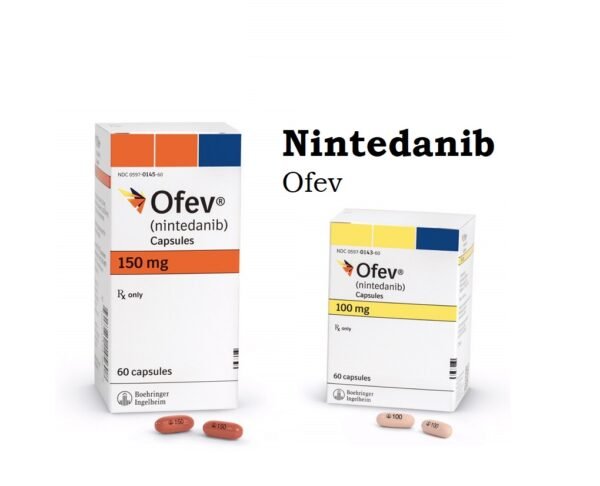
Nintedanib (Ofev) is a potent small-molecule tyrosine kinase inhibitor (of the PDGF, FGF, and vascular endothelial growth factor receptors). It is indicated for the treatment of idiopathic pulmonary fibrosis. It also causes a decline in the progression of pulmonary fibrosis associated with scleroderma and is used in patients with non-small cell lung cancer.
Nintedanib (Ofev) Uses:
-
Idiopathic pulmonary fibrosis:
- Used for treatment of idiopathic pulmonary fibrosis (IPF).
"See Pirfenidone for the treatment of idiopathic pulmonary fibrosis"
Nintedanib (Ofev) Dose in Adults
Nintedanib (Ofev) Dose in the treatment of idiopathic pulmonary fibrosis (IPF):
P/O:
- 150 mg every 12 hours (maximum: 300 mg/day)
Missed dose:
-
- If a dose is missed, the next dose should be taken at the next scheduled time.
- Do not make up a missed dose.
Nintedanib (Ofev) Dose in Childrens
Not indicated in children.
Nintedanib Pregnancy Risk Category: D
- Based on animal reproduction studies that have shown nintedanib to cause adverse events and a mechanism of action, it is possible for nintedanib to cause harm to fetuses if administered during pregnancy.
- Before initiating treatment for women with reproductive potential, a pregnancy test must be done.
- Effective contraception should be used by women with reproductive potential during treatment and for at least three months following the last dose.
Use of Nintedanib while breastfeeding
- It is unknown if nintedanib secretes in breast milk.
- Manufacturers do not recommend breastfeeding due to the risk of serious adverse reactions in breastfeeding infants.
Nintedanib (Ofev) Dose in Kidney Disease:
-
CrCl ≥30 mL/minute:
- Initial dosage adjustment not necessary.
-
CrCl <30 mL/minute:
- No dosage adjustments provided in the manufacturer's labeling (has not been studied).
-
ESRD:
- No dosage adjustments provided in the manufacturer's labeling (has not been studied).
Nintedanib (Ofev) Dose in Liver disease:
Hepatic impairment at baseline:
-
Mild impairment (Child-Pugh class A):
- 100 mg every 12 hours.
- If a patient does not tolerate 100 mg every 12 hours, consider treatment interruption or discontinue treatment to manage adverse reactions.
-
Moderate to severe impairment (Child-Pugh class B or C):
- Not recommended (exposure is increased in moderate impairment; has not been studied in severe impairment).
Hepatotoxicity during treatment:
-
AST or ALT >3 times to <5 times upper limit of normal (without signs of liver damage):
- Treatment should be interrupted or reduce dosage to 100 mg every 12 hours.
- Once liver enzymes have returned to baseline values after treatment interruption, reintroduce therapy at 100 mg every 12 hours
- maybe subsequently increased to 150 mg every 12 hours.
-
AST or ALT >5 times ULN or >3 times upper limit of normal with signs or symptoms of liver damage:
- Discontinue therapy.
Common Side Effects of Nintedanib (Ofev):
-
Gastrointestinal:
- Diarrhea
- Nausea
- Abdominal Pain
- Vomiting
- Decreased Appetite
-
Hepatic:
- Increased Liver Enzymes
Less Common Side Effects Of Nintedanib (Ofev):
-
Cardiovascular:
- Hypertension
- Arterial Thrombosis
- Myocardial Infarction
-
Central Nervous System:
- Headache
-
Endocrine & Metabolic:
- Weight Loss
- Hypothyroidism
-
Hematologic And Oncologic:
- Hemorrhage
-
Respiratory:
- Bronchitis
Contraindications to Nintedanib (Ofev):
- Hypersensitivity to peanut, nintedanib, soya, or any other component of the formulation
- pregnancy
Warnings and precautions
-
Bleeding
- The risk of bleeding may increase.
- Only use in patients who have a history of bleeding.
- Postmarketing has seen both serious and non-serious bleeding events, some fatal.
-
Cardiovascular effects
- There have been reports of arterial thromboembolic (including MI) events.
- Patients at high risk for cardiovascular disease, such as patients with coronary artery disease, should be cautious.
- Patients who experience signs or symptoms of acute coronary ischemia should be considered for treatment interruption.
-
GI effects
- It is possible to experience nausea, diarrhea, or vomiting.
- Over 50% of patients treated with nintedanib experienced diarrhoea. It was mild to moderate in intensity, and usually occurred within the first three months.
- Adequate hydration, antidiarrhea, and antiemetics are all important.
- Treatment interruption or dose reduction may be necessary.
- If GI effects do not resolve, discontinue treatment.
- It may also increase the risk for GI perforation.
- Postmarketing has seen cases of GI perforation (some even fatal)
- Patients who have recently had abdominal surgery or who have received concomitant corticosteroids, NSAIDs, or who have a history of diverticular disease should be treated with caution. Only use this method if there is a risk of perforation.
- It is recommended that you wait at least four weeks after abdominal surgery before starting therapy (OFEV Canadian product Monograph).
- Discontinue if perforation develops.
-
Hepatic effects
- There have been reports of both serious and less severe cases of drug-induced liver injuries (including fatal outcomes)
- Usually, hepatic effects occur within the first three months of treatment.
- Usually, elevations of ALT, AST and GGT, alkaline phosphatase and bilirubin can be reversed by dose modification or interruption.
- Patients with low bodyweight (65kg) or Asian and female patients may be at greater risk.
- Before starting treatment, obtain liver functions at regular intervals for the first three months and then periodically thereafter, or as indicated by the doctor.
- It is possible to modify or interrupt dosage.
Nintedanib: Drug Interaction
Note: Drug Interaction Categories:
- Risk Factor C: Monitor When Using Combination
- Risk Factor D: Consider Treatment Modification
- Risk Factor X: Avoid Concomitant Use
Risk Factor C (Monitor therapy) |
|
| Anticoagulants | May enhance the adverse/toxic effect of Nintedanib. Specifically, the risk for bleeding may be increased. |
| Combined Inhibitors of CYP3A4 and P-glycoprotein | May increase the serum concentration of Nintedanib. |
| Erdafitinib | May increase the serum concentration of P-glycoprotein/ABCB1 Substrates. |
| Lumacaftor | May decrease the serum concentration of P-glycoprotein/ABCB1 Substrates. Lumacaftor may increase the serum concentration of P-glycoprotein/ABCB1 Substrates. |
| P-glycoprotein/ABCB1 Inhibitors | May increase the serum concentration of P-glycoprotein/ABCB1 Substrates. P-glycoprotein inhibitors may also enhance the distribution of p-glycoprotein substrates to specific cells/tissues/organs where p-glycoprotein is present in large amounts (e.g., brain, T-lymphocytes, testes, etc.). |
| Ranolazine: | May increase the serum concentration of P-glycoprotein/ABCB1 Substrates. |
Risk Factor X (Avoid combination) |
|
| Combined Inducers of CYP3A4 and P-glycoprotein | May decrease the serum concentration of Nintedanib. |
Monitoring parameters:
- Obtain liver function tests prior to initiation of treatment, at regular intervals during the first 3 months of treatment, and periodically thereafter or as clinically indicated
- Obtain a pregnancy test prior to treatment.
- Monitor for GI events (eg, diarrhea, nausea, vomiting), arterial thromboembolic events, bleeding, and GI perforation.
How to administer Nintedanib (Ofev)?
P/O:
- Administer with food.
- Swallow capsules whole with liquid;
- Do not chew or crush (bitter taste).
Mechanism of action of Nintedanib (Ofev):
- It inhibits multiple receptor and non-receptor Tyrosine Kinases (RTKs) as well as platelet-derived Growth Factor (PDGFR alpha, PDGFR beta).
- Fibroblast growth factor receptor (FGFR1, FGFR2, FGFR3)
- Vascular endothelial Growth Factor (VEGFR1, VEGFR2, VEGFR3, and VEGFR3). Fms-like Tyrosine Kinase-3 (FLT3).
- Nintedanib binds to these receptors competitively and blocks intracellular signaling that is critical for the proliferation, migration and transformation of fibroblasts.
Absorption:
- Food increases exposure ~20% and delays absorption
Protein binding:
- ~98%
Metabolism:
- Hydrolytic cleavage by esterases to free acid moiety BIBF 1202
- which is then glucuronidated by UGT 1A1, UGT 1A7, UGT 1A8, and UGT 1A10 to BIBF 1202 glucuronide
- CYP 3A4 (minor).
Bioavailability:
- ~5%
Half-life elimination:
- 9.5 hours
Time to peak plasma concentrations:
- 2 hours (4 hours with food)
Excretion:
- Feces (~93%)
- urine (<1%)
International Brands of Nintedanib:
- Ofev
- Vargatef
Nintedanib Brand Names in Pakistan:
No Brands Available in Pakistan.
.png)


