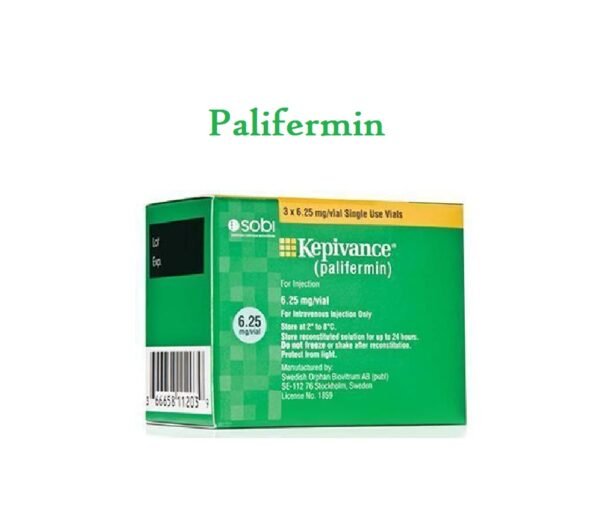
Palifermin (Kepivance) is a human recombinant keratinocyte growth factor produced by recombinant technology. it is used to reduce the incidence of mucositis in patients on myelotoxic chemotherapy.
Palifermin Uses:
-
Oral mucositis:
- It is indicated in patients on myelotoxic therapy for hematological malignancies who are undergoing autologous hematopoietic stem cell transplantation to reduce the incidence of oral mucositis.
- It is indicated when the preparative regimen is expected to result in mucositis of grade 3 or more.
- Limitations of use:
- The safety and efficacy of the drug have not been established in patients receiving chemotherapy for non-hematological malignancies.
- It is also not recommended with conditioning regimens that contain melphalan 200 mg/m².
- Furthermore, it was not found to be effective in patients who received myelotoxic chemotherapy in the setting of allogeneic hematopoietic stem cell support.
Palifermin (Kepivance) Dose in Adults
Palifermin (Kepivance) Dose in the treatment of Oral mucositis associated with autologous hematopoietic stem cell transplant (HSCT) conditioning regimens:
- 60 mcg/kg/day as an intravenous bolus for three consecutive days before and three consecutive days after myelotoxic therapy.
- A total of 6 doses are recommended.
Note:
- Three doses should be administered before myelotoxic chemotherapy with the third dose administered at least 24 to 48 hours prior to the myelotoxic conditioning regimen.
- The post-treatment doses should be administered after the completion of the myelotoxic conditioning regimen with the first dose administered 12 to 24 hours after HSCT infusion not later than 7 days after the most recent dose of palifermin.
Dose in children:
Not indicated.
Pregnancy Risk Factor C
- In animal reproduction studies, adverse events were noted.
Palifermin use during breastfeeding:
- It is unknown if the drug is found in breast milk.
- It could be harmful for the infant who is nursing.
- Manufacturers recommend weighing the potential benefits to the mother and the risk of drug exposure for the infant.
Dose in Kidney Disease:
- There are no dosage adjustments provided in the manufacturer's labeling.
- Kidney disease or renal impairment has little impact on the pharmacokinetics of the drug.
Dose in Liver Disease:
There are no dosage adjustments provided in the manufacturer's labeling (it has not been studied in liver disease).
Common Side Effects of Palifermin (Kepivance):
-
Cardiovascular:
- Edema
-
Central Nervous System:
- Pain
- Dysesthesia
-
Dermatologic:
- Skin Rash
- Pruritus
- Erythema
-
Gastrointestinal:
- Increased Serum Amylase
- Increased Serum Lipase
- Mouth Discoloration
- Swelling Of Mouth
- Tongue Discoloration
- Tongue Edema
- Dysgeusia
-
Miscellaneous:
- Fever
Less Common Side Effects Of Palifermin (Kepivance):
-
Immunologic:
- Antibody Development
-
Neuromuscular & Skeletal:
- Arthralgia
Contraindications to Palifermin (Kepivance):
The manufacturer's label does not list any contraindications.
Warnings and precautions
-
Mucocutaneous effects:
- It has been linked to mucocutaneous toxicities, which may be present at a median of 6 days and last for a median time of 5 days.
- Itching, rash, oral and perioral dysesthesias as well as altered taste, tongue discoloration, thickening, and itching may all be signs of mucocutaneous toxicity.
- If any of these symptoms are present, patients should report them.
-
Nonhematologic malignancies
- In vitro, epithelial tumor cells have been shown to be enhanced by the drug, but safety and efficacy in patients with other types of malignancies has not been established.
- It is unknown if the drug has any effect on non-hematopoietic, keratinocyte-expressing human tumors.
Monitoring Parameters:
Monitor for improvement in the symptoms of oral mucositis.
How to administer Palifermin (Kepivance)?
- It is administered as an intravenous bolus by a peripheral or central line.
- The solution is allowed to reach room temperature before it is administered.
- If the solution has been kept at room temperature for one hour or more, it should not be used. It should not be administered during or within 24 hours (before or after) chemotherapy.
- If heparin is used for IV line patency, before (and after) administering the drug, the line should be flushed with normal saline.
Mechanism of action of Palifermin (Kepivance):
- Recombinant technology in E.Coli produces Palifermin.
- It is a recombinant KGF (keratinocyte growth factors) that binds with the KGF receptors of various tissues, such as the tongue and salivary glands.
- It causes cellular proliferation, differentiation and migration of epithelial cell populations at the target sites.
- In response to epithelial tissue trauma, mesenchymal cells produce endogenous KGF in the human body.
The beginning of action:
- Although the dose is dependent on the onset of action, epithelial cells can proliferate in as little as 48 hours.
Half-life elimination:
- 4.5 hours (range: 3.3 to 5.7 hours)
International Brand Names of Palifermin:
- Kepivance
Palifermin Brand Names in Pakistan:
No Brands Available in Pakistan.
.png)


