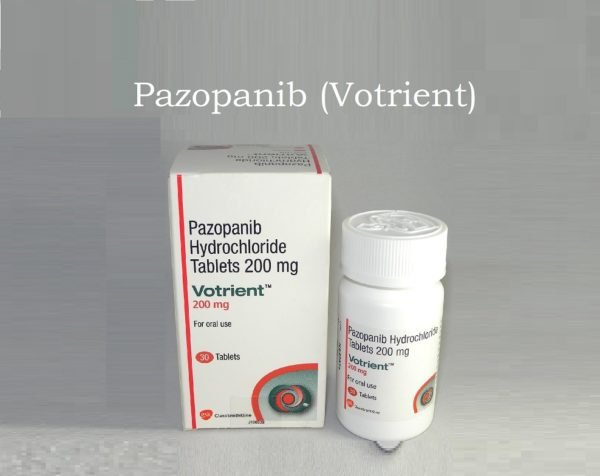
Pazopanib (Votrient) is a multitargeted Tyrosine kinase inhibitor that inhibits angiogenesis and tumor growth.
Indications of Pazopanib (Votrient):
-
Advanced Renal cell carcinoma:
- It is indicated for the treatment of advanced renal cell carcinoma.
-
Advanced Soft tissue sarcoma:
- It is used for the treatment of advanced soft tissue sarcoma (in patients who have received prior chemotherapy)
- Limitations of use: The efficacy of pazopanib for the treatment of adipocytic soft tissue sarcoma or gastrointestinal stromal tumors has not been demonstrated.
-
Off Label Use of Pazopanib in Adults:
- Advanced differentiated Thyroid cancer
Pazopanib (Votrient) dose in Adults
Pazopanib (Votrient) dose in the treatment of advanced Renal cell carcinoma:
- 800 mg per oral once daily.
Pazopanib (Votrient) dose in the treatment of advanced Soft tissue sarcoma:
- 800 mg per oral once daily.
Pazopanib (Votrient) dose in the treatment of advanced Thyroid cancer, differentiated (off-label):
- 800 mg per oral once daily until disease progression or unacceptable toxicity.
Missed doses:
- If a dose is missed, do not take it if <12 hours until the next dose.
Concomitant CYP3A4 inhibitors/inducers:
-
CYP3A4 inhibitors:
- Concomitant strong CYP3A4 inhibitors can increase pazopanib concentration, therefore reduction of pazopanib to 400 mg once daily with careful monitoring is required.
-
CYP3A4 inducers:
- Concomitant strong CYP3A4 inducers can decrease pazopanib concentrations therefore pazopanib is not recommended in situations where the chronic use of a strong CYP3A4 inducer is required.
Pazopanib (Votrient) use in children:
The efficacy and safety of the drug in children have not been established.
Pregnancy Risk Category: D
- Pazopanib may cause harm to the fetus. Therefore, it is important that you avoid pregnancy before beginning therapy.
- Effective contraception should be used by women during treatment and at least two weeks after stopping.
- Condoms should be used by male patients, including vasectomized patients, during treatment and at least two weeks following the last dose.
Use of Pazopanib while breastfeeding
- It is unknown if Pazopanib is excreted in breast milk.
- Due to the potential for fatal side effects, the manufacturer suggests that you stop breastfeeding during treatment and for at least 2 weeks after your last dose of pazopanib.
Pazopanib (Votrient) Dose adjustment in renal disease:
-
Creatinine clearance ≥30 mL/minute:
- No dosage adjustment necessary.
-
Creatinine clearance <30 mL/minute:
- There are no dosage adjustments provided in the manufacturer’s labeling.
Pazopanib (Votrient) Dose adjustment in liver disease:
-
Preexisting impairment:
-
Mild (bilirubin ≤1.5 times upper normal limit or ALT >Upper normal limit):
- No dosage adjustment required.
-
Moderate (bilirubin >1.5 to 3 times the upper normal limit):
- Consider alternative therapy or reduce to 200 mg once daily.
-
Severe (bilirubin >3 times upper normal limit with any ALT level):
- Use is not recommended.
-
-
During treatment:
-
Isolated ALT elevations 3 to 8 times upper normal limit:
- Continue treatment, monitor liver function weekly until ALT returns to grade 1 or baseline.
-
Isolated ALT elevations >8 times upper normal limit:
- Interrupt treatment until ALT returns to grade 1 or baseline.
- Restart treatment at ≤400 mg once daily (with liver function monitored weekly for 8 weeks);
- permanently discontinue if ALT >3 times ULN occurs with reinitiation.
-
ALT >3 times upper normal limit concurrently with bilirubin >2 times upper normal limit:
- Permanently discontinue.
-
Gilbert syndrome with mild indirect bilirubin elevation and ALT >3 times upper normal limit:
- Refer to isolated ALT elevations dosage recommendations above.
-
Common Side Effects of Pazopanib (Votrient):
-
Cardiovascular:
- Hypertension
- Bradycardia
- Peripheral Edema
- Cardiac Insufficiency
-
Central Nervous System:
- Fatigue
- Tumor Pain
- Headache
- Dizziness
-
Dermatologic:
- Hair Discoloration
- Exfoliative Dermatitis
- Alopecia
- Dermatological Disease
- Hypopigmentation
- Palmar-Plantar Erythrodysesthesia
-
Endocrine & Metabolic:
- Weight Loss
- Increased Serum Glucose
- Increased Thyroid-Stimulating Hormone
- Decreased Serum Albumin
- Decreased Serum Phosphate
- Decreased Serum Sodium
- Decreased Serum Magnesium
- Decreased Serum Glucose
- Increased Serum Potassium
-
Gastrointestinal:
- Diarrhea
- Nausea
- Decreased Appetite
- Anorexia
- Vomiting
- Dysgeusia
- Increased Serum Lipase
- Gastrointestinal Pain
- Abdominal Pain
- Mucositis
- Stomatitis
-
Hematologic & Oncologic:
- Leukopenia
- Lymphocytopenia
- Thrombocytopenia
- Neutropenia
- Hemorrhage
-
Hepatic:
- Increased Serum AST
- Increased Serum ALT
- Increased Serum Bilirubin
- Increased Serum Alkaline Phosphatase
-
Neuromuscular & Skeletal:
- Musculoskeletal Pain
- Myalgia
- Weakness
-
Respiratory:
- Dyspnea
- Cough
-
Miscellaneous:
- Tumor Pain
Uncommon Side Effects Of Pazopanib (Votrient):
-
Cardiovascular:
- Chest Pain
- Left Ventricular Systolic Dysfunction
- Venous Thrombosis
- Ischemia
- Myocardial Infarction
- Prolonged Q-T Interval On ECG
- Facial Edema
- Transient Ischemic Attacks
-
Central Nervous System:
- Insomnia
- Voice Disorder
- Chills
-
Dermatologic:
- Skin Rash
- Skin Depigmentation
- Xeroderma
- Nail Disease
-
Endocrine & Metabolic:
- Hypothyroidism
-
Gastrointestinal:
- Dyspepsia
- Anal Hemorrhage
- Gastrointestinal Fistula
- Gastrointestinal Perforation
-
Genitourinary:
- Proteinuria
- Hematuria
-
Hematologic & Oncologic:
- Oral Hemorrhage
- Rectal Hemorrhage
-
Ophthalmic:
- Blurred Vision
-
Respiratory:
- Epistaxis
- Pneumothorax
- Hemoptysis
Rare side effects of Pazopanib (Votrient):
-
Cardiovascular:
- Decreased Left Ventricular Ejection Fraction
- Hypertensive Crisis
-
Central Nervous System:
- Reversible Posterior Leukoencephalopathy Syndrome
-
Hematologic & Oncologic:
- Hemolytic-Uremic Syndrome
- Neutropenic Infection
- Thrombotic Thrombocytopenic Purpura
-
Hepatic:
- Hepatotoxicity
- Severe Hepatotoxicity
-
Infection:
- Serious Infection
-
Neuromuscular & Skeletal:
- Arthralgia
- Muscle Spasm
Contraindication to Pazopanib (Votrient):
The US labeling of the manufacturer does not list any contraindications.
- Canadian labeling
- Hypersensitivity to pazopanib and any component of the formulation
- Patients 2 Years of Age
Warnings and precautions
-
Perforation/fistula of the gastrointestinal tract
- For symptoms such as gastrointestinal perforation or fistula, it is important to monitor closely.
-
Reaction to skin on the hand-foot:
- The hand-foot syndrome is caused by pazopanib and can be localized with hyperkeratotic lesions. It presents with tingling/burning, dysesthesia, and paresthesia of the palms/soles.
- You might experience blisters, dry/cracked or hyperkeratosis, hyperkeratosis, desquamation, and erythema on flexure surfaces.
- For hand-foot syndrome, topical steroids and emollients should be used. A temporary reduction or delay may be necessary.
-
Heart Failure:
- This can cause heart failure so it is important to monitor your cardiac health regularly. Pre-existing hypertension increases the risk.
-
Hemorrhage
- Often, pazopanib is used to treat hemorhagic events like epistaxis and hematuria.
- Avoid it in hemoptysis or cerebral hemorhage, and massive GI hemorhage within six months.
-
Hepatotoxicity: [US Boxed Warning]
- People over 65 years old are more likely to experience severe transaminitis.
- It is important to monitor the liver function and take appropriate dose reduction, delay, or cessation measures.
- Patients with Gilbert syndrome may experience mild unconjugated hyperbilirubinemia.
- Dosage modification is necessary for patients with known Gilbert Syndrome (only a mild indirect bilirubin eleviation and ALT >3x the normal limit).
-
Hypertension
- Pazopanib may raise blood pressure or worsen hypertension.
- For persistent hypertension, dosage reduction might be necessary. Hypertensive crises should be treated with the drug.
-
Infections
- Sometimes, life-threatening or serious infections may occur and require a temporary or permanent discontinuation of therapy.
-
Ocular toxicities:
- Pazopanib has been shown to cause retinal detachment.
-
Proteinuria
- It is possible to cause proteinuria by using it so regular monitoring of the 24-hour urine protein level and dosage reduction are necessary for proteinuria that exceeds 3 g/24. Recurrent proteinuria should be treated with immediate cessation.
-
Toxicity in the lungs:
- Pneumonitis and interstitial lung disease can lead to fatalities. Therefore, drug therapy should be stopped.
-
Extension of QTc:
- This can cause QTc prolongation and torsade des pointes. Regular electrolyte and ECG monitoring is therefore necessary.
- You should not use it if you have a history QTc prolongation or are taking medications that prolong the QT interval.
-
Reversible posterior Leukoencephalopathy Syndrome (RPLS).
- It can cause blindness, confusion and headaches, as well as seizure, visual, neurologic, or other symptoms.
- In the event of RPLS, the drug should be stopped immediately.
-
Events that are thromboembolic:
- These include life-threatening deep venous thrombosis (DVT), pulmonary embolism, angina and TIA.
- It is important to consider risk factors and not use it within the last 6 months of an arteriothrombotic episode.
-
Thrombotic microangiopathy
- The condition of thrombotic microangiopathy (including thrombotic hemocytopenic purpura or hemolytic uremic disorder) can be caused by either a single drug or combined with topotecan or bevacizumab. It is important to stop the drug immediately.
-
Thyroid disorders
- Hypothyroidism is possible. Therefore, it is important to monitor thyroid function.
-
Wound healing complications
- Vascular endothelial Growth Factor Inhibitors can cause impaired wound healing.
- The treatment should be stopped for at least a week prior to scheduled surgery. Reinitiation of treatment should only be done under the supervision of a physician.
- Therapy should be stopped in the event of wound dehiscence.
Pazopanib: Drug Interaction
Note: Drug Interaction Categories:
- Risk Factor C: Monitor When Using Combination
- Risk Factor D: Consider Treatment Modification
- Risk Factor X: Avoid Concomitant Use
Risk Factor C (Monitor therapy) |
|
| Aprepitant | May increase the serum concentration of CYP3A4 Substrates (High risk with Inhibitors). |
| ARIPiprazole | CYP3A4 Inhibitors (Weak) may increase the serum concentration of ARIPiprazole. Management: Monitor for increased aripiprazole pharmacologic effects. Aripiprazole dose adjustments may or may not be required based on concomitant therapy and/or indication. Consult full interaction monograph for specific recommendations. |
| Bisphosphonate Derivatives | Angiogenesis Inhibitors (Systemic) may enhance the adverse/toxic effect of Bisphosphonate Derivatives. Specifically, the risk for osteonecrosis of the jaw may be increased. |
| Bosentan | May decrease the serum concentration of CYP3A4 Substrates (High risk with Inducers). |
| Clofazimine | May increase the serum concentration of CYP3A4 Substrates (High risk with Inhibitors). |
| Coccidioides immitis Skin Test | Immunosuppressants may diminish the diagnostic effect of Coccidioides immitis Skin Test. |
| CYP3A4 Inducers (Moderate) | May decrease the serum concentration of CYP3A4 Substrates (High risk with Inducers). |
| CYP3A4 Inhibitors (Moderate) | May decrease the metabolism of CYP3A4 Substrates (High risk with Inhibitors). |
| Deferasirox | May decrease the serum concentration of CYP3A4 Substrates (High risk with Inducers). |
| Denosumab | May enhance the adverse/toxic effect of Immunosuppressants. Specifically, the risk for serious infections may be increased. |
| Dofetilide | CYP3A4 Inhibitors (Weak) may increase the serum concentration of Dofetilide. |
| Dofetilide | Duvelisib: May increase the serum concentration of CYP3A4 Substrates (High risk with Inhibitors). |
| Erdafitinib | May decrease the serum concentration of CYP3A4 Substrates (High risk with Inducers). |
| Fosaprepitant | May increase the serum concentration of CYP3A4 Substrates (High risk with Inhibitors). |
| Fosnetupitant | May increase the serum concentration of CYP3A4 Substrates (High risk with Inhibitors). |
| Haloperidol | QT-prolonging Agents (Indeterminate Risk - Caution) may enhance the QTcprolonging effect of Haloperidol. |
| Ivosidenib | May decrease the serum concentration of CYP3A4 Substrates (High risk with Inducers). |
| Larotrectinib | May increase the serum concentration of CYP3A4 Substrates (High risk with Inhibitors). |
| Netupitant | May increase the serum concentration of CYP3A4 Substrates (High risk with Inhibitors). |
| NiMODipine | CYP3A4 Inhibitors (Weak) may increase the serum concentration of NiMODipine. |
| Ocrelizumab | May enhance the immunosuppressive effect of Immunosuppressants. |
| Palbociclib | May increase the serum concentration of CYP3A4 Substrates (High risk with Inhibitors). |
| Pidotimod | Immunosuppressants may diminish the therapeutic effect of Pidotimod. |
| QT-prolonging Agents (Highest Risk) | QT-prolonging Agents (Indeterminate Risk - Caution) may enhance the QTc-prolonging effect of QT-prolonging Agents (Highest Risk). Management: Monitor for QTc interval prolongation and ventricular arrhythmias when these agents are combined. Patients with additional risk factors for QTc prolongation may be at even higher risk. |
| Sarilumab | May decrease the serum concentration of CYP3A4 Substrates (High risk with Inducers). |
| Siltuximab | May decrease the serum concentration of CYP3A4 Substrates (High risk with Inducers). |
| Simvastatin | May enhance the adverse/toxic effect of PAZOPanib. Specifically, the risk for ALT/AST elevations may be increased. |
| Siponimod | Immunosuppressants may enhance the immunosuppressive effect of Siponimod. |
| Tafamidis | May increase the serum concentration of BCRP/ABCG2 Substrates. |
| Tertomotide | Immunosuppressants may diminish the therapeutic effect of Tertomotide. |
| Tocilizumab | May decrease the serum concentration of CYP3A4 Substrates (High risk with Inducers). |
| Trastuzumab | May enhance the neutropenic effect of Immunosuppressants. |
| Vinflunine | PAZOPanib may enhance the adverse/toxic effect of Vinflunine. |
Risk Factor D (Consider therapy modification) |
|
| Antacids | May decrease the serum concentration of PAZOPanib. Management: Avoid the use of antacids in combination with pazopanib whenever possible. Separate doses by several hours if antacid treatment is considered necessary. The impact of dose separation has not been investigated. |
| Baricitinib | Immunosuppressants may enhance the immunosuppressive effect of Baricitinib. Management: Use of baricitinib in combination with potent immunosuppressants such as azathioprine or cyclosporine is not recommended. Concurrent use with antirheumatic doses of methotrexate or nonbiologic disease modifying antirheumatic drugs (DMARDs) is permitted. |
| CYP3A4 Inhibitors (Strong) | May increase the serum concentration of PAZOPanib. Management: Avoid concurrent use of pazopanib with strong inhibitors of CYP3A4 whenever possible. If it is not possible to avoid such a combination, reduce pazopanib adult dose to 400 mg. Further dose reductions may also be required. |
| Dabrafenib | May decrease the serum concentration of CYP3A4 Substrates (High risk with Inducers). Management: Seek alternatives to the CYP3A4 substrate when possible. If concomitant therapy cannot be avoided, monitor clinical effects of the substrate closely (particularly therapeutic effects). |
| Echinacea | May diminish the therapeutic effect of Immunosuppressants. |
| Fingolimod | Immunosuppressants may enhance the immunosuppressive effect of Fingolimod. Management: Avoid the concomitant use of fingolimod and other immunosuppressants when possible. If combined, monitor patients closely for additive immunosuppressant effects (eg, infections). |
| Lomitapide | CYP3A4 Inhibitors (Weak) may increase the serum concentration of Lomitapide. Management: Patients on lomitapide 5 mg/day may continue that dose. Patients taking lomitapide 10 mg/day or more should decrease the lomitapide dose by half. The lomitapide dose may then be titrated up to a max adult dose of 30 mg/day. |
| Lorlatinib | May decrease the serum concentration of CYP3A4 Substrates (High risk with Inducers). Management: Avoid concurrent use of lorlatinib with any CYP3A4 substrates for which a minimal decrease in serum concentrations of the CYP3A4 substrate could lead to therapeutic failure and serious clinical consequences. |
| MiFEPRIStone | May increase the serum concentration of CYP3A4 Substrates (High risk with Inhibitors). Management: Minimize doses of CYP3A4 substrates, and monitor for increased concentrations/toxicity, during and 2 weeks following treatment with mifepristone. Avoid cyclosporine, dihydroergotamine, ergotamine, fentanyl, pimozide, quinidine, sirolimus, and tacrolimus. |
| Nivolumab | Immunosuppressants may diminish the therapeutic effect of Nivolumab. |
| Roflumilast | May enhance the immunosuppressive effect of Immunosuppressants. |
| Sipuleucel-T | Immunosuppressants may diminish the therapeutic effect of Sipuleucel-T. Management: Evaluate patients to see if it is medically appropriate to reduce or discontinue therapy with immunosuppressants prior to initiating sipuleucel-T therapy. |
| St John's Wort | May decrease the serum concentration of CYP3A4 Substrates (High risk with Inducers). Management: Consider an alternative for one of the interacting drugs. Some combinations may be specifically contraindicated. Consult appropriate manufacturer labeling. |
| Stiripentol | May increase the serum concentration of CYP3A4 Substrates (High risk with Inhibitors). Management: Use of stiripentol with CYP3A4 substrates that are considered to have a narrow therapeutic index should be avoided due to the increased risk for adverse effects and toxicity. Any CYP3A4 substrate used with stiripentol requires closer monitoring. |
| Tofacitinib | Immunosuppressants may enhance the immunosuppressive effect of Tofacitinib. Management: Concurrent use with antirheumatic doses of methotrexate or nonbiologic disease modifying antirheumatic drugs (DMARDs) is permitted, and this warning seems particularly focused on more potent immunosuppressants. |
| Tolvaptan | May increase the serum concentration of BCRP/ABCG2 Substrates. |
| Vaccines (Inactivated) | Immunosuppressants may diminish the therapeutic effect of Vaccines (Inactivated). Management: Vaccine efficacy may be reduced. Complete all age-appropriate vaccinations at least 2 weeks prior to starting an immunosuppressant. If vaccinated during immunosuppressant therapy, revaccinate at least 3 months after immunosuppressant discontinuation. |
Risk Factor X (Avoid combination) |
|
| BCG (Intravesical) | Immunosuppressants may diminish the therapeutic effect of BCG (Intravesical). |
| BCRP/ABCG2 Inhibitors | May increase the serum concentration of PAZOPanib. |
| Cladribine | May enhance the immunosuppressive effect of Immunosuppressants. |
| Conivaptan | May increase the serum concentration of CYP3A4 Substrates (High risk with Inhibitors). |
| CYP3A4 Inducers (Strong) | May decrease the serum concentration of PAZOPanib. |
| Fusidic Acid (Systemic) | May increase the serum concentration of CYP3A4 Substrates (High risk with Inhibitors). |
| Grapefruit Juice | May increase the serum concentration of PAZOPanib. |
| Histamine H2 Receptor Antagonists | May decrease the serum concentration of PAZOPanib. Management: Avoid the use of histamine H2-antagonists in combination with pazopanib. Strategies to minimize the expected interaction between these agents (eg, dose separation) have not been investigated. |
| Idelalisib | May increase the serum concentration of CYP3A4 Substrates (High risk with Inhibitors). |
| Irinotecan Products | UGT1A1 Inhibitors may increase serum concentrations of the active metabolite(s) of Irinotecan Products. Specifically, concentrations of SN-38 may be increased. UGT1A1 Inhibitors may increase the serum concentration of Irinotecan Products. |
| Lapatinib | May enhance the QTc-prolonging effect of PAZOPanib. Lapatinib may increase the serum concentration of PAZOPanib. |
| Natalizumab | Immunosuppressants may enhance the adverse/toxic effect of Natalizumab. Specifically, the risk of concurrent infection may be increased. |
| P-glycoprotein/ABCB1 Inhibitors | May increase the serum concentration of PAZOPanib. |
| Pimecrolimus | May enhance the adverse/toxic effect of Immunosuppressants. |
| Pimozide | CYP3A4 Inhibitors (Weak) may increase the serum concentration of Pimozide. |
| Proton Pump Inhibitors | May decrease the serum concentration of PAZOPanib. |
| Tacrolimus (Topical) | May enhance the adverse/toxic effect of Immunosuppressants. |
| Vaccines (Live) | Immunosuppressants may enhance the adverse/toxic effect of Vaccines (Live). Immunosuppressants may diminish the therapeutic effect of Vaccines (Live). Management: Avoid use of live organism vaccines with immunosuppressants; live-attenuated vaccines should not be given for at least 3 months after immunosuppressants. |
| Voxilaprevir | May increase the serum concentration of BCRP/ABCG2 Substrates. |
Monitoring parameters:
- Blood pressure
- Liver function tests
- serum electrolytes including calcium, magnesium
- Thyroid function tests
- Pregnancy status
- routine urine exam for proteinuria/24-hour urine protein
- ECG/ Echocardiography
- Signs/symptoms of GI perforation or fistula, venous/arterial thrombotic events, interstitial lung disease/pneumonitis, infection, heart failure, or neurological changes.
How to administer Pazopanib (Votrient)?
- It should be given orally as a whole on an empty stomach, 1 hour before or 2 hours after a meal.
- Crushing of the tablet can increase absorption and effect systemic exposure.
Mechanism of action of Pazopanib (Votrient):
Pazopanib is a tyrosine kinase inhibitor which works by inhibiting cell surface vascular endothelial growth factor receptors (VEGFR-1, VEGFR-2, VEGFR-3), platelet derived growth factor receptors (PDGFR-alpha,beta), fibroblast growth factor receptor (FGFR-1 and -3), cytokine receptor, interleukin-2 receptor inducible T-cell kinase, lymphocyte-specific protein tyrosine kinase and transmembrane glycoprotein receptor tyrosine kinase leading to inhibition of angiogenesis ,thereby arresting tumor growth.
Protein binding: >99%
Metabolism: Occurs in the liver, primarily via CYP3A4, minor metabolism via CYP1A2 and CYP2C8
Bioavailability: Rate and extent of bioavailability are increased with food and increased if tablets are crushed.
Half-life elimination: 31 hours
Time to peak, plasma: 2 to 4 hours
Excretion: Occurs in feces (primarily), urine (<4%)
Pazopanib Brand Names (International):
- Votrient
- Votrieny
- Vottrient
Pazopanib Brand Names in Pakistan:
No Brands Available in Pakistan.
.png)


