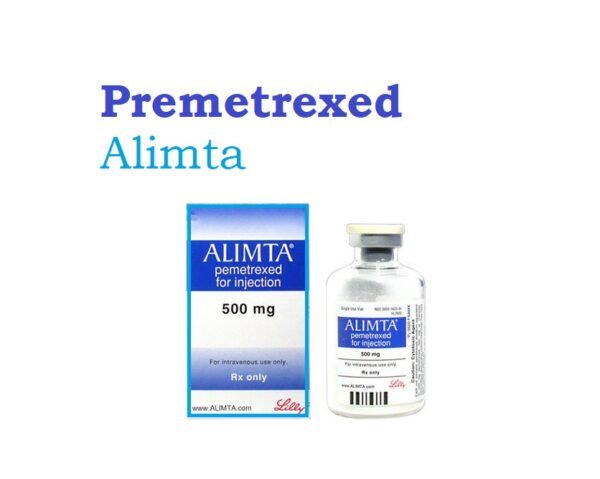
Pemetrexed (Alimta) is an anti-metabolite that inhibits the enzymes involved in the folate pathway. It is used in combination with other chemotherapeutic drugs in the treatment of certain types of cancers.
Indications of Pemetrexed (Alimta):
-
Mesothelioma:
- It is given as first-line treatment of malignant pleural mesothelioma (in combination with cisplatin) that is unresectable or in patients who are inoperable.
-
Non-small cell lung cancer (NSCLC), nonsquamous:
- It is indicated for initial treatment of locally advanced or metastatic nonsquamous NSCLC (in combination with cisplatin)
- Initial treatment of metastatic, nonsquamous NSCLC (in combination with platinum chemotherapy and pembrolizumab) in patients with no epidermal growth factor receptor (EGFR) or anaplastic lymphoma kinase (ALK) genomic tumor aberrations.
- It is also given as maintenance treatment (single-agent) of locally advanced or metastatic nonsquamous NSCLC if no progression after 4 cycles of platinum-based first-line therapy
- It is used as monotherapy (after prior chemotherapy) of recurrent/metastatic nonsquamous NSCLC.
- Limitation of use: Not indicated for the treatment of squamous cell cancer.
-
Off Label Use of Pemetrexed in Adults:
- Metastatic Bladder cancer;
- Persistent or recurrent cervical cancer;
- Malignant pleural mesothelioma (single agent and off-label combination);
- Platinum-resistant Ovarian cancer;
- Metastatic Thymic malignancies.
Pemetrexed dose in adults:
Note:
- Vitamin supplements should be started 7 days before initial pemetrexed dose:
- Folic acid 400 to 1,000 mcg orally once daily (begin 7 days prior to treatment initiation;
- continue daily during treatment and for 21 days after last pemetrexed dose) and vitamin B12 1,000 mcg IM 7 days before treatment and then every 3 cycles.
- Give dexamethasone 4 mg orally twice daily for 3 days, beginning the day before treatment to minimize cutaneous reactions.
- New treatment cycles should not begin unless ANC ≥1,500/mm³, platelets ≥100,000/mm³, CrCl ≥45 mL/minute, and recovery of nonhematologic toxicity to ≤ grade 2.
Pemetrexed Treatment dose of Malignant pleural mesothelioma:
- 500 mg/m² I/V on day 1 of each 21-day cycle (in combination with cisplatin);
- continue until disease progression or unacceptable toxicity or (off-label) in combination with carboplatin or (off-label) as monotherapy.
Pemetrexed Treatment dose of Non-small cell lung cancer, nonsquamous:
-
Initial treatment of locally advanced or metastatic NSCLC:
- 500 mg/m² I/V on day 1 of each 21 day cycle (in combination with cisplatin) for up to 6 cycles or until disease progression or unacceptable toxicity.
-
Initial treatment of metastatic NSCLC:
- 500 mg/m² I/V on day 1 of each 21-day cycle (in combination with pembrolizumab and either carboplatin or cisplatin) for 4 cycles;
- following platinum-based therapy may continue pemetrexed (alone or with pembrolizumab) as maintenance therapy until disease progression or unacceptable toxicity.
-
Maintenance treatment of locally advanced or metastatic NSCLC (after 4 cycles of initial platinum-based therapy):
- 500 mg/m² I/V on day 1 of each 21-day cycle (as monotherapy).
- Continue until disease progression or unacceptable toxicity.
-
Second-line treatment of recurrent/ metastatic disease:
- 500 mg/m² I/V on day 1 of each 21-day cycle (as monotherapy).
- Continue until disease progression or unacceptable toxicity.
Pemetrexed Treatment dose of metastatic bladder cancer (off-label):
- 500 mg/m² I/V on day 1 of each 21-day cycle until disease progression or unacceptable toxicity.
Pemetrexed Treatment dose of Cervical cancer, persistent or recurrent (off-label):
- 500 mg/m² I/V on day 1 of each 21-day cycle until disease progression or unacceptable toxicity occurs or
- 900 mg/m² on day 1 of each 21-day cycle.
Pemetrexed Treatment dose of platinum-resistant ovarian cancer (off-label):
- 500 mg/m² I/V on day 1 of each 21-day cycle.
Pemetrexed Treatment dose of metastatic thymic malignancies (off-label):
- 500 mg/m² I/V on day 1 of each 21-day cycle for 6 cycles or until disease progression or unacceptable toxicity occurs.
Use in Children:
Not indicated
Pregnancy Risk Category: D
- Studies on animal reproduction revealed that fetal outcomes in pregnancy were not as good as expected.
- It is important to use effective contraception during treatment, and at least six months after the last dose of pemetrex in young females.
- Effective contraception should be used by males who have female partners with reproductive potential during treatment as well as for three months following the last dose of pemetrexed.
- It can cause male fertility problems.
Use of pemetrexed during lactation
- It is unknown if the drug is secreted in breast milk.
- Due to the possibility of fatal side effects, breastfeeding is not recommended during treatment or for at least one week after the last dose.
Pemetrexed Dose adjustment in renal disease:
Renal function may be estimated using the Cockcroft-Gault formula.
-
CrCl ≥45 mL/minute:
- Dosage adjustment is not necessary.
-
CrCl <45 mL/minute:
- Use is not recommended by the manufacturer (an insufficient number of patients have been studied for dosage recommendations).
-
Renal toxicity during treatment:
- Therapy should be withheld until CrCl is 45 mL/minute or higher.
According to a phase I study in advanced cancer patients with renal impairment, pemetrexed doses up to 500 mg/m² (with vitamin supplementation) were well tolerated in patients with glomerular filtration rate (GFR) 40 to 79 mL/minute; however, accrual was halted in patients with GFR <29 mL/minute (due to toxicity) and accrual did not occur in patients with GFR 30 to 39 mL/minute. Patients with GFR ≥80 mL/minute tolerated doses of 600 mg/m².
-
Concomitant ibuprofen use with renal dysfunction:
-
CrCl ≥80 mL/minute:
- No dosage adjustment is necessary.
-
CrCl 45 to 79 mL/minute:
- Avoid ibuprofen for 2 days before, the day of, and for 2 days following a dose of pemetrexed.
- Monitor for myelosuppression, renal, and GI toxicities is required if concomitant ibuprofen administration cannot be avoided.
-
Pemetrexed Dose adjustment in liver disease:
There are no dosage adjustments provided in the manufacturer's labeling. Pemetrexed pharmacokinetics is not affected by transaminitis or raised bilirubin.
Common Side Effects of Pemetrexed (Alimta):
-
Central Nervous System:
- Fatigue
-
Dermatologic:
- Desquamation
- Skin Rash
-
Gastrointestinal:
- Nausea
- Anorexia
- Vomiting
- Stomatitis
- Diarrhea
-
Hematologic & Oncologic:
- Anemia
- Neutropenia
-
Respiratory:
- Pharyngitis
Rare Side Effects Of Pemetrexed (Alimta):
-
Cardiovascular:
- Edema
-
Central Nervous System:
- Neuropathy
-
Dermatologic:
- Pruritus
- Alopecia
- Erythema Multiforme
-
Gastrointestinal:
- Constipation
- Abdominal Pain
-
Hematologic & Oncologic:
- Thrombocytopenia
- Febrile Neutropenia
-
Hepatic:
- Increased Serum Alanine Aminotransferase
- Increased Serum Aspartate Aminotransferase
-
Hypersensitivity:
- Hypersensitivity Reaction
-
Infection:
- Infection
- Sepsis
-
Ophthalmic:
- Conjunctivitis
- Increased Lacrimation
-
Miscellaneous:
- Fever
Contraindication to Pemetrexed (Alimta):
- Hypersensitivity to pemetrexed and any component of the formulation
Canadian labeling: Additional contraindications not in the US labeling
- Yellow fever vaccine concomitant
Warnings and precautions
-
Suppression of bone marrow
- Pemetrexed can cause severe myelosuppression, including anemia, neutropenia and thrombocytopenia. This could require a blood transfusion.
- Regular monitoring of CBC is therefore necessary.
- Folic acid and vitamin B supplementation are necessary to decrease hematologic toxicities, febrile neutropenia, and infection.
- They should be started one week before the first pemetrexed dose and continued for 21 consecutive days.
- Patients who have not received vitamin supplementation face a higher risk of myelosuppression.
- Doses may be reduced for myelosuppression in subsequent cycles.
-
Cutaneous reactions
- To reduce the severity and incidence of severe cutaneous reactions, it is important to administer dexamethasone prior to therapy.
- Severe reactions, including Stevens-Johnson Syndrome and toxic epidermal Necrolysis, can occur.
- Therapy should be stopped if there is a life-threatening condition such as bullous, blistering or exfoliating dermatologic toxic toxicity.
-
Gastrointestinal toxicities:
- To reduce gastrointestinal toxicities, prophylactic vitamin B and folic acid should be administered.
- You should start supplementation one week prior to the first dose and continue it for 21 days following the last dose.
-
Hypersensitivity
- Hypersensitivity and allergic reactions can occur when you take Pemetrexed.
-
Nephrotoxicity
- The combination of pemetrexed with other drugs can cause life-threatening renal toxicities.
- Monitoring of renal function and creatinine clearance is necessary before and during treatment.
- Therapy should be stopped if creatinine clearance is below 45 mL/minute
- It should be stopped in extreme cases.
-
Toxicity in the lungs:
- Pemetrexed can cause fatal interstitial pneumonitis.
- Therapy should be stopped immediately for any new or acutely onset pulmonary symptoms, such as dyspnea, cough, and fever.
- If interstitial pneumonitis has been confirmed, it should be stopped immediately
-
Radiation recall
- Patients who have received pemetrexed previously (weeks or years) may experience radiation recall.
- Radiotherapy should be monitored for any inflammation or blistering caused by prior radiation. If radiation recall is confirmed, pemetrexed should not be used permanently.
-
Renal impairment
- Pemetrexed is primarily eliminated by the kidneys. A decreased renal function can lead to increased toxicities.
- Manufacturer does not recommend CrCl below 45 mL/minute.
- Patients who are receiving concurrent nephrotoxins should exercise caution
- A delayed clearance may occur due to renal failure.
-
Fluid for third space:
- While the effects of third space fluid on pemetrexed's pharmacokinetics have not been fully understood, studies have shown that patients suffering from mild-to-moderate ascites/pleural effusions have similar levels to those seen in trials of patients who had no third space fluid accumulation.
Pemetrexed: Drug Interaction
Note: Drug Interaction Categories:
- Risk Factor C: Monitor When Using Combination
- Risk Factor D: Consider Treatment Modification
- Risk Factor X: Avoid Concomitant Use
Risk Factor C (Monitor therapy) |
|
| Chloramphenicol (Ophthalmic) | May enhance the adverse/toxic effect of Myelosuppressive Agents. |
| CloZAPine | Myelosuppressive Agents may enhance the adverse/toxic effect of CloZAPine. Specifically, the risk for neutropenia may be increased. |
| Coccidioides immitis Skin Test | Immunosuppressants may diminish the diagnostic effect of Coccidioides immitis Skin Test. |
| Denosumab | May enhance the adverse/toxic effect of Immunosuppressants. Specifically, the risk for serious infections may be increased. |
| Mesalamine | May enhance the myelosuppressive effect of Myelosuppressive Agents. |
| Nitisinone | May increase the serum concentration of OAT1/3 Substrates. |
| Ocrelizumab | May enhance the immunosuppressive effect of Immunosuppressants. |
| Pidotimod | Immunosuppressants may diminish the therapeutic effect of Pidotimod. |
| Pretomanid | May increase the serum concentration of OAT1/3 Substrates. |
| Promazine | May enhance the myelosuppressive effect of Myelosuppressive Agents. |
| Pyrimethamine | May enhance the adverse/toxic effect of PEMEtrexed. |
| Siponimod | Immunosuppressants may enhance the immunosuppressive effect of Siponimod. |
| Teriflunomide | May increase the serum concentration of OAT1/3 Substrates. |
| Tertomotide | Immunosuppressants may diminish the therapeutic effect of Tertomotide. |
| Trastuzumab | May enhance the neutropenic effect of Immunosuppressants. |
Risk Factor D (Consider therapy modification) |
|
| Baricitinib | Immunosuppressants may enhance the immunosuppressive effect of Baricitinib. Management: Use of baricitinib in combination with potent immunosuppressants such as azathioprine or cyclosporine is not recommended. Concurrent use with antirheumatic doses of methotrexate or nonbiologic disease modifying antirheumatic drugs (DMARDs) is permitted. |
| Deferiprone | Myelosuppressive Agents may enhance the neutropenic effect of Deferiprone. Management: Avoid the concomitant use of deferiprone and myelosuppressive agents whenever possible. If this combination cannot be avoided, monitor the absolute neutrophil count more closely. |
| Echinacea | May diminish the therapeutic effect of Immunosuppressants. |
| Fingolimod | Immunosuppressants may enhance the immunosuppressive effect of Fingolimod. Management: Avoid the concomitant use of fingolimod and other immunosuppressants when possible. If combined, monitor patients closely for additive immunosuppressant effects (eg, infections). |
| Ibuprofen | May increase the serum concentration of PEMEtrexed. Management: In patients with an estimated creatinine clearance of 45 to 79 mL/min, avoid ibuprofen for 2 days before, the day of, and 2 days following the administration of pemetrexed. Monitor for increased pemetrexed toxicities if combined. |
| Leflunomide | Immunosuppressants may enhance the adverse/toxic effect of Leflunomide. Specifically, the risk for hematologic toxicity such as pancytopenia, agranulocytosis, and/or thrombocytopenia may be increased. Management: Consider not using a leflunomide loading dose in patients receiving other immunosuppressants. Patients receiving both leflunomide and another immunosuppressant should be monitored for bone marrow suppression at least monthly. |
| Lenograstim | Antineoplastic Agents may diminish the therapeutic effect of Lenograstim. Management: Avoid the use of lenograstim 24 hours before until 24 hours after the completion of myelosuppressive cytotoxic chemotherapy. |
| Lipegfilgrastim | Antineoplastic Agents may diminish the therapeutic effect of Lipegfilgrastim. Management: Avoid concomitant use of lipegfilgrastim and myelosuppressive cytotoxic chemotherapy. Lipegfilgrastim should be administered at least 24 hours after the completion of myelosuppressive cytotoxic chemotherapy. |
| Nivolumab | Immunosuppressants may diminish the therapeutic effect of Nivolumab. |
| Palifermin | May enhance the adverse/toxic effect of Antineoplastic Agents. Specifically, the duration and severity of oral mucositis may be increased. Management: Do not administer palifermin within 24 hours before, during infusion of, or within 24 hours after administration of myelotoxic chemotherapy. |
| Roflumilast | May enhance the immunosuppressive effect of Immunosuppressants. |
| Sipuleucel-T | Immunosuppressants may diminish the therapeutic effect of Sipuleucel-T. Management: Evaluate patients to see if it is medically appropriate to reduce or discontinue therapy with immunosuppressants prior to initiating sipuleucel-T therapy. |
| Tofacitinib | Immunosuppressants may enhance the immunosuppressive effect of Tofacitinib. Management: Concurrent use with antirheumatic doses of methotrexate or nonbiologic disease modifying antirheumatic drugs (DMARDs) is permitted, and this warning seems particularly focused on more potent immunosuppressants. |
| Tolvaptan | May increase the serum concentration of OAT1/3 Substrates. Management: Patients being treated with the Jynarque brand of tolvaptan should avoid concomitant use of OAT1/3 substrates. Concentrations and effects of the OAT1/3 substrate would be expected to increase with any combined use. |
| Vaccines (Inactivated) | Immunosuppressants may diminish the therapeutic effect of Vaccines (Inactivated). Management: Vaccine efficacy may be reduced. Complete all age-appropriate vaccinations at least 2 weeks prior to starting an immunosuppressant. If vaccinated during immunosuppressant therapy, revaccinate at least 3 months after immunosuppressant discontinuation. |
Risk Factor X (Avoid combination) |
|
| BCG (Intravesical) | Immunosuppressants may diminish the therapeutic effect of BCG (Intravesical). |
| BCG (Intravesical) | Myelosuppressive Agents may diminish the therapeutic effect of BCG (Intravesical). |
| Cladribine | May enhance the immunosuppressive effect of Immunosuppressants. |
| Cladribine | May enhance the myelosuppressive effect of Myelosuppressive Agents. |
| Dipyrone | May enhance the adverse/toxic effect of Myelosuppressive Agents. Specifically, the risk for agranulocytosis and pancytopenia may be increased |
| Natalizumab | Immunosuppressants may enhance the adverse/toxic effect of Natalizumab. Specifically, the risk of concurrent infection may be increased. |
| Pimecrolimus | May enhance the adverse/toxic effect of Immunosuppressants. |
| Tacrolimus (Topical) | May enhance the adverse/toxic effect of Immunosuppressants. |
| Vaccines (Live) | Immunosuppressants may enhance the adverse/toxic effect of Vaccines (Live). Immunosuppressants may diminish the therapeutic effect of Vaccines (Live). Management: Avoid use of live organism vaccines with immunosuppressants; live-attenuated vaccines should not be given for at least 3 months after immunosuppressants. |
Monitoring parameters:
- CBC with differentials and platelets (before every cycle, on days 8, 15 and 16 of each cycle and as required; monitor for nadir or recovery).
- Tests of renal function (serum creatinine and creatinine clearance, BUN) are performed prior to each cycle, as well as as if necessary.
- Tests of liver function including total bilirubin (periodic), ALT, and AST
- Mucositis, diarrhea, pulmonary toxicology, dermatologic toxicity and radiation recall are all signs and symptoms.
How to administer Pemetrexed (Alimta)?
- It should be given as IV infusion over 10 minutes.
- It should be given before platinum when used in combination with platinum-based therapy (cisplatin or carboplatin).
- It should be given after pembrolizumab if administered on the same day.
Mechanism of action of Pemetrexed (Alimta):
- Pemetrexed can be used as an antifolate.
- It causes the destruction of folate-dependent metabolic pathways that are essential for cell replication.
- It causes inhibition of purine nucleotide (THYMINE NUCLEOTIDE) and protein synthesis.
- This includes thymidylate synase, DHFR, dihydrofolate reductase and glycinamide ribonucleotide myltransferase.
Protein binding:
- 81%
Metabolism:
- Minimal
Half-life elimination:
- Normal renal function: 3.5 hours
Excretion:
- Urine (70% to 90% as unchanged drug).
International Brands of Pemetrexed:
- Alimta
- TARO-PEMEtrexed
- Armisarte
- Ciambra
- Emetex
- Empet
- Enzastar
- Jie Baili
- Mytrex
- Pemecine
- Pemeker
- Pemeted
- Pemetrex
- Pemex
- Pemirex
- Pexate
- Pleutrex
- Reladdin
- Tevatrexed
- Virplazit
Pemetrexed Brand Names in Pakistan:
Pemetrexed Injection 100 mg |
|
| Alimta | Eli Lilly Pakistan (Pvt) Ltd. |
Pemetrexed Injection 500 mg |
|
| Alimta | Eli Lilly Pakistan (Pvt) Ltd. |
| Trexam | Haji Medicine Co. |
.png)


