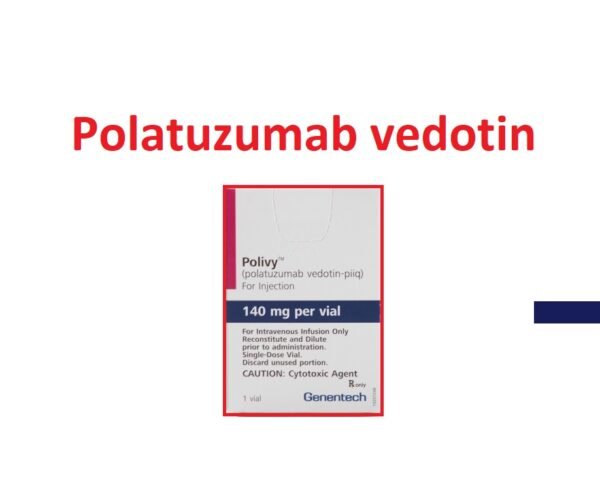
Polatuzumab vedotin (Polivy) is an antibody-drug conjugate (ADC) that causes cell-cycle arrest and induces apoptosis. It has got FDA approval for the treatment of patients with diffuse large B-cell lymphoma in combination with Rituximab and Bendamustine.
Polatuzumab vedotin (Polivy) Uses:
- Diffuse large B-cell lymphoma (relapsed or refractory):
- Treatment of adults with relapsed or refractory diffuse large B-cell lymphoma (in combination with bendamustine and a rituximab product) not otherwise specified, after at least two prior therapies.
Polatuzumab vedotin (Polivy) Dose in Adults
Note:
- Administer prophylaxis for Pneumocystis jiroveci pneumonia and herpes virus throughout the treatment.
- If not already premedicated, administer an antihistamine and antipyretic at least 30 to 60 minutes before the infusion.
- Consider prophylactic growth factor support, and administer tumor lysis syndrome prophylaxis as clinically necessary.
Polatuzumab vedotin (Polivy) Dose in the treatment of Relapsed or Refractory Diffuse large B-cell Lymphoma:
- 1.8 mg/kg intravenously once every 21 days for 6 cycles (in combination with bendamustine and rituximab).
- Missed dose:
- If the dose is missed, administer as soon as possible.
- Adjust cycle schedule in order to maintain a 21-day interval between doses.
Use in Children:
Not indicated.
Pregnancy Risk Category: N
- Based on data from animal reproduction studies and the mechanism of action, it is possible that in utero the drug could cause harm to fetal health.
- Before using the information in females with reproductive potential, it is important to evaluate your pregnancy status.
- Effective contraception should be used by females with reproductive potential during treatment, and at least for three months following the last dose.
- Effective contraception should be used by male patients who have female partners with reproductive potential.
Use of Polatuzumab vedotin during breastfeeding
- It is unknown if breast milk contains polatuzumab Vedotin.
- Breastfeeding is not recommended by the manufacturer because of the risk of serious adverse reactions in breastfed infants.
- It should be done at least for 2 months after the last dose.
Polatuzumab vedotin (Polivy) Dose in Kidney Disease:
- CrCl 30 to 89 mL/minute:
- There are no dosage adjustments provided in the manufacturer's labeling; however, no clinically significant pharmacokinetic differences were observed based on CrCl 30 to 89 mL/minute.
- CrCl <30 mL/minute:
- There are no dosage adjustments provided in the manufacturer's labeling. The drug has not been studied in patients with severe kidney impairment.
- End-stage renal disease (with or without dialysis):
- There are no dosage adjustments provided in the manufacturer's labeling. The drug has not been studied in patients with end-stage renal disease.
Polatuzumab vedotin (Polivy) Dose in Liver disease:
- Mild impairment (AST or ALT >1 to 2.5 times ULN or total bilirubin >1 to 1.5 times ULN):
- No initial dosage adjustment is necessary.
- Moderate to severe impairment (AST or ALT >2.5 times ULN or total bilirubin >1.5 times ULN):
- Avoid use;
- Monomethyl auristatin exposure may be increased in patients with moderate to severe hepatic impairment.
Common Side Effects of Polatuzumab vedotin (Polivy):
- Central Nervous System:
- Dizziness
- Peripheral Neuropathy
- Endocrine & Metabolic:
- Decreased Serum Calcium
- Hypokalemia
- Weight Loss
- Hypoalbuminemia
- Hypocalcemia
- Gastrointestinal:
- Diarrhea
- Increased Serum Lipase
- Decreased Appetite
- Increased Serum Amylase
- Vomiting
- Hematologic & Oncologic:
- Neutropenia
- Thrombocytopenia
- Anemia
- Lymphocytopenia
- Febrile Neutropenia
- Hepatic:
- Increased Serum Alanine Aminotransferase
- Increased Serum Aspartate Transaminase
- Renal:
- Increased Serum Creatinine
- Respiratory:
- Pneumonia
- Upper Respiratory Tract Infection
- Miscellaneous:
- Fever
- Infusion Related Reaction
Less Common Side Effects Of Polatuzumab vedotin (Polivy):
- Endocrine & Metabolic:
- Hypophosphatemia
- Hematologic & Oncologic:
- Pancytopenia
- Hepatic:
- Increased Serum Transaminases
- Hepatotoxicity
- Immunologic:
- Antibody Development
- Infection:
- Sepsis
- Neuromuscular & Skeletal:
- Arthralgia
- Respiratory:
- Pneumonitis
Polatuzumab vedotin (Polivy) Side effects (Frequency Not Defined):
- Hepatic:
- Increased Serum Bilirubin
- Infection:
- Cytomegalovirus Disease
- Herpes Virus Infection
- Respiratory:
- Pneumonia Due To Pneumocystis Jirovecii
Contraindications to Polatuzumab vedotin (Polivy):
The manufacturer's labeling does not list any contraindications.
Warnings and precautions
- Suppression of bone marrow
- With polatuzumab, severe or even fatal myelosuppression can occur.
- There have been reports of grade 3 and higher neutropenias, thrombocytopenias, anemia, lymphopenia, anemia, and neutropenic fever.
- More than 40% of patients were treated with primary prophylaxis using granulocyte colony stimulating factor.
- Monitoring blood counts is important during therapy. Myelosuppression can lead to treatment interruptions, dose reductions, or discontinuation.
- Prophylaxis can be done with granulocyte colony stimulating factor.
- Hepatotoxicity
- Clinical studies have shown severe hepatotoxicity.
- These cases are consistent with hepatocellular injuries, which manifests as an increase in transaminases or bilirubin.
- A small number of patients experienced Grade 3 or 4 transaminase elevations.
- Suspected drug-induced liver injury (AST/ALT >3x ULN, total bilirubin>2x ULN) was also common.
- Hepatotoxicity is more likely in those with liver disease or elevated baseline liver enzymes.
- Monitor liver enzymes, bilirubin.
- Infection
- Sepsis, pneumonia, cytomegalovirus and other opportunistic infection can all lead to serious and/or fatal infections.
- You must monitor your patients for signs and symptoms of fungal, bacterial or viral infections.
- All treatment should include prophylaxis against P. jiroveci bronchitis and herpesvirus.
- Nearly one-third of patients receiving treatment had a grade 3 or higher infection.
- Infection-related death was only reported in a small number of patients within the first 90 days.
- Reactions that are related to infusion:
- There have been reports of severe infusion-related reactions.
- The symptoms included fever, chills and flushing. Most reactions were grade 1 or 2.
- Infusion reactions can occur up to 24 hours after administration.
- Monitor the infusions during and after.
- Before polatuzumab-vedotin administration, take a medication with an antihistamine or antipyretic.
- Infusion-related reactions can be treated by stopping the infusion immediately and obtaining the necessary medical attention.
- Peripheral neuropathy
- Peripheral neuropathy can be both common and chronic. Treatment may make it worse for pre-existing peripheral neuropathy.
- Neuropathy can occur even before the start of therapy.
- Neuropathy is typically sensory but can also be motor or sensorimotor peripheral neuropathy. Most cases are grade 1 or 2.
- However, some cases have been reported as having grade 3 toxicities.
- The median time from onset to neuropathy was 2.1 months. Nearly one-third of patients experienced complete resolution within one month.
- Monitor for clinical signs of neuropathy, such as hypoesthesia, paresthesia or hyperesthesia, burning sensations, neuropathic pains, weakness, and gait disturbance.
- For new or worsening neurological conditions, it may be necessary to discontinue, reduce, or interrupt treatment.
- Progressive multifocal Leukoencephalopathy
- With polatuzumab, vedotin, progressive multifocal leukoencephalopathy has been reported.
- Monitor for any new or worsening cognitive, neurological, and/or behavioral problems.
- Withhold polatuzumab and concomitant chemotherapy for new-onset symptoms that suggestive of PML.
- Permanently stop treating PML if you are confirmed to have PML.
- Tumor lysis syndrome
- Tularemia lysis syndrome (TLS), may be a possibility.
- Patients with high tumor burdens and/or rapid tumor growth are at greater risk for TLS.
- TLS management/prophylaxis should be administered as soon as possible.
- Hepatic impairment
- Patients with severe or moderate hepatic impairment should not use this product.
- Patients with severe impairment may be more likely to be exposed to monomethyl auristatinE (MMAE), a component in polatuzumab vedotin. This can increase the risk of adverse events.
Polatuzumab vedotin: Drug Interaction
|
Chloramphenicol (Ophthalmic) |
May enhance the adverse/toxic effect of Myelosuppressive Agents. |
|
CloZAPine |
|
|
Coccidioides immitis Skin Test |
Immunosuppressants may diminish the diagnostic effect of Coccidioides immitis Skin Test. |
|
CYP3A4 Inducers (Strong) |
May decrease the serum concentration of Polatuzumab Vedotin. Exposure to unconjugated MMAE, the cytotoxic small molecule component of polatuzumab vedotin, may be decreased. |
|
CYP3A4 Inhibitors (Strong) |
May increase the serum concentration of Polatuzumab Vedotin. Exposure to unconjugated MMAE, the cytotoxic small molecule component of polatuzumab vedotin, may be increased. |
|
Denosumab |
May enhance the adverse/toxic effect of Immunosuppressants. Specifically, the risk for serious infections may be increased. |
|
Mesalamine |
May enhance the myelosuppressive effect of Myelosuppressive Agents. |
|
Ocrelizumab |
May enhance the immunosuppressive effect of Immunosuppressants. |
|
Pidotimod |
Immunosuppressants may diminish the therapeutic effect of Pidotimod. |
|
Promazine |
May enhance the myelosuppressive effect of Myelosuppressive Agents. |
|
Siponimod |
Immunosuppressants may enhance the immunosuppressive effect of Siponimod. |
|
Tertomotide |
Immunosuppressants may diminish the therapeutic effect of Tertomotide. |
|
Trastuzumab |
May enhance the neutropenic effect of Immunosuppressants. |
|
Risk Factor D (Consider therapy modification) |
|
|
Baricitinib |
Immunosuppressants may enhance the immunosuppressive effect of Baricitinib. Management: Use of baricitinib in combination with potent immunosuppressants such as azathioprine or cyclosporine is not recommended. Concurrent use with antirheumatic doses of methotrexate or nonbiologic disease modifying antirheumatic drugs (DMARDs) is permitted. |
|
Deferiprone |
|
|
Echinacea |
May diminish the therapeutic effect of Immunosuppressants. |
|
Fingolimod |
Immunosuppressants may enhance the immunosuppressive effect of Fingolimod. Management: Avoid the concomitant use of fingolimod and other immunosuppressants when possible. If combined, monitor patients closely for additive immunosuppressant effects (eg, infections). |
|
Leflunomide |
Immunosuppressants may enhance the adverse/toxic effect of Leflunomide. Specifically, the risk for hematologic toxicity such as pancytopenia, agranulocytosis, and/or thrombocytopenia may be increased. Management: Consider not using a leflunomide loading dose in patients receiving other immunosuppressants. Patients receiving both leflunomide and another immunosuppressant should be monitored for bone marrow suppression at least monthly. |
|
Nivolumab |
Immunosuppressants may diminish the therapeutic effect of Nivolumab. |
|
Roflumilast |
May enhance the immunosuppressive effect of Immunosuppressants. |
|
Sipuleucel-T |
Immunosuppressants may diminish the therapeutic effect of Sipuleucel-T. Management: Evaluate patients to see if it is medically appropriate to reduce or discontinue therapy with immunosuppressants prior to initiating sipuleucel-T therapy. |
|
Tofacitinib |
Immunosuppressants may enhance the immunosuppressive effect of Tofacitinib. Management: Concurrent use with antirheumatic doses of methotrexate or nonbiologic disease modifying antirheumatic drugs (DMARDs) is permitted, and this warning seems particularly focused on more potent immunosuppressants. |
|
Vaccines (Inactivated) |
Immunosuppressants may diminish the therapeutic effect of Vaccines (Inactivated). Management: Vaccine efficacy may be reduced. Complete all age-appropriate vaccinations at least 2 weeks prior to starting an immunosuppressant. If vaccinated during immunosuppressant therapy, revaccinate at least 3 months after immunosuppressant discontinuation. |
|
Risk Factor X (Avoid combination) |
|
|
BCG (Intravesical) |
Immunosuppressants may diminish the therapeutic effect of BCG (Intravesical). |
|
BCG (Intravesical) |
Myelosuppressive Agents may diminish the therapeutic effect of BCG (Intravesical). |
|
Cladribine |
May enhance the immunosuppressive effect of Immunosuppressants. |
|
Cladribine |
May enhance the myelosuppressive effect of Myelosuppressive Agents. |
|
Dipyrone |
May enhance the adverse/toxic effect of Myelosuppressive Agents. Specifically, the risk for agranulocytosis and pancytopenia may be increased |
|
Natalizumab |
Immunosuppressants may enhance the adverse/toxic effect of Natalizumab. Specifically, the risk of concurrent infection may be increased. |
|
Pimecrolimus |
May enhance the adverse/toxic effect of Immunosuppressants. |
|
Tacrolimus (Topical) |
May enhance the adverse/toxic effect of Immunosuppressants. |
|
Vaccines (Live) |
Immunosuppressants may enhance the adverse/toxic effect of Vaccines (Live). Immunosuppressants may diminish the therapeutic effect of Vaccines (Live). Management: Avoid use of live organism vaccines with immunosuppressants; live-attenuated vaccines should not be given for at least 3 months after immunosuppressants. |
Monitoring parameters:
- CBC throughout treatment;
- liver function tests.
- Pregnancy test (in females of reproductive potential) before treatment initiation.
- Monitor for at least 90 minutes after the first infusion and at least 30 minutes after subsequent infusions for infusion-related reactions.
- Monitor for signs of neuropathy such as hypoesthesia, paresthesia, hyperesthesia, dysesthesia, burning sensation, or neuropathic pain or weakness, or gait disturbance.
- Monitor for tumor lysis syndrome, features of progressive multifocal leukoencephalopathy, and infection.
How to administer Polatuzumab vedotin (Polivy)?
IV:
- Allow the first dose to infuse for at least 90 minutes.
- Use a dedicated infusion line that is non-pyrogenic and low-protein binding.
- After the infusion has ended, monitor the patient closely for any infusion-related reactions.
- If tolerated at the initial dose, you can continue infusions for up to 30 minutes. Monitor for any changes in infusion time.
- Pre-medicate with an antihistamine or antipyretic 30-60 minutes before each infusion if you are not already taking them.
- Infusion-related reactions can be treated by stopping polatuzumab Vedotin infusions and providing supportive treatment if necessary.
- After resolution, you can resume infusion at 50% of your prior rate.
- If tolerated and there are no infusion-related reactions, may increase infusion rate by 50 mg/hour every 30 min.
Polatuzumab vedotin and bendamustine can be administered in any order (on the first day of each cycle). Do not give intravenous pushes or boluses. Do not combine or infuse other medications.
Mechanism of action of Polatuzumab vedotin (Polivy):
Polatuzumab vedotin (ADC) is directed at CD79b, which consists 3 components.
- A CD79b-specific, humanized IgG1 antibody
- Monomethyl auristatin E is a microtubule-disrupting drug.
- A protease cleavable linkinger that covalently conjugates MMAE with the polatuzumab anti-body
The conjugate binds with CD79b, a B-cell specific cell surface protein that is commonly expressed in mature lymphomas.
It forms a complex inside the cell which releases MMAE. MMAE binds with the tubules, disrupting the cellular microtubule networks.
This causes cell cycle arrest (G2/M Phase) and apoptosis.
Protein binding:
- MMAE: 71% to 77%
Metabolism:
- Catabolism to small peptides, amino acids, unconjugated MMAE, and unconjugated MMAE-related catabolites;
- MMAE is a CYP3A4 substrate
Half-life elimination:
- Antibody-conjugated MMAE: ~12 days (at cycle 6);
- unconjugated MMAE: ~4 days (after the first dose)
International Brand Names of Polatuzumab vedotin:
- Polivy
Polatuzumab vedotin Brand Names in Pakistan:
No Brands Available in Pakistan.
.png)


