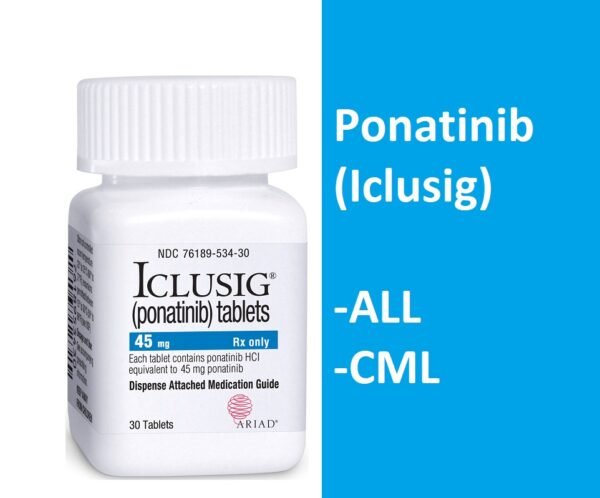
Ponatinib (Iclusig) is a third-generation pan-tyrosine kinase inhibitor that is used in the treatment of acute lymphoblastic leukemia and chronic myeloid leukemia refractory to first-line therapies.
Ponatinib (Iclusig) Uses:
- Acute lymphoblastic leukemia:
- Treatment of Philadelphia chromosome-positive acute lymphoblastic leukemia (Ph+ ALL) in patients for whom no other tyrosine kinase inhibitor therapy is indicated or who are T315I-positive.
- Chronic myeloid leukemia:
- Treatment of chronic myeloid leukemia (CML) in chronic, accelerated, or blast phase in patients for whom no other tyrosine kinase inhibitor therapy is indicated or who are T315I-positive.
- Limitations of use:
- Ponatinib is not indicated for the treatment of newly diagnosed chronic phase of CML.
Ponatinib (Iclusig) Dose in Adults
Note:
- The optimal ponatinib dose has not been identified.
- Consider discontinuing therapy if no response has occurred by 3 months (90 days) of therapy.
Ponatinib (Iclusig) Dose in the treatment of Acute lymphoblastic leukemia (ALL):
Indications:
- Philadelphia chromosome-positive (Ph+),
- T315I positive or
- in patients for whom no other tyrosine kinase inhibitor therapy is indicated.
- Oral: Initial- 45 mg once daily
Ponatinib (Iclusig) Dose in the treatment of Chronic myeloid leukemia (CML; chronic, accelerated, or blast phase):
Indications:
- T315I-positive or
- in patients for whom no other tyrosine kinase inhibitor therapy is indicated.
- Oral: Initial: 45 mg once daily;
- consider reducing the dose for patients in chronic or accelerated phase who have achieved a major cytogenetic response
Note: This drug is not recommended for treatment of newly diagnosed chronic phase CML.
- Dosage adjustment for strong CYP3A inhibitors:
- Reduce ponatinib dose to 30 mg once daily when administered with concomitant strong CYP3A inhibitors (eg, boceprevir, clarithromycin, conivaptan, grapefruit juice, indinavir, itraconazole, ketoconazole, lopinavir/ritonavir, nefazodone, nelfinavir, posaconazole, ritonavir, saquinavir, telaprevir, telithromycin, voriconazole).
Use in Children:
Not indicated.
Pregnancy Risk Category: D
- Based on animal data and the mechanism of action, it is probable that ponatinib will cause harm to fetal health if administered during pregnancy.
- Before starting ponatinib therapy, confirm your pregnancy. Effective contraception should be used by women of childbearing age during treatment and for three weeks following the last dose.
Use Ponatinib while breastfeeding
- It is unknown if ponatinib can be found in breast milk.
- The manufacturer suggests that nursing should be stopped during therapy as well as for six days following the last dose.
Ponatinib (Iclusig) Dose in Kidney Disease:
There are no dosage adjustments provided in the manufacturer's labeling (has not been studied); although renal excretion is not a major excretion route for ponatinib.
Ponatinib (Iclusig) Dose in Liver disease:
- Hepatic impairment prior to treatment initiation:
- Mild-to-severe impairment (Child-Pugh class A, B, or C):
- Initial: 30 mg once daily;
- monitor closely for toxicity.
- Mild-to-severe impairment (Child-Pugh class A, B, or C):
- Hepatotoxicity during treatment:
- AST or ALT >3 times ULN (≥ Grade 2):
- If toxicity occurs at a dose of 45 mg daily, interrupt therapy; upon recovery to ≤ grade 1 (<3 times ULN), resume therapy at 30 mg daily.
- If toxicity occurs at a dose of 30 mg daily, interrupt therapy; upon recovery to ≤ grade 1, resume therapy at 15 mg daily.
- If toxicity occurs at a dose of 15 mg daily, discontinue therapy.
- ALT or AST ≥3 times ULN with bilirubin >2 times ULN and alkaline phosphatase <2 times ULN:
- Discontinue therapy.
- AST or ALT >3 times ULN (≥ Grade 2):
Common Side Effects of Ponatinib (Iclusig):
- Cardiovascular:
- Hypertension
- Arterial Ischemia
- Peripheral Vascular Disease
- Arterial Embolism
- Cerebral Ischemia
- Cerebrovascular Accident
- Myocardial Infarction
- Peripheral Edema
- Coronary Occlusion
- Occlusive Arterial Disease
- Cardiac Arrhythmia
- Cardiac Failure
- Hypertensive Crisis
- Mesenteric Artery Occlusion
- Peripheral Arterial Disease
- Central Nervous System:
- Fatigue
- Headache
- Peripheral Neuropathy
- Pain
- Dizziness
- Insomnia
- Chills
- Dermatologic:
- Skin Rash
- Xeroderma
- Pruritus
- Cellulitis
- Alopecia
- Endocrine & Metabolic:
- Increased Serum Glucose
- Decreased Serum Phosphate
- Fluid Retention
- Decreased Serum Calcium
- Decreased Serum Albumin
- Decreased Serum Sodium
- Decreased Serum Bicarbonate
- Increased Serum Potassium
- Decreased Serum Potassium
- Decreased Serum Glucose
- Weight Loss
- Increased Serum Calcium
- Gastrointestinal:
- Constipation
- Abdominal Pain
- Increased Serum Lipase
- Nausea
- Decreased Appetite
- Vomiting
- Diarrhea
- Stomatitis
- Increased Serum Amylase
- Genitourinary:
- Urinary Tract Infection
- Hematologic & Oncologic:
- Leukopenia
- Bone Marrow Depression
- Neutropenia
- Anemia
- Thrombocytopenia
- Lymphocytopenia
- Hemorrhage
- Febrile Neutropenia
- Hepatic:
- Increased Serum Alanine Aminotransferase
- Increased Serum Alkaline Phosphatase
- Increased Serum Aspartate Aminotransferase
- Hepatotoxicity
- Increased Serum Bilirubin
- Infection:
- Sepsis
- Neuromuscular & Skeletal:
- Arthralgia
- Myalgia
- Limb Pain
- Back Pain
- Ostealgia
- Muscle Spasm
- Musculoskeletal Pain
- Ophthalmic:
- Conjunctival Edema
- Conjunctival Hemorrhage
- Conjunctival Hyperemia
- Conjunctival Irritation
- Conjunctivitis
- Corneal Abrasion
- Corneal Erosion
- Dry Eye Syndrome
- Eye Pain
- Renal:
- Increased Serum Creatinine
- Respiratory:
- Cough
- Dyspnea
- Pleural Effusion
- Nasopharyngitis
- Pneumonia
- Upper Respiratory Tract Infection
- Miscellaneous:
- Fever
Less Common Side Effects Of Ponatinib (Iclusig):
- Cardiovascular:
- Left Ventricular Dysfunction
- Atrial Fibrillation
- Venous Thromboembolism
- Pericardial Effusion
- Reduced Ejection Fraction
- Deep Vein Thrombosis
- Pulmonary Embolism
- Syncope
- Retinal Vein Occlusion
- Subdural Hematoma
- Central Nervous System:
- Paresthesia
- Hypoesthesia
- Cranial Nerve Palsy
- Myasthenia
- Cerebral Hemorrhage
- Hyperesthesia
- Dermatologic:
- Erythema
- Endocrine & Metabolic:
- Increased Serum Sodium
- Hyperuricemia
- Increased Serum Triglycerides
- Gastrointestinal:
- Gastrointestinal Hemorrhage
- Pancreatitis
- Dysgeusia
- Hematologic & Oncologic:
- Major Hemorrhage
- Hepatic:
- Ascites
- Ophthalmic:
- Blurred Vision
- Macular Edema
- Retinal Hemorrhage
Rare Side effects of Ponatinib (Iclusig):
- Genitourinary:
- Decreased Renal Blood Flow
- Hepatic:
- Hepatic Failure
- Ophthalmic:
- Blepharitis
- Cataract
- Corneal Ulcer
- Eyelid Edema
- Glaucoma
- Iridocyclitis
- Iritis
- Ocular Hyperemia
- Periorbital Edema
Contraindications to Ponatinib (Iclusig):
The US labeling of the manufacturer does not list any contraindications.
Canadian labeling
- Hypersensitivity to ponatinib and any component of the formulation
- Unmanaged cardiovascular risk factors including uncontrolled hypertension
- Patients with untreated hyperuricemia and patients who are not properly hydrated
Warnings and precautions
- Arrhythmias
- There have been reports of cardiac arrhythmias (bradyarrhythmias or tachyarrhythmias).
- Atrial fibrillation is the most common arrhythmia. Approximately 50% of all events are grade 3 or 4.
- Case reports also show that there have been other rhythm disorders of grade 3 and 4.
- Some events required hospitalization. In some cases, symptomatic bradyarrhythmia that required pacemaker implantation was required.
- You should be aware of signs and symptoms such as bradycardia (fainting or dizziness, chest pain, dizziness) and tachycardia, (palpitations, dizziness).
- You may need to interrupt therapy and have further evaluation.
- Arterial occlusion [US Boxed Warn]
- At least 35% of patients treated with ponatinib have experienced a bowel obstruction.
- Some patients may have experienced multiple types of events.
- These events included stroke, fatal myocardial injury (MI), stroke, stenting of large blood vessels in the brain, severe peripheral and serious vascular disease, and the urgent need for revascularization procedures. Incidents were also observed in patients with and not having cardiovascular risk factors (including patients younger than 50 years).
- You should monitor your arterial condition closely and stop or interrupt therapy immediately if you notice any signs of it.
- When deciding whether to resume therapy, consider the risk-benefit ratio.
- Within 2 weeks of therapy initiation, fatal and life-threatening arterial obstruction may occur. It is not dose dependent.
- Hypertension, hyperlipidemia and history of heart disease are the most common risk factors for arterial occlusive events.
- An increased age and a history of hypertension, diabetes or ischemia are risk factors for developing ponatinib-associated vessel occlusion.
- Due to severe arterial thrombosis/occlusion, patients required a revascularization procedure (cerebrovascular and coronary)
- MI and coronary vessel occlusion can lead to heart failure.
- Cerebrovascular Occlusion (including fatal strokes) may have occurred. It can cause stenosis in multiple segments of major arterial vessels that supply the head.
- Peripheral arterial obstruction events have been reported, including fatal mesenteric arterial occlusion and life-threatening peripheral arterial disease.
- Amputations have been required for some patients with distal or digital extremity necrosis.
- It has been reported that renal artery stenosis can be associated with worsening hypertension or refractory hypertension.
- Suppression of bone marrow
- Patients with severe myelosuppression (grade 3 and 4) are more likely to experience ponatinib.
- The incidence of severe myelosuppression was higher in patients with blast or accelerated phase CML or Ph+ ALL.
- The median time it took to experience severe myelosuppression was one month.
- You should monitor your blood counts. This could be a sign that therapy needs to be interrupted or reduced.
- Fluid retention/edema
- Patients treated with ponatinib experienced serious fluid retention, including brain edema that led to death (case report).
- Commonly seen were peripheral edema, peripheral swelling, pleural effusions and pericardial effusions.
- Patients should be monitored for fluid retention. Therapy interruptions, dosage reductions, or discontinuation may be necessary.
- Perforation of the gastrointestinal tract:
- Very rarely, serious gastrointestinal perforation (fistula), occurs. Monitor for signs/symptoms.
- Heart Failure: [US Boxed Warning]
- Clinical trials reported serious heart failure (HF), or left ventricular dysfunction that included fatalities.
- Monitor for signs/symptoms indicating HF. Stop or discontinue ponatinib treatment if you notice a worsening condition.
- Congestive heart disease and decreased ejection fraction are the most common types of heart failure.
- If HF develops, treat as medically necessary.
- In the event of severe HF, consider discontinuing ponatinib.
- Hemorrhage
- Patients treated with ponatinib experienced hemorhagic events, which included serious events like cerebral (subdural) hematomas and gastrointestinal hemorhages. There were also fatalities.
- Patients with Ph+ ALL and accelerated or blast-phase CML had more severe bleeding episodes; the majority of patients had grade 4 hemocytopenia.
- You should monitor your platelet levels and look out for bleeding signs and symptoms. If necessary, stop therapy.
- Hepatotoxicity: [US Boxed Warning]
- Death and liver failure due to ponatinib-induced hepatotoxicity were both observed.
- The median time it took to get started was 3 months. There were a range of less than 1 month up to 47 months.
- Treatment interruption may be necessary for hepatotoxicity. Doses should be reduced or discontinued.
- Within one week of therapy initiation, there was one case of severe hepatic dysfunction that led to death. A second case of acute liver failure occurred.
- Common side effects of treatment include ALT//AST, bilirubin and alkaline phosphatase elevated.
- Elevations of ALT/AST may not be reversible.
- Hypertension
- Over two-thirds (systolic and diastolic treatment-emergent) of patients treated with ponatinib experienced elevated blood pressure.
- Symptomatic hypertension and hypertensive crises were reported by several patients, which required immediate intervention.
- Patients with hypertension may have their blood pressure increase.
- Keep an eye on your blood pressure and take appropriate action if you feel the need.
- Hypertension may require medication interruption, dosage reduction or discontinuation.
- Some patients who have received ponatinib have experienced renal artery stenosis.
- This is a condition that can be associated with worsening, labile or treatmentresistant hypertension.
- Assess for renal artery obstruction for hypertension.
- Neuropathy
- Reports of peripheral and cranial neuropathy were made.
- Most common were peripheral neuropathy, paraesthesia, hypoesthesia and hyperesthesia. Cranial neuropathy was rare.
- One-quarter of patients who had symptoms developed neuropathy within the first month of therapy.
- If neuropathy is present, monitor for symptoms and discontinue treatment.
- Ocular toxicities:
- Ponatinib has been linked to serious ocular conditions such as blurred vision and blindness.
- A small number of patients have reported macular edema and retinal vein obstruction.
- Conjunctival irritation, corneal damage or abrasion, dry eyes, conjunctival hemorhage, hyperaemia, edema, and conjunctival hemorhage were also common.
- Other toxicities include cataracts and periorbital swelling, blepharitis and glaucoma.
- Before treatment begins, and every other time you need to do so, make sure that your eyes are examined thoroughly.
- Pancreatitis
- Clinical studies included grade 3 and 4, which included treatment-related lipase elevations as well as clinical pancreatitis.
- Median time to onset was approximately 14 days. The range of 3 days to 48 month is possible.
- Most cases resolve within two weeks of treatment interruption or dose reduction.
- For the first two months, monitor serum lipase once a week and then monthly thereafter.
- Patients with a history or abuse of alcohol or pancreatitis may need to be monitored more frequently.
- If you notice any symptoms of pancreatitis such as abdominal pain, monitor it and stop therapy immediately.
- You should not re-initiate treatment until you have resolved all symptoms. Lipase levels must be 1.5x ULN.
- Reversible posterior Leukoencephalopathy Syndrome:
- Postmarketing surveillance has shown that RPLS (reversible posterior leukoencephalopathy) was reported.
- Seizure, headaches, reduced awareness, altered mental state, vision loss, and any other neurological or visual disturbances are some of the symptoms.
- Hypertension is common. RPLS can be diagnosed by MRI of the brain.
- Stop using Ponatinib if you have RPLS. If RPLS is resolved, resume treatment.
- Tumor lysis syndrome
- Reports of hyperuricemia and severe tumor lysis syndrome (rarely) were made.
- Patients must be hydrated and monitored for high uric acid and/or tumor lysis syndrome.
- Before you start therapy, manage your elevated levels of uric acid.
- Venous thromboembolism: [US-Bound Warning]
- In 6% of patients treated with ponatinib, venous occlusive events occurred.
- Check for evidence of venous embolism.
- Patients with severe venous embolism should be considered for dose adjustment or discontinuation.
- There have been reports of vein thrombosis including deep vein embolism, pulmonary embolism and superficial thrombophlebitis.
- Inability to heal wounds
- Therapy may cause wound healing to be impaired because ponatinib inhibits VEGF activation.
- Keep therapy going for at least one week before major surgery.
- You can resume therapy after the procedure, based on your clinical judgement of adequate wound healing.
- Cardiovascular disease
- Patients who have had ponatinib treatment may be at greater risk of vascular occlusion.
- If you notice signs/symptoms that indicate occlusion, stop therapy immediately and discontinue treatment.
- CML in chronic phase (newly diagnosed).
- A randomized trial of first-line treatment for newly diagnosed chronic phase CML was conducted.
- Ponatinib was found to have a 2-fold higher risk of serious adverse reactions than imatinib. The study was stopped because of safety concerns.
- Patients receiving ponatinib had a greater incidence of venous and arterial thrombosis, as well as occlusion events, than those in the imatinib group.
- Ponatinib should not be used to treat newly diagnosed chronic phase CML.
- Hepatic impairment
- A single-dose (30mg) pharmacokinetic study showed that ponatinib was not more effective in patients with hepatic impairment (Child–Pugh class A or B) than it was in patients with normal hepatic function.
- Although generally well tolerated, patients with hepatic impairment experienced an increase in the incidence of adverse reactions, such as gastrointestinal disorders and pancreatitis.
- Patients with impaired liver function should be monitored closely.
- Patients with hepatic impairment should have their starting dose reduced.
Ponatinib: Drug Interaction
|
Chloramphenicol (Ophthalmic) |
May enhance the adverse/toxic effect of Myelosuppressive Agents. |
|
CloZAPine |
Myelosuppressive Agents may enhance the adverse/toxic effect of CloZAPine. Specifically, the risk for neutropenia may be increased. |
|
Mesalamine |
May enhance the myelosuppressive effect of Myelosuppressive Agents. |
|
Promazine |
May enhance the myelosuppressive effect of Myelosuppressive Agents. |
|
CYP3A4 Inhibitors (Strong) |
May increase the serum concentration of PONATinib. Management: Per ponatinib U.S. prescribing information, the adult starting dose of ponatinib should be reduced to 30 mg daily during treatment with any strong CYP3A4 inhibitor. |
|
Deferiprone |
Myelosuppressive Agents may enhance the neutropenic effect of Deferiprone. Management: Avoid the concomitant use of deferiprone and myelosuppressive agents whenever possible. If this combination cannot be avoided, monitor the absolute neutrophil count more closely. |
|
Grapefruit Juice |
May increase the serum concentration of PONATinib. Management: Reduce ponatinib starting dose to 30 mg daily when patients consume grapefruit consistently or in large amounts. Since grapefruit effects on CYP3A mediated metabolism are variable and poorly predictable, consider advising patients to avoid. |
|
BCG (Intravesical) |
Myelosuppressive Agents may diminish the therapeutic effect of BCG (Intravesical). |
|
Cladribine |
May enhance the myelosuppressive effect of Myelosuppressive Agents. |
|
CYP3A4 Inducers (Strong) |
May decrease the serum concentration of PONATinib. |
|
Dipyrone |
May enhance the adverse/toxic effect of Myelosuppressive Agents. Specifically, the risk for agranulocytosis and pancytopenia may be increased |
|
St John's Wort |
May decrease the serum concentration of PONATinib. |
Monitoring parameters:
- CBC with differential and platelets every 2 weeks for the first 3 months, then monthly or as clinically needed;
- liver function tests at baseline and at least monthly thereafter or more frequently if clinically warranted;
- serum lipase every 2 weeks for the first 2 months and monthly thereafter (more frequently in patients with a history of pancreatitis or alcohol abuse);
- serum electrolytes and uric acid; monitor cardiac function and blood pressure.
- Monitor for signs/symptoms of arterial/venous occlusion or thromboembolism, hemorrhage, fluid retention, pancreatitis (clinical signs), gastrointestinal perforation/fistula, hepatotoxicity (jaundice, anorexia, bleeding, bruising), and reversible posterior leukoencephalopathy syndrome;
- comprehensive ocular exam at baseline and periodically;
- signs and symptoms of neuropathy
How to administer Ponatinib?
Administer with or without food. Swallow tablets whole (do not crush or dissolve).
Mechanism of action of Ponatinib (Iclusig):
Ponatinib is a pan-BCR-ABL tyrosine kinase inhibitor with in vitro activity against cells expressing native or mutant BCR-ABL (including T315I); It also inhibits VEGFR, FGFR, PDGFR, EPH, and SRC kinases, as well as KIT, RET, TIE2, and FLT3.
Absorption:
- Plasma concentrations not affected by food
Protein binding:
- >99% to plasma proteins
Metabolism:
- Primarily hepatic through CYP3A4; CYP2C8, CYP2D6, and CYP3A5 are also involved in metabolism.
- Phase II metabolism occurs via esterases and/or amidases.
Half-life elimination:
- ~24 hours (range: 12 to 66 hours)
Time to peak:
- ≤6 hours
Excretion:
- Feces (~87%);
- urine (~5%)
International Brand Names of Ponatinib:
- Iclusig
Ponatinib Brand Names in Pakistan:
No Brands Available in Pakistan.
.png)


