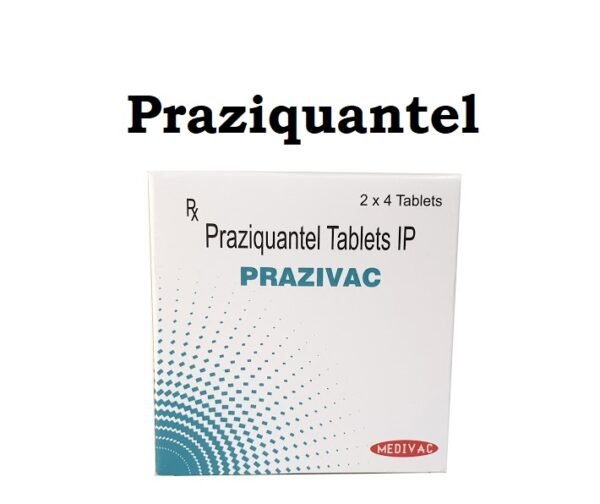
Praziquantel (Biltricide) is an antihelminthic medicine that is used to treat most infections caused by cestodes and schistosomes.
Praziquantel Uses:
-
Helminths:
- Treatment of infections in patients ≥1 year caused by the following species of Schistosoma:
- Schistosoma mekongi,
- S. japonicum,
- S. mansoni,
- S. hematobium) and the
- liver flukes (Clonorchis sinensis/ Opisthorchis viverrini)
- Treatment of infections in patients ≥1 year caused by the following species of Schistosoma:
-
Off Label Use of Praziquantel in Adults:
- Neurocysticercosis, parenchymal;
- Tapeworms
Praziquantel Dose in Adults
Praziquantel Dose in the treatment of Schistosomiasis:
- Oral: 20 mg/kg/dose 3 times a day at 4- to 6-hour intervals for 1 day
Praziquantel Dose in the treatment of Clonorchiasis/ opisthorchiasis:
- Oral: 25 mg/kg/dose 3 times a day for 1 to 2 days.
Praziquantel Dose in the treatment of parenchymal Neurocysticercosis (>2 viable cysts) (off-label):
- Oral:
- 50 mg/kg/day in 3 divided daily doses (in combination with albendazole) for 10 to 14 days;
- The dose may be repeated if persistent viable lesions on 6-month follow-up imaging.
-
Note:
- Initiate adjunctive corticosteroid therapy prior to initiation of antiparasitic therapy.
- Antiparasitic therapy should not be prescribed in patients with untreated hydrocephalus, calcified lesions, or cysticerci encephalitis;
- consultation with an infectious disease specialist for specific treatment recommendations is necessary.
Praziquantel Dose in the treatment of Tapeworms (off-label):
- Oral: 5 to 10 mg/kg as a single stat dose (25 mg/kg for Hymenolepis nana).
Praziquantel Dose in Childrens
- Note: Dosing interval and duration highly variable dependent on condition; for 3 times daily doses, intervals of 4 to 6 hours are suggested.
Praziquantel Dose in the treatment of Flukes:
Clonorchiasis (Clonorchis sinensis or Chinese liver fluke); Opisthorchiasis (Opisthorchis viverrini or Southeast Asian liver fluke):
-
Children and Adolescents:
- Oral: 25 mg/kg/dose 3 times a day at 4- to 6-hour intervals for 1 to 2 days.
Fasciolopsiasis (Fasciolopsis buski [intestinal fluke]):
-
Children and Adolescents:
- Oral: 25 mg/kg/dose 3 times a day for 1 day.
Paragonimiasis (Paragonimus spp. or lung fluke]):
-
Children and Adolescents:
- Oral: 25 mg/kg/dose 3 times a day for 2 to 3 days
Praziquantel Dose in the treatment of Schistosomiasis (Bilharziasis):
Treatment (CDC 2018c; Red Book [AAP 2018]):
- Note: Repeat treatment may be needed in 2-4 weeks to increase the effectiveness
Schistosoma japonicum and Schistosoma mekongi:
-
Children and Adolescents:
- Oral: 20 mg/kg/dose 3 times a day for 1 day
Schistosoma mansoni, Schistosoma haematobium, and Schistosoma intercalatum:
-
Children and Adolescents:
- Oral: 20 mg/kg/dose twice a day for 1 day
Control programs for endemic areas:
-
Infants, Children, and Adolescents:
- Oral:
- 40 mg/kg as a single dose;
- a single dose of 40 mg/kg has been successfully used for the treatment of urogenital S. haematobium in children 1 to 10 years of age and S. mansoni in the population that included infants (age range: 5 months to 7 years)
- however, pharmacokinetic data shows a lower cure rate in infants and preschool children. one possible explanation is that higher doses may be required in younger patients due to pharmacokinetic/dynamic differences;
- In preschool children, one dose of 60 mg/kg was successfully used in children 3 to 8 years of age in a hyperendemic area to treat S.mansoni.
- Oral:
Praziquantel Dose in the treatment of Tapeworms:
Praziquantel for the treatment of the intestinal (Adult) stage of Diphyllobothrium latum (fish tapeworm), Taenia saginata (beef tape worm), Taenia solium (pork tapeworm):
-
Children and Adolescents:
- Oral: 5 to 10 mg/kg as a single stat dose
Praziquantel for the treatment of intestinal stage (adult stage) of Dipylidium caninum:
-
Infants ≥6 months, Children, and Adolescents:
- Oral: 5 to 10 mg/kg as a single stat dose
Praziquantel for the treatment of Hymenolepis nana (dwarf tapeworm):
-
Children and Adolescents:
- Oral: 25 mg/kg as a single dose
Praziquantel for tissue stage (larva stage) of Neurocysticercosis (Taenia solium or pork tapeworm):
-
Children and Adolescents:
- Oral: 50 mg/kg/day for 15 days.
- Note: May be used in conjunction with antiseizure medication and/or corticosteroids.
Praziquantel Pregnancy Category: B
- According to available data, there has been no evidence of an increase in maternal or fetal outcomes after the use of Praziquantel during Schistosoma treatment.
- The World Health Organization recommends that pregnant women receive praziquantel in areas where soil-transmitted and schistosomiasis are common.
- The non-emergent treatment for neurocysticercosis may be postponed until after the completion of pregnancy.
Praziquantel use during breastfeeding:
- Breast milk contains Praziquantel.
- One study found that breast milk concentrations of praziquantel 50mg/kg or three 20mg/kg doses was 1% after maternal use.
- According to the manufacturer breastfeeding during therapy is a decision that should be made after considering the risks to infants and the benefits to mothers.
- The World Health Organization considers that praziquantel is compatible for breastfeeding females.
Praziquantel Dose in Kidney disease:
- No dosage adjustment necessary.
Praziquantel Dose in Liver disease:
- There are no dosage adjustments provided in manufacturer's labeling.
- However, total drug exposure in moderate-to-severe impairment is increased.
- May be more frequent and/or serious in patients with a heavy worm burden.
Side effects of Praziquantel
-
Central nervous system:
- Dizziness
- Headache
- Malaise
-
Dermatologic:
- Urticaria
-
Gastrointestinal:
- Abdominal distress
- Nausea
-
Miscellaneous:
- Fever
Contraindications to Praziquantel:
- Hypersensitivity to the primary drug, i.e. praziquantel, or any component of its formulation
- ocular cysticercosis;
- a concomitant prescription with strong cytochrome P450 (CYP450) inducers, such as rifampin
Warnings and precautions
-
Cardiac arrhythmias:
- During treatment, monitor patients suffering from arrhythmias;
- Praziquantel administration has been linked to a variety of conditions including ectopic rhythms and ventricular fibrillation.
-
Effects of central nervous system:
- Praziquantel could be used to treat central nervous system disorders such as paragonimiasis or schistosomiasis.
- Consider whether there is a greater risk for patients who have had seizures in the past or other signs that could indicate central nervous system involvement, such as subcutaneous nodules suggesting cysticercosis.
-
Hepatic impairment
- Take care when you have moderate or severe hepatic impairment.
- A decreased liver drug metabolism could lead to higher plasma concentrations of nonmetabolized praziquantel.
-
Neurocysticercosis:
- Use only when indicated: Antiparasitic therapy can worsen neurocysticercosis symptoms by inducing an inflammation response.
- It is important to start adjunctive corticosteroid treatment before you begin antiparasitic therapies.
- Untreated hydrocephalus, cysticerci, and calcified lesions should not be treated with antiparasitic treatment.
- To exclude intraocular cysticerci, perform a funduscopic examination before initiating antiparasitic treatment. In some cases of unsuspected intraocular parasites, antiparasitic treatment may result in blindness.
-
Schistosomiasis:
- Praziquantel might not be effective against migrating Schistosomulae
- Data from observation indicate that praziquantel may not be effective in treating the acute phase.
- In addition, use in patients with schistosomiasis may be associated with clinical deterioration such as paradoxical reactions or serum sickness Jarisch-Herxheimer-like reactions, which is a sudden inflammatory immune response likely caused by the release of schistosomal antigens.
- These reactions are most common during acute phase. They can lead to life-threatening events like respiratory failure, encephalopathy and papilledema.
Praziquantel: Drug Interaction
Note: Drug Interaction Categories:
- Risk Factor C: Monitor When Using Combination
- Risk Factor D: Consider Treatment Modification
- Risk Factor X: Avoid Concomitant Use
Risk Factor C (Monitor therapy) |
|
| Aprepitant | May increase the serum concentration of CYP3A4 Substrates (High risk with Inhibitors). |
| Bosentan | May decrease the serum concentration of CYP3A4 Substrates (High risk with Inducers). |
| Chloroquine | May decrease the serum concentration of Praziquantel. |
| Cimetidine | May increase the serum concentration of Praziquantel. |
| Clofazimine | May increase the serum concentration of CYP3A4 Substrates (High risk with Inhibitors). |
| CYP3A4 Inducers (Moderate) | May decrease the serum concentration of CYP3A4 Substrates (High risk with Inducers). |
| CYP3A4 Inhibitors (Strong) | May increase the serum concentration of Praziquantel. |
| Deferasirox | May decrease the serum concentration of CYP3A4 Substrates (High risk with Inducers). |
| Duvelisib | May increase the serum concentration of CYP3A4 Substrates (High risk with Inhibitors). |
| Erdafitinib | May decrease the serum concentration of CYP3A4 Substrates (High risk with Inducers). |
| Erdafitinib | May increase the serum concentration of CYP3A4 Substrates (High risk with Inhibitors). |
| Fosaprepitant | May increase the serum concentration of CYP3A4 Substrates (High risk with Inhibitors). |
| Fosnetupitant | May increase the serum concentration of CYP3A4 Substrates (High risk with Inhibitors). |
| Grapefruit Juice | May increase the serum concentration of Praziquantel. |
| Ivosidenib | May decrease the serum concentration of CYP3A4 Substrates (High risk with Inducers). |
| Larotrectinib | May increase the serum concentration of CYP3A4 Substrates (High risk with Inhibitors). |
| Netupitant | May increase the serum concentration of CYP3A4 Substrates (High risk with Inhibitors). |
| Palbociclib | May increase the serum concentration of CYP3A4 Substrates (High risk with Inhibitors). |
| Sarilumab | May decrease the serum concentration of CYP3A4 Substrates (High risk with Inducers). |
| Siltuximab | May decrease the serum concentration of CYP3A4 Substrates (High risk with Inducers). |
| Simeprevir | May increase the serum concentration of CYP3A4 Substrates (High risk with Inhibitors). |
| Tocilizumab | May decrease the serum concentration of CYP3A4 Substrates (High risk with Inducers). |
Risk Factor D (Consider therapy modification) |
|
| Dabrafenib | May decrease the serum concentration of CYP3A4 Substrates (High risk with Inducers). Management: Seek alternatives to the CYP3A4 substrate when possible. If concomitant therapy cannot be avoided, monitor clinical effects of the substrate closely (particularly therapeutic effects). |
| Lorlatinib | May decrease the serum concentration of CYP3A4 Substrates (High risk with Inducers). Management: Avoid concurrent use of lorlatinib with any CYP3A4 substrates for which a minimal decrease in serum concentrations of the CYP3A4 substrate could lead to therapeutic failure and serious clinical consequences. |
| MiFEPRIStone | May increase the serum concentration of CYP3A4 Substrates (High risk with Inhibitors). Management: Minimize doses of CYP3A4 substrates, and monitor for increased concentrations/toxicity, during and 2 weeks following treatment with mifepristone. Avoid cyclosporine, dihydroergotamine, ergotamine, fentanyl, pimozide, quinidine, sirolimus, and tacrolimus. |
| St John's Wort | May decrease the serum concentration of CYP3A4 Substrates (High risk with Inducers). Management: Consider an alternative for one of the interacting drugs. Some combinations may be specifically contraindicated. Consult appropriate manufacturer labeling. |
| Stiripentol | May increase the serum concentration of CYP3A4 Substrates (High risk with Inhibitors). Management: Use of stiripentol with CYP3A4 substrates that are considered to have a narrow therapeutic index should be avoided due to the increased risk for adverse effects and toxicity. Any CYP3A4 substrate used with stiripentol requires closer monitoring. |
Risk Factor X (Avoid combination) |
|
| Conivaptan | May increase the serum concentration of CYP3A4 Substrates (High risk with Inhibitors). |
| CYP3A4 Inducers (Strong) | May decrease the serum concentration of Praziquantel. Management: Use of praziquantel with strong CYP3A4 inducers is contraindicated. Discontinue rifampin 4 weeks prior to initiation of praziquantel therapy. Rifampin may be resumed the day following praziquantel completion. |
| Fusidic Acid (Systemic) | May increase the serum concentration of CYP3A4 Substrates (High risk with Inhibitors). |
| Idelalisib | May increase the serum concentration of CYP3A4 Substrates (High risk with Inhibitors). |
Monitoring parameters:
- Liver function tests;
- monitor patients with cardiac irregularities during treatment;
- monitor for seizures;
- culture urine or feces for ova before instituting therapy
How to administer Praziquantel?
- Administer tablets with water during meals.
- Tablets should be swallowed promptly to avoid the bitter taste that may cause gagging or vomiting.
- Tablets may be halved or quartered; do not chew.
- Tablets may be crushed or disintegrated and mixed with semi-solid food or liquid, but should be used within 1 hour of mixing.
- Tablets are scored and may be split into four segments of 150 mg.
Mechanism of action of Praziquantel:
- This increases the cell permeability of calcium in schistosomes.
- It causes strong contractions of worm muscle and paralysis of worms.
- The result is detachment and dislodgment of suckers from blood vessel walls.
Absorption:
- Oral: 80%
Distribution:
- CSF concentration is 14% to 20% of plasma concentration
Protein binding:
- ~80%
Metabolism:
- Extensive first-pass effect; metabolized by the liver to hydroxylated and conjugated metabolites
Half-life elimination:
- Parent drug: 0.8 to 1.5 hours; Metabolites: 4.5 hours
Time to peak, serum:
- 1 to 3 hours
Excretion:
- Urine ~80% (>99% as metabolites)
International Brands of Praziquantel:
- Biltricide
- Belicide
- Biltricid
- Biltricide
- Cesol
- Cisticid
- Cysticide
- Distocide
- Droncit Vet
- Epiquantel
- Fluxide
- Kalcide
- Opticide
- Prasikon
- Prazine
- Praziquin
- Prazite
- Prazitral
- Vermaqpharma Vet
- Wormicide
Praziquantel Brand Names in Pakistan:
No Brands Available in Pakistan.
.png)