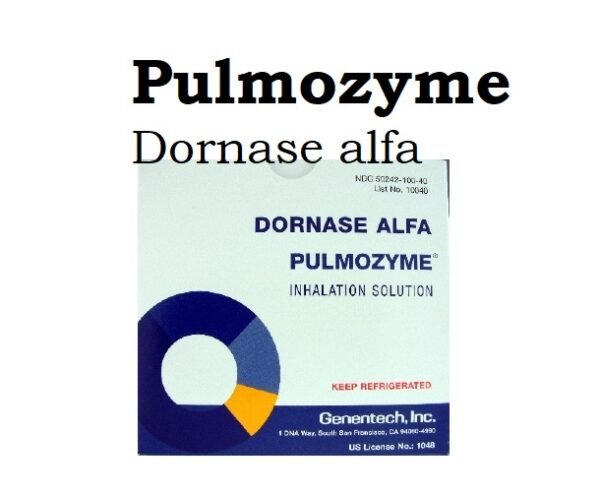
Pulmozyme (Dornase alfa) is a recombinant human deoxyribonuclease I (rhDNase) an enzyme that selectively cleaves DNA. It is used in patients with cystic fibrosis to reduce the sputum viscosity and in loculated parapneumonic effusions.
Dornase alfa (Pulmozyme) Uses:
-
Cystic fibrosis:
- Management of cystic fibrosis patients, in conjunction with standard therapies, to improve pulmonary function;
- reduce the risk of respiratory tract infections requiring parenteral antibiotics in patients with a forced vital capacity (FVC) ≥40% of predicted.
-
Off Label Use of Dornase alfa in Adults:
- Parapneumonic pleural effusions and empyemas
Pulmozyme (Dornase alfa) use in COVID-19 associated severe ARDS:
Dornase alfa (Pulmozyme) has also been postulated to promote recovery from severe COVID-19 (Coronavirus) related ARDS primarily via inhibiting dornase alfa-sensitive neutrophil extracellular traps (NETs) from neutrophils [Ref]. Dornase alfa is well tolerated and can be easily administered to mechanically ventilated patients.
Dornase alfa (Pulmozyme) Dose in Adults
Dornase alfa (Pulmozyme) Dose in the treatment of Cystic fibrosis:
- Inhalation: 2.5 mg per day through selected jet nebulizers in concomitance with a Pulmo-Aide, Pari-Proneb, Mobilaire, or Porta-Neb compressor system or eRapid Nebulizer System
- Patients who are unable to inhale or exhale orally throughout the entire treatment period may use Pari-Baby nebulizer.
- Some patients may benefit from twice-daily administration.
Dornase alfa (Pulmozyme) Dose in the treatment of Parapneumonic pleural effusions and empyemas (off-label):
- Intrapleural: 5 mg twice daily.
- Administer >2 hours after each intrapleural alteplase dose (with a 1-hour dwell time for each drug) for 3 days.
- Data from a single-center study reported that concurrent administration of alteplase and dornase alfa (with a 2-hour dwell time) is safe and effective.
Dornase alfa (Pulmozyme) Dose in Childrens
Pulmozyme (Dornase alfa) Dose in the treatment of Cystic fibrosis:
Infants and Children <2 years;
-
Symptomatic patients:
- Inhalation: Nebulization: 2.5 mg/day through selected nebulizers in conjunction with Pulmo-Aide, Pari-Proneb, Mobilaire, PortaNeb, or Pari Baby compressor system or eRapid Nebulizer System (Berge 2003)
Children 2 to <5 years;
-
Acute exacerbations or chronic use in select patients:
- Inhalation: Nebulization: 2.5 mg/day through selected nebulizers in conjunction with Pulmo-Aide, Pari-Proneb, Mobilaire, Porta-Neb, or Pari Baby compressor system or eRapid Nebulizer System (Nasr 2001)
Children ≥5 years and Adolescents;
-
Chronic therapy:
- Inhalation: Nebulization:
- 2.5 mg/day through selected nebulizers in conjunction with a Pulmo-Aide, Pari-Proneb, Mobilaire, Porta-Neb, or Pari Baby compressor system or the eRapid Nebulizer System; chronic daily use in cystic fibrosis patients ≥6 years of age.
- Some patients may benefit from twice-daily dosing.
- Inhalation: Nebulization:
Pulmozyme (Dornase Alfa) Dose in the treatment of chronic Rhinosinusitis Secondary to cystic fibrosis:
-
Children ≥5 years and Adolescents:
- Inhalation: Intranasal:
- 2.5 mg/day nebulized intranasal with the Pari Sinus.
- Inhalation: Intranasal:
Pregnancy Risk Category: B
- Animal reproduction studies have not shown any adverse events.
Dornase alfa use during breastfeeding:
- After inhalation, breast milk would not contain any measurable amounts; however it is unknown if breast milk contains dornase fa.
- According to the manufacturer breastfeeding during therapy should be considered in order to minimize the risk to the infant as well as the benefits to the mother.
Pulmozyme Dose in Kidney disease:
- There are no dosage adjustments provided in the drug manufacturer's labeling.
Pulmozyme Dose in Liver disease:
- There are no dosage adjustments provided in the drug manufacturer's labeling.
- Adverse events were similar in children using the PARI BABY nebulizer (facemask as opposed to mouthpiece) with the addition of cough.
Common Side Effects of Pulmozyme (Dornase alfa):
-
Cardiovascular:
- Chest Pain
-
Central Nervous System:
- Voice Disorder
-
Dermatologic:
- Skin Rash
-
Respiratory:
- Cough
- Pharyngitis
- Rhinitis
- Decrease In Forced Vital Capacity
- Dyspnea
-
Miscellaneous:
- Fever
Less Common Side Effects Of Pulmozyme (Dornase alfa):
-
Gastrointestinal:
- Dyspepsia
-
Immunologic:
- Antibody Development
-
Ophthalmic:
- Conjunctivitis
-
Respiratory:
- Laryngitis
Contraindications to Pulmozyme (Dornase alfa):
- Hypersensitivity/allergy to dornase alfa, Chinese hamster ovary cell products, or any component of the formulation
Warnings and precautions
-
Reduced pulmonary function
- Dornase Alfa is not recommended for patients with pulmonary function below 40%. This can lead to respiratory infections that need parenteral antibiotics.
Monitoring Parameters
Monitor Pulmonary function tests and oxygen saturation.
How to administer Pulmozyme (Dornase alfa)?
Nebulization:
- Prior to use, squeeze each ampul to check for leaks.
- Should not be diluted or mixed with any other drugs in the nebulizer, this may inactivate the drug.
- When administered with the eRapid Nebulizer System, replace the handset after 90 uses to ensure delivery of appropriate dose; the eRapid Nebulizer System should only be used by patients who can use a mouthpiece.
- Follow the manufacturer’s instructions on the use and maintenance of the equipment.
Parapneumonic pleural effusions and empyemas (off-label use):
Intrapleural administration:
- For sequential administration of alteplase and dornase alfa, dilute each dose in 30 mL sterile water.
- Stability of dornase alfa diluted in sterile water has not been formally evaluated; use immediately after preparation.
- Instill dose into chest tube and clamp drain.
- After 1-hour dwell time, release the clamp and connect chest tube to continuous suction.
- For concurrent administration of alteplase and dornase alfa, using separate syringes, dilute each dose in 50 mL normal saline.
- Instill each dose into a chest tube, one immediately after the other, followed by a 60 mL normal saline flush.
- Clamp drain; after 2-hour dwell time, release clamp.
Mechanism of action of Pulmozyme (Dornase alfa):
- Cystic Fibrosis lung disease is characterized by the presence of high-quality, purulent secretions from the airways. These secretions are mainly made up of highly polymerized DNA.
- This DNA comes primarily from the degenerating neutrophil nuclei, which are found in high concentrations in infected pulmonary secretions.
- This DNA can cause a viscous mucous, which may explain the reduced mucociliary transport and persistent infection that are common in this population.
- Recombinant genetic technology produces Dornase Alfa, a deoxyribonuclease enzyme (DNA) that is produced by Dornase.
- Dornase selectively breaks down DNA. As a result, the risk of infection and airflow in the lungs may be reduced.
The onset of action:
- Nebulization: Enzyme levels are measured in sputum in ~15 minutes and decline rapidly thereafter
Duration:
- Sputum concentrations decline within 2 hours of inhalation
International Brands of Dornase alfa:
- Pulmozyme
Dornase alfa Brand Names in Pakistan:
No Brands Available in Pakistan.
.png)


