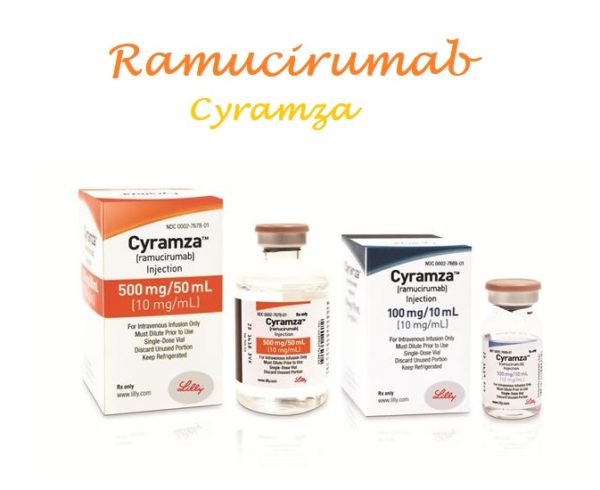
Ramucirumab (Cyramza) is a recombinant monoclonal antibody that also inhibits vascular endothelial growth factor receptor 2 (VEGFR2). It is used in the treatment of the following conditions:
-
Colorectal cancer, metastatic:
-
It is used in treatment (in combination with FOLFIRI [irinotecan, leucovorin, and fluorouracil]) of metastatic colorectal cancer in patients showing disease progression on or after prior therapy with bevacizumab, oxaliplatin, and a fluoropyrimidine.
-
-
Gastric cancer, advanced or metastatic:
-
It is used in treatment (single agent or in combination with paclitaxel) of advanced or metastatic gastric or gastroesophageal junction adenocarcinoma in patients showing disease progression on or following fluoropyrimidine- or platinum-containing chemotherapy.
-
-
Hepatocellular carcinoma, advanced or relapsed/refractory:
-
It is used in treatment (as a single agent) of hepatocellular carcinoma in patients who have an alpha-fetoprotein of ≥400 ng/mL and have been previously treated with sorafenib.
-
-
Non-small cell metastatic lung cancer:
-
It is used in treatment (in combination with docetaxel) of metastatic non-small cell lung cancer in patients showing disease progression on or after platinum-based chemotherapy.
-
Disease progression on approved therapy in patients with epidermal growth factor receptor or anaplastic lymphoma kinase genomic tumor aberrations.
-
Cyramza (Ramucirumab) dose in Adults
- Premedication is done prior to infusion with an intravenous H-1 antagonist (eg, diphenhydramine);
- Grade 1 or 2 infusion reaction with a prior infusion
- Also, pre-medicate with dexamethasone (or equivalent) and acetaminophen.
Dosage in the treatment of metastatic colorectal cancer:
- 8 mg/kg intravenous is given every 2 weeks in combination with FOLFIRI (irinotecan, leucovorin, and fluorouracil)
- It is continued until toxicity or disease progression.
Dosage in the treatment of advanced or metastatic Gastric cancer:
- 8 mg/kg intravenous is given every 2 weeks as a single agent or in combination with weekly paclitaxel
- continue ramucirumab till disease progression or unacceptable toxicity.
Dosage in the treatment of Hepatocellular carcinoma (advanced, relapsed/refractory):
- 8 mg/kg intravenous is given every 2 weeks (as a single agent)
- continue ramucirumab till disease progression or unacceptable toxicity.
Dosage in the treatment of metastatic Non-small cell lung cancer:
- 10 mg/kg intravenous is given on day 1 every 21 days in combination with docetaxel;
- continue ramucirumab till disease progression or unacceptable toxicity.
Cyramza (Ramucirumab) dose in Childrens
Not recommended for use in children
Ramucirumab (Cyramza) Pregnancy Risk Category: C
- Ramucirumab is known to inhibit angiogenesis, which is crucial for human fetal development.
- Ramucirumab can cause fetal harm when administered during pregnancy based on its mechanism of action.
- Before initiating treatment for females with reproductive potential, verify your pregnancy status.
- Effective contraception should be used by females with reproductive potential for at least three months following the last dose of ramucirumab.
- Female fertility may be affected by ramucirumab.
Ramucirumab can be used during breastfeeding
- It is unknown if ramucirumab can be found in breast milk.
- Breast milk contains immunoglobulins, which are excreted in breastmilk. Ramucirumab is also thought to be present in breast milk.
- The manufacturer does not recommend breastfeeding during treatment or for at least 2 months after the last ramucirumab dose.
Cyramza (Ramucirumab) dose in Renal disease:
- No dosage adjustment required.
Cyramza (Ramucirumab) dose in Liver disease:
-
Mild (normal bilirubin with AST > ULN or total bilirubin >1 to 1.5 times ULN and any AST) or moderate (total bilirubin >1.5 to 3 times ULN and any AST) impairment:
- No dosage adjustment required.
-
Severe impairment (total bilirubin >3 times ULN and any AST):
- There are no dosage adjustments given in the manufacturer's labeling (has not been studied).
- Use in patients with Child-Pugh class B or C cirrhosis if the potential benefits outweigh the potential risks.
Common Side Effects of Ramucirumab (Cyramza) Include:
-
Cardiovascular:
- Peripheral Edema
- Hypertension
-
Central Nervous System:
- Fatigue
- Headache
- Insomnia
-
Endocrine & Metabolic:
- Hypoalbuminemia
- Hyponatremia
- Hypocalcemia
-
Gastrointestinal:
- Abdominal Pain
- Decreased Appetite
- Nausea
- Diarrhea
-
Genitourinary:
- Proteinuria
-
Hematologic & Oncologic:
- Thrombocytopenia
- Neutropenia
-
Hepatic:
- Ascites
-
Respiratory:
- Epistaxis
-
Miscellaneous:
- Infusion Related Reaction
Less Common Side Effects of Ramucirumab (Cyramza) Include:
-
Cardiovascular:
- Arterial Thromboembolism
-
Dermatologic:
- Skin Rash
-
Gastrointestinal:
- Vomiting
- Intestinal Obstruction
-
Hematologic & Oncologic:
- Anemia
-
Hepatic:
- Hepatic Encephalopathy
- Hepatorenal Syndrome
-
Immunologic:
- Antibody Development
-
Neuromuscular & Skeletal:
- Back Pain
-
Respiratory:
- Pneumonia
-
Miscellaneous:
- Fever
Rare side effects of Cyramza:
-
Cardiovascular:
- Acute Myocardial Infarction
- Cerebral Ischemia
- Cerebrovascular Accident
- Severe Hypertension
-
Endocrine & Metabolic:
- Hypothyroidism
-
Gastrointestinal:
- Gastrointestinal Hemorrhage
- Gastrointestinal Perforation
-
Hematologic & Oncologic:
- Major Hemorrhage
Contraindication to Ramucirumab Include:
- The US labeling of the manufacturer does not contain any contraindications.
- Hypersensitivity to ramucirumab and any part of the formula
Warnings and precautions
-
Arterial thrombotic episodes:
- Ramucirumab has been used to treat serious arterial thrombotic events such as myocardial injury, cardiac arrest, cerebrovascular accident and cerebral ischemia.
- Patients who have suffered arterial thrombotic events should be treated immediately.
-
Suppression of bone marrow
- There may be thrombocytopenia or neutropenia.
- Patients who are exposed to combination therapies, especially if they also use paclitaxel, have a higher risk of developing thrombocytopenia.
- Monitor CBC with differential when used with paclitaxel.
-
Perforation of the gastrointestinal tract:
- Ramucirumab can increase the risk of gastrointestinal bleeding, which could be fatal.
- Patients who have a gastrointestinal perforation should be treated immediately.
-
Hemorrhage
- Ramucirumab has a higher chance of hemorhage and gastrointestinal bleeding, including events >= grade 3, which can sometimes be fatal or severe.
- Patients who have suffered severe (grade 3-4) bleeding should be stopped immediately.
- Some clinical trials excluded patients who were taking nonsteroidal anti-inflammatory drug (NSAIDs).
- It is unknown if patients with gastric cancers who are taking NSAIDs may experience gastric hemorhage.
-
Hypertension
- It can lead to or worsen hypertension. Ramucirumab may increase the likelihood of severe hypertension.
- Before treatment can be initiated, it is important to control your BP.
- During treatment, monitor BP every 14-days (or more frequently if necessary).
- Stop temporarily if severe hypertension develops.
- If medically significant hypertension is not controlled by antihypertensive therapy, or in patients suffering from hypertensive crisis and hypertensiveencephalopathy, you should stop permanently.
-
Infusion reaction
- Ramucirumab may cause infusion-related reactions, which can be severe. These reactions usually occur with the second or third dose.
- Infusion reactions can cause symptoms such as chills, flushing and hypoxia, hypoxia, wheezing and hypotension.
- Before infusion, it is recommended to take medication(s).
- When the infusion is administered, monitor for symptoms of an infusion reaction.
- For grade 1 and 2, reduce the infusion rate; for grade 3 and 4, stop immediately and permanently
- Infusion reactions can be managed in a facility.
-
Nephrotic syndrome/proteinuria:
- Ramucirumab can also be associated with proteinuria, including >= grade 3 proteinuria or cases of nephrotic Syndrome.
- For the assessment of proteinuria, use urine dipstick or urinary protein creatinine to determine if it is occurring.
- Stop treating urine protein levels greater than 2 g/24 hours. Reduce the dose immediately after therapy re-initiation.
- Permanently stop if your urine protein is greater than 3 g/24 hour or if you have nephrotic syndrome.
-
Reversible posterior Leukoencephalopathy Syndrome:
- Reversible posterior Leukoencephalopathy Syndrome (RPLS) has been reported in some cases.
- RPLS symptoms include headaches, seizures, confusion, blindness, and/or other visual disturbances.
- Confirm RPLS diagnosis by MRI. Permanently stop ramucirumab after RPLS diagnosis.
- Most patients will experience a resolution of symptoms within a few days. However, some patients may have neurologic sequelae.
-
Thyroid dysfunction
- It has been reported that hypothyroidism (grades 1 and 2) has been detected.
- During treatment, monitor thyroid function.
-
Inability to heal wounds
- An antibody that inhibits the vascular endothelial factor (VEGF), or VEGF receptor pathway can cause impaired wound healing.
- For 4 weeks before elective surgery, and at least 28 days following major surgery (or until the wound has fully healed), you should withhold ramucirumab.
- If patients develop complications that cause wound healing, they should be referred to a physician immediately.
-
Hepatic impairment
- Patients with Child-Pugh class C or B cirrhosis have been known to experience worsening encephalopathy, ascites or hepatorenal symptoms.
- Use in patients with Child-Pugh Class B or C cirrhosis only when the potential benefits outweigh any potential risks.
- Clinical data regarding the treatment of hepatocellular cancer showed that patients with Child-Pugh class B liver cirrhosis who were given ramucirumab had a higher incidence of hepatic and hepatorenal symptoms than patients who were given a placebo.
Ramucirumab: Drug Interaction
|
Bisphosphonate Derivatives |
Angiogenesis Inhibitors (Systemic) may enhance the adverse/toxic effect of Bisphosphonate Derivatives. Specifically, the risk for osteonecrosis of the jaw may be increased. |
Monitor:
- Liver function tests
- urine protein (by urine dipstick and/or urinary protein creatinine ratio)
- thyroid function tests
- Blood CBC with differential counts (especially when used as a part of combination chemotherapy)
- verify pregnancy status before treatment (in females of reproductive potential).
- Monitor blood pressure (every 2 weeks or more frequently if indicated)
- signs/symptoms of infusion-related reactions (during infusion);
- signs/symptoms of arterial thromboembolic events,
- bleeding/hemorrhage,
- gastrointestinal perforation
- wound healing impairment
- reversible posterior leukoencephalopathy syndrome
How to administer Ramucirumab (Cyramza)?
- Premedicate before infusion with an intravenous H-1 antagonist (eg, diphenhydramine)
- for patients who had a grade 1 or 2 infusion reaction with a prior infusion
- Premedicate with dexamethasone (or equivalent) and acetaminophen.
- Give intravenously over 1 hour through a separate infusion line using an infusion pump
- A 0.22-micron protein-sparing filter should be used.
- an IV push or bolus should be avoided.
- Flush the line with NS after the infusion is complete.
- Do not give in the same IV line with solutions other than NS, or with electrolytes or other medications.
- Monitor for infusion reaction
- reduce infusion rate (by 50%) for grade 1 or 2 infusion reaction
- Stop permanently for grade 3 or 4 infusion reactions.
- Give ramucirumab prior to docetaxel, paclitaxel, or FOLFIRI if administering in combination.
Mechanism of action of Ramucirumab (Cyramza):
- Ramucirumab, a monoclonal recombinant antibody that also inhibits vascular growth factor receptor 2 (VEGFR2), is also available.
- Ramucirumab is highly sensitive to VEGFR2 (Spratlin 2010,). It binds to VEGFR ligands and blocks binding of VEGF ligands, VEGF -A, VEGF -C and VEGF -D to prevent activation of VEGFR2.
- It prevents the ligand-induced migration and proliferation of endothelial cell populations.
- VEGFR2 inhibition can also reduce tumor growth and vascularity.
Half-life elimination: 14 days
Distribution: V : 5.4 L Excretion: Clearance: 0.015 L/hour
International Brands of Ramucirumab:
- Cyramza
Cyramza (Ramucirumab) Brands in Pakistan:
Cyramza (Ramucirumab) is not available in Pakistan.
.png)


