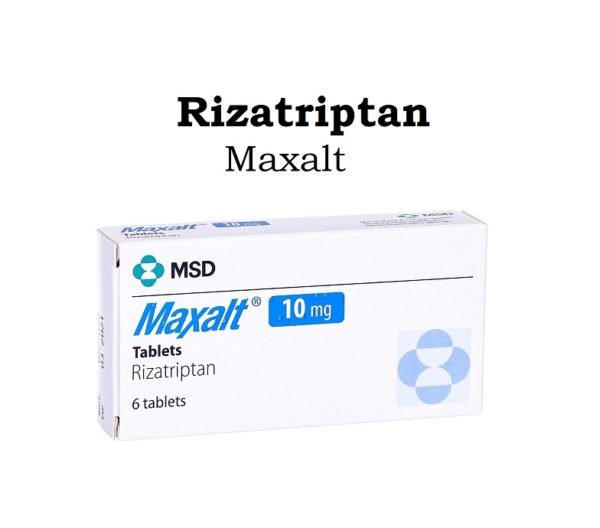
Rizatriptan (Maxalt) is a 5-HT receptor agonist that causes vasoconstriction of the serotonin receptors present in the cranial arteries. It is indicated for the acute treatment of migraine with or without aura.
Rizatriptan (Maxalt) Dose in Adults:
Note:
Patients who have risk factors for coronary artery disease should be advised the first drug in a healthcare setting where ECG monitoring can be done.
Rizatriptan (Maxalt) Dose in the treatment of Migraine:
- 5 to 10 mg orally
- The dose may be repeated after 2 hours if the patient remains symptomatic
- The maximum daily dose is 30 mg
-
Dose adjustment with concomitant propranolol therapy:
- 5 mg/dose
- The maximum dose should not exceed 15 mg per day.
Rizatriptan (Maxalt) Dose in Childrens
Rizatriptan (Maxalt) Dose in the treatment of acute Migraine:
-
Children older than 6 years:
- Note:
- The safety and efficacy of multiple daily doses have not been established in children.
-
weight < 40 kgs:
- 5 mg as a single dose
-
Children weighing 40 kgs or more:
- 10 mg as a single dose
-
- The safety and efficacy of multiple daily doses have not been established in children.
-
Dosage adjustment with concomitant propranolol:
-
Children and Adolescents 6 to 17 years:
-
Less than 40 kgs:
- Avoid using rizatriptan
-
Weight more than 40 kgs:
- 5 mg as a single dose
- The maximum dose is 5 mg in a 24-hour period
-
-
Adolescents ≥ 18 years:
- 5 mg orally
- The dose may be repeated after 2 hours
- The maximum daily dose is 15 mg per day.
-
Pregnancy Risk Factor C
- Pregnant women are being tested for Rizatriptan.
- Although limited data has not shown any adverse outcomes for fetal health, the manufacturer suggests that you consider other preferred treatment options.
Use while breastfeeding
- It is unknown if the drug will be excreted into breastmilk.
- Manufacturer recommends alternative preferred drugs.
- You should use it with caution when breastfeeding infants.
Dose in renal disease:
- The manufacturer has not recommended any adjustments in the dose.
- However, in patients on hemodialysis, the AUC was 44% greater.
Dose in liver disease:
- The manufacturer has not recommended any adjustments in the dose.
- In patients with moderate hepatic impairment, plasma concentration may increase by 30%.
Side Effects of Rizatriptan (Maxalt):
-
Cardiovascular:
- Chest Pain
- Flushing
- Palpitations
- Flushing
-
Central Nervous System:
- Dizziness
- Drowsiness
- Fatigue
- Paresthesia
- Pain
- Feeling Of Heaviness
- Headache
- Euphoria
- Hypoesthesia
-
Gastrointestinal:
- Nausea
- Xerostomia
- Sore Throat
- Abdominal Distress
- Diarrhea
- Vomiting
-
Neuromuscular & Skeletal:
- Weakness
- Jaw Pain
- Jaw Pressure
- Jaw Tightness
- Neck Pain
- Neck Pressure
- Neck Tightness
- Tremor
-
Respiratory:
- Pharyngeal Edema
- Pressure On Pharynx
- Dyspnea
Contraindications to Rizatriptan (Maxalt):
- Allergy reactions to any component of the drug or the drug itself
- Ischemic heart disease and other serious cardiovascular diseases
- Vasospasm of the Coronary Artery
- History of strokes or TIA (transient ischemic attacks)
- Peripheral Vascular Disease
- Bowel Ischemia
- Hypertension uncontrolled
- Basilar or hemiplegic headache
- Within 2 weeks or less of MAO inhibitors being used
- Concomitant or within 24 hours after use of another 5-HT antagonistor an Ergot-containing or Ergot-type medication, such as methysergide or dihydroergotamine.
- Ophthalmoplegic migraine
- Severe hepatic impairment.
Warnings and precautions
-
Cardiac events
- Use of 5-HT agonists has been associated with cardiac events such as transient coronary arterial vasospasm and myocardial injury, ischemia, ventricular tachycardia and ventricular fibrillation, heart arrest, and even death.
- Patients should be told to seek medical attention if they experience chest pain, heaviness or chest tightness, exertional pain or dyspnea, as well as apprehension.
- Patients with symptoms should be examined for prinzmetal's Angina.
-
Cerebrovascular events
- Use of 5-HT agonists has been linked to stroke, cerebral and subarachnoid hemorhage.
- Triptans should be avoided in patients who have had strokes or transient ischemic attacks.
-
High blood pressure
- Hypertension and hypertensive crises can develop in patients.Triptans have been linked to hypertension in patients who were previously normotensives.
-
Headaches
- Patients who take acute migraine medication for more than 10 days per month may experience headaches from medication overuse.
- Treatment withdrawal might be required in these cases.
-
Vasospasm-related events
- It can cause ischemic and vasospasm.It is possible for patients to develop peripheral vascular or gastrointestinal ischemia.
-
Visual effects
- With 5-HT agonists, vision problems can be permanent or transient.
-
Coronary artery disease
- Patients who have suspected coronary artery disease must be evaluated before the drug can be prescribed.
- Patients with a satisfactory evaluation should receive the first dose in a healthcare setting and ECG monitoring.
- Without proper cardiac evaluation, patients with risk factors for coronary heart disease should not receive the drug.These are risk factors for coronary heart disease:
- Hypertension
- Hypercholesterolemia
- Smoker
- Obesity
- Diabetes
- Strong family history in CAD
- Menopause
- Males over 40 years old
- Patients at high risk should be checked for signs and symptoms of angina.
-
Hepatic impairment
- Reduced clearance causes an increase in plasma drug concentrations.Patients with severe hepatic impairment should not use it.
-
Renal impairment
- Patients with kidney disease are more likely to be exposed systemically.Take care.
Rizatriptan: Drug Interaction
|
Antiemetics (5HT3 Antagonists) |
May enhance the serotonergic effect of Serotonin Modulators. This could result in serotonin syndrome. |
|
Antipsychotic Agents |
Serotonin Modulators may enhance the adverse/toxic effect of Antipsychotic Agents. Specifically, serotonin modulators may enhance dopamine blockade, possibly increasing the risk for neuroleptic malignant syndrome. Antipsychotic Agents may enhance the serotonergic effect of Serotonin Modulators. This could result in serotonin syndrome. |
|
Droxidopa |
Serotonin 5-HT1D Receptor Agonists may enhance the hypertensive effect of Droxidopa. |
|
Metaxalone |
May enhance the serotonergic effect of Serotonin Modulators. This could result in serotonin syndrome. |
|
Methylphenidate |
May enhance the adverse/toxic effect of Serotonin Modulators. Specifically, the risk of serotonin syndrome or serotonin toxicity may be increased. |
|
Metoclopramide |
Serotonin Modulators may enhance the adverse/toxic effect of Metoclopramide. This may be manifest as symptoms consistent with serotonin syndrome or neuroleptic malignant syndrome. |
|
Opioid Agonists |
May enhance the serotonergic effect of Serotonin Modulators. This could result in serotonin syndrome. |
|
Serotonin Modulators |
May enhance the adverse/toxic effect of other Serotonin Modulators. The development of serotonin syndrome may occur. Exceptions: Nicergoline; Tedizolid. |
|
TraMADol |
Serotonin Modulators may enhance the adverse/toxic effect of TraMADol. The risk of seizures may be increased. TraMADol may enhance the serotonergic effect of Serotonin Modulators. This could result in serotonin syndrome. |
|
Propranolol |
May increase the serum concentration of Rizatriptan. Management: Rizatriptan adult dose should be reduced to 5 mg in patients who are also being treated with propranolol. |
|
Dapoxetine |
May enhance the adverse/toxic effect of Serotonin Modulators. |
|
Ergot Derivatives |
May enhance the vasoconstricting effect of Serotonin 5-HT1D Receptor Agonists. Serotonin 5-HT1D Receptor Agonists may enhance the vasoconstricting effect of Ergot Derivatives. Exceptions: Nicergoline. |
|
Methylene Blue |
May enhance the serotonergic effect of Serotonin Modulators. This could result in serotonin syndrome. |
|
Monoamine Oxidase Inhibitors |
May decrease the metabolism of Serotonin 5-HT1D Receptor Agonists. Management: If MAO inhibitor therapy is required, naratriptan, eletriptan or frovatriptan may be a suitable 5-HT1D agonist to employ. |
|
SUMAtriptan |
Serotonin 5-HT1D Receptor Agonists may enhance the adverse/toxic effect of SUMAtriptan. |
Monitor:
- Patients' reaction to treatment (Monitor Headache severity).
- Examine the angina clinical signs.
- Patients at high risk for coronary artery disease should monitor their BP, heart rate and ECG. The first dose is used to monitor the patient. Patients at high risk who require cardiac monitoring include:
- Patients with hypertension
- Patients with Dyslipidemia
- Obese
- Diabetic patients
- Smokers
- Patients with strong family history of coronary heart disease.
How to administer Rizatriptan (Maxalt)?
- It can be taken without regard for food. MAXALT-MLT tablets can be taken orally.
- It is possible for patients to place the tablet onto their tongue, and then allow it to dissolve. The saliva will then be swoloed.
Mechanism of action of Rizatriptan (Maxalt):
- It acts as a selective serotonin receptor agonist (5-HT-1B, 5-HT-1D), in the cranial arteries.
- It reduces migraine symptoms by increasing blood flow and reducing inflammation.
The beginning of actionThe time taken to respond to treatment is 2 hours.
Absorption is Complete
Protein binding: 14%
Metabolism: It is metabolized by the enzyme monoamine oxidase-A forming metabolites. It undergoes significant first-pass metabolism.
Bioavailability: About 45%
Half-life elimination: 2-3 hours
Time to peak:
- Maxalt: 1 to 1.5 hours;
- Maxalt-MLT: 1.6 to 2.5 hours
Excretion: Urine (82%, 14% as unchanged drug); feces (12%)
Brand Names of Rizatriptan (International):
- Maxalt
- Maxalt-MLT
- ACT Rizatriptan
- ACT Rizatriptan ODT
- APO-Rizatriptan
- APO-Rizatriptan RPD
- AuroRizatriptan
- CCP-Rizatriptan ODT
- DOM-Rizatriptan RDT
- JAMP-Rizatriptan
- JAMP-Rizatriptan IR
- JAMP-Rizatriptan ODT
- MAR-Rizatriptan
- MAR-Rizatriptan ODT
- Maxalt
- Maxalt RPD
- MINTRizatriptan ODT
- MYLAN-Rizatriptan ODT
- NAT-Rizatriptan ODT
- PMS-Rizatriptan RDT
- RIVARizatriptan ODT
- SANDOZ Rizatriptan ODT
- TEVA-Rizatriptan ODT
- VAN-Rizatriptan ODT
- VAN-Rizatriptan
- Amigran
- maxalt
- Maxalt
- Maxalt RPD
- Maxaltlyo
- Maxatan
- Migoff
- Migrapain
- Migriz
- Migson
- Ouliting
- Risamigren
- Rizact
- Rizagrain
- Rizalt
- Rizamelt
- Rizamig
- Rizat
- Rizatan
- Rizatin
- Triptaxalat
Rizatriptan Brand Names in Pakistan:
No Brands Available in Pakistan.
.png)


