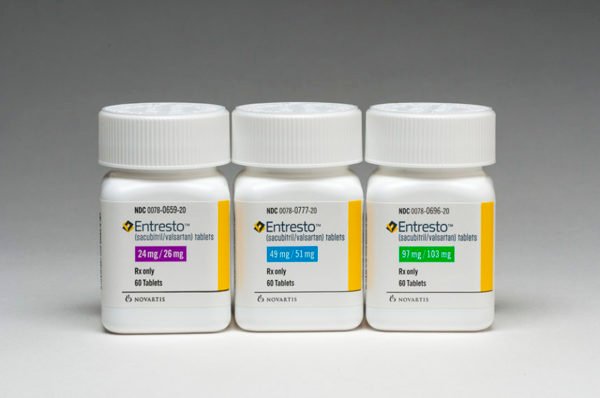
Sacubitril prevents the degradation of natriuretic peptides resulting in a diuretic effect. It is indicated in patients with symptomatic heart failure NYHA class II or above and a reduced ejection fraction. It is usually coadministered with other heart failure therapies like ACE inhibitors and angiotensin receptor blockers. The ACC/AHA/HFSA recommends treatment with sacubitril – valsartan in patients with a reduced ejection fraction and symptomatic heart failure who can tolerate ACE inhibitor or ARBs. Recent studies have shown that it may improve the ejection fraction by up to 10% in patients with decompensated cardiac failure.
Sacubitril/ valsartan Dose in Adults
The drug is a compound of sacubitril and valsartan available as 24/26 mg, 49/51 mg, 97/103 mg. 26 mg, 51 mg, and 103 mg valsartan in entresto is equivalent to 40, 80, and 160 mg of valsartan in other brands. When initiating sacubitril and valsartan in patients already on an ACE inhibitor or ARBs, a washout period of three days is recommended. Concomitant use of an ACE inhibitor and an ARB is contraindicated.
Patients on a high dose of ACE inhibitor (10 mg of an ACE inhibitor or equivalent or 160 mg of valsartan or equivalent):
- Initiate sacubitril 49 mg/valsartan 51 mg twice daily.
- The dose may be doubled every 2-4 weeks to a target maintenance dose of 97mg of sacubitril and 103 mg of valsartan twice daily.
Patients previously on a low dose of ACE inhibitor (less than 10 mg per day) or ARB (less than 160 mg of valsartan) & those not taking an ACE inhibitor or ARB:
- Initiate sacubitril 24 mg/valsartan 26 mg twice daily.
- The dose may be doubled every 2-4 weeks to a target maintenance dose of 97mg of sacubitril and 103 mg of valsartan twice daily.
Sacubitril/ valsartan Dose in Childrens
Not recommended for use in children
Pregnancy category X
- Entresto is not recommended for use during pregnancy.
- Fetal death can result from drugs that act on the renin angiotensin system.
- It is important to stop using the drug as soon as you can.
Entresto during lactation and breastfeeding
- It is unknown if the drug is absorbed into breast milk.
- Due to possible adverse effects on the infant who is breastfeeding, the manufacturer suggests that you avoid sacubitril/valsartan.
Sacubitril/ valsartan dose in Renal disease:
-
eGFR of 30 ml/min/1.73 m2 or more:
- No dose adjustment is necessary
-
eGFR of les than 30 ml/min/1.73 m2:
- Sacubitril 24/ valsartan 26 mg twice daily.
- Some experts advise against its use.
Sacubitril/ valsartan dose in Liver disease:
-
Mild hepatic impairment (Child Class A):
- No dose adjustment is necessary.
-
Moderate hepatic impairment (Child Class B):
- Advise a lower dose i.e. sacubitril 24 mg/ valsartan 26 mg.
-
Severe hepatic impairment (Child Class C):
- Avoid using sacubitril (Not studied in this sub-group.
Common side effects of Entresto:
- Hyypotesnsion, hyperkalemia, and raised serum creatinine
Less common side effects:
- Orthostatic hypotension, dizziness, vertigo, anemia, hypersensitivity reactions, angioedema, cough, and renal failure.
Contraindications to sacubitril/ vasartan include
-
Severe hypersensitivity reactions to sacubitril, valsartan or any component of the formulation.
-
Angioedema:
- Patients with hereditary angioneurotic edema and angioedema after the use of ACE inhibitors and ARBs.
-
Serious allergic reactions to ACE inhibitors.
-
Concomitant use of an ACE inhibitor, ARB or direct renin inhibitor within 36 hours.
-
Symptomatic hypotension
-
Pregnancy & Lactation
- According to ACC/AHA/HFSA guidelines, entresto is contraindicated in any patients with a history of angioedema regardless of the cause.
Warnings & Precautions:
- Hyperkalemia:
- Patients with impaired renal function, diabetes mellitus and those taking potassium-sparing diuretics or high potassium diets, potassium supplements, hyperaldosteronism or Aliskiren (contraindicated with concurrent use) may experience hyperkalemia when entresto is used.
-
Hypotension:
- Hypotension may occur in patients who are salt and volume depleted, on diuretics, and post-myocardial infarction.
- Hypotension can also be caused by anesthetic agents. Other blood pressure drugs should not be used during surgery.
-
Inadequate renal function:
- Small deterioration may be noted after initiating sacubitril/ valsartan.
- Patients with impaired renal blood flow, such as those suffering from renal artery narrowing, may experience progressive deterioration of their renal functions.
Monitoring Parameters:
- Renal functions,
- Blood pressure, and
- serum Potassium.
- The ACCF/AHA Heart Failure guidelines recommend monitoring renal functions, Blood pressure, and serum potassium one to two weeks after initiating ACE inhibitor or ARBs.
How to take Entresto?
Take the drug (sacubitril/valsartan) with or without food.
Mechanism of Action of sacubitril/ valsartan:
- Sacubitril blocks the enzyme Neprilysin, which degrades natriuretic amino peptides. In response to cardiac dilatation, natriuretic peptides can be released.
- Cardiac dilatation can occur due to fluid overload, secondary to weak heart and pump failure.
- Valsartan directly inhibits the angiotensin receptors and antagonizes the angiotensin-induced vasoconstriction, release of aldosterone & catecholamine, and prevents cardiac remodeling.
Bioavailability
- is 60%.
Metabolism:
- Valsartan is minimally metabolized.
- Sacubitril is converted to the active metabolite LBQ657 by esterases.
Half-life elimination:
- Sacubitril: 1.4 hours, LBQ657: 11.5 hours,
- Valsartan: 9.9 hours
Excretion:
- Sacubitril is excreted in urine and stools, valsartan is excreted via stools.
International Brands of Sacubitril Valsartan:
- Azmada
- Entresto
- Sacutrend
- Uperio
- Vacubitron
Sacubitril/ valsartan brands in Pakistan:
Sacvin (Pharmevo) - 24/26 mg, 49/51 mg, 97/103 mg
Uperio (Novartis) - 49/51 mg, 97/103 mg
.png)


