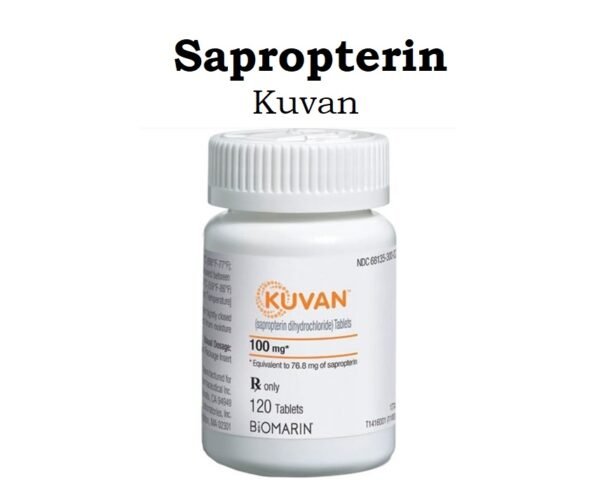
Sapropterin (Kuvan) is a co-factor in the synthesis of nitric oxide and three other aromatic amino acid hydroxylase enzymes. Along with restricted diet, it is used in children with phenylketonuria.
Sapropterin (Kuvan) Uses:
-
Hyperphenylalaninemia:
- It is used to reduce blood phenylalanine (PHE) levels in patients with hyperphenylalaninemia caused by tetrahydrobiopterin (BH4)-responsive phenylketonuria in conjunction with a PHE-restricted diet.
Sapropterin (Kuvan) Dose in Adults
Sapropterin (Kuvan) Dose in the treatment of Hyperphenylalaninemia:
- Initial: 10 to 20 mg/kg orally once on a daily basis
-
Maintenance:
- The dose should be adjusted after 1 month based on blood phenylalanine levels (if phenylalanine levels do not decrease from baseline after initiating 10 mg/kg, increase the dose to 20 mg/kg once daily).
- It can be discontinued if phenylalanine levels do not decrease after 1 month of treatment at 20 mg/kg/day (nonresponder). Maintenance range: 5 to 20 mg/kg once a day
-
Missed dose:
- A missed dose should be taken as early as possible, but 2 doses should not be taken on the same day.
Sapropterin (Kuvan) Dose in Childrens
Sapropterin (Kuvan) Dose in the adjunct treatment of Phenylalanine hydroxylase (PAH) deficiency disorders (eg, hyperphenylalaninemia, phenylketonuria [PKU]):
-
Infants and Children ≤6 years:
- Initial: 10 mg/kg/dose orally once daily
- The dose should be adjusted after 1 month based on phenylalanine levels.
- If phenylalanine levels do not decrease from baseline after 1 month of therapy then increase dose to 20 mg/kg/dose once a day, however, if still no response after 1 month of therapy at the higher dose (20 mg/kg/day) then sapropterin (non-responder) should be discontinued.
-
Usual maintenance range:
- 5 to 20 mg/kg/dose once a day, albeit the dosage should be individualized based on patient response.
Note: In the clinical trials of patients ≥7 months, doses were rounded to the nearest 100 mg increment so dosages up to 24 mg/kg per day were used.
-
Children ≥7 years and Adolescents:
- Initial: 10 to 20 mg/kg/dose orally once day-to-day or adjust the dose after 1 month based on phenylalanine levels.
- Initial dose 10 mg/kg/dose:
- Increase the dose to 20 mg/kg/dose orally once daily, if phenylalanine levels have not decreased from baseline after 1 month of therapy
- If there is still no response after 1 month of therapy at the higher dose (20 mg/kg/day) then discontinue sapropterin (non-responder).
- Initial dose 20 mg/kg/dose.
- If no response is found after 1 month of therapy, discontinue sapropterin (non-responder)
-
Usual maintenance range:
- 5 to 20 mg/kg/dose once a day, however, the dosage needs to be individualized based on patient response.
- Note: Doses were rounded in clinical trials of patients ≥7 months to the nearest 100 mg increment so dosages up to 24 mg/kg per day were used.
Pregnancy Risk Category: C
- However, it is not known what the outcome of maternal sapropterin use during pregnancy will be.
- A high level of maternal phenylalanine is associated with adverse fetal outcomes such as congenital heart disease and developmental delay.
- Normalization of Phe (Phenylalanine) levels is necessary before conception.
- When maternal PHE levels are maintained at the appropriate levels, pregnancy outcomes are comparable to those in the general population.
- However, optimal fetal development can only be achieved if maternal PHE concentrations are 360 micromol/L before conception.
- It is important to maintain a healthy diet and take proper supplements before, during and after pregnancy.
- Because of the limited data on pregnancy outcomes, sapropterin may be used by pregnant females with tetrahydrobiopterin-responsive phenylketonuria.
- This can be done in conjunction with a PHE-restricted diet.
- Continued data collection is ongoing to monitor the outcomes of infants and pregnant women after exposure to sapropterin.
Sapropterin use during breastfeeding:
- It is not known if breast milk contains sapropterin.
- According to the manufacturer, the decision about whether to continue or stop breastfeeding during therapy must take into consideration the risks to infants, the benefits to the mother, and the benefits to the mother.
- Mothers with phenylketonuria (PKU) have higher breast milk concentrations of phenylalanine.
- Infants without PKU can still metabolize phenylalanine. Breastfeeding should be encouraged if the infant is not affected by PKU or the mother is taking sapropterin.
Sapropterin (Kuvan) Dose in Kidney Disease:
No dosage adjustments are provided in the manufacturer's labeling.
Sapropterin (Kuvan) Dose in Liver disease:
No dosage adjustments are provided in the manufacturer's labeling.
Common Side Effects of Sapropterin (Kuvan):
-
Central nervous system:
- Headache
-
Respiratory:
- Rhinorrhea
Less Common Side Effects of Sapropterin (Kuvan):
-
Gastrointestinal:
- Diarrhea
- Vomiting
-
Respiratory:
- Pharyngolaryngeal Pain
- Cough
- Rhinitis
- Nasal Congestion
Contraindications to Sapropterin (Kuvan):
- There are no contraindications listed on the label.
- Canadian labeling: Hypersensitivity of sapropterin and any component of the formulation
Warnings and precautions
-
Gastritis
- Gastritis has been added to the list.
- Gastritis must be checked on patients.
-
Hyperactivity
- Hyperactivity was observed.
- Hyperactivity should be closely monitored.
-
Hypersensitivity
- Patients with a history sapropterin-related anaphylaxis have experienced hypersensitivity reactions, including rash and anaphylaxis. However, it is not recommended to be used in these patients.
- If anaphylaxis occurs, discontinue its use and seek medical attention.
- Patients who have anaphylaxis should continue to take Dietary Phenylalanine (PHE), as they are at risk of becoming allergic.
-
Hypophenylalaninemia:
- Low blood phenylalanine levels may be experienced by some patients. Patients <7 years of age treated at 20 mg/kg on a daily basis are at increased risk for hyperphenylalaninemia if compared with patients >=7 years of age.
-
Phenylketonuria:
- PHE levels during sapropterin treatment should be monitored and maintained within the target limits.
- Once diagnosed, blood PHE levels should be reduced to the desired range (120-360 micromol/L) as soon as possible.
- Treatment is required for infants with levels above 600 micromol/L. However, treatment can be initiated at >=360 micromol/L.
- If testing is done early in life, it is recommended to lower blood pH to between 480 and 600 micromol/L.
- High levels of phenylalanine can lead to severe neurologic damage, including behavioral abnormalities, seizures, microcephaly and seizures. Low levels of phenylalanine can cause protein breakdown and catabolism.
- To ensure nutritional balance and adequate control of phenylalanine, it is important to manage phenylalanine intake.
- During treatment, blood PHE levels should always be monitored (frequently for children).
- The response rate may be affected by PHE blood levels testing at doses of 20 mg/kg.
Sapropterin: Drug Interaction
|
Levodopa-Containing Products |
Sapropterin may enhance the adverse/toxic effect of LevodopaContaining Products. |
|
Methotrexate |
May decrease the serum concentration of Sapropterin. Specifically, methotrexate may decrease tissue concentrations of tetrahydrobiopterin. |
|
Phosphodiesterase 5 Inhibitors |
Sapropterin may enhance the hypotensive effect of Phosphodiesterase 5 Inhibitors. |
|
PRALAtrexate |
May decrease the serum concentration of Sapropterin. Specifically, pralatrexate may decrease tissue concentrations of tetrahydrobiopterin. |
Monitoring parameters:
- Blood phenylalanine levels (baseline, after 1 week of treatment, periodically for the first month, regularly thereafter).
- However, children may require more frequent monitoring.
- Blood pressure in patients who are taking concomitant PDE-5 inhibitors (eg, sildenafil, vardenafil, tadalafil).
- Variation in neurologic status in patients who are taking concurrent levodopa;
- Signs and symptoms of gastritis;
- Hyperactivity
- Furthermore, guideline suggested monitoring for patients with phenylalanine hydroxylase deficiency:
- Newly diagnosed infants:
- Phenylalanine (PHE) and tyrosine (TYR) need to be monitored frequently until the PHE concentrations stabilize, then monitor PHE weekly until age 1 (increase frequency during rapid growth or dietary transitions)
- Among children 1 to 12 years of age:
- PHE should be monitored every 2 to 4 weeks
- PHE will be monitored monthly among adolescents and Adults who are stable.
- If the formal nutritional assessment recommends suboptimal dietary intake or for over-reliance on nutritionally incomplete medical foods:
- Consider monitoring plasma amino acids (full panel), transthyretin, albumin, CBC, ferritin, 25-OH vitamin D, vitamin B, red blood cell essential fatty acids, trace minerals (copper, selenium, zinc), vitamin A, comprehensive metabolic panel, and folic acid.
How to administer Sapropterin (Kuvan)?
-
Powder for oral solution:
- It should be administered with food, preferably at the same time each day.
- However, the powder should be dissolved for oral solution in 120 to 240 mL (4 to 8 oz) water or apple juice or in a small number of soft foods e.g. apple sauce or pudding and mix thoroughly.
- It must be taken within 30 minutes of dissolution.
-
Tablets:
- It should be administered with food, preferably at the same time each day.
- Swallow tablets whole or it can be dissolved in 120 to 240 mL (4 to 8 oz) water or apple juice.
- It may also be crushed or stirred to aid in dissolution.
- It must be taken within 15 minutes of dissolution.
- There might be the case that tablets may not dissolve completely; rinse remaining tablet residue (with more water or apple juice) and drink.
- More to that, tablets may also be crushed and then mixed in a small amount of soft food such as apple sauce or pudding.
Mechanism of action of Sapropterin (Kuvan):
- It must be noted that sapropterin is a synthetic form of the cofactor BH4 (tetrahydrobiopterin) for the enzyme phenylalanine hydroxylase (PAH).
- However, PAH hydroxylates Phenylalanine to make tyrosine.
- BH4 activates the residual PAH enzyme, improving normal phenylalanine metabolic rate and decreasing phenylalanine concentrations in sapropterin responseers.
- About 25% to 50% patients suffering from PAH deficiency respond to sapropterin.
The onset of action:
- Within 24 hours;
- The maximum effect: up to 1 month
Duration:
- 24 hours
Absorption:
- Its absorption is enhanced when it is administered with food (high fat/high calorie) furthermore absorption via intact tablet administration is greater than dissolved tablet administration.
Metabolism:
- The enzymes dihydrofolate reductase and dihydropteridine reductase are liable for the metabolism and recycling of BH4.
Half-life elimination:
- About 6.7 hours (range: 3.9 to 17 hours)
International Brands of Sapropterin:
- Kuvan
Sapropterin Brand Names in Pakistan:
No Brands Available in Pakistan.
.png)


