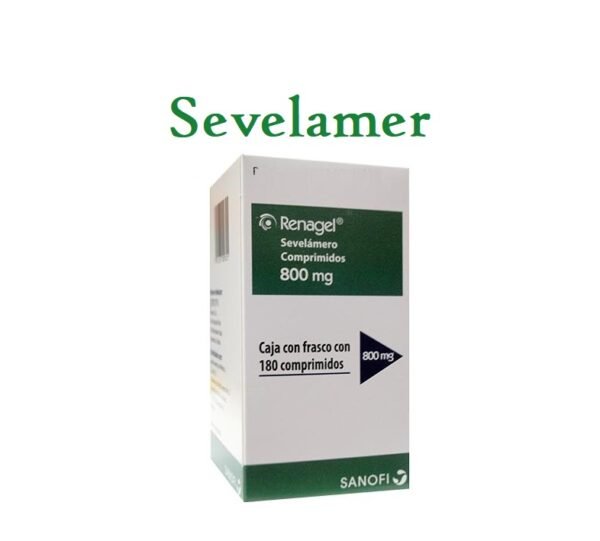
Sevelamer (Renagel) binds to phosphate in the gastrointestinal tract inhibiting the absorption of dietary phosphate. It does not affect the absorption of calcium, aluminum, or bicarbonate.
Sevelamer Uses:
-
Control of serum phosphorous:
- It is used to controls serum phosphorous in CKD patients on hemodialysis.
Sevelamer (Renagel) Dose in Adults
Note: Sevelamer carbonate and sevelamer hydrochloride dosing are similar; the same dose (on a mg per mg basis) should be utilized when switching from one product to another.
Sevelamer (Renagel) Dose to Control serum phosphorous levels: Oral:
-
Patients not taking a phosphate binder:
- Initial: 800 to 1,600 mg thrice a day with meals; serum phosphorous levels may deterrmine the initial dose:
- >5.5 mg/dL to <7.5 mg/dL: 800 mg 3 times daily
- ≥7.5 mg/dL to <9 mg/dL: 1,200 to 1,600 mg thrice a day
- ≥9 mg/dL: 1,600 mg thrice a day
- Maintenance dose adjustment based on serum phosphorous concentration (goal range of 3.5 to 5.5 mg/dL; maximum dose studied was equivalent to 13 g/day [sevelamer hydrochloride] or 14 g/day [sevelamer carbonate]):
- >5.5 mg/dL: Dose should be increased by 400 to 800 mg per meal at an interval of 2 weeks
- 5 to 5.5 mg/dL: Current dose should be maintained
- <3.5 mg/dL: Dose should be decreased by 400 to 800 mg per meal
- Initial: 800 to 1,600 mg thrice a day with meals; serum phosphorous levels may deterrmine the initial dose:
-
Dosage adjustment when switching between phosphate-binder products:
-
- Calcium acetate 667mg equals ~800 mg sevelamer (carbonate or hydrochloride)
-
Conversion based on dose per meal:
- Calcium acetate 667 mg: Convert to 800 mg Renagel/Renvela
- Calcium acetate 1,334 mg: Convert to 1,600 mg as Renagel/Renvela (800 mg tablets x 2) or 1,200 mg as Renagel (400 mg tablets x 3)
- Calcium acetate 2,001 mg: Convert to 2,400 mg as Renagel/Renvela (800 mg tablets x 3) or 2,000 mg as Renagel (400 mg tablets x 5)
-
Sevelamer (Renagel) Dose in Childrens
Note: Phosphate binding capacity: 400mg of Sevelamer HCl binds almost 32 mg of phosphate & 800 mg binds ~64 mg of phosphate.
Sevelamer (Renagel) Dose in the treatment of Hyperphosphatemia in children:
Sevelamer carbonate (Renvela):
-
Children ≥6 years and Adolescents: Oral:
-
Patients not taking a phosphate binder: Initial:
- BSA ≥0.75 to <1.2 m²: 800 mg thrice a day with meals; dose should be titrated as per need by 400 mg per dose at 2-week intervals.
- BSA ≥1.2 m²: 1,600 mg thrice a day with meals; dose should be titrated as per need by 800 mg per dose at 2-week intervals.
-
Dosage adjustment when switching from calcium acetate to sevelamer carbonate:
- Calcium acetate 667 mg equals almost 800 mg sevelamer; conversion based on dose per meal:
- Calcium acetate 667 mg: Convert to 800 mg sevelamer carbonate
- Calcium acetate 1,334 mg: Convert to 1,600 mg sevelamer carbonate
- Calcium acetate 2,001 mg: Convert to 2,400 mg sevelamer carbonate
- Calcium acetate 667 mg equals almost 800 mg sevelamer; conversion based on dose per meal:
-
Sevelamer hydrochloride (Renagel):
-
Infants ≥10 months and Children <2 years:
- Oral: Mean final dose of 140 ± 86 mg/kg/day (5.38 ± 3.24 g/day) was reported in a small trial (n=18, age range: 10 months to 18 years) to have achieved the targeted serum phosphorus level.
- Prior phosphate binder dose and serum phosphorus concentrations determined the initial dose.
- According to a case report of a 19-month old, an initial dose of 100 mg/kg/day divided every 8 hours with titration up to 130 mg/kg/day was reported to effectively cause a decrease in serum phosphorus levels.
-
Children ≥2 years and Adolescents:
- Oral: Initial dose: 400 or 800 mg thrice a day administered with meals;
- The dose should be titrated at monthly intervals in 1,200 mg/day increments (ie, 400 mg at each meal) to achieve a target phosphorus level;
- The final mean range: 140 to 163 mg/kg/day (5.38 to 6.7 g/day);
-
Dosage adjustment when switching from calcium acetate to sevelamer hydrochloride:
- Calcium acetate 667mg equals almost 800 mg sevelamer; conversion based on dose per meal.
Sevelamer (Renagel) dose in hyperphosphatemia, pretreatment of oral and enteral nutrition:
- Oral: 800 mg tablets or powder is added to 400 mL of breast milk or 100 mL of infant formula milk, tube feeding, or cow's milk;
- The mixture is kept for 10 minutes. A precipitate is formed at the bottom of the mixture.
- It has been shown to reduce the phosphate levels by up to 85% or more when added to breast milk, 42% when added to cow's milk, 48% to tube feeding, and 68% when added to infant formula.
Pregnancy Risk Category: C
- Sevelamer cannot be absorbed systemically. However, it can cause a decrease in maternal absorption fat-soluble vitamins or folic acid. Supplementation may be necessary.
Use during breastfeeding:
- Sevelamer cannot be absorbed systemically and breastfeeding is not considered unsafe.
- It can cause a decrease in maternal absorption for fat-soluble vitamins or folic acid. Supplementation may be necessary.
Dose in Kidney Disease:
No dosage adjustments are provided in the manufacturer's labeling (has not been studied).
Dose in Liver disease:
No dosage adjustments are provided in the manufacturer's labeling.
Common Side Effects of Sevelamer (Renagel):
-
Endocrine & metabolic:
- Metabolic acidosis
-
Gastrointestinal:
- Vomiting
- Nausea
- Diarrhea
- Dyspepsia
Less Common Side Effects of Sevelamer (Renagel):
-
Gastrointestinal:
- Abdominal Pain
- Constipation
- Flatulence
- Peritonitis
Contraindications to Sevelamer (Renagel):
- Hypersensitivity to sevelamer and any other component of the formulation
- Obstructive GI
Canadian labeling: Additional contraindications not in US labeling
- Hypophosphatemia
- Active mucosal injury (eg. necrosis, perforation and ulcerative colitis, GI bleeding, etc.)
Warnings and precautions
-
Gastrointestinal effects:
- There have been reports of obstruction and perforation in the bowel. Tablet formulation has been associated with dysphagia, esophageal retention and tablet formulation.
- Patients with swallowing problems should switch to suspension formulation.
-
Gastrointestinal Disease:
- Patients with GI disorders such as dysphagia, swallowing problems, severe gastrointestinal motility disorders (including severe constipation) or major gastrointestinal surgery should be cautious.
Sevelamer: Drug Interaction
|
Calcitriol (Systemic) |
Sevelamer may decrease the serum concentration of Calcitriol (Systemic). |
|
CycloSPORINE (Systemic) |
Sevelamer may decrease the serum concentration of CycloSPORINE (Systemic). |
|
Tacrolimus (Systemic) |
Sevelamer may decrease the serum concentration of Tacrolimus (Systemic). |
|
Cholic Acid |
Sevelamer may decrease the absorption of Cholic Acid. Management: Administer cholic acid at least 1 hour before or 4 to 6 hours after administration of any bile acid-binding products, such as sevelamer, to minimize the potential for a significant interaction. |
|
Levothyroxine |
Sevelamer may decrease the serum concentration of Levothyroxine. Management: Consider separating administration of sevelamer and levothyroxine by at least several hours whenever possible in order to decrease the risk of a significant interaction. |
|
Mycophenolate |
Sevelamer may decrease the serum concentration of Mycophenolate. Management: Administer mycophenolate at least 2 hours prior to sevelamer administration. |
|
Quinolones |
Sevelamer may decrease the absorption of Quinolones. Management: Administer oral quinolones at least 2 hours before or 6 hours after sevelamer. Exceptions: LevoFLOXacin (Oral Inhalation). |
Monitoring parameters:
- Serum chemistries(including bicarbonate and chloride)
- Serum calcium, phosphorus, and parathyroid hormone (PTH): Frequency of measurement is determined by the presence and magnitude of abnormalities, the rate of progression of chronic kidney disease (CKD), and the use of treatments for chronic kidney disease-mineral and bone disorder (CKD-MBD):
- CKD stage G3a to G3b:
- Serum calcium and phosphate should be done every 6 to 12 months
- PTH: Frequency determined by baseline level and progression of CKD
- CKD stage G4:
- Serum calcium and phosphate should be done every 3 to 6 months and PTH at every 6 to 12 months interval
- CKD stage G5 and G5D:
-
- Serum calcium and phosphate should be done every 1 to 3 months and PTH at every 3 to 6 months interval
-
- Periodic 24-hour urinary calcium and phosphorus
- Magnesium levels
- Alkaline phosphatase annually( more frequently with raised PTH) in the presence of elevated PTH)
- Creatinine, BUN, albumin
- Intact parathyroid hormone (iPTH) every 3 to 12 months based on the severity of CKD
How to administer Sevelamer (Renagel)?
Administer with meals.
Powder for oral suspension:
- An oral suspension in water may be prepared using the directed amount of water appropriate for the packet size or the entire content of the packet may be premixed with a small amount of food or beverage (do not heat or add to heated foods or liquids).
- Consume the preparation consumed immediately or within 30 minutes.
- Resuspended oral suspension in water immediately before drinking.
Tablets:
- Should be swallowed as a whole; not to be crushed or chewed.
Mechanism of action of Sevelamer (Renagel):
- Sevelamer, a polymeric compound, binds phosphate within the intestinal lumen and limits its absorption.
- It also decreases serum concentrations of phosphate without altering calcium, bicarbonate, or aluminum concentrations.
The beginning of actionThe reduction of serum phosphorus takes approximately 1-2 weeks.
Absorption: Not absorbed systemsically.
International Brand Names of Sevelamer:
- Renagel
- Renvela
- ACCEL-Sevelamer
- Eurolamer
- Inophos
- Invela
- Lameraseve
- Postiline
- Renagel
- Renosev
- Renvela
- Sevel
- Tasermity
Sevelamer Brand Names in Pakistan:
Sevelamer HCl Tablets 400 mg in Pakistan |
|
| Renavel | Genome Pharmaceuticals (Pvt) Ltd |
.png)


