Sacubitril Valsartan is a combination of sacubitril (a neprilysin inhibitor) and Valsartan (Angiotensin receptor blocker) Sacubitril prevents the degradation of natriuretic peptides (atrial and brain natriuretic peptides) by inhibiting the enzyme neprilysin resulting in a diuretic effect. It is indicated in patients with symptomatic heart failure NYHA class II or above and a reduced ejection fraction. It is usually coadministered with other heart failure therapies like ACE inhibitors and angiotensin receptor blockers. The ACC/AHA/HFSA recommends treatment with sacubitril valsartan in patients with a reduced ejection fraction and symptomatic heart failure who can tolerate ACE inhibitor or ARBs. The Paradigm heart failure trial enrolled patients who were already on an ACE inhibitor or angiotensin receptor blockers. Recent studies have shown that it may improve the ejection fraction by up to 10% in patients with decompensated cardiac failure.
Sacubitril-Valsartan dose in Adults
- The drug is marketed as a compound that contains a fixed ratio of the two drugs sacubitril and valsartan.
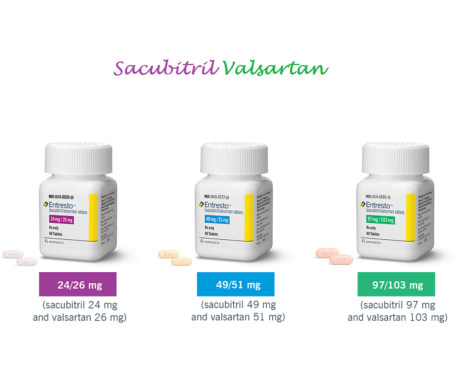
- The usual strength of the two drugs is 24/26 (also referred to as 50 mg that contains 24 mg sacubitril and 26 mg valsartan), 49/51 (also referred to as 100 mg that contains 49 mg sacubitril and 51 mg valsartan), and 97/103 mg (also referred to as 200 mg that contains 97 mg sacubitril and 103 mg valsartan).
- Since the valsartan in the compound is more bioavailable, 26 mg is equivalent to 40 mg, 51, and 103 mg is equivalent to 80 and 160 mg respectively.
Sacubitril-Valsartan dose in the treatment of Heart failure:
Note: Patients who are on ACE inhibitors or angiotensin receptor blockers should withhold the drug for 36 hours prior to switching to Sacubitril-Valsartan.
The initial dose is based on the patients' current history of angiotensin receptor blocker or angiotensin-converting enzyme inhibitor use:
-
Patients on a moderate to high dose ACE inhibitor ( >10 mg/day of enalapril or equivalent) or ARB ( >160 mg/day of valsartan or equivalent):
- Initiate at a dose of 100 mg of the compound drug i.e. Sacubitril 49 mg and valsartan 51 mg two times a day.
- If 100 mg is tolerated, double the dose every 2 - 4 weeks to the target maintenance dose of 200 mg i.e. sacubitril 97 mg and valsartan 103 mg two times a day.
-
Patients on a low dose ACE inhibitor ( < 10 mg/day of enalapril or equivalent) or ARB ( < 160 mg/day of valsartan or equivalent):
- Initiate at a dose of 50 mg of the compound drug i.e. Sacubitril 24 mg and valsartan 26 mg two times a day.
- If 50 mg is tolerated, double the dose every 2 - 4 weeks to the target maintenance dose of 200 mg i.e. sacubitril 97 mg and valsartan 103 mg two times a day.
-
Patients not taking an ACE inhibitor or an ARB:
- Initiate at a dose of 50 mg of the compound drug i.e. Sacubitril 24 mg and valsartan 26 mg two times a day.
- If 50 mg is tolerated, double the dose every 2 - 4 weeks to the target maintenance dose of 200 mg i.e. sacubitril 97 mg and valsartan 103 mg two times a day.
Sacubitril-Valsartan dose in Childrens
Not recommended in children
Pregnancy category X
- Pregnancy is not a good time to use valsartan.
- The compound drugs sacubitril, valsartan and sacubitril are also contraindicated.
- Drugs acting on the renin-angiotensin-aldosterone system can cause fetal death.
- If you suspect that your baby is pregnant, it is important to stop using the drug immediately.
- Drugs that act in the RAAS system can be associated with oligohydramnios, causing fetal lung hypoplasia or skeletal malformations.
- It can also lead to hypotension, anuria and skull hypoplasia in infants/neonates.
- Exchange transfusions may be necessary for infants who are exposed in utero.
- The second and third trimesters are when most complications occur in neonates.
Use during lactation and breastfeeding
- It is unknown whether the drug is absorbed into breast milk.
- Due to possible adverse effects on the infant who is breastfeeding, the manufacturer suggests that sacubitril-valsartan be avoided.
Dose in Renal disease:
-
eGFR of 30 ml/min/1.73 m2 or more:
- No dose adjustment is necessary
-
eGFR of les than 30 ml/min/1.73 m2:
- Sacubitril 24/ valsartan 26 mg two times a day.
- Some experts advise against its use.
Dose in Liver disease:
-
Mild hepatic impairment (Child Class A):
- No dose adjustment is necessary.
-
Moderate hepatic impairment (Child Class B):
- Advise a lower dose i.e. sacubitril 24 mg/ valsartan 26 mg.
-
Severe hepatic impairment (Child Class C):
- Avoid using sacubitril (Not studied in this sub-group.
Common Side Effects of Valsartan and Sacubitril include:
-
Cardiovascular:
- Hypotension
-
Endocrine & Metabolic:
- Increased Serum Potassium
- Hyperkalemia
-
Renal:
- Increased Serum Creatinine
Less Common Side Effects of Valsartan and sacubitril Include:
-
Cardiovascular:
- Orthostatic Hypotension
-
Central Nervous System:
- Dizziness
- Falling
-
Hematologic & Oncologic:
- Decreased Hematocrit
- Decreased Hemoglobin
-
Hypersensitivity:
- Angioedema
-
Renal:
- Renal Failure
-
Respiratory:
- Cough
Contraindication to Sacubitril Valsartan Include:
- Hypersensitivity severe reactionsTo valsartan or sacubitril, or any other component of the formulation.
Angioedema:
- Patients suffering from angioedema or angioneurotic edema due to hereditary factors should be evaluated after taking ACE inhibitors and ARBs.
- Severe allergic reactionsToACE inhibitors.
- ConcomitantUse of anACE inhibitor?ARBOrdirect renin inhibitorWithin 36 hours.
- Hypotension symptoms
- Pregnancy and lactation
- According to ACC/AHA/HFSA guidelines sacubitril valsartan should not be administered to patients who have angioedema.
Warnings and precautions
- Angioedema
- Angioedema, a rare but potentially life-threatening side effect of Valsartan, can occur at any stage during treatment.
- Angioedema can affect the neck and head, causing the upper airway and laryngeal edema. If not treated quickly, it could be fatal.
- Treatment with sacubitril and valsartan should be immediately discontinued and the patient should be managed aggressively (with Intramuscular epinephrine)
- Patients who have angioedema in the past, are black, or have a history of hereditary, angioedema are at higher risk.
- Hyperkalemia:
- Patients who are diabetics or have had surgery may experience hyperkalemia.
- Reduced renal function
- diabetes mellitus,
- those on potassium-sparing diuretics,
- high potassium diet,
- potassium supplements,
- Hyperaldosteronism is a form of and
- Patients taking Aliskiren/ other ACE inhibitors/ ARBs should be aware that they may also be using them concomitantly.
- Patients who are diabetics or have had surgery may experience hyperkalemia.
- Hypotension
- Hypotension can occur in patients with:
- Who are volume and salt depleted
- Diuretics and
- post-myocardial infarction.
- Anesthetic drugs can also cause hypotension. It is important to avoid using any other blood pressure medications during surgery.
- It is not contraindicated to use mild transient hypotension.
- Hypotension can occur in patients with:
- Renal function deterioration:
- After starting the drug, small deterioration might be noticed.
- Patients with compromised renal blood flow, such as those suffering from heart failure or renal artery stenosis, may experience progressive deterioration of their renal functions. The GFR in these patients depends on efferent arterial vasoconstriction.
- These patients could develop oliguria or acute renal failure and progressive azotemia.
- Mitral and aortic stenosis:
- Patients suffering from severe mitral and aortic stenosis or severe aortic stenosis should not use it.
- Heart failure:
- Concurrent diuretic therapy for heart disease should be used with caution. Patients taking diuretic therapy in conjunction should adjust their dose to prevent hypotension.
- Patients must also be monitored for changes in serum potassium and renal function.
- Hepatic impairment
- It should be avoided in cases of severe hepatic impairment.
- Patients with mild hepatic impairment may need to take a lower dose.
- Renal artery stenosis
- Patients with unstented bilateral renal arterioles stenosis or unilateral renal artery narrowing should be cautious about using the drug.
- Renal impairment
- Patients with kidney impairment should be cautious about taking the drug, especially if their GFR is less than 30ml/min.
Monitor:
- Renal functions,
- Blood pressure, and
- serum Potassium.
- The ACCF/AHA Heart Failure guidelines recommend monitoring renal functions, Blood pressure, and serum potassium one to two weeks after initiating ACE inhibitor or ARBs.
How to administer Sacubitril/valsartan?
Administer with or without food.
Mechanism of action of Sacubitril valsartan:
- Sacubitril blocks the enzyme Neprilysin, which degrades natriuretic amino peptides. In response to cardiac dilatation, natriuretic peptides can be released
- Cardiac dilatation can occur due to fluid overload, secondary to weak hearts and pumps failure.
- Valsartan directly inhibits the angiotensin receptors and antagonizes the angiotensin-induced vasoconstriction, release of aldosterone & catecholamine, and prevents cardiac remodeling.
Bioavailability is 60%.
Metabolism: Valsartan is minimally metabolized. Sacubitril is converted to the active metabolite LBQ657 by esterases.
Bioavailability: Sacubitril: greater than 60%
Half-life elimination: Sacubitril: 1.4 hours, LBQ657: 11.5 hours, Valsartan: 9.9 hours
Time to peak: Sacubitril: 0.5 hours; LBQ657: 2 hours; Valsartan: 1.5 hours
Excretion: Sacubitril is excreted in urine and stools, valsartan is excreted via stools.
International Brands:
- Entresto
- Azmada
- Sacutrend
- Uperio
- Vacubitron
Sacubitril Valsartan brands in Pakistan:
Cubil - Genix Sacvin - Pharamevo Savesto - Getz Uperio - Novartis Valsar-S - Helix Valsatril - Sami
.png)


