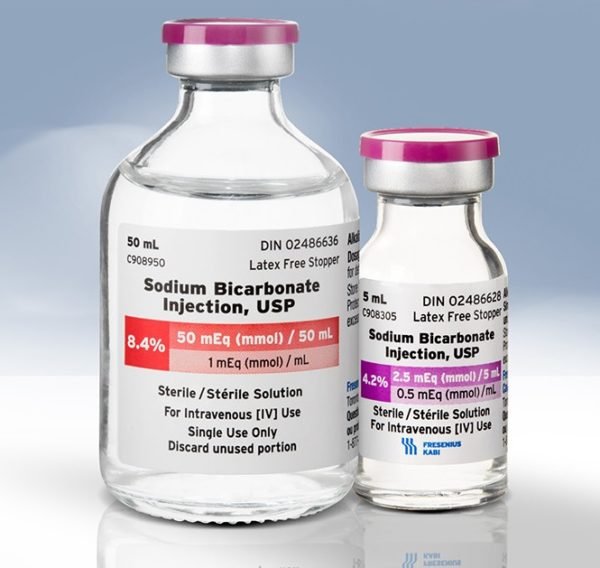
Sodium Bicarbonate raises the blood and urine PH by neutralizing the Hydrogen ions. It is commonly known as "Baking Soda" and is used for a variety of medical problems including its use as a "quick-relief" home remedy for heartburn.
Sodium bicarbonate uses:
- It is used for management of
- metabolic acidosis
- hyperkalemia
- overdose of certain drugs, including tricyclic antidepressants/aspirin
- gastric hyperacidity
- urine alkalinization
-
Neutralizing additive (dental use):
- It is helpful in reducing injection site pain by adjustment of lidocaine with epinephrine solution to appropriate physiologic pH and also enhances its analgesic effect.
-
Off Label Use of Sodium Bicarbonate in Adults:
- It can be used for preventing contrast induced nephropathy
Sodium bicarbonate dose in adults:
Note: 1 mEq NaHCO3 is equivalent to 84 mg; each g of NaHCO provides 12 mEq each of sodium and bicarbonate ions. Each oral tablet (650 mg) contains 7.7 mEq of sodium and bicarbonate ions.
Sodium bicarbonate dose in Cardiac arrest:
- The initial dose of intravenous 1 mEq/kg is administered. Repeat doses should be monitored by arterial blood gases
- It is mostly given after prolonged cardiac arrest only after adequate alveolar ventilation and effective cardiac compressions.
Sodium bicarbonate dose in the treatment of Metabolic acidosis in patients with chronic kidney disease:
Note: The oral replacement should be given when bicarbonate level <22 mEq/L.
- An initial dose of 15.4 to 23.1 mEq/day in divided doses (eg, 650 mg tablet twice or thrice daily) titrated to normal serum bicarbonate levels of 23 to 29 mEq/L or up to 5850 mg/day.
- Bicarbonate concentrations should not increase >32 mEq/L in renal disease as it increases the risk of mortality.
Sodium Bicarbonate dose in the management of Metabolic acidosis:
- Intravenous dosage should be based on the following formula if blood gases and pH measurements are available:
HCO3 (mEq) = 0.5 x weight (kg) x [24 - serum HCO (mEq/L)] or
HCO3 (mEq) = 0.5 x weight (kg) x [desired increase in serum HCO3 (mEq/L)]
- The remaining dose should be given over the next 24 hours after the initial dose with regular monitoring of pH, bicarbonate and clinical condition.
Note: These equations provide an estimated replacement dose. Prevention of over alkalinization is achieved with an approximate pH of 7.2 and a plasma bicarbonate level of 10 mEq/L.
- If an acid base level is not known, 2 to 5 mEq/kg intravenous infusion can be given over 4 to 8 hours.
Sodium bicarbonate dose in the treatment of Hyperkalemia:
- 50 mEq intravenous over 5 minutes with other methods of management.
Sodium bicarbonate Dose in the treatment of Renal tubular acidosis:
- Distal tubular acidosis:
- 0.5 to 2 mEq/kg/day orally in 4 to 5 divided doses
- Proximal renal tubular acidosis:
- Initial: 5 to 10 mEq/kg/day orally
- maintenance: Increase as required to maintain serum bicarbonate in the normal range.
Sodium bicarbonate dose for Urine alkalinization:
- An initial oral dose of 48 mEq (4 g), then 12 -24 mEq (1 to 2 g) every 4 hours.
- doses up to 16 g/day (200 mEq) in patients <60 years and 8 g (100 mEq) in patients >60 years.
Note:
In case of overdose with salicylates, bicarbonate can be given intravenously with a target urinary pH of 7.5-8.5
Sodium bicarbonate dose as an Antacid:
- 325 mg to 2 g per oral 1 to 4 times/day
Sodium bicarbonate dose to Neutralize lidocaine with epinephrine dental anesthetic:
- Neutralizing additive:
- Mix 10 parts anesthetic (lidocaine with epinephrine) to 1 part 8.4% sodium bicarbonate
- Add 0.18 mL NaHCO3 to 1.8 mL cartridge of lidocaine 2% with epinephrine 1:50,000 or 1:100,000
- Add 2 mL NaHCO3 to 20 mL vial of lidocaine 2% with epinephrine 1:100,000
- Add 3 mL NaHCO3 to 30 mL vial of lidocaine 2% with epinephrine 1:100,000
- Add 5 mL NaHCO3 to 50 mL vial of lidocaine 2% with epinephrine 1:100,000
Sodium bicarbonate dose in the Prevention of contrast-induced nephropathy (off-label):
- Intravenous infusion of 154 mEq/L sodium bicarbonate in D/W solution:
- 3 mL/kg/hour for 1 hour before contrast injection, then 1ml/kg/hour during contrast exposure and for 6 hours after the procedure.
Sodium bicarbonate dose in children:
Note: Dose should be adjusted to patient response and target parameters for condition being treated.
Sodium bicarbonate dose as an Antacid:
Note: Chronic antacid therapy is not recommended for gastroesophageal reflux disease in children.
-
Children ≥5 years and Adolescents:
- Oral powder: teaspoonful/dose;
- may repeat up to every 2 hours not to exceed 7 doses in 24 hours, and do not use longer than 14 days.
Sodium bicarbonate dose in children with Cardiac arrest (PALS guidelines):
- An intravenous or intraosseous dose of 1 mEq/kg/dose;
- repeat doses depend on arterial blood gases.
- In infants and children <2 years of age, the 4.2% (0.5 mEq/mL) solution should be used.
Sodium bicarbonate dose in children with acidosis due to chronic kidney disease (CKD):
Note: Initiate if serum bicarbonate <22 mEq/L (KDIGO 2012):
- An initial oral dose depends on serum bicarbonate levels and adjusted to have the targeted bicarbonate levels (eg, children: 22 to 23 mEq/L; adults: 24 to 25 mEq/L)
- undertreatment can result in negative effects of acidosis on growth.
- HCO3 (mEq) = 0.5 x weight (kg) x [desired HCO (mEq/L) - serum HCO (mEq/L)]
Sodium bicarbonate dose in the management of Hyperkalemia in children:
- Intravenous doses of 1 to 2 mEq/kg is considered to redistribute extracellular potassium into cells. The serum sodium should also be monitored closely.
Sodium bicarbonate dose in the treatment of acute Metabolic acidosis:
-
Blood-gas directed dosing (equations):
- These equations provide an estimated replacement intravenous dose.
- Over alkalinization is usually prevented by keeping the target pH of 7.2.
- HCO (mEq) = 0.3 x weight (kg) x base deficit (mEq/L) or
- HCO (mEq) = 0.5 x weight (kg) x [24 - serum HCO (mEq/L)]
- The remaining dose is given over the next 24 hours after initial dose with strict monitoring of pH,bicarbonate level and clinical condition.
-
Weight-directed dosing (if an acid-base status is not available):
- Intravenous or intraosseous dose of 1 to 2 mEq/kg
- Children (>2 years) and Adolescents:
- 2 to 5 mEq/kg intravenous infusion over 4 to 8 hours, further doses should depend on the patient's acid-base status.
NaHCO3 dose to Neutralize local (dental) anesthetic (lidocaine with epinephrine):
- Neutralizing additive:
- Mix 10 parts anesthetic (lidocaine with epinephrine) to 1 part 8.4%sodium bicarbonate
- Add 0.18 mL NaHCO3 to 1.8 mL cartridge of lidocaine 2% with epinephrine 1:50,000 or 1:100,000
- Add 2 mL NaHCO3 to 20 mL vial of lidocaine 2% with epinephrine 1:100,000
- Add 3 mL NaHCO3 to 30 mL vial of lidocaine 2% with epinephrine 1:100,000
- Add 5 mL NaHCO3 to 50 mL vial of lidocaine 2% with epinephrine 1:100,000
Sodamint (NaHCO3) dose in patients with Renal tubular acidosis (RTA):
Note: Dose depends on age, bicarbonate level, and urinary bicarbonate excretion.
-
Distal RTA:
- Some data suggests infants and children <6 years require higher daily dose than older children.
-
Infants:
- Usual range: 5 to 8 mEq/kg per oral per day
- reported range: 3.9 to 10 mEq/kg per oral per day
-
Children and Adolescents:
- An initial oral dose of 3 mEq/kg/day
- usual initial range: 3 to 4 mEq/kg/day titrated accordingly
-
-
Proximal (type 2) RTA:
-
Infants, Children, and Adolescents:
- An initial oral dose of 5 to 10 mEq/kg/day in divided doses.
- usual range: 10 to 20 mEq/kg/day titrated accordingly.
-
NaHCO3 dose as a Skin protectant and for the relief of minor irritation:
-
Children ≥2 years and Adolescents:
- Topical: Oral powder (baking soda):
-
Bath soak:
- Dissolve 1 to 2 cups in a tub of warm water, soak for 10 to 30 minutes; pat skin dry
-
Compress or wet dressing:
- Mix the powder with water; soak with a clean soft cloth, apply cloth loosely to the affected area for 15 to 30 minutes, may repeat as needed or as directed by the physician.
-
Paste:
- Mix the powder with water to form a paste, apply to the affected area of skin as needed
NaHCO3 dose in the treatment of Tricyclic antidepressant overdose:
-
Infants, Children, and Adolescents:
- An intravenous or intraosseous dose of 1 to 2 mEq/kg titrated to maintain serum pH 7.45 to 7.55, follow with 150 mEq NaHCO /L infusion to maintain targeted pH.
Pregnancy Risk Category: C
- Studies on animal reproduction have not been completed.
- Fears of fetal Teratogenicity should not prevent drug discontinuation.
- Fluid overload can be caused by sodium bicarbonate containing anticids.
Use during breastfeeding:
- It is excreted from breast milk.
Dose adjustment in renal disease:
- There are no dosage adjustments provided in the manufacturer's labeling.
- Use with caution as it might cause sodium retention.
Dose adjustment in liver disease:
- There are no dosage adjustments provided in the manufacturer's labeling.
- Use with caution, especially in edema and sodium retention.
Side effects of sodium bicarbonate:
-
Cardiovascular:
- Cardiac Failure (Exacerbation)
- Edema
-
Central Nervous System:
- Cerebral Hemorrhage
-
Endocrine & Metabolic:
- Acidosis (Intracranial)
- Hypernatremia
- Hypocalcemia
- Hypokalemia
- Metabolic Alkalosis
- Milk-Alkali Syndrome (Especially With Renal Dysfunction)
-
Gastrointestinal:
- Abdominal Distention
- Eructation
- Flatulence (Oral Administration)
-
Neuromuscular & Skeletal:
- Tetany
-
Respiratory:
- Pulmonary Edema
Contraindication to Sodium bicarbonate:
These include
- Alkalosis
- Undiagnosed abdominal pain
- Pulmonary edema
- Hypernatremia
- hypocalcemia
- It is not intended to be used as a systemic acidizer
Warnings and precautions
-
Extravasation:
- It is a vesicant in concentrations up to 8.4%. Extravasation can be avoided by positioning the catheter/needle correctly before and during infusion.
-
Cirrhosis
- Patients with cirrhosis should be cautious.
-
Edema
- Patients with edema should be cautious.
-
Heart failure:
- Patients with heart failure should be cautious.
-
Peptic ulcer disease:
- Peptic ulcer disease can be managed with this medication.
Sodium bicarbonate: Drug Interaction
Note: Drug Interaction Categories:
- Risk Factor C: Monitor When Using Combination
- Risk Factor D: Consider Treatment Modification
- Risk Factor X: Avoid Concomitant Use
Risk Factor C (Monitor therapy). |
|
| AcetaZOLAMIDE | Could increase the toxic/adverse effects of Sodium Bicarbonate. Particularly, renal calculus formation could be at greater risk. |
| Indirect-Acting Alpha-/Beta Agonists | The serum concentrations of Alpha-/Beta Agonists can be increased by alkalinizing agents (Indirect-Acting). |
| Amantadine | Amantadine may be increased by alkalinizing agents. |
| Antipsychotic Agents (Phenothiazines). | Antacids can decrease the absorption Antipsychotic Agents (Phenothiazines) |
| Bromperidol | Bromperidol may be less absorbed by antacids. |
| Captopril | Captopril serum concentration may be decreased by taking an antacid. |
| Cefpodoxime | Antenacids can decrease Cefpodoxime serum concentrations. |
| Cysteamine (Systemic) | Cysteamine (Systemic) may be affected by anantacids. |
| Dexmethylphenidate | Antacids can increase Dexmethylphenidate's absorption. Antacids can interfere with the normal release from extended-release capsules (FocalinXR brand) which could lead to both an increased (early) or decreased (later) absorption. |
| Flecainide | Flecainide's arrhythmogenic effects may be diminished by Sodium Bicarbonate. Sodium Bicarbonate can increase Flecainide serum concentrations. |
| Lithium | Sodium Bicarbonate could increase the excretion rate of Lithium. |
| Mecamylamine | The serum concentrations of Mecamylamine may be increased by alkalinizing agents. |
| Memantine | Memantine serum concentration may be increased by alkalinizing agents |
| Methylphenidate | Antacids can increase Methylphenidate's absorption. Antacids can interfere with the normal release from extended-release capsules (Ritalin LA) which may lead to both an increased (early) or decreased (later) absorption. |
| QuiNIDine | QuiNIDine excretion may be decreased by antacids |
| QuiNINE | QuiNINE serum concentrations could be increased by alkalinizing agents |
| Rosuvastatin | Rosuvastatin serum concentration may be decreased by anantacids |
Risk Factor D (Consider therapy modifications) |
|
| Acalabrutinib | Antabuses can decrease Acalabrutinib's serum concentration. To minimize potential interactions, it is important to administer Acalabrutinib separately from any other antacids for at least 2 hours. |
| Amphetamines | The excretion of Amphetamines can be decreased by using alkalinizing agents. Management: There are alternatives to the combination of amphetamines with alkalinizing agents. Patients should be closely monitored for excess amphetamine effects if these agents are used together. |
| Atazanavir | Antacids can decrease Atazanavir's absorption. |
| Bisacodyl | Antacids can decrease the therapeutic effects of Bisacodyl. Antacids can cause delayed-release bisacodyl tablets not to reach the large intestine. You may experience gastric irritation or cramps. |
| Bismuth Subcitrate | Bismuth Subcitrate may be affected by antacids. Management: Antacids should not be administered within 30 minutes after bismuth subcitrate's (tripotassium Bismuth dicitrate-) administration. |
| Bosutinib | Bosutinib serum concentration may be decreased by antacids. Administration: Do not take antacids for more than two hours prior to or after taking bosutinib. |
| Calcium Polystyrene Sulfonate | Antacids can increase the toxic/adverse effects of Calcium Polystyrene Sulfonate. Combining these two agents can lead to metabolic alkalosis, and/or loss in efficacy for the cation exchange resin. Management: This interaction can be minimized by separating doses for a period of 2 hours or more, b)rectal administration or alternative antacids. Monitoring for metabolic alkalosis is important. Attenuation of CPS side effects should be considered. Avoid magnesium hydroxide. |
| Cefditoren | Antabics can decrease Cefditoren serum concentration. Management: Cefditoren should not be taken with antacids. Alternate methods of controlling acid reflux, such as diet modification or antimicrobial therapy, may be considered. Separate dosing can be done if antacid therapy cannot be avoided. |
| Cefuroxime | Antenacids can decrease serum Cefuroxime concentration. Management: Cefuroxime Axetil should be administered at least one hour before or two hours after administration of short-acting antacids. |
| Chloroquine | Chloroquine serum concentrations could be decreased by antacids. Management: It is important to separate the administration of chloroquine and antacids for at least four hours in order to minimize any negative effects on chloroquine bioavailability. |
| Corticosteroids (Oral) | Antacids can decrease the bioavailability (Oral) of Corticosteroids. Management: It is worth separating doses for at least 2 hours. Budesonide enteric-coated tablets may dissolve prematurely when combined with lower gastric acid drugs, which have unknown effects on the budesonide therapeutic benefits. |
| Dabigatran Etexilate | Antabics can decrease the serum concentrations of Dabigatran Etexilate. Management: Dabigatran Etexilate Canadian product labeling suggests that you avoid concurrent use of antacids for 24 hrs after surgery. In all other cases, dabigatran should be administered 2 hours before antacids. Monitoring the clinical response to dabigatran therapy. |
| Dasatinib | Antenacids can decrease serum levels of Dasatinib. Administration: Avoid simultaneous administration of Dasatinib with antacids. Do not give antacids two hours prior to or after dasatinib. |
| Delavirdine | Antabics can decrease Delavirdine serum concentration. Management: Give delavirdine and an antacid a separate dose for at least one hour. This combination may cause decreased therapeutic effects of delavirdine. |
| Elvitegravir | Antabics can decrease Elvitegravir serum concentrations. Management: Separate administration of antacids and elvitegravir-containing products by at least 2 hours in order to minimize the risk for an interaction. |
| Erlotinib | Antabics can decrease serum Erlotinib concentration. Management: Keep the administration of Erlotinib and any other antacid separated for several hours to reduce the chance of an interaction. |
| Fosinopril | Fosinopril serum concentration may be decreased by antacids. Management: According to the Canadian and US fosinopril manufacturers labels, it is recommended that fosinopril and antacids be separated by at least 2 hours. |
| Gefitinib | Gefitinib serum concentration may be decreased by antacids. Gefitinib administration: Give gefitinib at the least 6 hours before or following an antacid. Monitor your patient's response to gefitinib. |
| Hyoscyamine | The serum concentration of Hyoscyamine may be decreased by antacids. Treatment: If you are giving these agents in combination, administer immediate release Hyoscyamine and antacids before and after meals. |
| Iron Salts | Iron Salts can be less absorbed by antacids. Exceptions: Ferric Carboxymaltose, Ferric Citrate, Ferric Gluconate and Ferric Gluconate. Ferric Pyrophosphate Citrate Complex; Ferumoxytol. Iron Dextran Complex. Iron Isomaltoside. Iron Sucrose. |
| Itraconazole | Itraconazole serum concentration may be decreased by anantacids. Antacids can increase serum Itraconazole concentrations. Sporanox brand Itraconazole should be administered at least two hours prior to or after any antacids are administered. Antibiotics may increase the exposure to Tolsura brand Itraconazole. Consider reducing itraconazole dosage. |
| Ketoconazole (Systemic) | Antabics can decrease serum levels of Ketoconazole Systemic. Administration: Take oral ketoconazole at the very least two hours before you start using any antacid. Watch out for any signs or symptoms that indicate an insufficient clinical response to ketoconazole. |
| Lanthanum | Antenacids can reduce the therapeutic effects of Lanthanum. |
| Ledipasvir | Antabics can decrease serum Ledipasvir concentration. Management: Keep the administration of Ledipasvir and Antacids separated for at least 4 hours. |
| Mesalamine | Mesalamine's therapeutic effects may be diminished by antacids. Antacid-induced increases in the gastrointestinal pH can lead to premature release mesalamine from certain sustained-release mesalamine product. Management: It is important to avoid concurrent administration of antacids and sustained-release mesalamine product. This interaction can be avoided by seperating antacid from mesalamine administration and/or using lower doses of antacids. |
| Methenamine | Methenamine's therapeutic effects may be diminished by antacids. |
| Multivitamins/Minerals (with ADEK, Folate, Iron) | Antacids may decrease the serum concentration of Multivitamins/Minerals (with ADEK, Folate, Iron). Antacids can decrease iron absorption from orally administered iron. Management: Dose of iron-containing multivitamin preparations orally and antacids separately as soon as possible to minimize any adverse effects on the iron preparation's therapeutic efficacy. |
| Neratinib | Antabics can decrease Neratinib serum concentration. Antacids can decrease neratinib sorption. Management: Give neratinib to your child at least three hours after you have finished taking the antacid. |
| Nilotini | - Antacids can decrease Nilotinib's serum concentration. Management: It is important to separate the administration of Nilotinib from any antacid at least two hours before starting treatment. This will reduce the chance of an adverse reaction. |
| PAZOPanib | PAZOPanib serum concentration may be decreased by antacids. Management: If possible, avoid using pazopanib with antacids. If antacid treatment is necessary, separate doses by several hours. It has not been possible to determine the impact of dose separation. |
| Pexidartinib | Antineodes may lower the serum level of Pexidartinib. Administration: Pexidartinib should be administered 2 hours prior to or after taking antacids. |
| Supplements with phosphate | Antabics can decrease the absorption rate of phosphate supplements. Management: This only applies to oral phosphate administration. The interaction may be minimized by separating oral phosphate supplement administration from antacid management for as long as possible. Exceptions: Sodium Glycerophosphate pentahydrate. |
| Potassium Phosphate | Antabics can lower the serum level of Potassium Phosphate. Management: It is a good idea to separate oral potassium phosphate and antacids by at least two hours in order to reduce the risk of an interaction. |
| Rilpivirine | Rilpivirine may be reduced by antacids. Administration: Antacids should be administered at least 2 hours prior to or 4 hours after the administration of rilpivirine. Administer antacids at least 6 hours before or 4 hours after the rilpivirine/dolutegravir combination product. |
| Riociguat | Antacids can decrease Riociguat serum concentrations. Management: Keep Riociguat and Antacids separated for at least one hour to avoid any possible interaction. |
| Sotalol | Antabics can decrease Sotalol's serum concentration. Administration: It is best to avoid simultaneous administration of Sotalol and Antacids. Two hours after taking sotalol, administer antacids. |
| Sulpiride | Sulpiride serum concentration may be decreased by antacids. Management: Antacids should be administered separately to sulpiride for at least two hours to reduce the effect of antacids upon sulpiride absorption. |
| Tetracyclines | Antacids can decrease Tetracycline absorption. Management: It is best to separate the administration of antacids from oral tetracycline derivatives for several hours, if possible, in order to reduce the potential interaction. Eravacycline is an exception. |
| Velpatasvir | Antabics can decrease Velpatasvir serum concentration. Management: At least 4 hours of separate administration of velpatasvir or antacids is recommended. |
Monitoring parameters:
Monitor arterial/ venous PH, Blood pressure, serum sodium levels, and signs of fluid overload. Monitor the patient for heart failure if at-risk Observe the site for extravasation.
How to administer Sodium bicarbonate?
- Slow intravenous infusion is given over 120 minutes at a maximum rate of 1 mEq/kg/hr after diluting to a maximum concentration of 0.5 mEq/mL in Dextrose Solution.
Extravasation management:
- If extravasation occurs, the infusion should be stopped immediately and disconnected (leave needle/cannula in place).
- The extravasated solution should be gently aspirated without flushing the line and hyaluronidase antidote should be given.
- The needle/cannula should be removed and dry cold compresses should be applied after elevating the extremity.
- Hyaluronidase is administered as an intradermal or subcutaneous injection a total of 1 to 1.7 mL (15 units/mL) as five separate 0.2 to 0.3 mL injections using a 25-gauge needle into the area of extravasation in a clockwise manner.
- The oral dose should be given 60-180 minutes after food.
Mechanism of action of Sodium bicarbonate:
- It provides bicarbonate ion via dissociation, which neutralizes hydrogen ion. This causes an increase in blood/urinary pH
- Use of a neutralizing agent (dental use).
- It increases tissue uptake by raising the pH of epinephrine and lidocaine solutions, which in turn leads to a better tolerance.
The onset of action:
- Oral: 15 minutes
- Intravenous: Rapid
Duration:
- Oral: 1 to 3 hours
- Intravenous: 8 to 10 minutes
Absorption:
- Oral: Well absorbed
Excretion:
- Occurs in urine (<1%)
Sodium bicarbonate Brand Names (International):
- Neut
- Betsol "Z"
- Bicafres
- Bicart
- Natribic
- Natrium bicarbonicum
- Solunate
Sodium bicarbonate Brand Names in Pakistan:
Sodium Bicarbonate Injection 7.5 % W/V |
|
| Sodium Bicarbonate | Elko Organization (Pvt) Ltd. |
| Sodium Bicarbonate | Venus Pharma |
Sodium Bicarbonate Injection 8.4 % W/V |
|
| Meylon | Hospital Supply Corporation |
| Sobicarb | Zafa Pharmaceutical Laboratories (Pvt) Ltd. |
| Sodium Bi Carbonate | Usman-co International |
| Sodium Bicarbonate | Venus Pharma |
Sodium Bicarbonate tablets 300 mg |
|
| Sodamint | Irza Pharma (Pvt) Ltd. |
| Sodamint | Karachi Pharmaceutical Laboratory |
| Sodamint | Ideal Pharmaceutical Industries |
| Sodium Bicarbonate | Biosynth Pharma (Pvt) Ltd. |
Sodium Bicarbonate capsules 1100 mg |
|
| Neusec | Biorex Pharmaceuticals |
| Operos | Medizan Labs (Pvt) Ltd |
.png)


