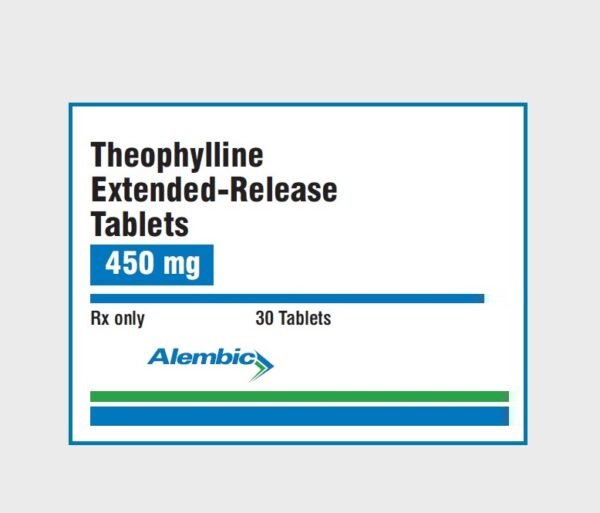
Theophylline is a non-selective phosphodiesterase inhibitor that has bronchodilating properties and acts to increase diaphragmatic contractility. It relaxes smooth muscles and has diuretic effects as well.
Theophylline Uses:
-
Reversible airflow obstruction:
- It is used orally for the treatment of symptoms and reversible airflow obstruction associated with chronic asthma, or other chronic lung diseases like emphysema and chronic bronchitis.
- It is used in the intravenous formulation for the management of acute exacerbations of the symptoms and reversible airflow obstruction associated with asthma and other chronic lung diseases (eg, chronic bronchitis and emphysema) as an adjunct to inhaled beta-2 selective agonists and systemically administered corticosteroids.
-
Guideline recommendations:
- Asthma:
- The 2018 Global Initiative for Asthma Guidelines (GINA) and the 2007 National Heart, Lung, and Blood Institute Asthma Guidelines recommend against oral theophylline as a long-term control medication for asthma in children less than 5 years of age.
- Moreover, GINA guidelines do not prefer oral theophylline for asthma in children 6 to 11 years of age.
- Oral theophylline is a potential alternative option and not the preferred drug in adolescents and adults as a long-term control medication in mild asthma or as an add-on long-term control medication in moderate to severe asthma.
- However, a stepwise approach using inhaled corticosteroids with or without inhaled long-acting beta-agonists depending upon asthma severity is preferred to theophylline due to efficacy concerns and potential for adverse events.
- Both guidelines recommend against the use of theophylline for the treatment of exacerbations of asthma due to poor efficacy and safety concerns.
- COPD:
- The Global Initiative for Chronic Obstructive Lung Disease Guidelines (2018) suggests that while higher doses of slow-release formulations of theophylline have been proven to be effective for use in COPD, it is not a preferred agent for COPD exacerbations due to its potential for systemic toxicity. It has moderate bronchodilator activity when used in chronic stable COPD patients.
- Asthma:
-
Off Label Use of Theophylline in Adults:
- Bradycardia
- In patients who had heart transplantation.
- Reversal of dipyridamole-, or regadenoson-induced adverse reactions for example in angina and hypotension during nuclear cardiac stress testing. However, they are not the first-line agent.
Theophylline Dose in Adults
It is important to note that dos should be individualized based on steady-state serum concentrations. Ideal body weight should be used. Theophylline distributes poorly into body fat.
Theophylline Dose for Bradycardia during heart transplantation (off-label):
- Oral: It is given initially as 150 mg twice a day. And titrate up as indicated based on heart rate response and tolerability.
- The daily dose of up to 900 mg/day have been reported and used clinically.
Theophylline Dose in the treatment of Reversible airflow obstruction for acute symptoms:
-
Loading dose: IV, Oral (immediate release solution):
-
Asthma exacerbations:
- The treatment of acute exacerbations of asthma with theophylline is indicated neither recommended by current clinical practice guidelines:
- The treatment of acute COPD with theophylline IV is not supported or recommended by current clinical practice guidelines due to a significant side effect profile.
- Patients who have not received theophylline in the previous 24 hours:
- it is given as 4.6 mg/kg/dose intravenously as a preferred route or 5 mg/kg orally as an immediate release only [oral solution]).
- It is noteworthy that the loading dose is intended to achieve a serum level of approximately 10 mcg/mL with a range of 5 to 16 mcg/mL.
- On average, for every 1 mg/kg theophylline given, blood levels will rise 2 mcg/mL.
- Obtain theophylline serum concentration 30 minutes for intravenous formulation or 24 hours for oral formulation after the loading dose.
- This is done when the distribution is complete. It is to assess the need for and size of subsequent loading doses and for the guidance of maintenance therapy.
- Patients who have received theophylline in the previous 24 hours:
- A loading dose should not be administered prior to obtaining a serum theophylline concentration.
- The loading dose should be calculated as follows:
- Dose = (desired serum theophylline concentration - measured serum theophylline concentration) x (Vd)
- The treatment of acute exacerbations of asthma with theophylline is indicated neither recommended by current clinical practice guidelines:
-
Maintenance: Continuous IV infusion:
The dose is administered to achieve a target concentration of 10 mcg/mL unless otherwise noted. Lower initial doses might be indicated in patients with decreased theophylline clearance. Dosage should be adjusted according to serum level measurements during the first 12- to 24-hour period.
-
Adults ≤60 years:
- It is given as 0.4 mg/kg/hour with a maximum dose up to 900 mg/day unless serum levels indicate the need for a larger dose.
-
Adults >60 years:
- It is given as 0.3 mg/kg/hour with a maximum dose up to 400 mg/day unless serum levels indicate the need for a larger dose.
-
Dose in the treatment of Cardiac decompensation, cor pulmonale, sepsis with multiorgan failure, or shock:
- It is administered as 0.2 mg/kg/hour with a maximum dose of 400 mg/day unless serum levels indicate the need for a larger dose.
Theophylline Dose in the treatment of Reversible airflow obstruction, chronic conditions: Oral:
it should be noted that increased dose only if tolerated and if indicated. Consider lowering the dose or using a slower titration if caffeine-like adverse events occur. One can use smaller doses more periodically in patients requiring higher than average doses to prevent breakthrough symptoms. If at risk for impaired theophylline clearance or not feasible to monitor serum theophylline concentrations, do not exceed the maximum dose of 400 mg/day.
-
Immediate release (oral solution) (without risk factors for impaired clearance):
- Initially, it is given as 300 mg/day in divided doses every 6 to 8 hours.
- If tolerated, after 3 days increase the dose to 400 mg/day divided every 6 to 8 hours. And if further tolerated, after 3 more days increase to 600 mg/day divided every 6 to 8 hours.
-
Extended-release (without risk factors for impaired clearance):
- 12-hour formulation (tablets):
- Initially, it is given as 300 mg/day in divided doses every 12 hours and if tolerated, after 3 days increase to 400 mg/day in divided doses every 12 hours.
- If it is further tolerated, after 3 days, increase the dose to 600 mg/day in divided doses every 12 hours
- 24-hour formulation (capsules and tablets):
- Initially, it is given as 300 to 400 mg once a day. And if tolerated after 3 days increase to 400 to 600 mg once a day.
- If a dose of more than 600 mg is indicated then titrate up according to serum level measurement.
- 12-hour formulation (tablets):
Theophylline Dose in the treatment of Reversal of dipyridamole- or regadenoson-induced adverse reactions (eg, angina, hypotension) during nuclear cardiac stress testing (alternative agent) (off-label):
- IV: it is given as 50 mg over 1 minute. Repeat the dose if necessary.
-
Dosage adjustment based on serum theophylline concentrations: IV, Oral:
- <9.9 mcg/mL:
- If symptoms not adequately controlled and the current dose is tolerated, increase the dose or infusion rate by approximately 25%.
- Recheck serum concentration after 24 hours for IV formulation or 3 days for oral formulation for further dosage adjustment.
- 10 to 14.9 mcg/mL:
- If symptoms are adequately controlled and the current dose is tolerated, maintain the dose and recheck serum concentrations at 24-hour intervals for IV formulation or 6- to 12-month intervals for oral formulation.
- If symptoms are not controlled and the current dose is tolerated, consider adding additional medications.
- 15 to 19.9 mcg/mL:
- Consider a 10% reduction in dose or infusion rate even if the current dosage is tolerated.
- 20 to 24.9 mcg/mL:
- Reduce the dose or infusion rate by 25% even if no adverse effect present.
- Recheck serum concentrations after 24 hours for Iv formulation or 3 days for oral formulation to guide further dose adjustment.
- 25 to 30 mcg/mL:
- Stop infusion for 24 hours or skip the next oral dose. Then decrease subsequent doses or infusion rate at least 25% even if no adverse effects present.
- Recheck serum concentrations after 24 hours for IV formulation or 3 days for the oral formulation to guide further dosage adjustments.
- If the patient is still symptomatic, withhold infusion, and consider if overdose treatment is needed.
- >30 mcg/mL:
- Stop infusion and treat overdose as needed. If theophylline is resumed, decrease dose or infusion rate by at least half and recheck serum concentrations after 24 hours for IV formulation or 3 days for the oral formulation to guide further dose adjustments.
- <9.9 mcg/mL:
Theophylline Dose in Childrens
The dose should be individualized based on steady-state serum concentrations. Theophylline pharmacokinetics have age-dependent factors that may alter required doses, particularly in pediatric patients. For obese patients, ideal body weight should be used for dose calculation.
Theophylline Dose in the treatment of Acute symptoms of asthma or other chronic lung conditions:
It is not recommended for the treatment of acute exacerbations of asthma.
-
Loading dose:
It should be noted that doses administered are intended to achieve a serum level of approximately 10 mcg/mL. The loading dose should be given intravenously which is also the preferred dose or with a rapidly absorbed oral product (not an extended-release product). On average, for every 1 mg/kg theophylline given, blood concentrations will rise 2 mcg/mL.
-
Patients not currently receiving methylxanthines:
- IV: 4.6 mg/kg/dose
- Oral: Immediate release product: 5 mg/kg
-
Patients currently receiving methylxanthines:
- A loading dose is not indicated without first obtaining a serum theophylline concentration in patients who have received aminophylline or theophylline within the past 24 hours. The loading dose should be calculated as follows:
- Dose = (C desired – C measured) x (Vd)
- C desired = desired serum theophylline concentration
- C measured = measured serum theophylline concentration
- Maintenance dose: Continuous IV infusion:
- A loading dose is not indicated without first obtaining a serum theophylline concentration in patients who have received aminophylline or theophylline within the past 24 hours. The loading dose should be calculated as follows:
The dose is administered to achieve a target concentration of 10 mcg/mL. Lower initial doses might be indicated in patients with reduced theophylline clearance. Dosage should be adjusted according to serum concentration measurements during the first 12- to 24-hour period.
-
Infants 4 to 6 weeks:
- 1.5 mg/kg/dose every 12 hours
-
Infants 6 to 52 weeks:
- Dose (mg/kg/hour) = (0.008 X age in weeks) + 0.21
-
Children 1 to <9 years:
- 0.8 mg/kg/hour
-
Children 9 to <12 years:
- 0.7 mg/kg/hour
-
Adolescents 12 to <16 years (otherwise healthy, nonsmokers):
- It is given as 0.5 mg/kg/hour with a maximum daily dose of 900 mg/day unless serum concentrations indicate the need for a larger dose
-
Adolescents 12 to <16 years (cigarette or marijuana smokers):
- 0.7 mg/kg/hour
-
Adolescents 16 to 18 years (otherwise healthy, nonsmokers):
- It is given as 0.4 mg/kg/hour with a maximum dose of 900 mg/day unless serum concentrations indicate the need for larger doses.
-
Theophylline Dose in the treatment of Cardiac decompensation, cor pulmonale, hepatic dysfunction, sepsis with multiorgan failure, shock:
- Initially, it is given as 0.2 mg/kg/hour with a maximum dose of 400 mg/day unless serum concentrations indicate the need for larger doses.
Theophylline Dose in the treatment of Chronic conditions of asthma or other chronic lung conditions:
Increase the dose only if tolerated. Consider lowering the dose or using a slower up- titration if caffeine-like adverse events occur. Smaller doses given more periodically can be used in patients with a more rapid metabolism to prevent breakthrough symptoms that could occur due to low trough concentration prior to the next dose.
-
Immediate-release formulation: Oral:
It is important to note that if the patient is at risk for impaired clearance or not feasible to monitor serum theophylline concentrations then do not exceed 16 mg/kg/day. The maximum daily dose is 400 mg/day.
-
Manufacturer's labeling: Frequency-based upon age.
- Infants:
- Total daily dose (mg/day) = [(0.2 x age in weeks) + 5] x (weight in kg); frequency is based on age
- Dosing interval:
- ≤26 weeks:
- Divide into 3 equal doses and administer every 8 hours
- >26 weeks:
- Divide into 4 equal doses and administer every 6 hours
- Children and Adolescents 1 to 15 years and ≤45 kg: Initial:
- Days 1 to 3:
- it is given as 12 to 14 mg/kg/day in divided doses every 4 to 6 hours. The maximum daily dose is 300 mg/day
- Days 4 to 6:
- it is given as 16 mg/kg/day in divided doses every 4 to 6 hours. The maximum daily dose is 400 mg/day
- Maintenance:
- it is given as 20 mg/kg/day in divided doses every 4 to 6 hours. The maximum daily dose is 600 mg/day
- Children and Adolescents >45 kg or Adolescents ≥16 years: Initial:
- Days 1 to 3:
- it is given as 300 mg/day in divided doses every 6 to 8 hours.
- Days 4 to 6:
- then it is given as 400 mg/day in divided doses every 6 to 8 hours.
- Maintenance:
- and then 600 mg/day in divided doses every 6 to 8 hours.
- Infants:
-
Alternate dosing; age-directed:
- Children 1 to <9 years:
- it is given as 20 to 24 mg/kg/day. The maximum daily dose is 600 mg/day.
- Children 9 to 12 years:
- it is given as 16 mg/kg/day. The maximum daily dose is 600 mg/day.
- Children and Adolescents >12 to 16 years (nonsmokers):
- it is given as 13 mg/kg/day. The maximum daily dose is 600 mg/day.
- Children >12 years and Adolescents (smokers):
- it is given as 16 mg/kg/day. The maximum daily dose is 600 mg/day.
- Adolescents >16 years (nonsmokers):
- it is given as10 mg/kg/day. The maximum daily dose is 600 mg/day.
- Children 1 to <9 years:
-
Extended-release formulations: Oral:
It is important to note that if at risk for impaired clearance or if it's not feasible to monitor serum theophylline concentrations then do not exceed 16 mg/kg/day. The maximum recommended daily dose is 400 mg/day.
-
Manufacturer's labeling:
- Children ≥6 years and Adolescents <16 years, weighing ≤45 kg: Initial:
- Days 1 to 3:
- it is given as 12 to 14 mg/kg/day. The maximum daily dose is 300 mg/day.
- Days 4 to 6:
- it is given as 16 mg/kg/day. The maximum daily dose is 400 mg/day.
- Maintenance:
- it is given as 20 mg/kg/day. The maximum daily dose is 600 mg/day.
- Days 1 to 3:
-
Dosing interval (product specific):
- 12-hour extended-release tablets:
- Children ≥6 years and Adolescents:
- Divide into 2 equal doses and administer every 12 hours
- Children ≥6 years and Adolescents:
- 24-hour extended-release tablets:
- Children ≥12 years and Adolescents:
- Administer every 24 hours
- Children ≥6 years and Adolescents, weighing >45 kg or Adolescents ≥16 years:
- Children ≥12 years and Adolescents:
- 12-hour extended-release tablets:
- Children ≥6 years and Adolescents, weighing >45 kg or Adolescents ≥16 years: Initial:
- Days 1 to 3:
- it is given as 300 mg/day in divided doses every 12 hours
- Days 4 to 6:
- it is given as 400 mg/day in divided doses every 12 hours
- Maintenance:
- it is given as 600 mg/day in divided doses every 12 hours
- 24-hour extended-release tablets:
- Children ≥12 years and Adolescents, weighing >45 kg or Adolescents ≥16 years: Initial:
- Days 1 to 3:
- it is given as300 to 400 mg once a day.
- Days 4 to 6:
- it is given as400 to 600 mg once a day.
- Maintenance:
- Titration should be done according to serum concentrations.
- 12-hour extended-release tablets:
-
Alternate dosing; age-directed:
- Children 6 to <9 years:
- it is given as 20 to 24 mg/kg/day.
- The maximum daily dose is 600 mg/day
- Children 9 to 12 years:
- it is given as 16 mg/kg/day.
- The maximum daily dose is 600 mg/day
- Children and Adolescents >12 to 16 years (nonsmokers):
- it is given as 13 mg/kg/day.
- The maximum daily dose is 600 mg/day
- Children >12 years and Adolescents (smokers):
- it is given as 16 mg/kg/day.
- the maximum daily dose is 600 mg/day
- Adolescents >16 years (nonsmokers):
- it is given as 10 mg/kg/day.
- The maximum daily dose is 600 mg/day
- Children 6 to <9 years:
- Children ≥6 years and Adolescents <16 years, weighing ≤45 kg: Initial:
Chronic conditions: Oral:
It should be noted that the dose is only increased if tolerated. Consider lowering the dose or using a slower titration if caffeine-like adverse events occur. Smaller doses given more frequently may be used in patients with a more rapid metabolism to prevent breakthrough symptoms which could occur due to low trough concentration before the next dose.
-
Immediate-release oral solution:
- The initial dose is 300 mg/day administered in divided doses every 6 to 8 hours and the maintenance dose is 400 to 600 mg/day.
- The maximum daily dose is 600 mg/day.
-
Extended-release formulations:
- The initial dose is 300 to 400 mg once a day with a maintenance dose of 400 to 600 mg once a day.
- The maximum recommended daily dose is 600 mg/day.
-
Dosage adjustment based on serum theophylline concentrations:
-
Infants, Children, and Adolescents:
-
It is important to note that serum theophylline concentrations should be rechecked after 3 days when using the oral formulation, or after 12 hours in children or in 24 hours for adults when the dose is given intravenously. Patients maintained with oral therapy should be reassessed at 6- to 12-month intervals, when clinically needed, or if concomitant medication is added which may affect theophylline serum concentration.
- <9.9 mcg/mL:
- If tolerated, but symptoms remain, increase the dose by approximately 25%. Recheck serum theophylline concentrations.
- 10 to 14.9 mcg/mL:
- Maintain the current dose if tolerated. Recheck serum concentrations at 24-hour intervals for acute IV dosing, or at 6- to 12-month intervals for oral dosing.
- 15 to 19.9 mcg/mL:
- Consider 10% dose reduction to improve safety margin even if the dose is tolerated.
- 20 to 24.9 mcg/mL:
- Reduce the dose by approximately 25%. Recheck serum concentrations.
- 25 to 30 mcg/mL:
- Skip next oral dose or stop infusion for 12 hours in children or for 24 hours in adults and decrease subsequent doses by at least 25%. Recheck serum concentrations.
- >30 mcg/mL:
- Stop dosing and treat overdosage. If it is resumed, decrease subsequent doses by at least half. Recheck serum concentrations.
Theophylline Pregnancy Risk Factor C
- Animal reproduction studies have shown adverse effects.
- It can cause adverse effects in newborns because it crosses the placenta.
- The use of it at the recommended doses, keeping serum concentrations between 5 and 12 mcg/mL is safe.
- However, maternal adverse effects can increase and efficacy may be decreased in pregnant women.
- Theophylline metabolism may change during pregnancy.
- Half-life is approximately the same as that in healthy, nonsmoking adults who have asthma.
- It can increase to 13 hours during the first and second trimesters.
- The third trimester may see an 8 to 18 hour range.
- The third trimester also sees an increase in distribution volume.
- Monitor serum levels.
- Theophylline should be used in pregnant women with severe asthma just like in adults.
Use of theophylline during breastfeeding
- Breast milk contains theophylline.
- Breast milk contains the same amount of theophylline as maternal serum.
- Nursing infants may experience irritability. If toxic serum levels are not present in the mother, then serious adverse effects are unlikely for the infant.
Theophylline Dose in Kidney Disease:
No specific dose adjustments are required for both oral or intravenous formulation in kidney disease.
Theophylline Dose in Liver disease:
Oral:
- There are no specific dosage adjustments provided in the literature.
- Dose reduction and frequent monitoring of serum theophylline concentration are required, however.
- The risk of severe and potentially fatal toxicity can occur. The maximum recommended dose is 400 mg/day.
IV:
- Initially, it is given as 0.2 mg/kg/hour.
- The maximum dose is 400 mg daily unless serum concentrations indicate the need for a larger dose.
- Use with caution and monitor serum theophylline concentrations frequently. The risk of severe and potentially fatal toxicity may occur.
Side effects of Theophylline:
Adverse events were observed at therapeutic serum levels.
-
Cardiovascular:
- Cardiac Flutter
- Tachycardia
-
Central Nervous System:
- Headache
- Hyperactivity (Children)
- Insomnia
- Restlessness
- Seizure
- Status Epilepticus (Nonconvulsive)
-
Endocrine & Metabolic:
- Hypercalcemia (With Concomitant Hyperthyroid Disease)
-
Gastrointestinal:
- Gastroesophageal Reflux (Aggravation)
- Gastrointestinal Ulcer (Aggravation)
- Nausea
- Vomiting
-
Genitourinary:
- Difficulty In Micturition (Elderly Males With Prostatism)
- Diuresis (Transient)
-
Neuromuscular & Skeletal:
- Tremor
Contraindications to Theophylline:
Hypersensitivity to theophylline is a serious contraindication.
Canadian labeling: Additional contraindications, not in US labeling
- Hypersensitivity to xanthine derivatives
- Cardiac stimulation can be harmful in cases of coronary artery disease and heart failure.
- Peptic ulcers.
- Children can be co-administered with ephedrine.
Warnings and precautions
-
Toxicology of theophylline:
- Reduced clearance of theophylline can lead to severe and possibly fatal theophylline poisoning.
- Patients with severe pulmonary edema, heart disease, cor pulmonale and fever may have their theophylline clearance reduced.
- These patients will need to be monitored more closely and benefits should be considered. You can reduce the infusion rate.
- Patients should immediately be tested for theophylline poisoning if they experience nausea, persistent vomiting, or nausea. Do not take any further doses.
-
Cardiovascular disease
- Patients with cardiac arrhythmias, excluding bradyarrhythmias, should exercise caution. It can worsen arrhythmias.
-
Cystic Fibrosis:
- Cystic fibrosis patients should exercise caution. Patients with cystic fibrosis may have a higher clearance of theophylline.
-
Hepatic impairment
- Patients with hepatic impairment (eg cirrhosis or acute hepatitis) should be cautious. There is a greater risk of serious and possibly fatal theophylline poisoning. Theophylline clearance in these patients is reduced by more than half.
- It is important to reduce doses and monitor the serum theophylline levels frequently.
-
Hyperthyroidism:
- Hyperthyroidism patients should be cautious as it can increase renal clearance.
-
Peptic ulcer disease:
- It can also cause an exacerbation or worsening of pre-existing conditions such as peptic ulcer disease.
-
Seizure disorder:
- If already present, it can also worsen seizure disorders.
Theophylline: Drug Interaction
|
Abiraterone Acetate |
May increase the serum concentration of CYP1A2 Substrates (High risk with Inhibitors). |
|
Adalimumab |
May decrease the serum concentration of Theophylline Derivatives. |
|
Alcohol (Ethyl) |
|
|
Allopurinol |
May increase the serum concentration of Theophylline Derivatives. |
|
Amifampridine |
Agents With Seizure Threshold Lowering Potential may enhance the neuroexcitatory and/or seizure-potentiating effect of Amifampridine. |
|
Antithyroid Agents |
May increase the serum concentration of Theophylline Derivatives. |
|
AtoMOXetine |
May enhance the hypertensive effect of Sympathomimetics. AtoMOXetine may enhance the tachycardic effect of Sympathomimetics. |
|
Barbiturates |
May decrease the serum concentration of Theophylline Derivatives. |
|
Beta-Blockers (Beta1 Selective) |
May diminish the bronchodilatory effect of Theophylline Derivatives. Management: Monitor for reduced theophylline efficacy during concomitant use with any beta-blocker. Beta-1 selective agents are less likely to antagonize theophylline than nonselective agents, but selectivity may be lost at higher doses. |
|
Broccoli |
May decrease the serum concentration of CYP1A2 Substrates (High risk with Inducers). |
|
BuPROPion |
May enhance the neuroexcitatory and/or seizure-potentiating effect of Agents With Seizure Threshold Lowering Potential. |
|
Cannabinoid-Containing Products |
May enhance the tachycardic effect of Sympathomimetics. Exceptions: Cannabidiol. |
|
Cannabis |
May decrease the serum concentration of CYP1A2 Substrates (High risk with Inducers). |
|
CYP1A2 Inducers (Moderate) |
May decrease the serum concentration of CYP1A2 Substrates (High risk with Inducers). |
|
CYP1A2 Inhibitors (Moderate) |
May decrease the metabolism of CYP1A2 Substrates (High risk with Inhibitors). |
|
Cyproterone |
May decrease the serum concentration of CYP1A2 Substrates (High risk with Inducers). |
|
Disulfiram |
May increase the serum concentration of Theophylline Derivatives. |
|
Estrogen Derivatives |
May increase the serum concentration of Theophylline Derivatives. |
|
Febuxostat |
May increase serum concentrations of the active metabolite(s) of Theophylline Derivatives. Specifically, concentrations of 1-methylxanthine, a metabolite of unknown clinical importance, may become elevated. |
|
Fluconazole |
May increase the serum concentration of Theophylline Derivatives. |
|
Formoterol |
Theophylline Derivatives may enhance the adverse/toxic effect of Formoterol. Theophylline Derivatives may enhance the hypokalemic effect of Formoterol. |
|
Guanethidine |
May enhance the arrhythmogenic effect of Sympathomimetics. Guanethidine may enhance the hypertensive effect of Sympathomimetics. |
|
Indacaterol |
Theophylline Derivatives may enhance the adverse/toxic effect of Indacaterol. Theophylline Derivatives may enhance the hypokalemic effect of Indacaterol. |
|
Interferons |
May decrease the metabolism of Theophylline Derivatives. |
|
Isoniazid |
May increase the serum concentration of Theophylline Derivatives. |
|
Isoproterenol |
May decrease the serum concentration of Theophylline Derivatives. |
|
Lithium |
Theophylline Derivatives may decrease the serum concentration of Lithium. |
|
Methotrexate |
May increase the serum concentration of Theophylline Derivatives. |
|
Metreleptin |
May decrease the serum concentration of Theophylline. Metreleptin may increase the serum concentration of Theophylline. |
|
Obeticholic Acid |
May increase the serum concentration of CYP1A2 Substrates (High risk with Inhibitors). |
|
Olodaterol |
Theophylline Derivatives may enhance the adverse/toxic effect of Olodaterol. Theophylline Derivatives may enhance the hypokalemic effect of Olodaterol. |
|
Pefloxacin |
May increase the serum concentration of Theophylline Derivatives. |
|
Peginterferon Alfa-2b |
May increase the serum concentration of CYP1A2 Substrates (High risk with Inhibitors). |
|
Pentoxifylline |
May increase the serum concentration of Theophylline Derivatives. |
|
Propafenone |
May increase the serum concentration of Theophylline Derivatives. |
|
QuiNINE |
May increase the serum concentration of Theophylline Derivatives. |
|
Ritonavir |
May decrease the serum concentration of Theophylline Derivatives. |
|
Solriamfetol |
Sympathomimetics may enhance the hypertensive effect of Solriamfetol. |
|
Sulfinpyrazone |
May decrease the serum concentration of Theophylline Derivatives. |
|
Sympathomimetics |
May enhance the adverse/toxic effect of other Sympathomimetics. |
|
Tedizolid |
May enhance the hypertensive effect of Sympathomimetics. Tedizolid may enhance the tachycardic effect of Sympathomimetics. |
|
Teriflunomide |
May decrease the serum concentration of CYP1A2 Substrates (High risk with Inducers). |
|
Thyroid Products |
May increase the metabolism of Theophylline Derivatives. |
|
Ticlopidine |
May increase the serum concentration of Theophylline Derivatives. |
|
Tobacco (Smoked) |
May decrease the serum concentration of Theophylline Derivatives. |
|
Zafirlukast |
Theophylline Derivatives may decrease the serum concentration of Zafirlukast. Zafirlukast may increase the serum concentration of Theophylline Derivatives. |
|
Risk Factor D (Consider therapy modification) |
|
|
Adenosine |
Theophylline Derivatives may diminish the therapeutic effect of Adenosine. |
|
Benzodiazepines |
Theophylline Derivatives may diminish the therapeutic effect of Benzodiazepines. |
|
Beta-Blockers (Nonselective) |
May diminish the bronchodilatory effect of Theophylline Derivatives. |
|
CarBAMazepine |
May decrease the serum concentration of Theophylline Derivatives. Theophylline Derivatives may decrease the serum concentration of CarBAMazepine. Management: Seek alternatives to this combination when possible. If these agents are used together, monitor closely for decreased serum concentrations/therapeutic effects of both medications. |
|
Cimetidine |
May decrease the metabolism of Theophylline Derivatives. |
|
Cocaine (Topical) |
May enhance the hypertensive effect of Sympathomimetics. Management: Consider alternatives to use of this combination when possible. Monitor closely for substantially increased blood pressure or heart rate and for any evidence of myocardial ischemia with concurrent use. |
|
FluvoxaMINE |
May decrease the metabolism of Theophylline Derivatives. |
|
Fosphenytoin |
May decrease the serum concentration of Theophylline Derivatives. Theophylline Derivatives may decrease the serum concentration of Fosphenytoin. Management: Seek alternatives when possible. If used together, monitor for decreased concentrations/effects of phenytoin or theophylline if the other agent is initiated/dose increased, or increased concentrations/effects if the other is discontinued/dose decreased. |
|
Iohexol |
Agents With Seizure Threshold Lowering Potential may enhance the adverse/toxic effect of Iohexol. Specifically, the risk for seizures may be increased. Management: Discontinue agents that may lower the seizure threshold 48 hours prior to intrathecal use of iohexol. Wait at least 24 hours after the procedure to resume such agents. In nonelective procedures, consider use of prophylactic anticonvulsants. |
|
Iomeprol |
Agents With Seizure Threshold Lowering Potential may enhance the adverse/toxic effect of Iomeprol. Specifically, the risk for seizures may be increased. Management: Discontinue agents that may lower the seizure threshold 48 hours prior to intrathecal use of iomeprol. Wait at least 24 hours after the procedure to resume such agents. In nonelective procedures, consider use of prophylactic anticonvulsants. |
|
Iopamidol |
Agents With Seizure Threshold Lowering Potential may enhance the adverse/toxic effect of Iopamidol. Specifically, the risk for seizures may be increased. Management: Discontinue agents that may lower the seizure threshold 48 hours prior to intrathecal use of iopamidol. Wait at least 24 hours after the procedure to resume such agents. In nonelective procedures, consider use of prophylactic anticonvulsants. |
|
Linezolid |
May enhance the hypertensive effect of Sympathomimetics. Management: Reduce initial doses of sympathomimetic agents, and closely monitor for enhanced pressor response, in patients receiving linezolid. Specific dose adjustment recommendations are not presently available. |
|
Macrolide Antibiotics |
May decrease the metabolism of Theophylline Derivatives. Exceptions: Azithromycin (Systemic); Fidaxomicin; Roxithromycin; Spiramycin; Telithromycin. |
|
Mexiletine |
May decrease the metabolism of Theophylline Derivatives. |
|
Pancuronium |
Theophylline Derivatives may enhance the adverse/toxic effect of Pancuronium. Theophylline Derivatives may diminish the neuromuscular-blocking effect of Pancuronium. Management: Pancuronium dosage adjustment may be necessary to induce paralysis in patients receiving concomitant theophylline derivatives. Monitor closely for adverse effects (e.g., cardiac effects) with concomitant use of these agents. |
|
Phenytoin |
May decrease the serum concentration of Theophylline Derivatives. Theophylline Derivatives may decrease the serum concentration of Phenytoin. Management: Seek alternatives when possible. If used together, monitor for decreased concentrations/effects of phenytoin or theophylline if the other agent is initiated/dose increased, or increased concentrations/effects if the other is discontinued/dose decreased. |
|
Quinolones |
May decrease the metabolism of Theophylline Derivatives. Ciprofloxacin and enoxacin are of greatest concern. Theophylline/quinolone therapy might augment the seizureproducing potential of each of the individual agents. Exceptions: Delafloxacin; Gemifloxacin; LevoFLOXacin (Systemic); Lomefloxacin; Moxifloxacin (Systemic); Nalidixic Acid; Pefloxacin; Sparfloxacin. |
|
Regadenoson |
Theophylline may diminish the vasodilatory effect of Regadenoson. |
|
Thiabendazole |
May decrease the metabolism of Theophylline Derivatives. |
|
Vemurafenib |
May increase the serum concentration of CYP1A2 Substrates (High risk with Inhibitors). Management: Consider alternatives to such combinations whenever possible, particularly if the CYP1A2 substrate has a relatively narrow therapeutic index. Drugs listed as exceptions to this monograph are discussed in separate drug interaction monographs. |
|
Zileuton |
May increase the serum concentration of Theophylline. Management: Reduce theophylline dose by 50% upon initiation of zileuton therapy. If theophylline is added to existing zileuton therapy, use a lower starting dose. Monitor for increased serum concentrations and effects of theophylline. |
|
Risk Factor X (Avoid combination) |
|
|
Acebrophylline |
May enhance the stimulatory effect of Theophylline Derivatives. |
|
Deferasirox |
May increase the serum concentration of Theophylline. |
|
Doxofylline |
Theophylline Derivatives may enhance the adverse/toxic effect of Doxofylline. |
|
Riociguat |
Theophylline Derivatives may enhance the hypotensive effect of Riociguat. |
|
Stiripentol |
May increase the serum concentration of Theophylline. |
Monitoring parameters
- Heart rate.
- CNS effects like insomnia and irritability.
- Respiratory rate as in COPD patients often has resting controlled respiratory rates in the low 20s.
- Arterial or capillary blood gases if indicated.
- Fluid balance, electrolyte concentrations, and acid-base balance during prolonged IV therapy.
Theophylline levels:
- Serum theophylline levels should be monitored after initiation of therapy, prior to making dose increases, in the presence of signs or symptoms of toxicity or when a new illness, worsening of a present illness, or change in patient's treatment regimen occur that may alter theophylline clearance (eg, fever >102°F or sustained for 24 hours or more, hepatitis, or drugs that are added or discontinued).
- For oral formulations monitor serum concentrations at 6-month intervals for rapidly growing children and at yearly intervals for all others if symptoms are well controlled.
- For IV loading dose measure serum concentrations 30 minutes after the end of an IV loading dose in patients who have received no theophylline in the previous 24 hours to determine the need for an additional loading if serum concentration <10 mcg/mL or to delay starting the constant IV infusion if serum concentration >20 mcg/mL.
- For infusion administration, measure serum concentrations one expected half-life (eg, ~4 hours in children 1 to 9 years of age or 8 hours in nonsmoking, otherwise healthy adults) after starting a continuous infusion, then every 12 to 24 hours to determine if further adjustments are necessary, and then at 24-hour intervals for the duration of infusion.
How to administer Theophylline?
IV:
- Administer a loading dose over 30 minutes.
- Follow with a continuous infusion as appropriate.
- For patients with cor pulmonale, cardiac decompensation, hepatic impairment, the elderly, or patients taking drugs that reduce theophylline clearance, the maximum infusion rate should not exceed 17 mg/hour unless the patient continues to be symptomatic, steady-state serum concentrations are <10 mcg/mL, and serum concentrations can be monitored at 24-hour intervals.
- Do not administer solutions containing dextrose simultaneously through the same administration set as blood, as this may result in pseudo-agglutination or hemolysis.
Oral: Extended-release:
- Administer consistently with or without food (to maintain a consistent drug level).
- Do not chew or crush tablets. The tablet may be split if scored. An intact matrix tablet may pass in the stool.
12-hour formulation:
- It can be administered as once-daily dosing in non-smokers (with appropriate total body clearance) and patients with low dosage requirements.
- It should be considered only after titrated to therapeutic levels.
- Base once-daily dosing on the twice-daily dosing and initiate at the end of the last every 12-hour dosing interval. Once-daily dosing should not be administered at night after the evening meal.
24-hour formulation:
- Administer each morning at approximately the same time.
- Avoid administration at night after the evening meal.
- Patients who require a high dose i.e, more than 900 mg or 13 mg/kg, whichever is less, should take medication less than 1 hour before a high-fat meal as it can cause a significant increase in peak serum level and absorption.
- Patients should consistently take theophylline with food or in a fasting state.
- Twice daily dosing may be considered in patients who metabolize theophylline rapidly (eg, younger patients, smokers, and some nonsmoking adults) and who have symptoms at the end of a dosing interval.
- Administer one dose in the morning and the second dose 10 to 12 hours later but before the evening meal. Avoid administration at night after the evening meal.
Mechanism of action of Theophylline:
- Theophylline can be used for two different purposes: smooth muscle relaxation (bronchodilation), and suppression of the airway response to non-bronchodilator prophylactic stimuli.
- Bronchodilation occurs through inhibition of two enzymes, phosphodiesterase (PDE III, and to a lesser degree, PDE IV), while non-bronchodilation effects can be mediated via other molecular mechanisms.
- Theophylline enhances the diaphragmatic muscle contraction by enhancing calcium uptake via adenosine-mediated pathways.
Absorption:
- Oral (solution, immediate release): Rapid, complete
Distribution
- It is poorly distributed into body fat. Preterm neonates, elderly women, pregnant women in the third trimester, and those with hepatic dysfunction may experience an increase in distribution.
Metabolism:
- Hepatic via demethylation and hydroxylation (CYP 1A2 and 3A4); forms active metabolites such as caffeine and 3-methylxanthine
Protein binding
- It binds to approximately 40% of albumin, but its binding is reduced in neonates (due a higher percentage of fetalalbumin), hepatic dysfunction, acidemia (uncorrected), the third trimester, and the elderly).
Half-life elimination: Variable and highly dependent on age, hepatic function and cardiac function.
Premature infants, postnatal age 3 to 15 days:
-
- 30 hours (range: 17 to 43 hours).
- Premature infants, postnatal age 25 to 57 days:
- 20 hours (range: 9.4 to 30.6 hours).
- Term infants, postnatal age 1 to 2 days:
- 25.7 hours (range: 25 to 26.5 hours).
- Term infants, postnatal age 3 to 30 weeks:
- 11 hours (range: 6 to 29 hours).
- Children 1 to 4 years: 3.4 hours (range:
- 1.2 to 5.6 hours).
- Children and Adolescents 6 to 17 years:
- 3.7 hours (range: 1.5 to 5.9 hours).
- Adults ≥18 years to ≤60 years (nonsmoking, asthmatic, otherwise healthy):
- 8.7 hours (range: 6.1 to 12.8 hours).
- Elderly >60 years (nonsmoking, healthy):
- 9.8 hours (range: 1.6 to 18 hours)
Time to peak, serum:
- Oral (solution and immediate release): 1 to 2 hours;
- IV: Within 30 minutes
Excretion:
- Urine (~50% as an unchanged drug [Neonates]; ~10% as unchanged drug [Infants >3 months, Adolescents, and Adults])
Clearance: Certain conditions may significantly alter theophylline clearance. Severe and fatal theophylline toxicity can occur if reduced theophylline clearance occurs.
Decreased theophylline clearance:
- Neonates.
- infants <3 months with decreased renal function.
- infants <1 year.
- elderly >60 years.
- acute pulmonary edema and cor pulmonale.
- fever (≥ 102°F for ≥24 hours or lesser temperature elevations for longer periods)
- heart failure.
- hepatic impairment (eg, cirrhosis, acute hepatitis, and cholestasis).
- hypothyroidism.
- Patients following cessation of smoking.
- sepsis with multiple organ failure and shock.
- third trimester of pregnancy.
Increased theophylline clearance:
- Hyperthyroidism;
- cystic fibrosis;
- smoking (ie, marijuana or tobacco).
International Brand Names of Theophylline:
- Elixophyllin
- Theo-24
- Theochron
- Aerobin
- Amriphylline
- Austyn
- Bronchoretard
- Bronsolvan
- Bufabron
- Contine
- Diaphyllin
- Ditenaten
- Duralyn-CR
- Egifilin
- Elixifilin
- Elixine
- Eteophyl
- Etipramid
- Euphyllin
- Euphyllin Retard
- Euphyllin Retard Mite
- Euphylline
- Euphylong
- Euphylong Retardkaps
- Franol
- Frezma
- Lasma
- Meridian AP
- Minophylline
- Nefoben
- Neoffilin
- Neulin SA
- Neulin-SR
- Nosma
- Nuelin
- Nuelin SA
- Nuelin SR
- Pediaphyllin
- Pediaphyllin PL
- Pellapenta
- Pharmafil
- Phylobid
- Quibron T SR
- Quibron TSR
- Respicur retard
- Retafyllin
- Slo-Phyllin
- Slo-Theo
- Solosin
- Somofillina
- Teoclear
- Teoclear LA
- Teofilina Retard
- Teolex
- Teolex CR
- Teolex SR
- Teolin
- Teolong
- Teosona
- Teotard
- Teromol Retard
- Theo PA
- Theo-2
- Theo-24
- Theo-Bros
- Theo-Dur
- Theobron
- Theoclear
- Theodex
- Theolair
- Theolair LA
- Theolair S
- Theolan
- Theolin
- Theolin SR
- Theolong
- Theonate
- Theophar
- Theophtard
- Theophyllin-ratiopharm
- Theophylline Bruneau
- Theoplus Retard
- Theosol Elixir
- Theospirex
- Theospirex Retard
- Theostat
- Theostat LP
- Theotard
- Theotrim
- Uni-Dur
- Unicontin
- Unicontin-400 Continus
- Unidur
- Unifyl Retard
- Uniphyllin
- Uniphyllin Continus
- Uniphylline
- Ventophyl
- Xanthium
- Zepholin
- AA-Theo LA
- PMS-Theophylline
- Pulmophylline
- TEVA-Theophylline SR
- Theo ER
- Theolair
- Uniphyl
Theophylline Brand Names in Pakistan:
Theophylline Syrup 30 Mg/5ml in Pakistan |
|
| Theophylline | Lisko Pakistan (Pvt) Ltd |
| Theophylline | Reckitt Benckiser Pakistan Ltd. |
| Theophylline | Mian Brothers Laboratories (Pvt) Ltd. |
| Theophylline | Hizat Pharmaceutical Industries (Pvt) Ltd. |
| Theophylline | Mian Brothers Laboratories (Pvt) Ltd. |
| Theophylline | Lisko Pakistan (Pvt) Ltd |
Theophylline Tablets 100 Mg in Pakistan |
|
| Neophylline | Agp (Private) Ltd. |
Theophylline Tablets 300 Mg in Pakistan |
|
| Broncheez Sr | Csh Pharmaceuticals-North (Pvt) Ltd |
| Fynkoline | Fynk Pharmaceuticals |
| Neophylline | Agp (Private) Ltd. |
| Nuelin-Sa | Searle Pakistan (Pvt.) Ltd. |
| Theo-Dur | Pacific Pharmaceuticals Ltd. |
Theophylline Tablets 350 Mg in Pakistan |
|
| Asthalin Forte | Eros Pharmaceuticals |
| Biothyllin | Biogen Pharma |
Theophylline Tablets SR 200 Mg in Pakistan |
|
| Respro | Searle Pakistan (Pvt.) Ltd. |
| Theo-Dur | Pacific Pharmaceuticals Ltd. |
Theophylline Tablets SR 300 Mg in Pakistan |
|
| Quibron-T/Sr | Glaxosmithkline |
| Respro | Searle Pakistan (Pvt.) Ltd. |
Theophylline Tablets SR 350 Mg in Pakistan |
|
| Theograd Gradumet | Abbott Laboratories (Pakistan) Limited. |
.png)


