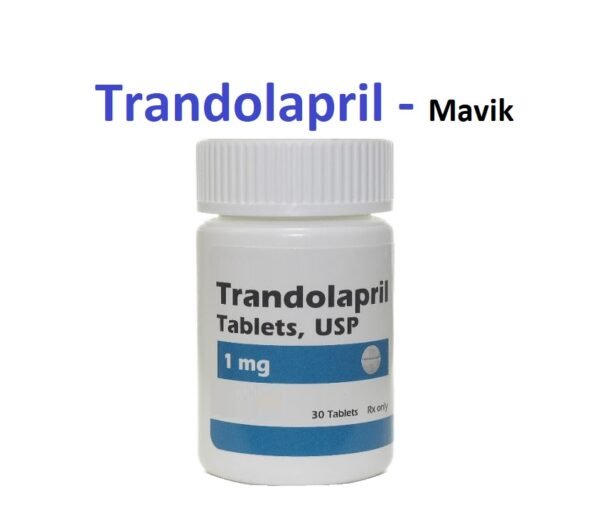
Angiotensin-converting enzyme inhibitor trandolapril (Mavik) is used to treat heart failure and hypertension in individuals.
Trandolapril Uses:
-
Hypertension
- Use to manage high blood pressure .
- Guidelines:
- In the absence of comorbidities (such as cerebrovascular disease, chronic kidney disease, diabetes, heart failure [HF], ischemic heart disease, etc.), the 2017 Guideline for the Prevention, Detection, Evaluation, and Management of
- Hypertension in Adults suggests that thiazide-like diuretics or dihydropyridine calcium channel blockers may be preferable options due to improved cardiovascular endpoints (eg, prevention of HF and stroke).
- ARBs and ACE inhibitors are also suitable for monotherapy.
- Combination therapy is initially favoured in patients at high risk (stage 2 hypertension or atherosclerotic cardiovascular disease [ASCVD] risk 10%) and may be necessary to reach blood pressure objectives.
-
Post-myocardial infarction (MI) heart failure dysfunction:
- Treatment of post-myocardial infarction left ventricular dysfunction in stable patients who have signs of left ventricular systolic dysfunction or post-myocardial infarction heart failure in patients who experience symptoms of the condition within a few days of suffering an acute myocardial infarction (identified by wall motion abnormalities)
-
Off Label Use in Adults:
- Non–ST-elevation acute coronary syndrome
- ST-elevation acute coronary syndrome
- Stable coronary artery disease
- Heart failure
Trandolapril (Mavik) Dose in Adults
Treatment of Hypertension:
- Oral: Initial: 1 mg once per day
- Depending on the patient's response, titrate the dose up to 4 mg once per day at intervals of 1 week.
- Less is known about doses greater than 8 mg per day.
Trandolapril (Mavik) Dose in the treatment of Post-MI heart failure or LV dysfunction:
- Oral: Initial: Titrate (as tolerated) from 1 mg once day to a target dose of 4 mg once daily.
- Patients may continue therapy with the highest tolerated dose if a 4 mg dose is not tolerated.
- According to the American College of Cardiology/American Heart Association guidelines, a 0.5 mg test dosage should be used, and the dose should be increased to 4 mg daily as tolerated.
Treatment of Heart failure with reduced ejection fraction:
- Oral: Initial: 1 mg once per day; target dose: 4 mg once per day.
Use in Children:
Not indicated.
Pregnancy Risk Factor D
- [US Boxed Warning]
- Once pregnancy is confirmed, stop therapy immediately.
- Drugs that influence the renin/angiotensin system can be extremely harmful to the growing foetus and even be deadly.
- Oligohydramnios may cause fetal kidney dysfunction and skeletal malformations.
- These drugs can also cause anuria and hypotension in pregnancy.
- Oligohydramnios is linked to drugs that affect the RAAS (renin-angiotensin-aldosterone system).
- Exposure to ACE inhibitors during pregnancy can cause adverse fetal outcomes. This is why it is not recommended.
- Although using an ACE-inhibitor when pregnant has the potential to have teratogenic effects (although this may be confounded with maternal disease),
- ACE drug exposure in utero should be monitored for hyperkalemia, hypotension, and oliguria in infants.
- Oligohydramnios cannot be detected until there has been significant foetal kidney impairment.
- Although dialysis is occasionally required to treat hypotension and enhance renal function, it is not always successful.
- Adverse outcomes for the mother and child can also be linked to chronic maternal hypertension.
- Pregnancy is not the time to take ACE inhibitors to treat simple hypertension.
- According to certain recommendations, they should not be used during pregnancy to treat chronic heart disease and hypertension.
- Women of childbearing years should also avoid ACE inhibitors.
- Other agents may be required if treatment is required for hypertension and chronic heart failure during pregnancy.
Trandolapril use during breastfeeding:
- It is unknown if breast milk contains trandolapril. It is not recommended to breastfeed.
Trandolapril (Mavik) Dose in Kidney Disease:
-
Manufacturer labeling:
- CrCl ≥30 mL/minute:
- No dosage adjustments provided.
- CrCl <30 mL/minute:
- Initial: 0.5 mg once per day; titrate as tolerated to optimal response.
- CrCl ≥30 mL/minute:
-
Alternate dosing: Recommendations based on an initial dose of 1 to 2 mg/day in normal renal function;
- GFR >50 mL/minute:
- No dosage adjustment is necessary
- GFR 10 to 50 mL/minute:
- Administer 50% to 100% of dose
- GFR <10 mL/minute:
- Administer 50% of dose
- GFR >50 mL/minute:
Trandolapril (Mavik) Dose in Liver disease:
-
Mild to severe impairment:
- No dosage adjustments provided on labeling;
- usage with caution in people who have liver disease.
-
Cirrhosis:
- Initial: 0.5 mg once per day
- titrate to achieve the best response as tolerated.
Data from trials on hypertension and heart failure are included in the frequency ranges. Patients with heart failure have often been found to experience higher rates of adverse effects. In this demographic, however, there are also more harmful effects linked to placebos.
Common Side Effects of Trandolapril (Mavik):
-
Cardiovascular:
- Hypotension
-
Central nervous system:
- Dizziness
-
Endocrine & metabolic:
- Increased uric acid
-
Respiratory:
- Cough
Less Common Side Effects of Trandolapril (Mavik):
-
Cardiovascular:
- Syncope
- Bradycardia
- Cardiogenic Shock
- Intermittent Claudication
- Cerebrovascular Accident
-
Endocrine & Metabolic:
- Hyperkalemia
- Hypocalcemia
-
Gastrointestinal:
- Gastritis
- Diarrhea
-
Neuromuscular & Skeletal:
- Myalgia
- Weakness
-
Renal:
- Increased Serum Creatinine
- Increased Blood Urea Nitrogen
Contraindications to Trandolapril (Mavik):
- Hypersensitivity to trandolapril and any formulation component when given in conjunction with aliskiren in diabetic individuals, or within 36 hours of starting or stopping a neprilysin inhibitor (such as sacubitril).
- hereditary/idiopathic angioedema
- Angioedema history prior to the use of an ACE inhibitor
There is not much evidence of cross-reactivity between ACE Inhibitors and allergens.
Similarities in chemical structure or pharmacologic outcomes may cause cross-sensitivity. Labeling in Canada: Additional warnings not included in US labelling
- Intolerance to alternative ACE inhibitors
- Women who are reproductive potential but are not utilising effective contraception, including those who are pregnant or who intend to become pregnant.
- Breastfeeding
- hemodynamically unstable and hypotensive situations
- Bilateral arterial stenosis of hemodynamic significance, or substantial artery narrowing in a kidney with only one working kidney.
concurrent usage of valsartan and sacubitril; - Patients who have heart failure (hypotensive) or type 1 or type 2 diabetes, moderate or severe renal impairment (GFR 60 mL/minute/1.73 m2), hyperkalemia (>5 mMol/L), or diabetes mellitus should not take ACE inhibitors, angiotensin-receptor blockers (ARBs), or medications containing aliskiren simultaneously.
- Hereditary conditions include glucose intolerance, Lapp lactase deficiency, and glyco-galactose malabsorption.
Warnings and precautions
-
Angioedema
- Angioedema can happen at any time, however it is more common after an ACE inhibitor's initial dose. It might be an unusual occurrence.
- African Americans and those with genetic or idiopathic angioedema may be more susceptible.
- The risk may be increased by concurrent therapy with a mTOR inhibitor (such as everolimus) or a neprilysin inhibitor (such as sacubitril).
- You may need to monitor your airway frequently if you have a tongue, glottis or larynx. This could cause obstruction of the airway.
- Patients who have had previous airway surgery may be at greater risk for obstruction.
- It is crucial to be aggressive early and appropriately managed.
- Patients with angioedema from ACE inhibitor therapy are not recommended.
-
Cholestatic jaundice
- Cholestatic jaundice is a rare side effect of ACE inhibitors. It can progress to fulminant hepatic neoplasm (some fatal); stop taking ACE inhibitors if you notice a marked increase in hepatic transaminases and jaundice.
-
Cough:
- Use of ACE inhibitors may result in a hacking, dry cough that is ineffective. Within the first few months of treatment, this typically occurs. It ought to go away in one to four weeks.
- Prior to stopping treatment, it's necessary to take alternative cough reasons into account (eg, pulmonary congestion in heart failure patients).
-
Hematologic effects
- Another ACE medication, captopril, has been connected to agranulocytosis, neutropenia, and myeloid hypoplasia. It's also possible to have anaemia and thrombocytopenia.
- Patients who have kidney disease are more likely to experience neutropenia.
- Neutropenia is more likely to occur in patients with collagen vascular disease and renal impairment (such as systemic lupus erythematosus).
- CBC should be routinely monitored in patients with a differential.
-
Hyperkalemia:
- Risk factors for hyperkalemia include kidney disease, diabetes, and the use of potassium-sparing diuretics or potassium supplements concurrently.
- Potassium levels should be carefully checked while using these medications.
-
Hypersensitivity reactions
- With ACE inhibitors, anaphylactic/anaphylactoid responses can happen.
- Hemodialysis, high-flux dialysis membranes, such as AN69, and low density lipoprotein (dextran sulphate cellulose) apheresis are two procedures that can cause severe anaphylactoid reactions.
- Patients who have received ACE inhibitors and are subject to sensitization with Hymenoptera (bee or wasp) venom have had rare cases of anaphylactoid reactions.
-
Hypotension/syncope
- Both syncope and hypotension symptoms can be brought on by ACE inhibitors. typically during the initial doses.
- Even when dosage adjustments are required, hypotension is not a reason to stop taking ACE inhibitors in the future. This is particularly true for HF patients.
-
Renal function deterioration:
- In patients with impaired renal perfusion, this may worsen renal function and/or raise serum creatinine and/or BUN levels (eg, kidney artery stenosis or heart failure). Oliguria and acute renal failure can occur in patients whose glomerular filter rate (GFR) is dependent on angiotensin II efferent arterial vasoconstriction.
- Initial serum creatinine levels may increase slightly but are not recommended for discontinuation unless there is a significant impairment to renal function.
-
Aortic stenosis
- Patients with aortic Stenosis should be used carefully. It may cause decreased coronary perfusion, which can lead to ischemia.
-
Ascites:
- Patients with ascites from cirrhosis and refractory ascites should not be used. If it is impossible to avoid ascites in patients suffering from cirrhosis or ascites.
-
Cardiovascular disease
- Patients with ischemic heart disease and cerebrovascular diseases should be closely monitored when initiating therapy. This is because of the possible consequences of lowering blood pressure, e.g stroke or myocardial damage.
- Fluid replacement may be done to maintain blood pressure. Therapy can then resume if necessary.
- Patients with hypotension should stop using it.
-
Collagen vascular disease:
- Patients with collagen vascular disease, especially those who also have concurrent renal impairment, should use this medicine with caution.
-
Hepatic impairment
- Hepatic patients need to exercise cautious. It is advised that people with severe cirrhosis adjust their dosage. Patients with cirrhosis ought to think about taking lesser doses.
- Hepatic patients need to exercise cautious. It is advised that people with severe cirrhosis adjust their dosage. Patients with cirrhosis ought to think about taking lesser doses.
-
Hypertrophic cardiomyopathy with outflow tract obstruction (HCM)
- Patients with HCM or outflow tract obstruction should be cautious as a reduction in afterload could worsen the symptoms.
-
Renal artery stenosis
- Patients with unilateral or bilateral renal artery stenosis that is untreated need to be closely watched.
- It is advised to avoid use if there is untreated bilateral renal arterial stenosis unless the benefits may outweigh the hazards.
-
Renal impairment
- Patients with kidney disease should exercise caution; patients with CrCl 30mL/minute should have their dose adjusted.
- Avoid rapid dose escalation as it can cause further renal impairment.
Trandolapril: Drug Interaction
|
Alfuzosin |
The hypotensive effects of blood pressure-lowering medications may be strengthened. |
|
Amphetamines |
May lessen the effectiveness of antihypertensive agents. |
|
Angiotensin II |
The therapeutic efficacy of angiotensin II may be enhanced by angiotensin-converting enzyme inhibitors. |
|
Antipsychotic Agents (Second Generation [Atypical]) |
Antipsychotic drugs' hypotensive effects may be enhanced by blood pressure-lowering medications (Second Generation [Atypical]). |
|
Aprotinin |
May lessen the effectiveness of angiotensin-converting enzyme inhibitors in treating hypertension. |
|
AzaTHIOprine |
AzaTHIOprine's myelosuppressive effects may be enhanced by angiotensin-converting enzyme inhibitors. |
|
Barbiturates |
The hypotensive effects of blood pressure-lowering medications may be strengthened. |
|
Benperidol |
The hypotensive effects of blood pressure-lowering medications may be strengthened. |
|
Brigatinib |
May lessen the effectiveness of antihypertensive agents. Antihypertensive Agents' bradycardic action may be strengthened by brutinib. |
|
Brimonidine (Topical) |
The hypotensive effects of blood pressure-lowering medications may be strengthened. |
|
Dapoxetine |
May increase the angiotensin-converting enzyme inhibitors' orthostatic hypotensive effects. |
|
Dexmethylphenidate |
Can lessen an antihypertensive drug's therapeutic impact. |
|
Diazoxide |
The hypotensive effects of blood pressure-lowering medications may be strengthened. |
|
Dipeptidyl Peptidase-IV Inhibitors |
May intensify angiotensin converting enzyme inhibitors' hazardous or harmful effects. Particularly, there may be a higher incidence of angioedema. |
|
Drospirenone |
Drospirenone's hyperkalemic impact may be enhanced by angiotensin-converting enzyme inhibitors. |
|
DULoxetine |
The hypotensive impact of DULoxetine may be enhanced by blood pressure lowering medications. |
|
Eplerenone |
May lessen the effectiveness of angiotensin-converting enzyme inhibitors in treating hypertension. |
|
Everolimus |
May intensify angiotensin-converting enzyme inhibitors' harmful or hazardous effects. Particularly, there may be a higher incidence of angioedema. |
|
Ferric Gluconate |
Angiotensin-Converting Enzyme Inhibitors might make ferric gluconate more harmful or poisonous. |
|
Ferric Hydroxide Polymaltose Complex |
Ferric Hydroxide Polymaltose Complex may have a more negative or toxic effect when taken with angiotensin-converting enzyme inhibitors. In particular, there may be an elevated risk for angioedema or allergic responses. |
|
Gelatin (Succinylated) |
Gelatin's harmful or toxic effects may be increased by angiotensin-converting enzyme inhibitors (Succinylated). Particularly, there may be a higher chance of a paradoxical hypotensive reaction. |
|
Gold Sodium Thiomalate |
Gold Sodium Thiomalate may have a more negative or toxic effect when used with angiotensin-converting enzyme inhibitors. Nitritoid responses are more likely now, it has been noted. |
|
Heparin |
May lessen the effectiveness of angiotensin-converting enzyme inhibitors in treating hypertension. |
|
Heparins (Low Molecular Weight) |
Angiotensin-Converting Enzyme Inhibitors may intensify their hyperkalemic effects. |
|
Herbs (Hypertensive Properties) |
May lessen the effectiveness of antihypertensive agents. |
|
Herbs (Hypotensive Properties) |
The hypotensive effects of blood pressure-lowering medications may be strengthened. |
|
Hypotension-Associated Agents |
The hypotensive action of hypotension-associated agents may be strengthened by blood pressure lowering medications. |
|
Icatibant |
May lessen the effectiveness of angiotensin-converting enzyme inhibitors in treating hypertension. |
|
Levodopa-Containing Products |
Levodopa-Containing Products' hypotensive effects may be strengthened by blood pressure-lowering medications. |
|
Loop Diuretics |
May strengthen angiotensin-converting enzyme inhibitors' hypotensive effects. Angiotensin-Converting Enzyme Inhibitors' nephrotoxic effects may be increased by loop diuretics. |
|
Lormetazepam |
The hypotensive effects of blood pressure-lowering medications may be strengthened. |
|
Methylphenidate |
May lessen the effectiveness of antihypertensive agents. |
|
Molsidomine |
The hypotensive effects of blood pressure-lowering medications may be strengthened. |
|
Naftopidil |
The hypotensive effects of blood pressure-lowering medications may be strengthened. |
|
Nicergoline |
The hypotensive effects of blood pressure-lowering medications may be strengthened. |
|
Nicorandil |
May lessen the effectiveness of angiotensin-converting enzyme inhibitors in treating hypertension. |
|
Nicorandil |
The hypotensive effects of blood pressure-lowering medications may be strengthened. |
|
Nitroprusside |
Nitroprusside's hypotensive impact may be strengthened by blood pressure-lowering medications. |
|
Nonsteroidal Anti-Inflammatory Agents |
Nonsteroidal Anti-Inflammatory Agents' negative/toxic effects may be increased by angiotensin-converting enzyme inhibitors. In particular, the combination may cause a marked decline in renal function. Angiotensin-Converting Enzyme Inhibitors' antihypertensive effects may be lessened by nonsteroidal anti-inflammatory drugs. |
|
Pentoxifylline |
The hypotensive effects of blood pressure-lowering medications may be strengthened. |
|
Pholcodine |
Pholcodine's hypotensive impact may be strengthened by blood pressure lowering medications. |
|
Phosphodiesterase 5 Inhibitors |
The hypotensive effects of blood pressure-lowering medications may be strengthened. |
|
Potassium Salts |
May lessen the effectiveness of angiotensin-converting enzyme inhibitors in treating hypertension. |
|
Potassium-Sparing Diuretics |
May lessen the effectiveness of angiotensin-converting enzyme inhibitors in treating hypertension. |
|
Pregabalin |
Angiotensin-Converting Enzyme Inhibitors may intensify Pregabalin's negative/toxic effects. Particularly, there may be a higher incidence of angioedema. |
|
Prostacyclin Analogues |
The hypotensive effects of blood pressure-lowering medications may be strengthened. |
|
Quinagolide |
The hypotensive effects of blood pressure-lowering medications may be strengthened. |
|
Racecadotril |
May intensify angiotensin-converting enzyme inhibitors' harmful or hazardous effects. In particular, this combination may make angioedema more likely. |
|
Ranolazine |
May lessen the effectiveness of angiotensin-converting enzyme inhibitors in treating hypertension. |
|
Salicylates |
May intensify angiotensin-converting enzyme inhibitors' nephrotoxic effects. The therapeutic benefit of angiotensin-converting enzyme inhibitors may be reduced by salicylates. |
|
Sirolimus |
May lessen the effectiveness of angiotensin-converting enzyme inhibitors in treating hypertension. |
|
Tacrolimus (Systemic) |
Tacrolimus's effect of making you more hyperkalemic may be enhanced by angiotensin-converting enzyme inhibitors (Systemic). |
|
Temsirolimus |
May lessen the effectiveness of angiotensin-converting enzyme inhibitors in treating hypertension. |
|
Thiazide and Thiazide-Like Diuretics |
May increase the angiotensin-converting enzyme inhibitors' hypotensive effects. Angiotensin-Converting Enzyme Inhibitors' nephrotoxic effects may be increased by thiazide and thiazide-like diuretics. |
|
TiZANidine |
May lessen the effectiveness of angiotensin-converting enzyme inhibitors in treating hypertension. |
|
Tolvaptan |
May lessen the effectiveness of angiotensin-converting enzyme inhibitors in treating hypertension. |
|
Trimethoprim |
May lessen the effectiveness of angiotensin-converting enzyme inhibitors in treating hypertension. |
|
Yohimbine |
May lessen the effectiveness of antihypertensive agents. |
|
Risk Factor D (Consider therapy modification) |
|
|
Aliskiren |
Angiotensin-Converting Enzyme Inhibitors may intensify their hyperkalemic effects. Angiotensin-Converting Enzyme Inhibitors' hypotensive effects may be strengthened by aliskiren. Angiotensin-Converting Enzyme Inhibitors' nephrotoxic effects may be made worse by aliskiren. Treatment: It is not advised for diabetic patients to take aliskiren along with ACEIs or ARBs. Combination therapy should be avoided in other patients, especially when CrCl is less than 60 mL/min. If combined, keep a close eye on your blood pressure, potassium, and creatinine levels. |
|
Allopurinol |
Angiotensin-Converting Enzyme Inhibitors might make Allopurinol more likely to cause allergic or hypersensitive reactions. |
|
Amifostine |
Amifostine's hypotensive impact may be strengthened by blood pressure lowering medications. Treatment: Blood pressure-lowering drugs need to be avoided for 24 hours before amifostine is administered when used at chemotherapeutic doses. Amifostine should not be given if blood pressure lowering treatment cannot be stopped. |
|
Angiotensin II Receptor Blockers |
May worsen angiotensin-converting enzyme inhibitors' toxic or severe effects. Angiotensin-Converting Enzyme Inhibitors' serum levels may rise in response to angiotensin II receptor blockers. Management: According to US labelling, it is not advisable to take telmisartan and ramipril. It is unclear whether another ACE inhibitor and ARB combo would be any safer. When possible, take into account alternatives to the mix. |
|
Grass Pollen Allergen Extract (5 Grass Extract) |
Grass pollen allergen extract may have a more negative or toxic effect if angiotensin-converting enzyme inhibitors are used (5 Grass Extract). With regard to grass pollen allergen extract, ACE inhibitors may specifically enhance the likelihood of a severe allergic reaction (5 Grass Extract). |
|
Iron Dextran Complex |
Angiotensin-Converting Enzyme Inhibitors might make Iron Dextran Complex more harmful or poisonous. Patients taking an ACE inhibitor may be more susceptible to events of the anaphylactic variety. Management: Adhere strictly to the instructions for iron dextran administration, including the use of a test dose before the initial therapeutic dose and the availability of resuscitation tools and qualified people. |
|
Lanthanum |
May lower angiotensin-converting enzyme inhibitors' serum concentration. Angiotensin-converting enzyme inhibitors should be given at least two hours before or after lanthanum. |
|
Lithium |
The serum concentration of lithium may rise in response to angiotensin-converting enzyme inhibitors. Management: After adding an ACE inhibitor, lithium dosage decreases will probably be required. Following the addition or discontinuation of concurrent ACE inhibitor therapy, carefully monitor the patient's response to lithium. |
|
Obinutuzumab |
The hypotensive effects of blood pressure-lowering medications may be strengthened. Management: Take into account temporarily stopping blood pressure-lowering drugs 12 hours before the start of the obinutuzumab infusion and keeping them off until 1 hour after the infusion is finished. |
|
Sodium Phosphates |
The nephrotoxic impact of sodium phosphates may be enhanced by angiotensin-converting enzyme inhibitors. In particular, there may be an increased risk of acute phosphate nephropathy. Treatment: You might want to temporarily stop taking ACEIs or look into alternatives to the oral sodium phosphate bowel preparation in order to prevent this combo. Maintaining appropriate hydration and properly monitoring renal function should be done if the combination cannot be avoided. |
|
Urapidil |
Angiotensin-Converting Enzyme Inhibitors may interact with them through an unidentified method. Avoid taking urapidil and ACE inhibitors simultaneously as a management strategy. |
|
Risk Factor X (Avoid combination) |
|
|
Bromperidol |
The hypotensive impact of bromperidol may be enhanced by blood pressure lowering medications. Blood Pressure Lowering Agents' hypotensive effects may be lessened by bromperidol. |
|
Sacubitril |
The negative or hazardous effects of sacubitril may be increased by angiotensin-converting enzyme inhibitors. In particular, this combination may raise the risk of angioedema. |
Monitoring parameters:
Blood pressure, BUN, serum creatinine, and electrolytes are all important measurements. If the patient has collagen vascular disease or renal impairment, complete blood count with differential is also frequently checked.
Heart Failure:
- Reassess renal function and serum potassium in patients with preexisting hypotension, hyponatremia, diabetes mellitus, azotemia, or those taking potassium supplements within 1 to 2 weeks of treatment's start-up and on an ongoing basis after that.
Hypertension:
- The 2017 Guideline for the Prevention, Detection, Evaluation, and Management of High Blood Pressure in Adults:
- Confirmed hypertension and known CVD or 10-year atherosclerotic cardiovascular disease (ASCVD) risk ≥10%:
- Target blood pressure <130/80 mm Hg is recommended
- Confirmed hypertension without markers of increased ASCVD risk:
- Target blood pressure <130/80 mm Hg may be reasonable
- Confirmed hypertension and known CVD or 10-year atherosclerotic cardiovascular disease (ASCVD) risk ≥10%:
- Diabetes and hypertension: The American Diabetes Association (ADA) guidelines:
- Patients 18 to 65 years of age, without ASCVD, and 10-year ASCVD risk <15%:
- Target blood pressure <140/90 mm Hg is recommended.
- Patients 18 to 65 years of age and known ASCVD or 10-year ASCVD risk >15%:
- Target blood pressure <130/80 mm Hg may be appropriate if it can be safely attained.
- Patients >65 years of age (healthy or complex/intermediate health):
- Target blood pressure <140/90 mm Hg is recommended.
- Patients >65 years of age (very complex/poor health):
- Target blood pressure <150/90 mm Hg is recommended.
- Patients 18 to 65 years of age, without ASCVD, and 10-year ASCVD risk <15%:
How to administer Trandolapril (Mavik)?
- Can be administered with no regard to meals. To avoid first-dose hypotension, the patient must be asked to remain seated for 30 minutes after the first dose.
Mechanism of action of Trandolapril (Mavik):
- To convert trandolapril into its physiologically active metabolite, trandolaprilat, trandolapril must be enzymatically degraded, primarily in the liver.
- Angiotensin I raises the CNS's adrenergic output, which suggests that the hypotensive effects may potentially be mediated through a CNS mechanism.
- ACE inhibitors may slow the conversion of vasoactive kallikreins to active hormones, lowering blood pressure.
Absorption:
- Food intake may slow down its absorption.
Protein binding:
- Trandolapril: ~80%;
- Trandolaprilat: 65% to 94% (concentration dependent)
Metabolism:
- Hydrolyze to active metabolites in the liver, trandolaprilat, and at least 7 other metabolites.
Bioavailability:
- Trandolapril: ~10%;
- Trandolaprilat: ~70%
Half-life elimination:
- Trandolapril: ~6 hours;
- Trandolaprilat: Effective: 22.5 hours
Time to peak:
- Trandolapril: ~1 hour;
- Trandolaprilat: 4 to 10 hours
Excretion:
- Urine (~33% as trandolapril and trandolaprilat);
- feces (~66%)
International Brand Names of Trandolapril:
- Mavik
- AURO-Trandolapril
- Odrik
- PMS-Trandolapril
- SANDOZ Trandolapril
- TEVA-Trandolapril
- Actapril
- Dolapril
- Gopten
- Larineo
- Mavik
- Nortensin
- Odace
- Odrik
- Tranalpha
- Trandoged
- Udrik
Trandolapril Brand Names in Pakistan:
Trandolapril Tablets 2 mg in Pakistan |
|
| Gopten | Abbott Laboratories (Pakistan) Limited. |
Trandolapril Tablets 0.5 mg in Pakistan |
|
| Gopten | Abbott Laboratories (Pakistan) Limited. |
.png)


