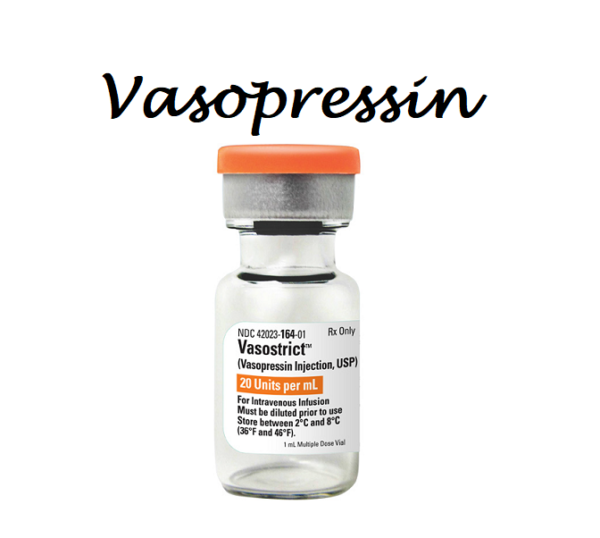
Vasopressin stimulates arginine vasopressin (AVP) receptors, oxytocin, and purinergic receptors. It is used to treat the following conditions:
-
Central Diabetes insipidus (Pitressin Synthetic only):
-
To increase blood pressure in adults with vasodilatory shock (eg, postcardiotomy or sepsis) who remain hypotensive despite fluid resuscitation and catecholamines
-
Off Label Usage of Vasopressin in Adults include:
-
Cadaveric organ recovery (hormone replacement therapy)
-
Gastroesophageal variceal hemorrhage
-
Vasopressin Dose in Adults
Usage as an alternative agent in central Diabetes insipidus:
- Dosage is highly variable
- It can be titrated based on serum and urine sodium and osmolality in addition to fluid balance and urine output.
- Use of vasopressin is impractical for chronic therapy.
- Intramuscular, SubQ:
- 5 to 10 units 2 to 4 times daily as required
-
Continuous Intravenous infusion (off-label route):
- A continuous infusion has not been evaluated in the post-neurosurgical adult.
- However, some physicians convert Intramuscular/SubQ requirement to an hourly continuous Intravenous infusion rate
Usage in the treatment of vasodilatory shock:
- Vasopressors should be used if the patient is hypotensive during or after fluid resuscitation to maintain mean arterial pressure (MAP) more than 65 mm Hg.
- It is used in addition to norepinephrine (preferred single-agent vasopressor) for raising MAP to target or to decrease norepinephrine dosage
- Titrate to the lowest effective dose.
-
Shock, post-cardiotomy:
- Initially, 0.03 units/minute intravenous is given.
- If the target blood pressure response is not achieved, then titrate up by 0.005 units/minute at 10- to 15-minute intervals
- The maximum dose is 0.1 units/minute.
- After target blood pressure has been maintained for 8 hours without the use of catecholamines, it can be tapered by 0.005 units/minute every hour as tolerated to maintain target blood pressure.
-
Shock, sepsis:
- Initially, ≤0.03 units/minute Intravenous is added to norepinephrine to raise MAP to target or to decrease norepinephrine dose.
- Use cautiously in patients who are not euvolemic or at doses >0.03 units/minute
-
Discontinuation in septic shock:
- When stopping therapy, consider slowly tapering by 0.01 units/minute every 30 to 60 minutes to reduce the risk of hypotension
- Cautiously monitor MAP when discontinuing vasopressin.
-
Manufacturer's labeling:
- Dosing in the prescribing information might not reflect current clinical practice.
- Initially 0.01 units/minute.
- The maximum dose is 0.07 units/minute.
Off label usage in the treatment of Cadaveric organ recovery (hormone replacement therapy):
- Use if the patient is hypotensive despite adequate fluid resuscitation, left ventricular ejection fraction <45%, low systemic vascular resistance (SVR), or if diabetes insipidus is present.
- Use along with levothyroxine (or liothyronine), methylprednisolone, and continuous insulin infusion (goal blood glucose: 120 to 180 mg/dL)
- Initially, 0.01 to 0.04 units/minute Intravenous is given
- some experts also recommend a bolus of 1 unit followed by 0.01 to 0.1 units/minute titrated to an SVR of 800 to 1,200 dynes-sec/cm²
- usual dose is 0.01 to 0.04 units/minute
Off label usage in the treatment of Gastroesophageal variceal hemorrhage (alternative agent):
-
Continuous Intravenous infusion:
- Initially 0.2 to 0.4 units/minute is given
- It may be titrated as needed to a maximum dose of 0.8 units/minute
- The maximum duration is 24 hours at the highest effective dose (to reduce the incidence of adverse effects).
- Give Intravenous nitroglycerin concurrently to prevent ischemic complications
- Monitor closely for signs and symptoms of myocardial, peripheral, and bowel ischemia.
Vasopressin Dose in Childrens
Usage in the treatment of Diabetes insipidus:
- Dose is highly variable
- Titrate the dosage based upon serum and urine sodium and osmolality in addition to fluid balance and urine output.
-
Children and Adolescents:
- Intramuscular, SubQ:
- 2.5 to 10 units 2 to 4 times daily is given
- Intramuscular, SubQ:
Central diabetes insipidus:
-
Infants, Children, and Adolescents:
- Continuous Intravenous infusion:
- Initially 0.5 milliunits/kg/hour is given
- Then titrate in 0.5 milliunits/kg/hour increments at approximately 10-minute intervals to target urine output
- Urine output target: <2 mL/kg/hour
- Infusion rates up to 10 milliunits/kg/hour have been seen.
- Use in combination with fluid therapy, monitor urine output and specific gravity, serum and urine electrolytes (primarily Na), and plasma osmolality.
- Continuous Intravenous infusion:
Usage in the treatment of hormone replacement therapy of Cadaveric organ donations:
-
Infants, Children, and Adolescents:
- Continuous Intravenous infusion:
- Initially 0.5 to 1 milliunits/kg/hour is given
- Titrate dose to maintain target urine output.
- Continuous Intravenous infusion:
Use in the treatment of Gastrointestinal hemorrhage:
-
Children and Adolescents:
- Continuous Intravenous infusion:
- Initial dose is 2 to 5 milliunits/kg/minute
- Titrate this dose as needed to a maximum dose of10 milliunits/kg/minute
- usual adult dosing range is 0.2 to 0.4 units/minute up to a maximum rate of 0.8 units/minute.
- Higher doses are not associated with greater efficacy but have been associated with increased risk of complications
- Continuous Intravenous infusion:
Usage in the treatment of Pulseless arrest, ventricular fibrillation, ventricular tachycardia:
-
Infants, Children, and Adolescents:
- 0.4 units/kg Intravenous as a single dose is given after traditional resuscitation methods and at least 2 doses of epinephrine have been administered.
Usage in the treatment of Vasodilatory shock with hypotension unresponsive to fluid resuscitation and exogenous catecholamines:
-
Infants, Children, and Adolescents:
- Continuous Intravenous infusion:
- 0.17 to 8 milliunits/kg/minute (0.01 to 0.48 units/kg/hour) is given
- Increases in arterial blood pressure and urine output and also allowed for dose reductions of additional vasopressors.
- The authors do not recommend routine use of vasopressin.
- Abrupt discontinuation of infusion can result in hypotension; to discontinue, gradually taper infusion.
- Continuous Intravenous infusion:
Pregnancy Risk Factor C
- Studies on animal reproduction have not been done.
- Vasopressin may cause tonic uterine contractions
- This effect is unlikely to occur if you have diabetes insipidus.
Use of Vasopressin during lactation
- It is unknown if vasopressin can be found in breast milk.
- Vasopressin is quickly destroyed in the GI tract, so oral absorption by breastfeeding babies is unlikely
- To reduce exposure to breastfed infants, pump and discard breast milk for at least 1.5 hours after receiving vasopressin (Vasostrict only).
- The manufacturer suggests that breastfeeding mothers be cautious when using vasopressin.
Vasopressin dose in Renal disease:
No dose adjustments have been advised by manufacture in patient with kidney disease.
Vasopressin dose in Liver disease:
No dose adjustments have been advised by manufacture in patient with liver disease.
Side effects of Vasopressin
-
Cardiovascular:
- Angina Pectoris
- Atrial Fibrillation
- Bradycardia
- Cardiac Arrest
- Cardiac Arrhythmia
- Ischemic Heart Disease
- Limb Ischemia (Distal)
- Localized Blanching
- Low Cardiac Output
- Myocardial Infarction
- Right Heart Failure
- Shock
- Vasoconstriction (Peripheral)
-
Central Nervous System:
- Headache (Pounding)
- Vertigo
-
Dermatologic:
- Circumoral Pallor
- Diaphoresis
- Gangrene Of Skin Or Other Tissues
- Skin Lesion (Ischemic)
- Urticaria
-
Endocrine & Metabolic:
- Hyponatremia
- Hypovolemic Shock
- Water Intoxication
-
Gastrointestinal:
- Abdominal Cramps
- Flatulence
- Mesenteric Ischemia
- Nausea
- Vomiting
-
Hematologic & Oncologic:
- Decreased Platelet Count
- Hemorrhage (Intractable)
-
Hepatic:
- Increased serum bilirubin
-
Hypersensitivity:
- Anaphylaxis
-
Neuromuscular & skeletal:
- Tremor
-
Renal:
- Renal insufficiency
-
Respiratory:
- Bronchoconstriction
Contraindication to Vasopressin include:
- Hypersensitivity to vasopressin and any part of the formulation
- Hypersensitivity to chlorobutanol (Vasostrict only).
- Chronic untreated nephritis (Pitressin synthetic only)
Warnings and precautions
- Extravasation:
- It is a vesicant.
- Before and during infusion, ensure that the catheter/ needle is properly placed.
- Extravasation can cause severe vasoconstriction, tissue necrosis, and even gangrene.
- Avoid extravasation.
- Intoxication with water:
- Water intoxication can occur, and should be treated promptly to avoid seizures or coma.
- Early symptoms include listlessness, drowsiness and headaches.
- Asthma
- Patients with asthma should be cautious.
- Cardiovascular disease
- Patients with arteriosclerosis or cardiovascular disease should be cautious. This could lead to a decrease in cardiac output.
- Goiter:
- Patients with a goiter or other cardiac problems should be cautious.
- Migraine
- Patients with migraine history should be cautious.
- Renal impairment
- Patients with kidney disease should be cautious.
- Seizures:
- Patients with seizure disorders should be cautious.
- Vascular disease
- Patients with vascular disease should be cautious.
Monitor:
- Serum and urine sodium
- urine specific gravity
- urine and serum osmolality
- urine output, fluid input and output
- blood pressure, heart rate
- digital/extremity perfusion
How to administer Vasopressin?
Intramuscular or SubQ:
- Give without further dilution.
Continuous Intravenous infusion:
- Dilution done prior to administration.
- Infusion through central line is advised.
- Vesicant; ensure proper needle or catheter placement before and during infusion; avoid extravasation.
Extravasation management:
- If extravasation occurs, then stop infusion immediately and disconnect (leave cannula/needle in place);
- The line should not be flushed.
- The extravasated solution should be gently aspirated
- Remove the needle/cannula after aspiration
- Elevate the extremity
- Apply topical nitroglycerin.
- Apply warm and dry compresses (based on mechanism of extravasation injury proximal to the injection site).
Nitroglycerin (topical):
- Nitroglycerin topical 2% ointment (based on mechanism of extravasation injury)
- Apply a 1-inch strip to the site of ischemia; can be repeated every 8 hours as necessary
Intranasal (topical administration on nasal mucosa):
- For diabetes insipidus, can be administered injectable vasopressin on cotton plugs, as a nasal spray, or by dropper.
- It should not be inhaled.
Mechanism of action of Vasopressin:
- Vasopressin is a hormone that is produced in the hypothalamus and stored in the posterior prituitary.
- It stimulates the oxytocin and arginine vasopressin receptors (AVP).
- Vasopressin, which is used to induce vasodilatory stress at therapeutic doses in order to increase systemic vascular resistance (or mean arterial blood pressure) and activate the AVPR1a (orV1) receptor, can be used for this purpose.
- A decrease in heart rate or cardiac output could be a result of the above-mentioned events.
- When activated by the AVPR2 or V2 receptor, cyclic adenosine monphosphate (cAMP), increases.
- This in turn increases the water permeability at renal tubules leading to decreased urine volume and an increase in osmolality.
- Vasopressin can cause smooth muscle contractions in the GI tract. It stimulates muscular V1 receptors, and releases prolactin via AVPR1b or V3 receptors.
The beginning of action:
- Nasal in 1 Hour
- Intravenous Vasopressor Effect: Fast, with peak effect occurring within 15 mins of the infusion.
Duration:
- Nasal is 3 to 8 hours
- Intramuscular, SubQ: Antidiuretic: 2 - 8 hours;
- Intravenous: Vasopressor effect: Within 20 minutes after Intravenous infusion stopped
Absorption:
- None from GI tract
- It is destroyed by trypsin in GI tract, must be administered parenterally
Metabolism: Hepatic & renal (inactive metabolites)
Half-life elimination: Intramuscular, Intravenous, SubQ: 10 - 20 minutes (apparent half-life: ≤10 minutes)
Excretion: Nasal: Urine; SubQ: Urine (5% as unchanged drug) after 4 hours; IV: Urine ( almost 6% as unchanged drug)
Vasopressin International Brands:
- C Pressin
- Encrise
- Farpresin
- Hemopressin
- Novopressina-V
- Petresin
- Vasosin
Vasopressin Brands in Pakistan:
No brands available in Pakistan
.png)


