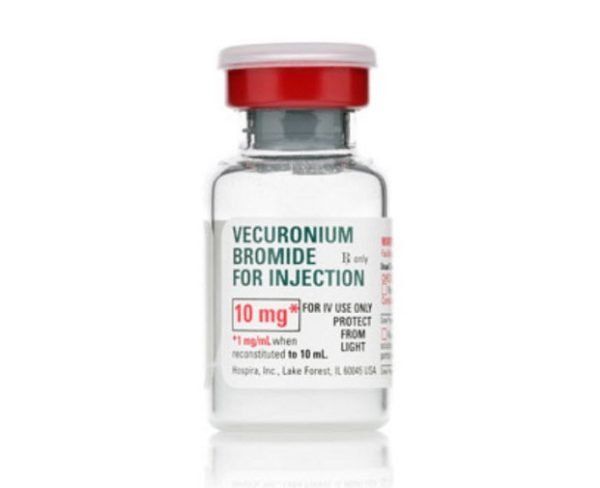
Vecuronium blocks the acetylcholine from binding to receptors on motor endplate inhibiting depolarization.
It is used to help endotracheal intubation and relax skeletal muscles in addition to general anesthesia during surgery or mechanical ventilation in sedated ICU patients.
-
The neuromuscular blockade does not help in pain control, sedation, or amnestic effects.
-
Adequate analgesia and sedative mediations should be given before and during the administration of neuromuscular blockade to help in achieving deep sedation.
Off Label Use of Vecuronium in Adults include:
- Shivering due to therapeutic hypothermia after cardiac arrest
-
Acute respiratory distress syndrome
"It is one of the WHO's lists of essential medicines"
Vecuronium Dose in Adults
- Doses differ due to interpatient variability.
- It should be ensured that adequate pain control and sedation before and during administration neuromuscular blockade to achieve deep sedation.
Dosage in the treatment of Neuromuscular blockade for surgery, endotracheal intubation or mechanical ventilation:
- For tracheal intubation:
- 0.08 - 0.1 mg/kg intravenous is given.
- If intubation is done using succinylcholine, then the dose of vecuronium can be reduced to 0.04 to 0.06 mg/kg with inhalation anesthesia & 0.05 - 0.06 mg/kg with balanced anesthesia.
- Obesity:
- For obese patients having ≥130% of IBW adult patients, can use ideal body weight
- Pretreatment and priming:
- 10% of the intubating dose is given 3 to 5 minutes before intubating dose
Maintenance for continued surgical relaxation after the return of neuromuscular function:
-
- Intermittent dosing is given as 0.01 - 0.015 mg/kg or as continuous infusion of 0.8 to 1.2 mcg/kg/minute (0.048 to 0.072 mg/kg/hour).
- Note: Use the lower end of the dosing range when anesthesia is maintained by an inhaled anesthetic agent
- Redosing interval should be guided by monitoring with a peripheral nerve stimulator.
Off label dosage in the intensive care unit paralysis:
- It can be used for up to 48 hours in patients with early ARDS with PaO2/FiO2 of less than 150 to facilitate mechanical ventilation
- It is used in patients shivering from therapeutic hypothermia
- Initially, a bolus dose of 0.08 to 0.1 mg/kg intravenous is given
- Afterwards a continuous IV infusion of 0.8 to 1.7 mcg/kg/minute (0.048 to 0.102 mg/kg/hour) is given
- Monitoring of depth of blockade every 1 to 2 hours is done until a stable dose, then every 8 to 12 hours.
- Maintenance infusion dose of 0.8 to 1.2 mcg/kg/minute (0.048 to 0.072 mg/kg/hour) is used
- Dosage adjustment:
- The rate should be adjusted in increments of 0.3 mcg/kg/minute (or 0.018 mg/kg/hour) or by 50% reductions of the previous dose as desired clinical response and by using peripheral nerve stimulation response.
- Stop infusion if the neuromuscular function does not return.
- Minimize the depth and duration of paralysis if possible.
- Stop the infusion daily for some time until forced to restart by seeing the patient condition is recommended to reduce post-paralytic complications.
- Intermittent bolus dosage is given as 0.1 to 0.2 mg/kg/dose
- It can be repeated when neuromuscular function returns
- It can be used for shivering from therapeutic hypothermia as 8 to 12 mg, repeated as required to maintain adequate control.
Vecuronium Dose in Childrens
- Dosing in obese patients should be given using ideal body weight.
Dose for Paralysis (as a skeletal muscle relaxant):
- Manufacturer's labeling for Tracheal intubation and Surgical relaxation:
- Infants older than 7 weeks, Children, and Adolescents:
- It is given 0.08 to 0.1 mg/kg IV
- If intubation is done using succinylcholine, then an initial dose of vecuronium may be reduced to 0.04 to 0.06 mg/kg with inhalation anesthesia and 0.05 to 0.06 mg/kg with balanced anesthesia.
- Children 1 to 10 years can require slightly higher initial doses and more frequent supplementation.
- Alternate dosing:
- Infants:
- 0.08 to 0.1 mg/kg/dose IV
- Repeat if necessary
- Continuous IV infusion is given as 0.8 to 1.7 mcg/kg/minute (0.05 to 0.1 mg/kg/hour)
- Children and Adolescents:
- 0.08 to 0.1 mg/kg/dose IV
- Repeat as required
- Continuous IV infusion of 0.8 to 2.5 mcg/kg/minute (0.05 to 0.15 mg/kg/hour)
- Infants:
- Infants older than 7 weeks, Children, and Adolescents:
Pregnancy Risk Factor C
- Although data is not available, it was used for C-sections in pregnancies.
- The pharmacokinetics and toxicity of vecuronium can be altered during pregnancy.
Vecuronium use during breastfeeding:
- It is unknown if breast milk contains vecuronium or not.
- It is important to exercise caution when giving vecuronium breastfeeding women.
Vecuronium Dose in Renal disease:
- There are no dosage adjustments given in the manufacturer’s labeling.
- Patients with renal impairment should not experience clinically significant prolongation of neuromuscular blockade with vecuronium
- In anephric patients, the clinical duration is prolonged.
Vecuronium Dose in Liver Disease:
- There are no dosage adjustments given in the manufacturer’s labeling.
- However, dosage reduction may be required in patients with liver disease.
Side effects of Vecuronium:
- Acute quadriplegic myopathy syndrome
- Bradycardia
- circulatory collapse
- edema
- flushing
- Allergic reactions including hypotension, tachycardia, erythema, rash, and urticaria
- itching
- myositis ossificans with prolonged use.
- rash
Contraindication to Vecuronium Include:
- Allergy reactions to vecuronium and any component of the formulation
- Cross-sensitivity is possible due to similarities in chemical structure or pharmacologic activities.
Warnings and precautions
- Anaphylaxis
- There have been severe anaphylactic reactions.
- Use carefully in patients with previous anaphylactic reactions to other neuromuscular-blocking agents.
- Paralysis for a prolonged period
- Some patients may experience delayed recovery of neuromuscular function following administration.
- Burn injury:
- Patients with burn injuries can resist (>=20% total body surface area).
- This happens often many days after the injury and may continue for several months.
- Conditions that could lead to neuromuscular blockade (decreased parity)
- Antagonism of neuromuscular blocking can occur due to demyelinating lesion, respiratory alkalosis and hypercalcemia.
- Conditions that can increase neuromuscular blockade (increased parity):
- Potentially causing neuromuscular blockade can be caused by electrolyte abnormalities, such as severe hypokalemia or hypocalcemia, hypermagnesemia, neuromuscular diseases and metabolic acidosis.
- Hepatic impairment
- Patients with hepatic impairment should be careful.
- Renal impairment
- Patients with renal impairment don't have any clinically significant prolongation in neuromuscular blockade by vecuronium
- The clinical duration of anephric patients may be longer.
- Respiratory disease
- Patients with an underlying respiratory condition should be cautious.
|
Acetylcholinesterase Inhibitors |
May diminish the neuromuscular-blocking effect of Neuromuscular-Blocking Agents (Nondepolarizing). |
|
Aminoglycosides |
May enhance the respiratory depressant effect of Neuromuscular-Blocking Agents. |
|
Bacitracin (Systemic) |
May enhance the neuromuscular-blocking effect of Neuromuscular-Blocking Agents. |
|
Botulinum Toxin-Containing Products |
May enhance the neuromuscular-blocking effect of Neuromuscular-Blocking Agents. |
|
Bromperidol |
May enhance the neuromuscular-blocking effect of Neuromuscular-Blocking Agents. |
|
Calcium Channel Blockers |
May enhance the neuromuscular-blocking effect of Neuromuscular-Blocking Agents (Nondepolarizing). |
|
Capreomycin |
May enhance the neuromuscular-blocking effect of Neuromuscular-Blocking Agents. |
|
CarBAMazepine |
May decrease the serum concentration of Vecuronium. |
|
Cardiac Glycosides |
Neuromuscular-Blocking Agents may enhance the arrhythmogenic effect of Cardiac Glycosides. |
|
Clindamycin (Topical) |
May enhance the neuromuscular-blocking effect of Neuromuscular-Blocking Agents. |
|
CycloSPORINE (Systemic) |
May enhance the neuromuscular-blocking effect of NeuromuscularBlocking Agents. |
|
Dantrolene |
May enhance the neuromuscular-blocking effect of Vecuronium. |
|
Fosphenytoin-Phenytoin |
May diminish the neuromuscular-blocking effect of NeuromuscularBlocking Agents (Nondepolarizing). Fosphenytoin-Phenytoin may enhance the neuromuscular-blocking effect of Neuromuscular-Blocking Agents (Nondepolarizing). Fosphenytoin-Phenytoin may decrease the serum concentration of Neuromuscular-Blocking Agents (Nondepolarizing). |
|
Inhalational Anesthetics |
May enhance the neuromuscular-blocking effect of Neuromuscular-Blocking Agents (Nondepolarizing). |
|
Ketorolac (Nasal) |
May enhance the adverse/toxic effect of Neuromuscular-Blocking Agents (Nondepolarizing). Specifically, episodes of apnea have been reported in patients using this combination. |
|
Ketorolac (Systemic) |
May enhance the adverse/toxic effect of Neuromuscular-Blocking Agents (Nondepolarizing). Specifically, episodes of apnea have been reported in patients using this combination. |
|
Lincosamide Antibiotics |
May enhance the neuromuscular-blocking effect of NeuromuscularBlocking Agents. |
|
Lithium |
May enhance the neuromuscular-blocking effect of Neuromuscular-Blocking Agents. |
|
Local Anesthetics |
May enhance the neuromuscular-blocking effect of Neuromuscular-Blocking Agents. Exceptions: Benzocaine; Benzydamine; Cocaine (Topical); Dibucaine; Dyclonine; Ethyl Chloride; Hexylresorcinol; Lidocaine (Ophthalmic); Lidocaine (Topical); Pramoxine; Proparacaine; Tetracaine (Ophthalmic); Tetracaine (Topical). |
|
Loop Diuretics |
May diminish the neuromuscular-blocking effect of Neuromuscular-Blocking Agents. Loop Diuretics may enhance the neuromuscular-blocking effect of NeuromuscularBlocking Agents. |
|
Magnesium Salts |
May enhance the neuromuscular-blocking effect of Neuromuscular-Blocking Agents. |
|
MetroNIDAZOLE (Systemic) |
May enhance the neuromuscular-blocking effect of Vecuronium. |
|
Minocycline |
May enhance the neuromuscular-blocking effect of Neuromuscular-Blocking Agents. |
|
Pholcodine |
May enhance the adverse/toxic effect of Neuromuscular-Blocking Agents. Specifically, anaphylaxis has been reported. |
|
Piperacillin |
May enhance the neuromuscular-blocking effect of Vecuronium. |
|
Procainamide |
May enhance the neuromuscular-blocking effect of Neuromuscular-Blocking Agents. |
|
QuiNIDine |
May enhance the neuromuscular-blocking effect of Neuromuscular-Blocking Agents. |
|
Spironolactone |
May enhance the neuromuscular-blocking effect of Neuromuscular-Blocking Agents (Nondepolarizing). |
|
Tetracyclines |
May enhance the neuromuscular-blocking effect of Neuromuscular-Blocking Agents. |
|
Thiazide and Thiazide-Like Diuretics |
May enhance the neuromuscular-blocking effect of Neuromuscular-Blocking Agents (Nondepolarizing). |
|
Trimebutine |
May enhance the neuromuscular-blocking effect of Neuromuscular-Blocking Agents (Nondepolarizing). |
|
Vancomycin |
May enhance the neuromuscular-blocking effect of Neuromuscular-Blocking Agents. |
|
Colistimethate |
May enhance the neuromuscular-blocking effect of Neuromuscular-Blocking Agents. |
|
Corticosteroids (Systemic) |
Neuromuscular-Blocking Agents (Nondepolarizing) may enhance the adverse neuromuscular effect of Corticosteroids (Systemic). Increased muscle weakness, possibly progressing to polyneuropathies and myopathies, may occur. |
|
Polymyxin B |
May enhance the neuromuscular-blocking effect of Neuromuscular-Blocking Agents. |
|
QuiNINE |
May enhance the neuromuscular-blocking effect of Neuromuscular-Blocking Agents. |
Monitor:
- Vital signs i.e heart rate, blood pressure, and respiratory rate
- Degree of muscle paralysis e.g, presence of spontaneous movement, ventilator asynchrony, and shivering
- Consider the use of a peripheral nerve stimulator with a train of four monitoring along with clinical assessments.
- In the ICU setting, prolonged paralysis and generalized myopathy, following discontinuation of agent, can be minimized by appropriately monitoring degree of blockade.
How to administer Vecuronium?
- It should only be administered as an intravenous injection.
- Do not administer intramuscularly.
- Concentration of 1 mg/mL may be administered by rapid intravenous injection.
- It may also be used for intravenous infusion in fluid-restricted patients.
Mechanism of action of Vecuronium:
It prevents acetylcholine binding to motor endplate receptors, inhibiting depolarization
- Start of action
- Good intubation conditions: Between 2.5 and 3 minutes
- Maximum neuromuscular blockade in 3 to 5 minutes
- Time: Under balanced anesthesia, approximately 25-40 minutes
- Nearly 45 to 65 minutes after intubating the dose, recovery is complete at 95%
- Hypothermia can increase the time of action
- DistributionV : 0.3-0.4 L/kg
- Protein binding60% to 80%
- Metabolism:
- Active metabolite: 3-desacetyl vecuronium
- Half-life elimination:
- For infants, 65 minutes
- Children: 41 minutes
- Adult surgical patients in good health and patients with renal disease undergoing transplant surgery: 65-75 minutes; Late pregnancy: 35-40 minutes
- Excretion:
- Primarily feces (40% - 75%);
- urine (30% as unchanged drug & metabolites)
- the rate of elimination is reduced with hepatic dysfunction but not with renal derangement
International Brands of Vecuronium:
- Curon
- Ecron
- Muscuvec
- Neovec
- Nodescron
- Nodescrón
- Nor Q
- Norcuron
- Survec
- Vecural
- Vecure
- Vecuron
Vecuronium bromide brands in Pakistan:
|
Vecuronium (Br) [Inj 4 Mg/Ml] |
|
| Norcuron | Obs |
| Veronium | Hoffman Health Pakistan Ltd. |
|
Vecuronium (Br) [Inj 10 Mg/Ml] |
|
| Norcuron | Obs |
| Veronium | Hoffman Health Pakistan Ltd. |
.png)


